WHAT IS FRAUD?
Fraud is the intentional activity to gain personal benefit directly or
indirectly illegally, against organisation or entity policy. It usually includes
lying , hiding the truth or manipulating information to trick someone.
Fraud detection :
Fraud detection refers to the process of identifying and preventing
fraudulent activities, typically involving deception for personal or financial
gain .
Fraud detection usually involves a combination of technology like machine
learning algorithms and manual review to spot patterns that indicate
possible fraud.
3.
• Proactive detection:
Proactive detection means identifying and addressing
potential problems before they cause harm . Instead of
waiting for something to go wrong, proactive detection
involves actively monitoring, analyzing and predicting risks or
threats .
Reactive detection :
Reactive detection is the process of identifying and
responding to problems after they have already occurred. in
contrast to proactive detection, it focuses on investing
incidents that have already taken place.
4.
Mechanism of detectionfraud
• Data collection:
• Financial records
• Transaction data
• Employee behaviour data
• Vendor and third party data
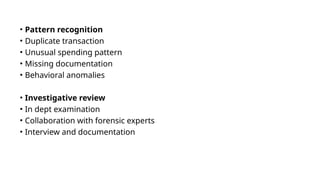
• Initial screening
• Automated screening tool
• Manual review
• Red flags
RED FLAGS
Red flagsare early warning signals or indicators that suggest the possibility of
fraudulent activities within an organization. These signs do not serve as direct
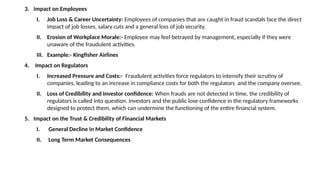
evidence of fraud but rather signal areas where further investigation is
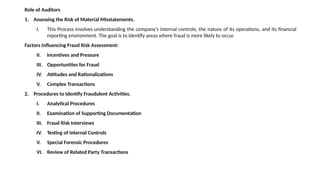
warranted. They can emerge in various aspects of business operations
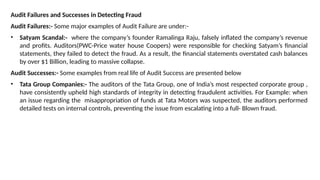
including financial records, employee behavior, vendor relationships, or
organizational processes.
8.
CLASSIFICATION OF REDFLAGS
1. Financial red flags –
These involve anomalies in financial transactions and reords that could suggest
fraudulent activity, such as misrepresentation or embezzlement.
Key financial red flags include:
• Unexplained discrepancies: Differences between reported financial data and actual
figures, such as inconsistencies in balance sheets or profit – and-loss accounts.
• Unusual transaction: Instances of large cash withdrawals, unexplained transfers, or
transactions occuring at odd times.
• Excessive or unjustified expensive: Spending patterns that do not align with the
organisations typical profile, such as extravagant purchases for business use.
• Changes in accounting practices: Sudden alterations in accounting policies or the
application of inconsistent financial reporting standards.
• Suspicious payments: Payments made to vendors or third parties that cannot be
traced or justified, often involving unknown entities.
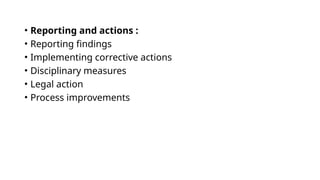
9.
2. Employee behaviourred flags –
Employee behaviour can provide significant insights into
potential fraud, especially when actions deviate from normal
workplace conduct.
Behavioural Red flag include:
• Lifestyle changes: Sudden acquisition of luxury items or significant
changes in lifestyle not supported by an employee’s salary.
• Avoidance of leave: Employees refusing vacations or sick leaves,
particularly if they handle critical financial functions, could indicate a
desire to conceal ongoing fraudulent schemes.
• Reluctance to share information : Employees who avoid providing
documentation or uncooperative during audits may have
something to hide.
• Secretive or overly defensive behaviour: Excessive resistance to
reviews, audits, or any form of scrutiny.
10.
3. Vendor orthird- party red flags –
Vendor and third-party relationships can also be sources of fraud.
Some indicators include:
• Inconsistent documentation: Missing or incomplete invoices,
delivery receipts, or contracts.
• Frequent changes in vendor details: Alterations in payment
accounts, contact information or contractual terms without valid
reasons.
• Mismatch in deliverables: Invoices that do not align with the
quantity , quality, or nature of goods delivered or services rendered.
• Unusual vendor transactions: Relationships or payments that
deviate from normal business practices , such as excessive reliance
on a single vendor.
11.
4. OPERATIONAL REDFLAGS –
Operational inefficiencies or procedural lapses often provide
opportunities for fraud.
Operational red flags include:
• Lack of segregation of duties: Instances where one individual
has control over multiple stages of a transaction, suggest such
as authorising, processing,and recording payments, making
fraud easier to conceal.
• Weak internal controls: Systems that allow employees to bypass
established procedures or lack oversight mechanisms.
• Delayed reconciliations: Failure to promptly reconcile accounts,
leaving room for fraudulent entries to remain undetected.
• Overly complex processes: Processes that are unnecessarily
complicated or opaque, creating opportunities to hide
fraudulent actions.
12.
5. Management andgovernance red flags-
Fraud often occurs due to weaknesses in leadership and
governance. Some common governance related red flags
include:
• Weak oversight: absence of effective supervision or
accountability for financial transactions and overall
performance.
• Inconsistent management behaviour: sudden changes in
corporate strategies or operational decisions that lack
transparency or justification.
• Poor compliance culture: lack of adherence to ethical
practices or external regulatory requirements, often resulting
from an indifferent or complicit management attitude.
• High employee turnover: frequent departures in key
departments, such as finance or operations, may indicate
internal dissatisfaction or attempts to escape scrutiny.
13.
TECHNIQUES OF FRAUD
DETECTION
1.Horizontal analysis: horizontal analysis also known as trend
analysis, is a valuable tool used to evaluate financial data across
multiple periods, offering insights into trends, anomalies and
unusual changes that may signal fraud. By examining fluctuations
in financial accounts, organisations can identify patterns that
deviate from expected behaviour prompting further
investigation.
14.
KEY COMPONENTS OFHORIZONTAL ANALYSIS IN FRAUD
DETECTION
1. Trend identification: horizontal analysis helps uncover abrupt
increases or decreases in key financial metrics, such as revenue,
expenses or asset balances . Unusual trends may point to fraudulent
activities, including revenue inflation or cost management.
• Example : A significant increase in revenue without a proportional rise
in accounts receivable or inventory could indicate fictitious sales.
2. Pattern analysis: Auditors analyze consistency in financial growth
over time. Fraudsters may try to manipulate data to show
unrealistically positive results, leading to irregular patterns.
• Example: A sudden spike in revenue during a typically slow season,
without a corresponding uptick in customer orders, could raise
suspicion.
15.
3. Focus onsuspicious line items: Certain line items, such as
accounts receivable, inventory, or expenses, may display
disproportionate changes year over year. These shifts could
signal fraudulent practices like false billing, skimming, or
inventory theft.
• Example: A sharp increase in inventory but no
corresponding increase in sales could suggest
overstatement of inventory to manipulate financial ratios.
16.
STEPS FOR USINGHORIZONTAL
ANALYSIS IN FRAUD DETECTION
1. Gather historical data : Collect financial statements for
multiple periods to ensure sufficient data for comparison.
2. Identify unusual variances: Look for significant year over
year changes in key accounts.
3. Investigate further: For accounts with unusual changes,
analyze underlying documentation, such as invoices,
contracts, or transaction records, to verify authenticity.
4. Correlate metrics: Ensure consistency between related
accounts (e.g revenue, receivables and cash flow).
17.
Vertical Analysis
Vertical analysis,also known as common size analysis, is a
financial tool that helps to assess the relative size of each item
within a financial statement, typically by expressing each line
item as a percentage of a base figure. In the case of an income
statement, this would involve calculating the percentage of each
expense item relative to total revenue. In a balance sheet,
vertical analysis expresses each asset, liability, and equity item
as a percentage of total assets. This method is particularly useful
in identifying discrepancies and inconsistencies in the structure of
financial statements, which may indicate fraudulent activity.
18.
Role Of VerticalAnalysis
Vertical analysis plays a crucial role in:
1. Financial statement analysis: It helps analyze financial
statements, identifying trends and patterns.
2. Comparison: Enables comparison between companies,
industries, or time periods.
3. Decision-making: Informs business decisions, investments,
or lending.
4. Identifying areas for improvement: Highlights areas of
strength and weakness in financial performance.
By using vertical analysis, stakeholders can gain valuable
19.
Prevention Of Fraud
Fraudprevention involves implementing strategies to deter,
detect, and mitigate fraudulent activities, safeguarding assets
and data. It's a proactive approach that includes establishing
strong internal controls, conducting thorough background checks,
providing fraud awareness training, and using technology for
monitoring and analysis. A comprehensive fraud prevention
program also involves incident response planning and regular
audits to identify weakness and improve existing measures.
20.
Strategies Organizations CanUsed To
Prevent Fraud
Here are some strategies to prevent fraud:
1. Implement Strong Internal Controls: Establish policies, procedures, and
systems to prevent and detect fraud.
2. Conduct Regular Audits: Perform regular audits to identify and address
potential fraud risks.
3. Train Employees: Educate employees on fraud prevention and detection
techniques.
4. Use Technology: Implement technology solutions, such as data analytics
and AI, to detect and prevent fraud.
5. Monitor Transactions: Regularly monitor transactions for suspicious activity.
21.
6. Implement AccessControls: Limit access to sensitive data
and systems based on user roles and permissions.
7. Encourage Whistleblowing: Create a culture where
employees feel comfortable reporting suspicious activity.
8. Conduct Background Checks: Perform background checks
on employees and vendors.
9. Implement Anti-Fraud Policies: Develop and enforce anti-
fraud policies and procedures.
10. Stay Up-to-Date with Regulations: Stay informed about
regulatory changes and industry best practices.
By implementing these strategies, organizations can reduce the
risk of fraud and protect their assets.
22.
STRATEGIES ORGANISATION CANUSE TO PREVENT FRAUD
Implementing Robust Internal Controls to Prevent Fraud
Internal controls play a critical role in preventing fraud by ensuring that all financial transactions and activities are
authorized recorded, and monitored. These controls are designed to safeguard an organization's assets, enhance the
reliability of financial reporting, and en compliance with laws and regulations, Effective internal controls help minimize
opportunities for fraudulent activities by creating checks and balances within the organization's operation framework.
A. Segregation of duties: Reducing the Risk of fraud
Segregation of duties (SOD) is one of the cornerstones of an effective internal control sym It is a preventive measure
that ensures no single employee has the authority to execute multiple critical steps of a financial transaction. By
dividing responsibilities among different individual organizations can reduce the risk of fraud, as no one person has
complete control over the process.
Key Aspects of Segregation of Duties
Authorization: The employee who authorizes a payment should not be the same as the one who records the
transaction or handles the cash.
Custody: Those responsible for handling physical assets, such as cash or inventory, should not be involved in
recording the transactions related to those assets.
Recording: The person responsible for accounting and recording transactions should nut be involved in
authorizing payments or handling assets.
23.
. Authorization andApproval Processes: Clear Levels of Approval
Establishing clear levels of authorization and approval for financial transactions is a crucial element of internal controls. By specifying who can
approve different types of transactions and at what levels, organizations can ensure that financial decisions are subject to appropriate scrutiny.
Key Components of Authorization and Approval Processes
(1) Authorization Hierarchy:
Define levels of authority within the organization to ensure that only certain individuals are authorized to approve specific transactions. For
instance, low-value expenses may be approved by department managers, while lass or unusual transactions should require the approval of
senior management or the board.
Transaction Limits
Establish thresholds for approval based on transaction amounts Transactions above a certain threshold should require multiple approvals or be
subjected to more rigorous review.
Review of Unusual Transactions:
Large or unusual transactions, especially those that fall outside regular business practices, should undergo additional scrutiny. This helps identify
potential fraud or errors early. For example, payments made to new vendors outside normal operational channels should be verified by more
than one individual.
C. Access Controls: Protecting Sensitive Financial Systems
Access controls are essential for safeguarding an organization's critical financial data ensuring that only authorized individuals have access to
sensitive systems and information. This is particularly important in the digital age , where financial information is stored and processed
electronically.
24.
Key Components ofAccess Controls
(i) Role-Based Access: Assign access to financial systems based on the employee's role within the organization. For example, a
staff member responsible for payroll should not have access to accounting systems that record sales transactions.
(ii) Least Privilege Principle: Limit access to the minimum level necessary for an employee to perform their tasks. This reduces
the risk of unauthorized access modification of critical data.
(iii) Password Protection: Ensure strong password policies that require employees to use complex passwords and change them
regularly. Weak passwords are an easy target for fraudsters to gain unauthorized access.
(iv) Two-Factor Authentication (2FA) Implement two-factor authentication for systems that store sensitive financial
information or process transactions. This adds an additional layer of security by requiring employees to provide two forms of
identification-something they know (a password) and something they have (a token or mobile device).
D. Integrating These Controls into a Holistic Fraud Prevention System
Together, segregation of duties, authorization and approval processes, and access controls form a robust system of internal controls
that can prevent fraud at various levels within the organization. These controls should not operate in isolation but rather be part of
an integrated fraud prevention framework that includes continuous monitoring, regular audits, and strong reporting mechanisms.
Holistic Fraud Prevention
(i) Continuous Monitoring: Ongoing monitoring of financial activities, especially high-risk transactions, ensures that any
irregularities or anomalies are detected in real-time.
(ii) Regular Audits: Periodic internal and external audits help ensure that internal controls are being followed and that there are
no significant weaknesses in the control systems
25.
(iii) Reporting Mechanisms:Establishing clear reporting channels (such as whistleblower hotlines) allows employees to report suspected
fraud or violations of internal cod without fear of retaliation
3. Regular Audits and Inspections: A Key Fraud Prevention Strategy
Audits are an essential part of a robust fraud detection and prevention strategy. They serve as a mechanism to assess the integrity of an
organization's financial processes, ensure compliance with policies, and identify potential fraud or operational inefficiencies Regular audits
help organizations stay vigilant, maintaining transparency and accountability within their systems.
(i)Internal Audits: Internal audits are a vital component of an organization's internal control system. Conducted by the company's own
auditing team or designated personnel internal audits are designed to regularly review and evaluate the effectiveness of internal controls,
policies, and procedures.
The primary goal of an internal audit is to ensure that the organization is adhering to it established policies and procedures, assessing
financial transactions for accuracy, and ensuring that resources are being used efficiently.
(ii) External Audits :- provides an unbiased evaluation of the company's financial statements, they are a true and fair representation of the
organization's helping to ensure that financial position,
The primary function of an external audit is to give stakeholders such as shareholders, regulators, and investors-confidence that the
company's financial statements are accurate and reliable External auditors are also responsible for reviewing the internal control ensure they
are adequate and functioning properly.
(iii) Surprise Audits: Surprise audits, or unscheduled inspections, are conducted without prior notice to the employees or departments being
audited. The unpredictable nature of surprise audits serves as an effective deterrent against fraudulent behavior as employees are aware
that they could be audited at any time.
The primary purpose of surprise audits is to keep employees on their toes and ensure that organizational processes are being followed
consistently.
26.
4. Implementing FraudDetection Tools and Technology
A. Transaction Monitoring Systems: Transaction monitoring systems are automated tools
that track financial transactions in real time to detect irregularities or suspicious activities.
The Key aspects of this system are:
(i) Real-Time Monitoring: These systems continuously track financial transactions, such as payments, wire
transfers, and credit card transactions, as they occur. This enables immediate detection of suspicious
transactions, including duplicate payments unauthorized transfers, or payments that exceed predefined
thresholds.
(ii) Automated Alerts: When a suspicious transaction is flagged, the system automatically generates an alert,
notifying relevant personnel, such as compliance officers of auditors, to investigate further. For example, if a
company’s policy is to limit payments over 50,000, the system will automatically alert management when a
transaction exceeds that limit without appropriate approval.
(iii) Risk-Based Analysis: Transaction monitoring tools often allow for risk-based parameter settings. This means
that transactions can be flagged based on risk levels which are determined by factors such as the location of
the transaction, the nature of the transaction, and the profile of the person involved in the transaction.
27.
B. Data Analyticsand Machine Learning:
Some of the key features and applicator’s of these technologies are:
(i) Pattern Recognition: By analyzing historical data, ML. algorithms can identify normal transaction patterns and behaviour
within the organization. Once these patterns are established, the system can quickly detect anomalies that deviate from the
norm. For instance, if an employee usually makes small transactions but suddenly processes a large payment to an
unapproved vendor, the system will flag this as unusual behaviour.
(ii) Predictive Analytics: ML tools can also predict potential fraud based on previous occurrences, using statistical models to
assess the likelihood of fraud in certain transactions or activities. These models improve over time, learning from new data
and evolving to detect increasingly sophisticated fraudulent schemes.
(iii) Anomaly Detection: By analyzing employee behaviour, purchase orders, payment histories, and financial records, data
analytics tools can uncover patterns that suggest fraud, such as an employee who repeatedly approves invoices from
unapproved vendors or someone consistently processing high-value transactions without proper documentation.
C. Continuous Monitoring:
(i) Automated Data Tracking: Continuous monitoring software tracks all financial and operational data across systems, from
procurement to sales, and flags discrepancies or unusual activities immediately. For example, if an employee repeatedly
accesses financial systems outside of working hours or alters records without proper authorization, the software can alert
security or management in real time
(ii) Proactive Fraud Detection: Continuous monitoring not only helps detect fraud in real time but also enables proactive
action to prevent potential fraudulent behaviusar.
28.
(iii) Cost andTime Efficiency: Continuous monitoring reduces the need for manual reviews, saving both time and resources.
This ensures that no potential fraud slips through the cracks, providing a more comprehensive and consistent approach to fraud
detection.
5. Whistleblower Mechanisms and Reporting Channels
A. Anonymous Reporting: Anonymity is one of the key features that makes whistleblower mechanisms effective in
fraud detection. Many employees may hesitate to report fraudulent activities due to fear of retaliation, such as
job loss, demotion, or harassment. By offering anonymous reporting options organizations provide a safe and
confidential way for employees to raise concerns without exposing themselves to personal risk. Various reporting
options are:
(i) Whistleblower Hotlines: Setting up anonymous whistleblower hotlines (either through phone calls or online
platforms) allows employees to report fraud confidentially. These hotlines can be managed internally or by a
third-party service provider to ensure impartiality and protect the anonymity of the person making the report.
(ii) Digital Platforms: In addition to phone lines, organizations can offer digital platforms that allow employees and
external stakeholders to submit reports or documents securely. These platforms may include online portals,
encrypted emails, or third-party apps specifically designed for confidential whistleblowing. The ability to submit
evidence, such as screenshots, documents, or transaction details, further strengthens the credibility of the report.
(iii) Encouragement of Use: It is important that organizations actively encourage employees to utilize these anonymous
channels by promoting them regularly. The anonymity provided by these reporting systems increases the
likelihood that employees will report unethical behaviour without fearing personal repercussions.
29.
B. Clear ReportingProcedures:
The key features of efficient reporting procedures are
(i) Accessibility: Reporting mechanisms should be easily accessible to all employees, regardless of their level within the organization or their
physical location.
(ii) Multiple Channels for Reporting: Organizations should offer various options for reporting fraud to accommodate the preferences of different
individuals
C. Protection Against Retaliation: An effective whistleblower program cannot succeed without a culture of trust and protection for those who report
fraudulent activities. One of the most critical elements in ensuring the success of whistleblower mechanisms is to guarantee that individuals
who report fraud will not face retaliation from their peers, supervisors, or management. The ways to ensure protation against retaliation are:
(i) Anti-Retaliation Policies
(ii) Legal protection
(iii) Fostering a culture of trust
(iv) Confidential and transparency
(v) 6. Employee Rotation and Mandatory Vacations: Fraud prevention is largely about minimizing the opportunities for fraudulent behaviour to take
place and go unnoticed. Employee rotation and mandatory vacations are two effective strategies that organizations can use to reduce
the risk of fraud. Both of these practices ensure that no individual maintains control over sensitive tasks for too long, making it more
difficult for fraudulent activities to be concealed.
A. Employee Rotation: Employee rotation involves periodically changing the roles or responsibilities of employees, especially those in
positions of financial control, accounting, or other areas where fraud might occur. This approach serves multiple purposes in fraud
prevention:
30.
(i) Limits Controland Access
(ii) Encourages Vigilance
(iii) Cross-Training and Knowledge Sharing
(iv) Detecting Irregularities
B. Mandatory Vacations:Mandatory vacation policies require employees to take time off from their job for a set period, which
is especially important for employees in positions with access to financial data or significant control over processes that could be
exploited for fraudulent purpose.
(i) Disruption of Continuous Fraud: Fraudulent schemes often rely on the employee’s ability to remain involved in their activities
over extended periods. By requiring employees to take mandatory vacations, their work is temporarily handed over to another person.
During this time, it may be easier to spot discrepancies or suspicious activities that the employee may have been hiding.
(ii) Detecting Hidden Fraud: When someone else takes over an employee’s responsibilities during their absence, they may uncover
fraudulent activities that were previously concealed. For example, an employee responsible for approving payments might be forging
signatures or altering records. When that employee takes a vacation, another person may notice unusual patterns or missing
documents that point to potential fraud.
(iii) Preventing Collusion: Mandatory vacations also help prevent collusion, where an employee works with others to commit
fraudulent activities. If a fraudster knows that someone else will temporarily take over their responsibilities during a mandatory break,
they may be less likely to engage in fraudulent activities in the first place. This added layer of unpredictability makes it harder to
coordinate and conceal fraud.
(iv) Ensuring Consistency and Accountability: During the employee’s absence, a temporary replacement or supervisor can review
the individual’s recent work for any signs of fraudulent activity. This ensures that the organization maintains consistent oversight over
its processes and helps identify irregularities before they lead to significant financial loss.
31.
Remaining strategies
A.Strong vendormanagement:-
1.Venter background checks- before entering into any business relationship, it is essential for organisations
to perform background checks on vendors ot assess their credibility and reliability. This includes investigating
their financial health, past performance, business practices and reputation with in the industry.
Various ways to conduct background checks are:
● Financial and legal due diligence
● Reputation and reference
● Third party audits
2. Monitoring vendor transactions -once a vendor relationship is established it’s important to regularly
monitoring and verify vendor transactions to ensure they are legitimate and un compliance in company
policy. Vendor transactions can be monitoring by:
● Reconciliation of documents
● Auditing payment schedules
● Spotting unusual patterns .
3. Establishing clear vendor contracts -clear and detailed vendor contracts are one of the most effective
ways to prevent fraud as they set expaction upfront and provide a legal framework fro dealing with non-
compliance. Well defined contracts should have following features:
● Defining expectations and deliverables
● Payment term and schedules
● Penalties for non-compliance
32.
Legal and regulatorycompliance
A.Regulatory framework- strong regulatory compliance
framework is essential for organisations to stay compliant
with law and regulations that protect stakeholder , prevent
fraudulent activities and promote financial transparency.
The following regulatory guidelines are key in India :
1.Companies act,2013:-the companies act governs
corporate governance and financial practice in india.it
require company yo maintain accurate financial records
disclose , material fact and ensure transparency in
transactions.
33.
2. Sarbanes oxleyact (sox):-
International compliance although the sarbanes oxleyact is primarily a U.S regulations,
india companies listed on U.S. stock exchange or oprating internationally are required to
comply with Sox.
3.anti-money laundering (AML)laws:-india prevention of money laundering act
(pmla) 2002governs prevention of money laundering activities. The laws mandate
organisations to follow stringent procedures to monitor and report suspicious financial
transactions ,especially in financial institutions and banks.
4. International financial reporting standards:- for multinational companies and those
with international stakeholders to IFRS standard ensure that financial statements are
transparent,reliable and free from manipulation.
34.
Legal actions andpenalties:-
1. Internal investigation and disciplinary action:-when fraud is suspected organisations most promptly initiate an internal
investigation to determine the scope of the issue and identify those responsible .the organisation may take internal action
such as-
● Suspension or termination
● Internal sanction
1. Civil and crime charges:-in India, the legal framwork allow for both civil and criminal penalties ,for fraud depending on
the nature and extent of the crime. Fraud under te India penal code(ipc) 1860can lead to criminal charges and may
face imprisonment fines are both.
● Section 420(ipc)
● Section 447 of the company's act 2013
● Penalties for non-compliance
4. Sever penalties and sanction:- fraudulent activities especially those that result in significant financial loss and
harm to stakeholders can lead to sever penalties for the organisations and its leadership.
● Corporate penalties
● Liability for directors
35.
Auditors and regulatorsrole in fraud detection and prevention
1. Auditors role:-
● Internal auditors: internal audit focus on evaluating an organisation internal control, policies and risk management systems.
● External auditors: external audit provide independent assessment of a organisations financial statements. They ensure that
financial report are accurate and free from manipulation.
● Data analytics:auditors increasingly use data analytics as a tool to enhance theirfraud detection capabilities.
● Forensic auditors: forensic auditors specialize in investigating suspected fraud cases. They collect and analyse evidence
fraudulent activities often preparing report can be used in legal proceedings.
1. Regulator’s role:-
● Monitoring compliance:regulatory bodies such as the securities and exchange board of india, reserve bank of India
(rbi)monitoring companies to ensure compliance with Financial regulation.
● Inspection and investigation:- regulator have the authority to conduct inspection and investigation into companies operations.
This includes reviewing financial record ,assessing internal control a d ensuring to law governing corporate behaviour.
● Established reporting framework:- regulatory established mandatory reporting framework that requires companies to disclose
relevant financial information.
● Imposing penalties:regulators have the authority to impose to penalties to organisations that fail to meet compliance
standards.
36.
Financial Statement Fraud
Financialstatement fraud refers to the deliberate misrepresentation or omission of material information from a
company’s financial reports, leading to an inaccurate portrayal of its financial health.
Impact of Financial Statement Fraud
1. Impact on Investors
I. Financial Loses and Erosion of Trust:- Misleading financial reporting leads them to make
investment decision based on accurate information, resulting in financial losses. When the fraud
was exposed, investors suffered significant losses as stock prices plummeted. The trust of
investors in the company and its management is severely undermined and creates a perception
of an untrustworthy financial ecosystem.
II. Long Term Consequences: It can cause long term damage to investors confidence, especially if a
fraud is significant or widespread.
III. Example:- Satyam Computers
2. Impact on Creditors
I. Increased Risk and Financial Losses: Creditors, including banks, lenders and suppliers, are
impacted by financial statement fraud as they base their lending and credit decisions on the
financial health of the company.
II. Regulatory Scrutiny & Cost:- Creditors are also impacted by the increased regulatory scrutiny
following major fraud cases.
37.
3. Impact onEmployees
I. Job Loss & Career Uncertainty: Employees of companies that are caught in fraud scandals face the direct
impact of job losses, salary cuts and a general loss of job security.
II. Erosion of Workplace Morale:- Employee may feel betrayed by management, especially if they were
unaware of the fraudulent activities.
III. Example:- Kingfisher Airlines
4. Impact on Regulators
I. Increased Pressure and Costs:- Fraudulent activities force regulators to intensify their scrutiny of
companies, leading to an increase in compliance costs for both the regulators and the company oversee.
II. Loss of Credibility and Investor confidence: When frauds are not detected in time, the credibility of
regulators is called into question. Investors and the public lose confidence in the regulatory frameworks
designed to protect them, which can undermine the functioning of the entire financial system.
5. Impact on the Trust & Credibility of Financial Markets
I. General Decline in Market Confidence
II. Long Term Market Consequences
38.
Role of Auditors
1.Assessing the Risk of Material Misstatements.
I. This Process involves understanding the company’s internal controls, the nature of its operations, and its financial
reporting environment. The goal is to identify areas where fraud is more likely to occur.
Factors Influencing Fraud Risk Assessment:
II. Incentives and Pressure
III. Opportunities for Fraud
IV. Attitudes and Rationalizations
V. Complex Transactions
2. Procedures to Identify Fraudulent Activities.
I. Analytical Procedures
II. Examination of Supporting Documentation
III. Fraud Risk Interviews
IV. Testing of Internal Controls
V. Special Forensic Procedures
VI. Review of Related Party Transactions
39.
Audit Failures andSuccesses in Detecting Fraud
Audit Failures:- Some major examples of Audit Failure are under:-
• Satyam Scandal:- where the company’s founder Ramalinga Raju, falsely inflated the company’s revenue
and profits. Auditors(PWC-Price water house Coopers) were responsible for checking Satyam’s financial
statements, they failed to detect the fraud. As a result, the financial statements overstated cash balances
by over $1 Billion, leading to massive collapse.
Audit Successes:- Some examples from real life of Audit Success are presented below
• Tata Group Companies:- The auditors of the Tata Group, one of India’s most respected corporate group ,
have consistently upheld high standards of integrity in detecting fraudulent activities. For Example: when
an issue regarding the misappropriation of funds at Tata Motors was suspected, the auditors performed
detailed tests on internal controls, preventing the issue from escalating into a full- Blown fraud.
40.
Financial statements frauds
Financialstatement fraud refers to the deliberate misrepresentation or omission of
material information from a company's financial reports, thereby misrepresenting its
financial health. Such fraud undermines confidence in financial reporting, harms
investors and leads to legal consequences. High profile corporate scandals in India
have highlighted the prevalence of financial statement fraud. The types of fraud that
occur in financial statements are discussed in detail below.
41.
India hasestablished a comprehensive legal and regulatory framework to
prevent and report financial statement fraud. This framework consists of
laws, regulations and provisions designed to ensure transparency,
accountability and fairness in financial reporting. The major components
include the Companies Act, 2013, Securities and Exchange Board of India
(SEBI) regulations and the role of forensic auditors. Each of these
components plays a vital role in promoting ethical business practices and
detecting financial fraud.
Legal and regulatory framework in
india
42.
The companies Act,2013
1. Key provisions relevent to financial statement fraud
2. Securities and exchange board of India (SEBI )
regulations
Role of forensic auditors
Forensic auditing has gained prominence as a specialized field that focuses on
investigating financial fraud. Forensic auditors conduct detailed investigations to identify
discrepancies, irregularities or fraud in a company’s financial statements. Their role is
particularly important when fraud is suspected that is not immediately detectable through
regular financial auditing.
1. Road detection
2. Financial statement verification
3. Litigation support
4. Reporting and recommendations
43.
Impact and effectivenessof the legal and
regulatory framework
The legal and regulatory framework in India, which aims to prevent financial statement
fraud, has both its strengths and weaknesses. While significant progress has been made
in improving transparency and accountability through laws such as the Companies Act,
2013 and the SEBI Regulations, there are still challenges that limit the effectiveness of
these measures. Let us take a deeper look at both the strengths and weaknesses of the
current system.
44.
Strength of thelegal and regulatory
framework
1. Increased transparency
2. Stronger corporate governance
3. Deterrence through penalties
4. Active enforcement
45.
Weakness of thelegal and regulatory
framework
1. Delay in legal proceedings
2. Limited resources for enforcement
3. Weakness in internal controls
46.
Types of auditevidence for detecting
financial statement fraud
1. Documentary evidence
2. Physical evidence
3. Third party confirmations
4. Management and employee interviews
5. Analytical procedures
47.
Auditor procedures fordetecting
fraud
Analytical procedures
1. Horizontal and vertical analysis
2. Ratio analysis
3. Trend analysis
Substantive testing
1. Test of transactions
2. Test of balances
3. Cut off testing
Forensic audit methods
1. fraud detection software
2. Document examination
3. Data mining