Accounting Concepts, Conventions & Principles Dr. Jatin Pancholi Website: http://www.jatinpancholi.com Dr. Jatin Pancholi has compiled and prepared this teaching note from various sources, as the basis for class discussion rather than to illustrate either effective or ineffective handling of a management situation.  The handling of a management situation requires personal guidance by a professional. To obtain copies, request permission to reproduce and to send feedback, please contact on website  http://www.jatinpancholi.com . Those wishing to co-author next edition of this handout may also contact.
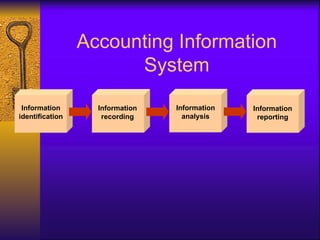
Accounting Information System Information analysis Information identification Information reporting Information recording
MEANINGS Concepts Conventions Principles
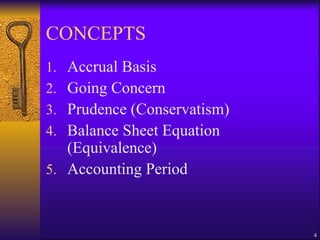
CONCEPTS Accrual Basis Going Concern Prudence (Conservatism) Balance Sheet Equation (Equivalence) Accounting Period
CONCEPTS…(2) (1) Accruals concept : revenue and expenses are taken account of when they occur and not when the cash is received or paid out;
CONCEPTS…(3) (2) Going concern : it is assumed that the business entity for which accounts are being prepared is solvent and viable , and will continue to be in business in the foreseeable future;  (3) Prudence concept : revenue and profits are included in the balance sheet only when they are realized (or there is reasonable 'certainty ' of realizing them) but liabilities are included when there is a reasonable 'possibility' of incurring them. Also called conservation concept.
CONCEPTS… (4) (4) Accounting equation : total assets of an entity equal total liabilities plus owners' equity ;  (5) Accounting period : financial records pertaining only to a specific period are to be considered in preparing accounts for that period
CONVENTIONS Historical Costs Monetary measurement Separate Entity Realisation Materiality
PRINCIPLES Understandability Relevance Consistency Comparability Reliability Objectivity
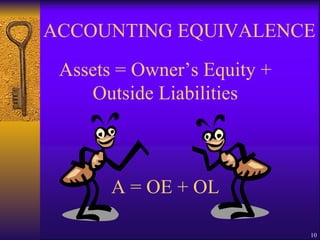
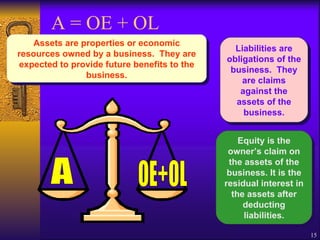
ACCOUNTING EQUIVALENCE Assets = Owner’s Equity + Outside Liabilities A = OE + OL
BALANCE SHEET BS is a ‘position’ statement. BS describes  the financial position of assets & liabilities  of the firm as on a particular date
DEFINITION: BS Balance Sheet is defined as a statement of the financial position of an enterprise as at a given date, which exhibits assets, liabilities, capital, etc.
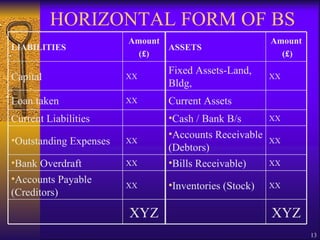
HORIZONTAL FORM OF BS LIABILITIES Amount (£) ASSETS Amount (£) Capital XX Fixed Assets-Land, Bldg, XX Loan taken XX Current Assets Current Liabilities Cash / Bank B/s XX Outstanding Expenses XX Accounts Receivable (Debtors) XX Bank Overdraft XX Bills Receivable) XX Accounts Payable (Creditors) XX Inventories (Stock) XX XYZ XYZ
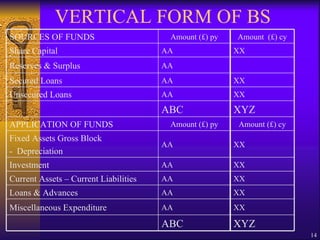
VERTICAL FORM OF BS SOURCES OF FUNDS Amount (£) py Amount  (£) cy Share Capital AA XX Reserves & Surplus AA Secured Loans AA XX Unsecured Loans AA XX ABC XYZ APPLICATION OF FUNDS Amount (£) py Amount (£) cy Fixed Assets Gross Block -  Depreciation AA XX Investment AA XX Current Assets – Current Liabilities AA XX Loans & Advances AA XX Miscellaneous Expenditure AA XX ABC XYZ
A = OE + OL Assets are properties or economic resources owned by a business.  They are expected to provide future benefits to the business. Liabilities are obligations of the business.  They are claims against the assets of the business. Equity is the owner’s claim on the assets of the business. It is the residual interest in the assets after deducting liabilities. A OE+OL
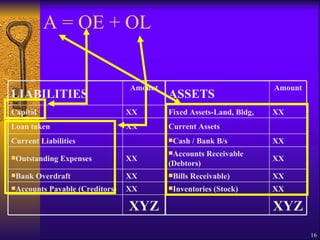
A = OE + OL LIABILITIES Amount ASSETS Amount Capital XX Fixed Assets-Land, Bldg, XX Loan taken XX Current Assets Current Liabilities Cash / Bank B/s XX Outstanding Expenses XX Accounts Receivable (Debtors) XX Bank Overdraft XX Bills Receivable) XX Accounts Payable (Creditors) XX Inventories (Stock) XX XYZ XYZ
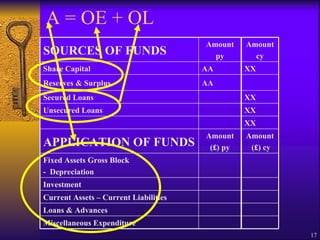
A = OE + OL SOURCES OF FUNDS Amount py Amount cy Share Capital AA XX Reserves & Surplus AA Secured Loans XX Unsecured Loans XX XX APPLICATION OF FUNDS Amount (£) py Amount (£) cy Fixed Assets Gross Block -  Depreciation Investment Current Assets – Current Liabilities Loans & Advances Miscellaneous Expenditure
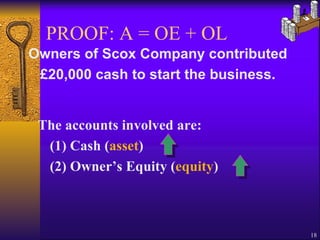
The accounts involved are: (1) Cash ( asset ) (2) Owner’s Equity ( equity ) PROOF: A = OE + OL Owners of Scox Company contributed £20,000 cash to start the business.
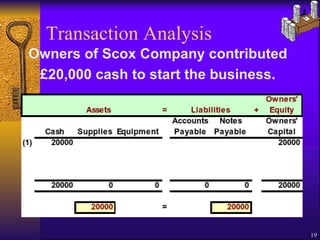
Transaction Analysis Owners of Scox Company contributed £20,000 cash to start the business.
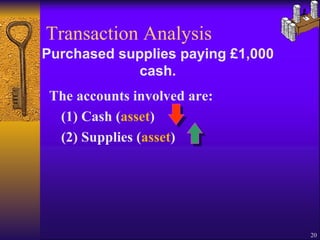
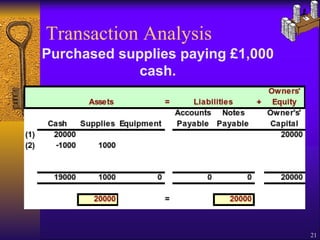
The   accounts involved are: (1) Cash ( asset ) (2) Supplies ( asset ) Transaction Analysis Purchased supplies paying £1,000 cash.
Transaction Analysis Purchased supplies paying £1,000 cash.
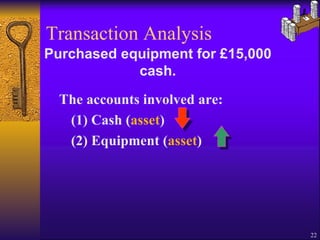
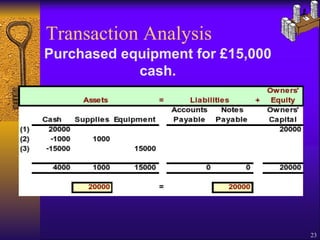
The accounts involved are: (1) Cash ( asset )  (2) Equipment ( asset )  Transaction Analysis Purchased equipment for £15,000 cash.
Transaction Analysis Purchased equipment for £15,000 cash.
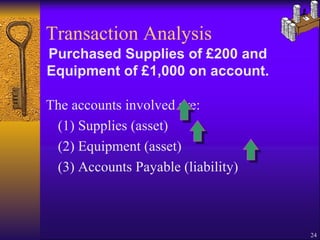
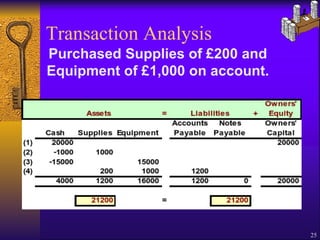
The accounts involved are: (1) Supplies (asset) (2) Equipment (asset) (3) Accounts Payable (liability) Transaction Analysis Purchased Supplies of £200 and Equipment of £1,000 on account.
Transaction Analysis Purchased Supplies of £200 and Equipment of £1,000 on account.
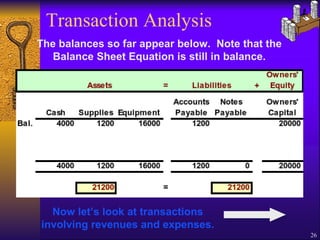
Transaction Analysis The balances so far appear below.  Note that the Balance Sheet Equation is still in balance. Now let’s look at transactions involving revenues and expenses.
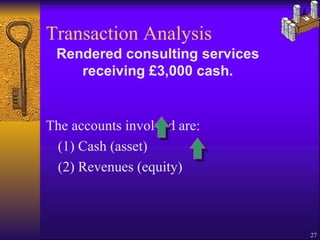
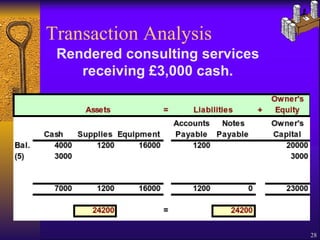
The accounts involved are: (1) Cash (asset)  (2) Revenues (equity)  Transaction Analysis Rendered consulting services receiving £3,000 cash.
Transaction Analysis Rendered consulting services receiving £3,000 cash.
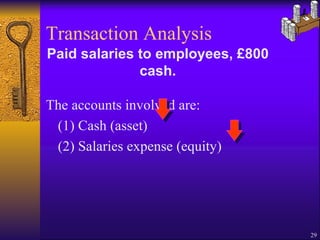
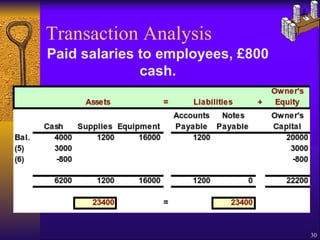
The accounts involved are: (1) Cash (asset) (2) Salaries expense (equity) Transaction Analysis Paid salaries to employees, £800 cash.
Transaction Analysis Paid salaries to employees, £800 cash.
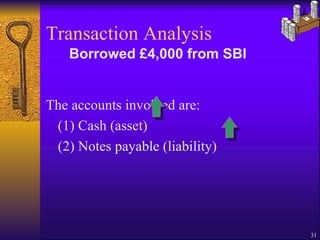
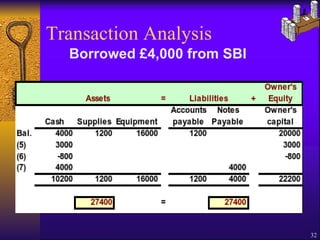
The accounts involved are: (1) Cash (asset)  (2) Notes payable (liability) Transaction Analysis Borrowed £4,000 from SBI
Transaction Analysis Borrowed £4,000 from SBI
Financial Statements Prepare the Financial Statements reflecting the transactions we have recorded.
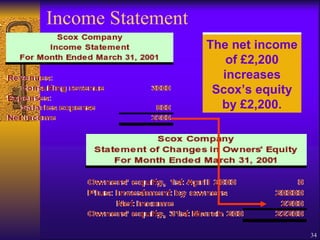
Income Statement Scox’s net income is the difference between Revenues and Expenses. The net income of £2,200 increases Scox’s equity by £2,200.
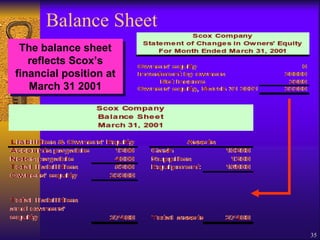
Balance Sheet The balance sheet reflects Scox’s financial position at March 31 2001
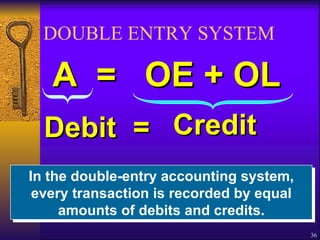
DOUBLE ENTRY SYSTEM A   =  OE + OL In the double-entry accounting system, every transaction is recorded by equal amounts of debits and credits. Debit = Credit
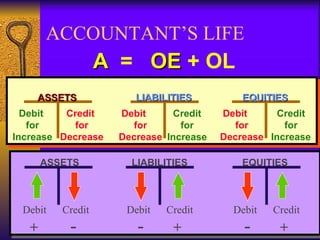
ACCOUNTANT’S LIFE A   =  OE  + OL ASSETS Debit  for Increase Credit  for Decrease EQUITIES Debit  for Decrease Credit for Increase LIABILITIES Debit  for Decrease Credit for Increase Debit  Credit ASSETS +   - LIABILITIES -  + Debit  Credit EQUITIES -  + Debit  Credit
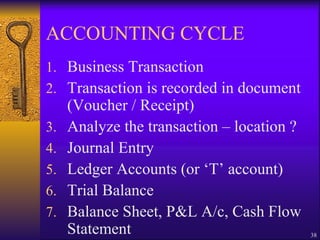
ACCOUNTING CYCLE Business Transaction Transaction is recorded in document (Voucher / Receipt) Analyze the transaction – location ? Journal Entry Ledger Accounts (or ‘T’ account) Trial Balance Balance Sheet, P&L A/c, Cash Flow Statement
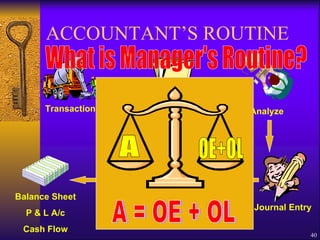
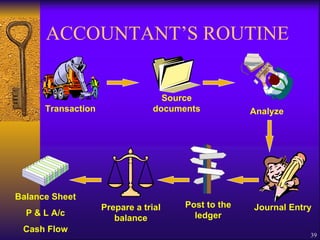
ACCOUNTANT’S ROUTINE Balance Sheet P & L A/c Cash Flow Prepare a trial balance Post to the ledger Journal Entry Source documents Transaction Analyze
ACCOUNTANT’S ROUTINE What is Manager's Routine? A = OE + OL Post to the ledger Source documents Journal Entry Prepare a trial balance Balance Sheet P & L A/c Cash Flow Transaction Analyze A OE+OL
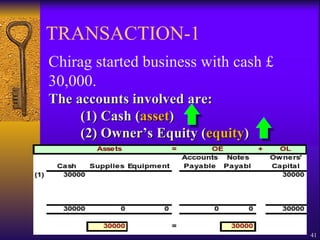
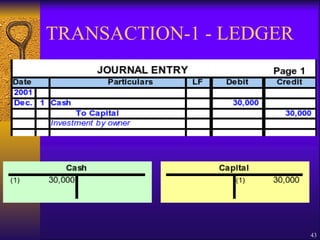
TRANSACTION-1 Chirag started business with cash £ 30,000. The accounts involved are: (1) Cash ( asset )  (2) Owner’s Equity ( equity )
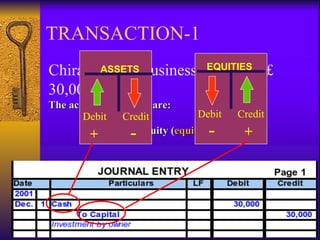
TRANSACTION-1 Chirag started business with cash £ 30,000. The accounts involved are: (1) Cash ( asset ) (2) Owner’s Equity ( equity ) Debit  Credit EQUITIES -  + Debit  Credit ASSETS +   -
TRANSACTION-1 - LEDGER
Thank You Dr. Jatin Pancholi Website: http://www.jatinpancholi.com Dr. Jatin Pancholi has compiled and prepared this teaching note from various sources, as the basis for class discussion rather than to illustrate either effective or ineffective handling of a management situation.  The handling of a management situation requires personal guidance by a professional. To obtain copies, request permission to reproduce and to send feedback, please contact on website  http://www.jatinpancholi.com . Those wishing to co-author next edition of this handout may also contact. Now, was that debits to the left or credits to the left? I sure wish I had paid more attention in class!

Accounting concepts conventions & principles

  • 1.
    Accounting Concepts, Conventions& Principles Dr. Jatin Pancholi Website: http://www.jatinpancholi.com Dr. Jatin Pancholi has compiled and prepared this teaching note from various sources, as the basis for class discussion rather than to illustrate either effective or ineffective handling of a management situation. The handling of a management situation requires personal guidance by a professional. To obtain copies, request permission to reproduce and to send feedback, please contact on website http://www.jatinpancholi.com . Those wishing to co-author next edition of this handout may also contact.
  • 2.
    Accounting Information SystemInformation analysis Information identification Information reporting Information recording
  • 3.
  • 4.
    CONCEPTS Accrual BasisGoing Concern Prudence (Conservatism) Balance Sheet Equation (Equivalence) Accounting Period
  • 5.
    CONCEPTS…(2) (1) Accrualsconcept : revenue and expenses are taken account of when they occur and not when the cash is received or paid out;
  • 6.
    CONCEPTS…(3) (2) Goingconcern : it is assumed that the business entity for which accounts are being prepared is solvent and viable , and will continue to be in business in the foreseeable future; (3) Prudence concept : revenue and profits are included in the balance sheet only when they are realized (or there is reasonable 'certainty ' of realizing them) but liabilities are included when there is a reasonable 'possibility' of incurring them. Also called conservation concept.
  • 7.
    CONCEPTS… (4) (4)Accounting equation : total assets of an entity equal total liabilities plus owners' equity ; (5) Accounting period : financial records pertaining only to a specific period are to be considered in preparing accounts for that period
  • 8.
    CONVENTIONS Historical CostsMonetary measurement Separate Entity Realisation Materiality
  • 9.
    PRINCIPLES Understandability RelevanceConsistency Comparability Reliability Objectivity
  • 10.
    ACCOUNTING EQUIVALENCE Assets= Owner’s Equity + Outside Liabilities A = OE + OL
  • 11.
    BALANCE SHEET BSis a ‘position’ statement. BS describes the financial position of assets & liabilities of the firm as on a particular date
  • 12.
    DEFINITION: BS BalanceSheet is defined as a statement of the financial position of an enterprise as at a given date, which exhibits assets, liabilities, capital, etc.
  • 13.
    HORIZONTAL FORM OFBS LIABILITIES Amount (£) ASSETS Amount (£) Capital XX Fixed Assets-Land, Bldg, XX Loan taken XX Current Assets Current Liabilities Cash / Bank B/s XX Outstanding Expenses XX Accounts Receivable (Debtors) XX Bank Overdraft XX Bills Receivable) XX Accounts Payable (Creditors) XX Inventories (Stock) XX XYZ XYZ
  • 14.
    VERTICAL FORM OFBS SOURCES OF FUNDS Amount (£) py Amount (£) cy Share Capital AA XX Reserves & Surplus AA Secured Loans AA XX Unsecured Loans AA XX ABC XYZ APPLICATION OF FUNDS Amount (£) py Amount (£) cy Fixed Assets Gross Block - Depreciation AA XX Investment AA XX Current Assets – Current Liabilities AA XX Loans & Advances AA XX Miscellaneous Expenditure AA XX ABC XYZ
  • 15.
    A = OE+ OL Assets are properties or economic resources owned by a business. They are expected to provide future benefits to the business. Liabilities are obligations of the business. They are claims against the assets of the business. Equity is the owner’s claim on the assets of the business. It is the residual interest in the assets after deducting liabilities. A OE+OL
  • 16.
    A = OE+ OL LIABILITIES Amount ASSETS Amount Capital XX Fixed Assets-Land, Bldg, XX Loan taken XX Current Assets Current Liabilities Cash / Bank B/s XX Outstanding Expenses XX Accounts Receivable (Debtors) XX Bank Overdraft XX Bills Receivable) XX Accounts Payable (Creditors) XX Inventories (Stock) XX XYZ XYZ
  • 17.
    A = OE+ OL SOURCES OF FUNDS Amount py Amount cy Share Capital AA XX Reserves & Surplus AA Secured Loans XX Unsecured Loans XX XX APPLICATION OF FUNDS Amount (£) py Amount (£) cy Fixed Assets Gross Block - Depreciation Investment Current Assets – Current Liabilities Loans & Advances Miscellaneous Expenditure
  • 18.
    The accounts involvedare: (1) Cash ( asset ) (2) Owner’s Equity ( equity ) PROOF: A = OE + OL Owners of Scox Company contributed £20,000 cash to start the business.
  • 19.
    Transaction Analysis Ownersof Scox Company contributed £20,000 cash to start the business.
  • 20.
    The accounts involved are: (1) Cash ( asset ) (2) Supplies ( asset ) Transaction Analysis Purchased supplies paying £1,000 cash.
  • 21.
    Transaction Analysis Purchasedsupplies paying £1,000 cash.
  • 22.
    The accounts involvedare: (1) Cash ( asset ) (2) Equipment ( asset ) Transaction Analysis Purchased equipment for £15,000 cash.
  • 23.
    Transaction Analysis Purchasedequipment for £15,000 cash.
  • 24.
    The accounts involvedare: (1) Supplies (asset) (2) Equipment (asset) (3) Accounts Payable (liability) Transaction Analysis Purchased Supplies of £200 and Equipment of £1,000 on account.
  • 25.
    Transaction Analysis PurchasedSupplies of £200 and Equipment of £1,000 on account.
  • 26.
    Transaction Analysis Thebalances so far appear below. Note that the Balance Sheet Equation is still in balance. Now let’s look at transactions involving revenues and expenses.
  • 27.
    The accounts involvedare: (1) Cash (asset) (2) Revenues (equity) Transaction Analysis Rendered consulting services receiving £3,000 cash.
  • 28.
    Transaction Analysis Renderedconsulting services receiving £3,000 cash.
  • 29.
    The accounts involvedare: (1) Cash (asset) (2) Salaries expense (equity) Transaction Analysis Paid salaries to employees, £800 cash.
  • 30.
    Transaction Analysis Paidsalaries to employees, £800 cash.
  • 31.
    The accounts involvedare: (1) Cash (asset) (2) Notes payable (liability) Transaction Analysis Borrowed £4,000 from SBI
  • 32.
  • 33.
    Financial Statements Preparethe Financial Statements reflecting the transactions we have recorded.
  • 34.
    Income Statement Scox’snet income is the difference between Revenues and Expenses. The net income of £2,200 increases Scox’s equity by £2,200.
  • 35.
    Balance Sheet Thebalance sheet reflects Scox’s financial position at March 31 2001
  • 36.
    DOUBLE ENTRY SYSTEMA = OE + OL In the double-entry accounting system, every transaction is recorded by equal amounts of debits and credits. Debit = Credit
  • 37.
    ACCOUNTANT’S LIFE A = OE + OL ASSETS Debit for Increase Credit for Decrease EQUITIES Debit for Decrease Credit for Increase LIABILITIES Debit for Decrease Credit for Increase Debit Credit ASSETS + - LIABILITIES - + Debit Credit EQUITIES - + Debit Credit
  • 38.
    ACCOUNTING CYCLE BusinessTransaction Transaction is recorded in document (Voucher / Receipt) Analyze the transaction – location ? Journal Entry Ledger Accounts (or ‘T’ account) Trial Balance Balance Sheet, P&L A/c, Cash Flow Statement
  • 39.
    ACCOUNTANT’S ROUTINE BalanceSheet P & L A/c Cash Flow Prepare a trial balance Post to the ledger Journal Entry Source documents Transaction Analyze
  • 40.
    ACCOUNTANT’S ROUTINE Whatis Manager's Routine? A = OE + OL Post to the ledger Source documents Journal Entry Prepare a trial balance Balance Sheet P & L A/c Cash Flow Transaction Analyze A OE+OL
  • 41.
    TRANSACTION-1 Chirag startedbusiness with cash £ 30,000. The accounts involved are: (1) Cash ( asset ) (2) Owner’s Equity ( equity )
  • 42.
    TRANSACTION-1 Chirag startedbusiness with cash £ 30,000. The accounts involved are: (1) Cash ( asset ) (2) Owner’s Equity ( equity ) Debit Credit EQUITIES - + Debit Credit ASSETS + -
  • 43.
  • 44.
    Thank You Dr.Jatin Pancholi Website: http://www.jatinpancholi.com Dr. Jatin Pancholi has compiled and prepared this teaching note from various sources, as the basis for class discussion rather than to illustrate either effective or ineffective handling of a management situation. The handling of a management situation requires personal guidance by a professional. To obtain copies, request permission to reproduce and to send feedback, please contact on website http://www.jatinpancholi.com . Those wishing to co-author next edition of this handout may also contact. Now, was that debits to the left or credits to the left? I sure wish I had paid more attention in class!

Editor's Notes