Chapter 10
Monopolistic Competition &
Oligopoly
The Monopolistic Competition Market
Structure
• A market structure characterized by:
 â–« Many small sellers
 â–« A differentiated product
 â–« Easy market entry & exit
• This market structure fits many real-world
  industries
Many Small Sellers
• The exact number cannot be stated.
• This structure is one where the seller can set
  prices slightly higher or improve services
  independently without fear that competitors will
  react by changing their prices or giving better
  service.
Differentiated Product
• This is the key difference between perfect
  competition and monopolistic competition
 â–« Def: Production differentiation is the process
   creating real or apparent differences between
   goods and services
Examples of Differentiated Products
•   Design
•   Reliability
•   Location
•   Costly information
How do they compete
• They often compete on non-price competition
 â–«   Advertising
 â–«   Packaging
 â–«   Product development
 â–«   Better quality
 â–«   Better services
Easy Entry & Exit
• They face low barriers to entry, but it is not as
  easy to enter as perfect competition.
• Because there are differentiated products it is
  hard for firms to get established in these
  markets.
  â–« Example: new restaurants in town
Monopolistically Competitive Firms are
Price Makers
• They are not price takers, meaning they let the
  market set the price.
• Thus the demand curve is less elastic than the
  perfectly competitive firm, but more elastic than
  the monopolist.
What do the Demand and Marginal
Revenue Curve look like
 • Demand and marginal revenue are negatively-
   sloped
  ▫ Negatively-sloped demand curve⇒marginal
    revenue is less than price at each quantity.
  â–« Marginal revenue curve is negatively-sloped and
    lies below the demand curve.
Short-Run
• The monopolistically competitive firm will
  maximize profit at MR=MC.
• If short-run economic losses occur, then the firm
  will exit the market.
Long-Run
• The firms will not earn a profit, like perfect
  competition.
  â–« Long-run equilibrium: Sellers earn zero
    economic profit (or a normal accounting profit).
13   Monopolistic
                                           Competition and
                                           Oligopoly


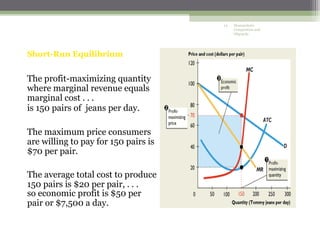
Short-Run Equilibrium


The profit-maximizing quantity
where marginal revenue equals
marginal cost . . .
is 150 pairs of jeans per day.

The maximum price consumers
are willing to pay for 150 pairs is
$70 per pair.

The average total cost to produce
150 pairs is $20 per pair, . . .
so economic profit is $50 per
pair or $7,500 a day.
14   Monopolistic
                                         Competition and
                                         Oligopoly


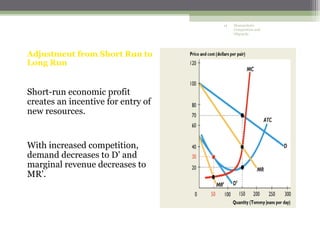
Adjustment from Short Run to
Long Run


Short-run economic profit
creates an incentive for entry of
new resources.


With increased competition,
demand decreases to D' and
marginal revenue decreases to
MR'.
How does it Compare to Perfect
             Competition
• The monopolistically competitive firm also fails
  the efficiency test, P>MC.
• The value to consumers is greater than the cost
  of producing it.
• The L-R equilibrium output is lower than the
  perfect competitive firm and the price is higher.
• What does this mean?
The Oligopoly Market Structure
• An imperfectly competitive market structure in
  which a few large firms dominate the market
• How to define an oligopoly?
 â–« Few sellers
 â–« Either a homogenous or a differentiated product
 â–« Difficult market entry
Few Sellers
• Again, there is no specific number that must
  dominate an industry before it is an oligopoly.
• The components of an oligopoly are the mutual
  interdependence .
  â–« Def: Mutual interdependence in which an action
    by one firm may cause a reaction from other firms.
• Being there are only a few firms in the market, it
  is easy to collude in the market
Homogenous or Differentiated
Product
• The goods produced may be identical or may not
  be identical.
Difficult Entry
• Some barriers:
 â–«   Exclusive financial requirements
 â–«   Control over an essential resource
 â–«   Patent rights
 â–«   Other legal barriers
 â–«   Economies of Scale- this is the major one
Examples of Oligopolies
• Characteristics of Oligopoly
  â–« Examples
• Do sellers in these markets behave competitively or
  monopolistically?

  • Beverages (soft drinks)
  • Music (CD’s)
  • Tobacco
  • Automobiles
• Characteristics of Oligopoly
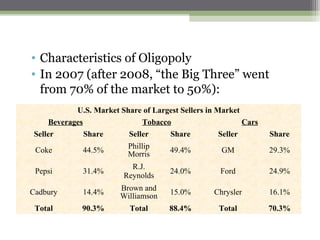
• In 2007 (after 2008, “the Big Three” went
  from 70% of the market to 50%):
            U.S. Market Share of Largest Sellers in Market
     Beverages                Tobacco                       Cars
 Seller        Share      Seller     Share           Seller        Share
                           Phillip
 Coke         44.5%        Morris      49.4%         GM            29.3%

                            R.J.
 Pepsi        31.4%                    24.0%         Ford          24.9%
                          Reynolds
                         Brown and
Cadbury       14.4%      Williamson    15.0%       Chrysler        16.1%

 Total        90.3%        Total       88.4%        Total          70.3%
Price and Output for an Oligopolist
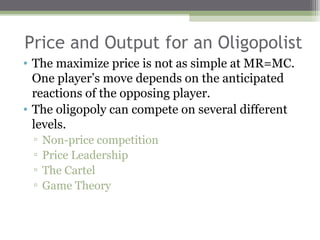
• The maximize price is not as simple at MR=MC.
  One player’s move depends on the anticipated
  reactions of the opposing player.
• The oligopoly can compete on several different
  levels.
 â–«   Non-price competition
 â–«   Price Leadership
 â–«   The Cartel
 â–«   Game Theory
Non-price Competition
• They often compete using advertising & product
  differentiation
• This is why research & development is so
  important in these type of firms.
Price Leadership
• They play a game of follow the leader.
 â–« Def: Price leadership is a pricing strategy in which
   a dominant firm sets the price for an industry and
   the other firms follow
Collusion
• An agreement among firms in the industry to
  divide the market and fix the prices
The Cartel
• Firms may decide to avoid price wars and they
  may openly or secretly conspire to form a
  monopoly called a “cartel.”
 â–« Def: A cartel is a group of firms that formally
   agree to control the price and the output of a
   product
CARTELS
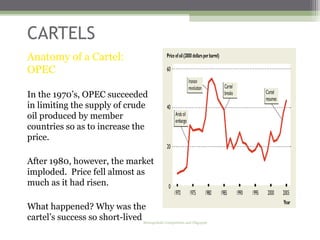
Anatomy of a Cartel:
OPEC

In the 1970’s, OPEC succeeded
in limiting the supply of crude
oil produced by member
countries so as to increase the
price.

After 1980, however, the market
imploded. Price fell almost as
much as it had risen.

What happened? Why was the
cartel’s success so short-lived?
                               Monopolistic Competition and Oligopoly

                                                                        28
Monopolistic
                                   Competition and
                              29   Oligopoly


CARTELS
• Anatomy of a Cartel: OPEC

 â–« Reaching agreement
Monopolistic
                                   Competition and
                              30   Oligopoly


CARTELS
• Anatomy of a Cartel: OPEC
 â–« New sources of supply
Monopolistic
                                          Competition and


• Anatomy of a Cartel: OPEC
                                     31   Oligopoly


 â–« Greater energy efficiency and consumer
   substitution
Monopolistic
                                            Competition and


• Anatomy of a Cartel: OPEC
                                       32   Oligopoly


 â–« Detecting and preventing cheating
Monopolistic
                                   Competition and
                              33   Oligopoly


CARTELS
• Anatomy of a Cartel: OPEC

 â–« Enforcing the agreement
Game Theory
• Def: Game theory is a model of strategic moves
  and countermoves of rivals
 â–« They are mutually interdependence because an
   action by one firm may cause a reaction from the
   other firm.
Game Theory
• In an oligopoly structure, a few firms compete
  for their customers. One firm may gain
  customers by decreasing the price at the expense
  of the other firms or they may increase
  advertising.
• In an oligopoly, the important element is those
  firms that do not follow suit will lose customers.
  However, if the other firms react competitively
  by doing the same, then all the firms lose. Thus,
  each firm finds itself on the horns of a dilemma-
  this example is known as the classic “prisoner’s
  dilemma.”
Game Theory
• Economists have increasingly used game theory
  (like the example of the prisoner’s dilemma) to
  analyze strategic choices made by competitors.
Example of Game Theory
• To see how this works, think about two touring
  Americans who just met at a train station in a
  small foreign country : Joe and William.
• The two are taken into the local police station
  under the suspicion of being involved in a local
  robbery of the bakery.
• The two are told that it will make the polices’ job
  easier if they confess immediately, giving them 6
  months of jail time each. But they are also told
  that if one confesses and the other does not, then
  the one who confesses will get 6 months of jail
  time, but the one who does not confess will get
  12 months.
Example of Game Theory
• If neither confesses, both will be held for three
  months while the investigation continues.
  William and Joe are not allowed to communicate
  with each other. Will they confess?
 â–« In order to figure this out, we must lay out the
   alternative outcomes and show how they would
   relate to the choices made by the players of the
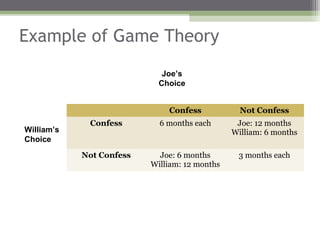
   game. This is done in a matrix form.
Example of Game Theory
                             Joe’s
                            Choice


                              Confess            Not Confess
             Confess        6 months each       Joe: 12 months
William’s                                      William: 6 months
Choice
            Not Confess     Joe: 6 months       3 months each
                          William: 12 months
Example of Game Theory
• For both Joe and William, the best choice
  depends on what the other does. If Joe
  confesses, then William can save 6 months of jail
  time by also confessing. The same will hold for
  William if he thinks that Joe is going to confess.
  But if neither confesses then they both will only
  receive 3 months of jail time. Joe and William
  must each decide, without communicating with
  each other, whether to confess.
Example of Game Theory
• Joe knows that if William does not confess, then
  he can either confess and spend 6 months in jail,
  or not confess and spend 3 months. But if
  William does confess, then Joe’s failure to
  confess will cost him an additional 6 months in
  jail. The story for William is the same… Thus,
  each man has an incentive to confess if he thinks
  the other one will, but an incentive not to
  confess if he thinks the other will also remain
  silent.
How does this apply to Oligopoly?
• The firms must make decisions in this same way,
  they are dependent on what the other firm is
  going to do. For instance, if one firm cuts its
  price, then how do the other firms react? Do
  they choice to advertise or not?
 â–« There is always a trade-off for the individual
   firms.

Chapter 10 monopolistic competition & oligopoly

  • 1.
  • 2.
    The Monopolistic CompetitionMarket Structure • A market structure characterized by: ▫ Many small sellers ▫ A differentiated product ▫ Easy market entry & exit • This market structure fits many real-world industries
  • 3.
    Many Small Sellers •The exact number cannot be stated. • This structure is one where the seller can set prices slightly higher or improve services independently without fear that competitors will react by changing their prices or giving better service.
  • 4.
    Differentiated Product • Thisis the key difference between perfect competition and monopolistic competition ▫ Def: Production differentiation is the process creating real or apparent differences between goods and services
  • 5.
    Examples of DifferentiatedProducts • Design • Reliability • Location • Costly information
  • 6.
    How do theycompete • They often compete on non-price competition ▫ Advertising ▫ Packaging ▫ Product development ▫ Better quality ▫ Better services
  • 7.
    Easy Entry &Exit • They face low barriers to entry, but it is not as easy to enter as perfect competition. • Because there are differentiated products it is hard for firms to get established in these markets. ▫ Example: new restaurants in town
  • 9.
    Monopolistically Competitive Firmsare Price Makers • They are not price takers, meaning they let the market set the price. • Thus the demand curve is less elastic than the perfectly competitive firm, but more elastic than the monopolist.
  • 10.
    What do theDemand and Marginal Revenue Curve look like • Demand and marginal revenue are negatively- sloped ▫ Negatively-sloped demand curve⇒marginal revenue is less than price at each quantity. ▫ Marginal revenue curve is negatively-sloped and lies below the demand curve.
  • 11.
    Short-Run • The monopolisticallycompetitive firm will maximize profit at MR=MC. • If short-run economic losses occur, then the firm will exit the market.
  • 12.
    Long-Run • The firmswill not earn a profit, like perfect competition. ▫ Long-run equilibrium: Sellers earn zero economic profit (or a normal accounting profit).
  • 13.
    13 Monopolistic Competition and Oligopoly Short-Run Equilibrium The profit-maximizing quantity where marginal revenue equals marginal cost . . . is 150 pairs of jeans per day. The maximum price consumers are willing to pay for 150 pairs is $70 per pair. The average total cost to produce 150 pairs is $20 per pair, . . . so economic profit is $50 per pair or $7,500 a day.
  • 14.
    14 Monopolistic Competition and Oligopoly Adjustment from Short Run to Long Run Short-run economic profit creates an incentive for entry of new resources. With increased competition, demand decreases to D' and marginal revenue decreases to MR'.
  • 15.
    How does itCompare to Perfect Competition • The monopolistically competitive firm also fails the efficiency test, P>MC. • The value to consumers is greater than the cost of producing it. • The L-R equilibrium output is lower than the perfect competitive firm and the price is higher. • What does this mean?
  • 16.
    The Oligopoly MarketStructure • An imperfectly competitive market structure in which a few large firms dominate the market • How to define an oligopoly? ▫ Few sellers ▫ Either a homogenous or a differentiated product ▫ Difficult market entry
  • 17.
    Few Sellers • Again,there is no specific number that must dominate an industry before it is an oligopoly. • The components of an oligopoly are the mutual interdependence . ▫ Def: Mutual interdependence in which an action by one firm may cause a reaction from other firms. • Being there are only a few firms in the market, it is easy to collude in the market
  • 18.
    Homogenous or Differentiated Product •The goods produced may be identical or may not be identical.
  • 19.
    Difficult Entry • Somebarriers: ▫ Exclusive financial requirements ▫ Control over an essential resource ▫ Patent rights ▫ Other legal barriers ▫ Economies of Scale- this is the major one
  • 20.
    Examples of Oligopolies •Characteristics of Oligopoly ▫ Examples • Do sellers in these markets behave competitively or monopolistically? • Beverages (soft drinks) • Music (CD’s) • Tobacco • Automobiles
  • 21.
    • Characteristics ofOligopoly • In 2007 (after 2008, “the Big Three” went from 70% of the market to 50%): U.S. Market Share of Largest Sellers in Market Beverages Tobacco Cars Seller Share Seller Share Seller Share Phillip Coke 44.5% Morris 49.4% GM 29.3% R.J. Pepsi 31.4% 24.0% Ford 24.9% Reynolds Brown and Cadbury 14.4% Williamson 15.0% Chrysler 16.1% Total 90.3% Total 88.4% Total 70.3%
  • 22.
    Price and Outputfor an Oligopolist • The maximize price is not as simple at MR=MC. One player’s move depends on the anticipated reactions of the opposing player. • The oligopoly can compete on several different levels. ▫ Non-price competition ▫ Price Leadership ▫ The Cartel ▫ Game Theory
  • 23.
    Non-price Competition • Theyoften compete using advertising & product differentiation • This is why research & development is so important in these type of firms.
  • 24.
    Price Leadership • Theyplay a game of follow the leader. ▫ Def: Price leadership is a pricing strategy in which a dominant firm sets the price for an industry and the other firms follow
  • 25.
    Collusion • An agreementamong firms in the industry to divide the market and fix the prices
  • 26.
    The Cartel • Firmsmay decide to avoid price wars and they may openly or secretly conspire to form a monopoly called a “cartel.” ▫ Def: A cartel is a group of firms that formally agree to control the price and the output of a product
  • 28.
    CARTELS Anatomy of aCartel: OPEC In the 1970’s, OPEC succeeded in limiting the supply of crude oil produced by member countries so as to increase the price. After 1980, however, the market imploded. Price fell almost as much as it had risen. What happened? Why was the cartel’s success so short-lived? Monopolistic Competition and Oligopoly 28
  • 29.
    Monopolistic Competition and 29 Oligopoly CARTELS • Anatomy of a Cartel: OPEC ▫ Reaching agreement
  • 30.
    Monopolistic Competition and 30 Oligopoly CARTELS • Anatomy of a Cartel: OPEC ▫ New sources of supply
  • 31.
    Monopolistic Competition and • Anatomy of a Cartel: OPEC 31 Oligopoly ▫ Greater energy efficiency and consumer substitution
  • 32.
    Monopolistic Competition and • Anatomy of a Cartel: OPEC 32 Oligopoly ▫ Detecting and preventing cheating
  • 33.
    Monopolistic Competition and 33 Oligopoly CARTELS • Anatomy of a Cartel: OPEC ▫ Enforcing the agreement
  • 34.
    Game Theory • Def:Game theory is a model of strategic moves and countermoves of rivals ▫ They are mutually interdependence because an action by one firm may cause a reaction from the other firm.
  • 35.
    Game Theory • Inan oligopoly structure, a few firms compete for their customers. One firm may gain customers by decreasing the price at the expense of the other firms or they may increase advertising. • In an oligopoly, the important element is those firms that do not follow suit will lose customers. However, if the other firms react competitively by doing the same, then all the firms lose. Thus, each firm finds itself on the horns of a dilemma- this example is known as the classic “prisoner’s dilemma.”
  • 36.
    Game Theory • Economistshave increasingly used game theory (like the example of the prisoner’s dilemma) to analyze strategic choices made by competitors.
  • 37.
  • 38.
    Example of GameTheory • To see how this works, think about two touring Americans who just met at a train station in a small foreign country : Joe and William. • The two are taken into the local police station under the suspicion of being involved in a local robbery of the bakery. • The two are told that it will make the polices’ job easier if they confess immediately, giving them 6 months of jail time each. But they are also told that if one confesses and the other does not, then the one who confesses will get 6 months of jail time, but the one who does not confess will get 12 months.
  • 39.
    Example of GameTheory • If neither confesses, both will be held for three months while the investigation continues. William and Joe are not allowed to communicate with each other. Will they confess? ▫ In order to figure this out, we must lay out the alternative outcomes and show how they would relate to the choices made by the players of the game. This is done in a matrix form.
  • 40.
    Example of GameTheory Joe’s Choice Confess Not Confess Confess 6 months each Joe: 12 months William’s William: 6 months Choice Not Confess Joe: 6 months 3 months each William: 12 months
  • 41.
    Example of GameTheory • For both Joe and William, the best choice depends on what the other does. If Joe confesses, then William can save 6 months of jail time by also confessing. The same will hold for William if he thinks that Joe is going to confess. But if neither confesses then they both will only receive 3 months of jail time. Joe and William must each decide, without communicating with each other, whether to confess.
  • 42.
    Example of GameTheory • Joe knows that if William does not confess, then he can either confess and spend 6 months in jail, or not confess and spend 3 months. But if William does confess, then Joe’s failure to confess will cost him an additional 6 months in jail. The story for William is the same… Thus, each man has an incentive to confess if he thinks the other one will, but an incentive not to confess if he thinks the other will also remain silent.
  • 44.
    How does thisapply to Oligopoly? • The firms must make decisions in this same way, they are dependent on what the other firm is going to do. For instance, if one firm cuts its price, then how do the other firms react? Do they choice to advertise or not? ▫ There is always a trade-off for the individual firms.