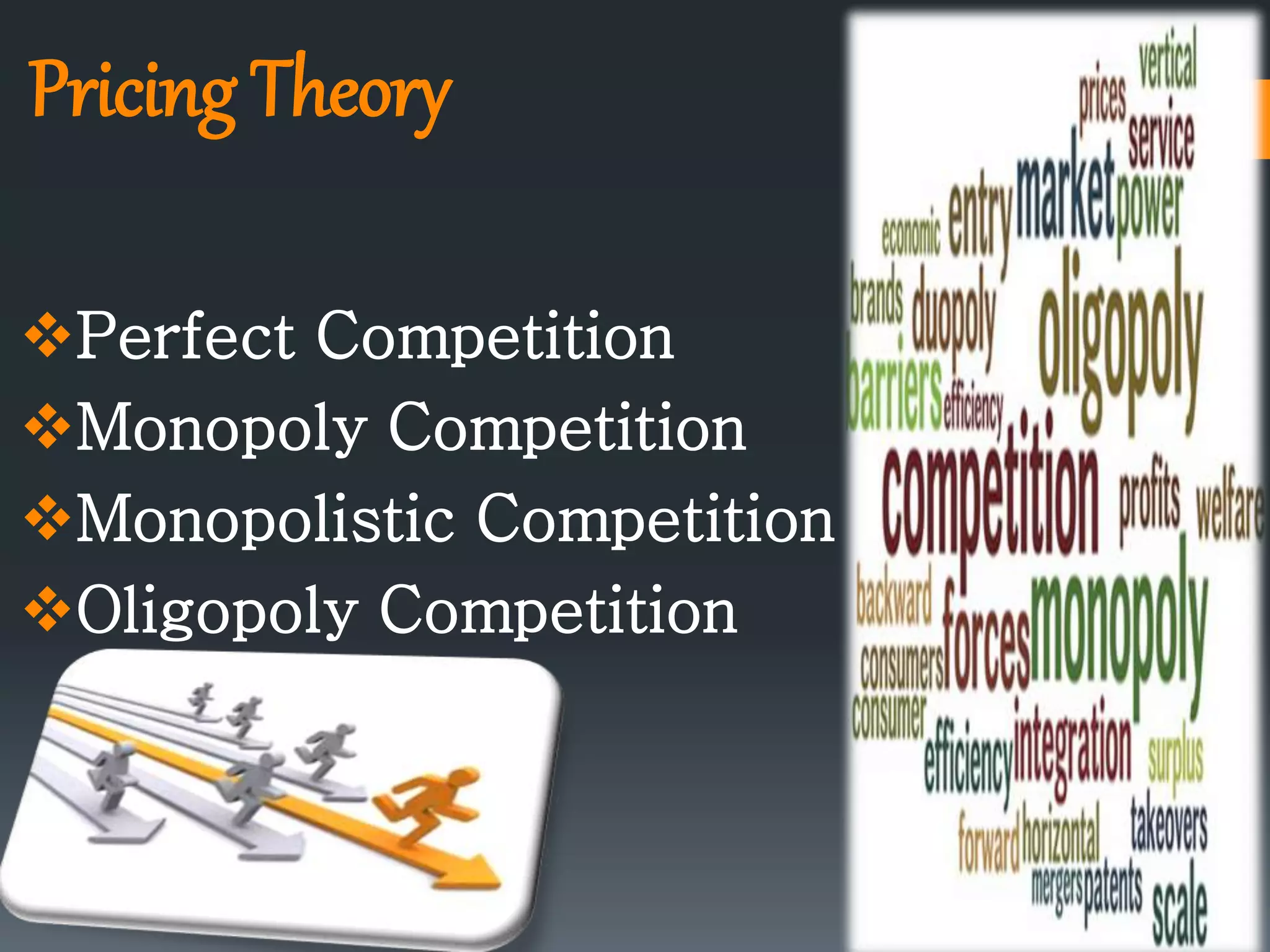
Pricing Theory
Perfect Competition
Monopoly Competition
Monopolistic Competition
Oligopoly Competition
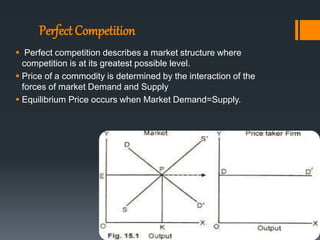
Perfect Competition
 Perfect competition describes a market structure where
competition is at its greatest possible level.
 Price of a commodity is determined by the interaction of the
forces of market Demand and Supply
 Equilibrium Price occurs when Market Demand=Supply.
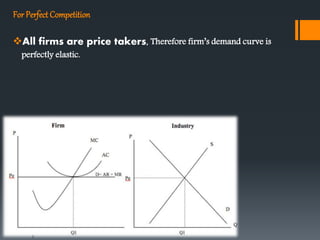
For Perfect Competition
All firms are price takers, Therefore firm’s demand curve is
perfectly elastic.
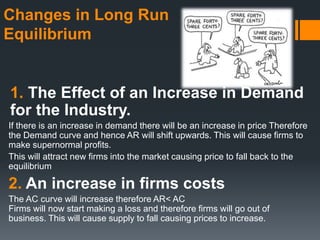
Changes in Long Run
Equilibrium
1. The Effect of an Increase in Demand
for the Industry.
If there is an increase in demand there will be an increase in price Therefore
the Demand curve and hence AR will shift upwards. This will cause firms to
make supernormal profits.
This will attract new firms into the market causing price to fall back to the
equilibrium
2. An increase in firms costs
The AC curve will increase therefore AR< AC
Firms will now start making a loss and therefore firms will go out of
business. This will cause supply to fall causing prices to increase.
In the real world it is hard to find examples of
industries which fit all the criteria of ‘perfect
Competition’. However, some industries are close.
Foreign Exchange Markets. Here currency is all homogenous. Also
traders will have access to many different buyers and sellers. There will
be good information about relative prices.
Agricultural markets. In some cases, there are several farmers
selling identical products to the market. Therefore, agricultural markets
often get close to perfect competition.
Monopoly Competition
A monopoly exists when a specific person or enterprise is
the only supplier of a particular commodity in the market.
For a true monopoly to be in effect, each of the
following characteristics would typically be
evident:
A sole provider of a viable product or service.
A lack of any close substitutes for consumers to choose from.
High barriers to dissuade the entry of any potential competitors.
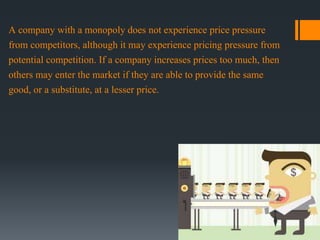
A company with a monopoly does not experience price pressure
from competitors, although it may experience pricing pressure from
potential competition. If a company increases prices too much, then
others may enter the market if they are able to provide the same
good, or a substitute, at a lesser price.
Price Determination
 The aim of a monopolist is to get maximum profits.
 The only seller in market.
 He will take advantage of the situation and try to get maximum profits. For,
all those who want the good should buy it only from him. They have no
other way.
 In determining the price of a commodity, monopolist will be guided by
only one motive, that is, to maximize his profits.
 Monopolies are thus characterized by a lack of economic competition to
produce the good or service and a lack of viable substitute goods.
Price Discrimination
 Sometimes, the monopolist may find it possible and profitable to charge
different prices to different buyers for the same good.
 For example, a doctor may charge a rich man more than a poor man for
a similar operation.
 price discrimination is possible only when there is no possibility of resale
from one consumer to another.
 That is, it should not be possible for people to buy goods in a cheaper
market and sell them in a dearer market.
Types of Monopolies
 Natural Monopolies: Natural monopolies arise on account of the limited
supplies of raw materials in particular regions.
 For example, India and Pakistan have the monopoly of jute; South Africa has the
monopoly of diamonds.
 Social Monopolies: Social monopolies are generally owned and managed by the
State. They are also known as state monopolies. Examples of State monopolies are
railways, harbors, canals and the central bank. Some of these things like post
offices and railways are known as ‘public utilities’.
 Legal Monopolies: Legal protection will be given by the State to certain firms by
way of patents, trade marks, copyright and so on. Such firms may be considered
as legal monopolies.
Examples of some Monopolies
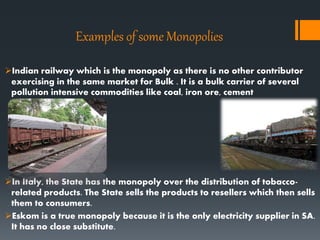
Indian railway which is the monopoly as there is no other contributor
exercising in the same market for Bulk . It is a bulk carrier of several
pollution intensive commodities like coal, iron ore, cement
In Italy, the State has the monopoly over the distribution of tobacco-
related products. The State sells the products to resellers which then sells
them to consumers.
Eskom is a true monopoly because it is the only electricity supplier in SA.
It has no close substitute.
MonopolisticCompetition
It is a market situation in which a relatively large number of producers offer
similar but not identical products.
A combination of perfect competition and monopoly.
Imperfect competition because a large number of sellers sell
heterogeneous or differentiated products and buyers have preferences for
specific sellers.
Monopolistic , because each of these sellers makes the product unique by
some differentiation and has control over the small section of market, just like
a monopolist.
Existence of monopoly power along with competition offers the producers
only a partial control over price of their product
Features of MonopolisticCompetition
Large number of buyers and sellers.
Heterogeneous products. – A differentiated product enjoys
some degree of uniqueness in the mindset of customers, be
it real, or imaginary.
Non-price competition.
Imperfect knowledge.
Unrestricted entry and exit.
Monopolistic Competition and Advertising
Criticism
 Advertising induces customers into spending more on products, because of
the name associated with the product, rather than because of rational factors.
 Advertising is a wasteful expenditure that adds perhaps no value to the
product being offered, and leads to brand confusion in the minds of the
consumers.
 Advertisements of rival products may even cancel each other, leading to
increase in average costs of each firm, without any corresponding increase of
sales. Optimal Level of Advertising MR derived from advertising (MRA)=MC
of advertising (MCA)
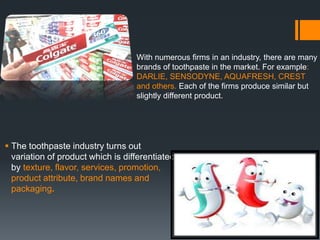
 The toothpaste industry turns out
variation of product which is differentiated
by texture, flavor, services, promotion,
product attribute, brand names and
packaging.
With numerous firms in an industry, there are many
brands of toothpaste in the market. For example:
DARLIE, SENSODYNE, AQUAFRESH, CREST
and others. Each of the firms produce similar but
slightly different product.
OLIGOPOLY
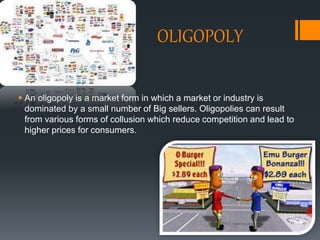
 An oligopoly is a market form in which a market or industry is
dominated by a small number of Big sellers. Oligopolies can result
from various forms of collusion which reduce competition and lead to
higher prices for consumers.
Features
Product branding : Each firm in the market is selling a
branded product.
Entry barriers : Entry barriers maintain supernormal profits for
the dominant firms. It is possible for many smaller firms to
operate on the periphery of an oligopolistic market, but none of
them is large enough to have any significant effect on prices
and output
Inter-dependent decision-making : Inter-dependence means that
firms must take into account the likely reactions of their
rivals to any change in price, output or forms of non-price
competition.
Non-price competition : Non-price competition is a consistent
feature of the competitive strategies of oligopolistic firms.
Types of Oligopoly
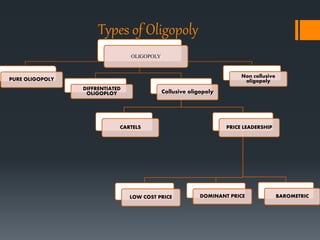
OLIGOPOLY
PURE OLIGOPOLY
DIFFRENTIATED
OLIGOPLOY Collusive oligopoly
CARTELS PRICE LEADERSHIP
LOW COST PRICE DOMINANT PRICE BAROMETRIC
Non collusive
oligopoly
Examples
Pure Oligopoly : Steel, Cement and chemicals producing industries
approach pure oligopoly.
Differentiated Oligopoly : Passenger Cars , cigarettes ,Or soft Drinks.
Collusive agreement
Oil and Petroleum Exporting Countries (OPEC) is the best example, where
few countries (countries:Iran,Iraq,Kuwait,Saudi Arabia& Venezuela)are
producing the commodity and they collude under the label of OPEC and it
influence the price fixing, market sharing and other related policies.
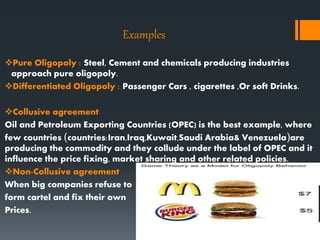
Non-Collusive agreement
When big companies refuse to
form cartel and fix their own
Prices.
Pepsi And Coke
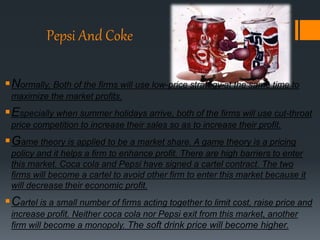
Normally, Both of the firms will use low-price strategy at the same time to
maximize the market profits.
Especially when summer holidays arrive, both of the firms will use cut-throat
price competition to increase their sales so as to increase their profit.
Game theory is applied to be a market share. A game theory is a pricing
policy and it helps a firm to enhance profit. There are high barriers to enter
this market. Coca cola and Pepsi have signed a cartel contract. The two
firms will become a cartel to avoid other firm to enter this market because it
will decrease their economic profit.
Cartel is a small number of firms acting together to limit cost, raise price and
increase profit. Neither coca cola nor Pepsi exit from this market, another
firm will become a monopoly. The soft drink price will become higher.
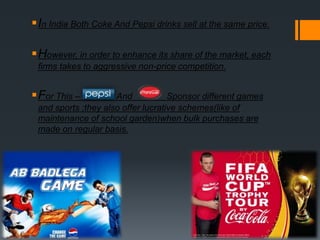
In India Both Coke And Pepsi drinks sell at the same price.
However, in order to enhance its share of the market, each
firms takes to aggressive non-price competition.
For This – And Sponsor different games
and sports ;they also offer lucrative schemes(like of
maintenance of school garden)when bulk purchases are
made on regular basis.
1. Is container shipping industry monopoly or oligopoly market?
 The container shipping industry is an example of an oligopoly market. While there are
not many companies that provide container shipping services, there are more than one.
The industry would only be a monopoly market if only one company provided the
services.
2. Is a public utility an example of a government monopoly?
Yes, it is more beneficial for the economy to have utilities as a monopoly, although they
are considered as a 'natural' monopoly. Governments can nationalize the utility in order
to maximize social welfare rather than maximize profit, this will keep prices low, keep
output high and increase consumer surplus and consumer choice.
3. Monopolist can sell whatever quantity he wishes to sell at a price fixed by
him. True /false
Being a single seller of the product a monopolist has full control over price,
thus it is a price maker.
4. In long Run which market structure earn Extra normal profit?
Monopoly.
Thank You
BY
Dinesh Nagar &
Ojonugwa Audu
B.Com(Hons.)
Ansal University

Pricing theory

  • 1.
    Pricing Theory Perfect Competition MonopolyCompetition Monopolistic Competition Oligopoly Competition
  • 2.
    Perfect Competition  Perfectcompetition describes a market structure where competition is at its greatest possible level.  Price of a commodity is determined by the interaction of the forces of market Demand and Supply  Equilibrium Price occurs when Market Demand=Supply.
  • 3.
    For Perfect Competition Allfirms are price takers, Therefore firm’s demand curve is perfectly elastic.
  • 4.
    Changes in LongRun Equilibrium 1. The Effect of an Increase in Demand for the Industry. If there is an increase in demand there will be an increase in price Therefore the Demand curve and hence AR will shift upwards. This will cause firms to make supernormal profits. This will attract new firms into the market causing price to fall back to the equilibrium 2. An increase in firms costs The AC curve will increase therefore AR< AC Firms will now start making a loss and therefore firms will go out of business. This will cause supply to fall causing prices to increase.
  • 5.
    In the realworld it is hard to find examples of industries which fit all the criteria of ‘perfect Competition’. However, some industries are close. Foreign Exchange Markets. Here currency is all homogenous. Also traders will have access to many different buyers and sellers. There will be good information about relative prices. Agricultural markets. In some cases, there are several farmers selling identical products to the market. Therefore, agricultural markets often get close to perfect competition.
  • 6.
    Monopoly Competition A monopolyexists when a specific person or enterprise is the only supplier of a particular commodity in the market. For a true monopoly to be in effect, each of the following characteristics would typically be evident: A sole provider of a viable product or service. A lack of any close substitutes for consumers to choose from. High barriers to dissuade the entry of any potential competitors.
  • 7.
    A company witha monopoly does not experience price pressure from competitors, although it may experience pricing pressure from potential competition. If a company increases prices too much, then others may enter the market if they are able to provide the same good, or a substitute, at a lesser price.
  • 8.
    Price Determination  Theaim of a monopolist is to get maximum profits.  The only seller in market.  He will take advantage of the situation and try to get maximum profits. For, all those who want the good should buy it only from him. They have no other way.  In determining the price of a commodity, monopolist will be guided by only one motive, that is, to maximize his profits.  Monopolies are thus characterized by a lack of economic competition to produce the good or service and a lack of viable substitute goods.
  • 9.
    Price Discrimination  Sometimes,the monopolist may find it possible and profitable to charge different prices to different buyers for the same good.  For example, a doctor may charge a rich man more than a poor man for a similar operation.  price discrimination is possible only when there is no possibility of resale from one consumer to another.  That is, it should not be possible for people to buy goods in a cheaper market and sell them in a dearer market.
  • 10.
    Types of Monopolies Natural Monopolies: Natural monopolies arise on account of the limited supplies of raw materials in particular regions.  For example, India and Pakistan have the monopoly of jute; South Africa has the monopoly of diamonds.  Social Monopolies: Social monopolies are generally owned and managed by the State. They are also known as state monopolies. Examples of State monopolies are railways, harbors, canals and the central bank. Some of these things like post offices and railways are known as ‘public utilities’.  Legal Monopolies: Legal protection will be given by the State to certain firms by way of patents, trade marks, copyright and so on. Such firms may be considered as legal monopolies.
  • 11.
    Examples of someMonopolies Indian railway which is the monopoly as there is no other contributor exercising in the same market for Bulk . It is a bulk carrier of several pollution intensive commodities like coal, iron ore, cement In Italy, the State has the monopoly over the distribution of tobacco- related products. The State sells the products to resellers which then sells them to consumers. Eskom is a true monopoly because it is the only electricity supplier in SA. It has no close substitute.
  • 12.
    MonopolisticCompetition It is amarket situation in which a relatively large number of producers offer similar but not identical products. A combination of perfect competition and monopoly. Imperfect competition because a large number of sellers sell heterogeneous or differentiated products and buyers have preferences for specific sellers. Monopolistic , because each of these sellers makes the product unique by some differentiation and has control over the small section of market, just like a monopolist. Existence of monopoly power along with competition offers the producers only a partial control over price of their product
  • 13.
    Features of MonopolisticCompetition Largenumber of buyers and sellers. Heterogeneous products. – A differentiated product enjoys some degree of uniqueness in the mindset of customers, be it real, or imaginary. Non-price competition. Imperfect knowledge. Unrestricted entry and exit.
  • 14.
    Monopolistic Competition andAdvertising Criticism  Advertising induces customers into spending more on products, because of the name associated with the product, rather than because of rational factors.  Advertising is a wasteful expenditure that adds perhaps no value to the product being offered, and leads to brand confusion in the minds of the consumers.  Advertisements of rival products may even cancel each other, leading to increase in average costs of each firm, without any corresponding increase of sales. Optimal Level of Advertising MR derived from advertising (MRA)=MC of advertising (MCA)
  • 15.
     The toothpasteindustry turns out variation of product which is differentiated by texture, flavor, services, promotion, product attribute, brand names and packaging. With numerous firms in an industry, there are many brands of toothpaste in the market. For example: DARLIE, SENSODYNE, AQUAFRESH, CREST and others. Each of the firms produce similar but slightly different product.
  • 16.
    OLIGOPOLY  An oligopolyis a market form in which a market or industry is dominated by a small number of Big sellers. Oligopolies can result from various forms of collusion which reduce competition and lead to higher prices for consumers.
  • 17.
    Features Product branding :Each firm in the market is selling a branded product. Entry barriers : Entry barriers maintain supernormal profits for the dominant firms. It is possible for many smaller firms to operate on the periphery of an oligopolistic market, but none of them is large enough to have any significant effect on prices and output Inter-dependent decision-making : Inter-dependence means that firms must take into account the likely reactions of their rivals to any change in price, output or forms of non-price competition. Non-price competition : Non-price competition is a consistent feature of the competitive strategies of oligopolistic firms.
  • 18.
    Types of Oligopoly OLIGOPOLY PUREOLIGOPOLY DIFFRENTIATED OLIGOPLOY Collusive oligopoly CARTELS PRICE LEADERSHIP LOW COST PRICE DOMINANT PRICE BAROMETRIC Non collusive oligopoly
  • 19.
    Examples Pure Oligopoly :Steel, Cement and chemicals producing industries approach pure oligopoly. Differentiated Oligopoly : Passenger Cars , cigarettes ,Or soft Drinks. Collusive agreement Oil and Petroleum Exporting Countries (OPEC) is the best example, where few countries (countries:Iran,Iraq,Kuwait,Saudi Arabia& Venezuela)are producing the commodity and they collude under the label of OPEC and it influence the price fixing, market sharing and other related policies. Non-Collusive agreement When big companies refuse to form cartel and fix their own Prices.
  • 20.
    Pepsi And Coke Normally,Both of the firms will use low-price strategy at the same time to maximize the market profits. Especially when summer holidays arrive, both of the firms will use cut-throat price competition to increase their sales so as to increase their profit. Game theory is applied to be a market share. A game theory is a pricing policy and it helps a firm to enhance profit. There are high barriers to enter this market. Coca cola and Pepsi have signed a cartel contract. The two firms will become a cartel to avoid other firm to enter this market because it will decrease their economic profit. Cartel is a small number of firms acting together to limit cost, raise price and increase profit. Neither coca cola nor Pepsi exit from this market, another firm will become a monopoly. The soft drink price will become higher.
  • 21.
    In India BothCoke And Pepsi drinks sell at the same price. However, in order to enhance its share of the market, each firms takes to aggressive non-price competition. For This – And Sponsor different games and sports ;they also offer lucrative schemes(like of maintenance of school garden)when bulk purchases are made on regular basis.
  • 22.
    1. Is containershipping industry monopoly or oligopoly market?  The container shipping industry is an example of an oligopoly market. While there are not many companies that provide container shipping services, there are more than one. The industry would only be a monopoly market if only one company provided the services. 2. Is a public utility an example of a government monopoly? Yes, it is more beneficial for the economy to have utilities as a monopoly, although they are considered as a 'natural' monopoly. Governments can nationalize the utility in order to maximize social welfare rather than maximize profit, this will keep prices low, keep output high and increase consumer surplus and consumer choice. 3. Monopolist can sell whatever quantity he wishes to sell at a price fixed by him. True /false Being a single seller of the product a monopolist has full control over price, thus it is a price maker. 4. In long Run which market structure earn Extra normal profit? Monopoly.
  • 23.
    Thank You BY Dinesh Nagar& Ojonugwa Audu B.Com(Hons.) Ansal University