Macro

McEachern
2011

ECON

1

2010-

CHAPTER
Designed by
Amy McGuire, B-books, Ltd.
Chapter 14

Money and the
Financial
System

Copyright ©2010 by South-Western, a division of Cengage Learning. All rights reserved

1
The Evolution of Money
 No exchange
 No money
 Specialization
 Exchange: Barter
 Barter
 Double coincidence of
wants
 Agree on exchange rate

LO1
Chapter 14

Copyright ©2010 by South-Western, a division of Cengage Learning. All rights reserved

2
One Red Paper Clip???

Chapter 14

Copyright ©2010 by South-Western, a division of Cengage Learning. All rights reserved

3
The Evolution of Money
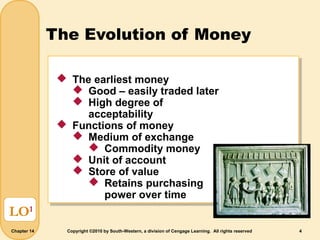
 The earliest money
 Good – easily traded later
 High degree of
acceptability
 Functions of money
 Medium of exchange
 Commodity money
 Unit of account
 Store of value
 Retains purchasing
power over time

LO1
Chapter 14

Copyright ©2010 by South-Western, a division of Cengage Learning. All rights reserved

4
The Evolution of Money
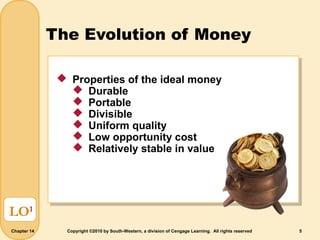
 Properties of the ideal money
 Durable
 Portable
 Divisible
 Uniform quality
 Low opportunity cost
 Relatively stable in value

LO1
Chapter 14

Copyright ©2010 by South-Western, a division of Cengage Learning. All rights reserved

5
LO1

Exhibit 1
Six Properties of Ideal Money

Chapter 14

Copyright ©2010 by South-Western, a division of Cengage Learning. All rights reserved

6
Coins
 Coinage
 Amount and quality of the
metal
 By count
 Problems
 Getting clipped
 Counterfeiting
 Token money
 Face value > cost of coinage
 Seigniorage – profit from
coinage

LO1
Chapter 14

Copyright ©2010 by South-Western, a division of Cengage Learning. All rights reserved

7
Money and Banking
 Banks = Goldsmith
 Safekeeping
 Earn interest
 Checks
 Extend loans
 Create medium of
exchange, money
 Public confidence
 Fractional reserve banking
system

LO1
Chapter 14

Copyright ©2010 by South-Western, a division of Cengage Learning. All rights reserved

8
Representative Money and
Fiat Money
 Bank notes
 IOUs
 Paper money
 As good as gold
 Representative money
 Represented gold in
the bank’s vault
 Fiat money
 From the power of the
state
 Legal tender

LO1
Chapter 14

Copyright ©2010 by South-Western, a division of Cengage Learning. All rights reserved

9
The Value of Money
 Purchasing power of money
 Rate of exchange for goods and
services
 Higher price level in economy
 Smaller purchasing power
 Purchasing power of $ in a year
 100 ÷Price index in same year
 Evolution over time
 Steady decline since 1960

LO1
Chapter 14

Copyright ©2010 by South-Western, a division of Cengage Learning. All rights reserved

10
LO1 Purchasing Power of $1 Measured

Exhibit 2

in 1982–1984 Constant Dollars

An increase in the price level over time reduces what $1.00 buys. The price level
has risen every year since 1960, so the purchasing power of $1.00 (measured in
1982-1984 constant dollars) has fallen from $3.38 in 1960 to $0.47 in 2009.
Chapter 14

Copyright ©2010 by South-Western, a division of Cengage Learning. All rights reserved

11
When Money Performs Poorly
 Hyperinflation in Zimbabwe
 Prices grow by the hour
 Not reliable store of value
 Exchange for stable
currency
 Barter

LO1
Chapter 14

Copyright ©2010 by South-Western, a division of Cengage Learning. All rights reserved

12
Financial Institutions
in the U.S.
 Depository institutions
 Commercial banks
 Loans to businesses
 Thrift institutions
 Savings banks
 Credit unions
 Loans to households

LO2
Chapter 14

Copyright ©2010 by South-Western, a division of Cengage Learning. All rights reserved

13
The Fed
 Before 1863: State banks
– Chartered by states
 National Banking Act of 1863
– National banks
– Issue notes
– Regulated
 Dual banking system
 19th century
LO3 – Panic ‘runs’
Chapter 14

Copyright ©2010 by South-Western, a division of Cengage Learning. All rights reserved

14
The Fed

LO
Chapter 14

 1913 Federal Reserve System
– Central bank
– Monetary authority
– 12 Federal Reserve districts
 National banks
– Had to join the Fed
 State banks
– Voluntary membership to
the Fed
3
Copyright ©2010 by South-Western, a division of Cengage Learning. All rights reserved

15
The Twelve Federal Reserve
Districts

Exhibit 3

LO3

The map shows by color the area covered by each of the 12 Federal Reserve
districts. Black dots note the locations of the Federal Reserve Bank in each district.
Identified with a star is the Board of Governors headquarters in Washington, D.C.
Chapter 14

Copyright ©2010 by South-Western, a division of Cengage Learning. All rights reserved

16
The Fed

LO3
Chapter 14

 Powers of the Fed
– Issue bank notes
– Buy and sell government
securities
– Extend loans to member banks
– Clear checks in the banking
system
– Reserve requirement for member
banks
 Banker’s bank
Copyright ©2010 by South-Western, a division of Cengage Learning. All rights reserved

17
 Board of Governors
– 7 members
• Appointed by the President
• Confirmed by the Senate
• 14-year nonrenewable term
• Insulated from political pressure
• 1 chair: 4 years
– Set and implement monetary policy
LO4 – Oversees the 12 reserve banks
Chapter 14

Copyright ©2010 by South-Western, a division of Cengage Learning. All rights reserved

18
 Federal Open Market Committee
FOMC
– Open-market operations
• The Fed buys, sells
government securities
– 7 board governors
– 5 presidents of reserve banks
– Advise the board

LO4
Chapter 14

Copyright ©2010 by South-Western, a division of Cengage Learning. All rights reserved

19
http://www.federalreserve.gov/monetarypolicy/fomc.htm

Chapter 14

Copyright ©2010 by South-Western, a division of Cengage Learning. All rights reserved

20
Exhibit 4

LO

Organization Chart of the Federal
Reserve System

4

Members of the Board of Governors: appointed by the president, confirmed by the
Senate. Seven board members also belong to the 12-member Federal Open Market
Committee, which advises the board. The Board of Governors controls the Reserve
Banks in each of the 12 districts, which in turn control the US banking system.
Chapter 14

Copyright ©2010 by South-Western, a division of Cengage Learning. All rights reserved

21
LO
Chapter 14

 Regulating the money supply
– Open-market operations
– Discount rate
– Reserve requirements
 Deposit insurance
– Federal Deposit Insurance
Corporation, FDIC
• $250,000 per depositor per bank
• 90% banks
4
Copyright ©2010 by South-Western, a division of Cengage Learning. All rights reserved

22
The Panic of 1907

Chapter 14

Copyright ©2010 by South-Western, a division of Cengage Learning. All rights reserved

23
Who is the Federal Reserve

Chapter 14

Copyright ©2010 by South-Western, a division of Cengage Learning. All rights reserved

24
 Goals
– High level of employment
in economy
– Economic growth
– Price stability
– Interest rate stability
– Financial market stability
– Exchange rate stability

LO4
Chapter 14

Copyright ©2010 by South-Western, a division of Cengage Learning. All rights reserved

25
 Before 1930s: Own corporate stock; bonds
 After 1930s
– Banking = heavily regulated
• Loans, government securities
• Ceiling on interest rates for deposits
 1970s: Inflation
• Increase interest rates
• Withdrawals
 Money market mutual fund
• Limited check writing

LO4
Chapter 14

Copyright ©2010 by South-Western, a division of Cengage Learning. All rights reserved

26
 Money market deposit accounts
– $8 billion in 1978
– $200 billion in 1982
 Deposit insurance
 Unregulated interest rates
 Wider variety of assets
 Moral hazard problem

LO4
Chapter 14

Copyright ©2010 by South-Western, a division of Cengage Learning. All rights reserved

27
 Savings banks
– Wild gambles
– Insolvency
– Collapse of a growing number of banks
– 1989 what was then largest financial bailout
– 3,418 in 1984
– 1,220 in 2008
 Credit unions
– Declined 34%

LO4

Chapter 14

Copyright ©2010 by South-Western, a division of Cengage Learning. All rights reserved

28
LO4

Exhibit 5

Failures of U.S. Savings Banks Peaked in 1989

Chapter 14

Copyright ©2010 by South-Western, a division of Cengage Learning. All rights reserved

29
 Demise of commercial banks
– Risky decisions
– Unsound loans
– Failures, mergers, acquisitions
– 14,496 in 1984
– 7,085 in 2008

LO4
Chapter 14

Copyright ©2010 by South-Western, a division of Cengage Learning. All rights reserved

30
LO4

Exhibit 6
Failures of U.S. Commercial Banks
Peaked in 1988

Chapter 14

Copyright ©2010 by South-Western, a division of Cengage Learning. All rights reserved

31
 Large number of U.S. banks
– Past restrictions on bank branches
 Branching restrictions
– Inefficiencies
– Bank failures (Great Depression)
 Bank holding company
– Owns several banks
– Offers other services
 Bank mergers
– Expand geographically

LO4
Chapter 14

Copyright ©2010 by South-Western, a division of Cengage Learning. All rights reserved

32
Number of Commercial Banks Declined
over the Last Two Decades, but the
Number of Branches Continues to Grow

Exhibit 7

LO4

Chapter 14

Copyright ©2010 by South-Western, a division of Cengage Learning. All rights reserved

33
 U.S. banks
– Domestic deposits
– Mergers and acquisitions
– National banks
 Worldwide assets
– No U.S. bank
• J.P. Morgan Chase,
Bank of America,
and Citibank were
13th through 15th,
respectively.

LO4
Chapter 14

Copyright ©2010 by South-Western, a division of Cengage Learning. All rights reserved

34
Largest U.S. Banks Based on
Total Domestic Deposits

Exhibit 8(a)

LO4

Chapter 14

Copyright ©2010 by South-Western, a division of Cengage Learning. All rights reserved

35
World’s Largest Banks Based on
Total Assets

Exhibit 8(b)

LO4

Chapter 14

Copyright ©2010 by South-Western, a division of Cengage Learning. All rights reserved

36

Chapter 14-Macro

  • 1.
    Macro McEachern 2011 ECON 1 2010- CHAPTER Designed by Amy McGuire,B-books, Ltd. Chapter 14 Money and the Financial System Copyright ©2010 by South-Western, a division of Cengage Learning. All rights reserved 1
  • 2.
    The Evolution ofMoney  No exchange  No money  Specialization  Exchange: Barter  Barter  Double coincidence of wants  Agree on exchange rate LO1 Chapter 14 Copyright ©2010 by South-Western, a division of Cengage Learning. All rights reserved 2
  • 3.
    One Red PaperClip??? Chapter 14 Copyright ©2010 by South-Western, a division of Cengage Learning. All rights reserved 3
  • 4.
    The Evolution ofMoney  The earliest money  Good – easily traded later  High degree of acceptability  Functions of money  Medium of exchange  Commodity money  Unit of account  Store of value  Retains purchasing power over time LO1 Chapter 14 Copyright ©2010 by South-Western, a division of Cengage Learning. All rights reserved 4
  • 5.
    The Evolution ofMoney  Properties of the ideal money  Durable  Portable  Divisible  Uniform quality  Low opportunity cost  Relatively stable in value LO1 Chapter 14 Copyright ©2010 by South-Western, a division of Cengage Learning. All rights reserved 5
  • 6.
    LO1 Exhibit 1 Six Propertiesof Ideal Money Chapter 14 Copyright ©2010 by South-Western, a division of Cengage Learning. All rights reserved 6
  • 7.
    Coins  Coinage  Amountand quality of the metal  By count  Problems  Getting clipped  Counterfeiting  Token money  Face value > cost of coinage  Seigniorage – profit from coinage LO1 Chapter 14 Copyright ©2010 by South-Western, a division of Cengage Learning. All rights reserved 7
  • 8.
    Money and Banking Banks = Goldsmith  Safekeeping  Earn interest  Checks  Extend loans  Create medium of exchange, money  Public confidence  Fractional reserve banking system LO1 Chapter 14 Copyright ©2010 by South-Western, a division of Cengage Learning. All rights reserved 8
  • 9.
    Representative Money and FiatMoney  Bank notes  IOUs  Paper money  As good as gold  Representative money  Represented gold in the bank’s vault  Fiat money  From the power of the state  Legal tender LO1 Chapter 14 Copyright ©2010 by South-Western, a division of Cengage Learning. All rights reserved 9
  • 10.
    The Value ofMoney  Purchasing power of money  Rate of exchange for goods and services  Higher price level in economy  Smaller purchasing power  Purchasing power of $ in a year  100 ÷Price index in same year  Evolution over time  Steady decline since 1960 LO1 Chapter 14 Copyright ©2010 by South-Western, a division of Cengage Learning. All rights reserved 10
  • 11.
    LO1 Purchasing Powerof $1 Measured Exhibit 2 in 1982–1984 Constant Dollars An increase in the price level over time reduces what $1.00 buys. The price level has risen every year since 1960, so the purchasing power of $1.00 (measured in 1982-1984 constant dollars) has fallen from $3.38 in 1960 to $0.47 in 2009. Chapter 14 Copyright ©2010 by South-Western, a division of Cengage Learning. All rights reserved 11
  • 12.
    When Money PerformsPoorly  Hyperinflation in Zimbabwe  Prices grow by the hour  Not reliable store of value  Exchange for stable currency  Barter LO1 Chapter 14 Copyright ©2010 by South-Western, a division of Cengage Learning. All rights reserved 12
  • 13.
    Financial Institutions in theU.S.  Depository institutions  Commercial banks  Loans to businesses  Thrift institutions  Savings banks  Credit unions  Loans to households LO2 Chapter 14 Copyright ©2010 by South-Western, a division of Cengage Learning. All rights reserved 13
  • 14.
    The Fed  Before1863: State banks – Chartered by states  National Banking Act of 1863 – National banks – Issue notes – Regulated  Dual banking system  19th century LO3 – Panic ‘runs’ Chapter 14 Copyright ©2010 by South-Western, a division of Cengage Learning. All rights reserved 14
  • 15.
    The Fed LO Chapter 14 1913 Federal Reserve System – Central bank – Monetary authority – 12 Federal Reserve districts  National banks – Had to join the Fed  State banks – Voluntary membership to the Fed 3 Copyright ©2010 by South-Western, a division of Cengage Learning. All rights reserved 15
  • 16.
    The Twelve FederalReserve Districts Exhibit 3 LO3 The map shows by color the area covered by each of the 12 Federal Reserve districts. Black dots note the locations of the Federal Reserve Bank in each district. Identified with a star is the Board of Governors headquarters in Washington, D.C. Chapter 14 Copyright ©2010 by South-Western, a division of Cengage Learning. All rights reserved 16
  • 17.
    The Fed LO3 Chapter 14 Powers of the Fed – Issue bank notes – Buy and sell government securities – Extend loans to member banks – Clear checks in the banking system – Reserve requirement for member banks  Banker’s bank Copyright ©2010 by South-Western, a division of Cengage Learning. All rights reserved 17
  • 18.
     Board ofGovernors – 7 members • Appointed by the President • Confirmed by the Senate • 14-year nonrenewable term • Insulated from political pressure • 1 chair: 4 years – Set and implement monetary policy LO4 – Oversees the 12 reserve banks Chapter 14 Copyright ©2010 by South-Western, a division of Cengage Learning. All rights reserved 18
  • 19.
     Federal OpenMarket Committee FOMC – Open-market operations • The Fed buys, sells government securities – 7 board governors – 5 presidents of reserve banks – Advise the board LO4 Chapter 14 Copyright ©2010 by South-Western, a division of Cengage Learning. All rights reserved 19
  • 20.
    http://www.federalreserve.gov/monetarypolicy/fomc.htm Chapter 14 Copyright ©2010by South-Western, a division of Cengage Learning. All rights reserved 20
  • 21.
    Exhibit 4 LO Organization Chartof the Federal Reserve System 4 Members of the Board of Governors: appointed by the president, confirmed by the Senate. Seven board members also belong to the 12-member Federal Open Market Committee, which advises the board. The Board of Governors controls the Reserve Banks in each of the 12 districts, which in turn control the US banking system. Chapter 14 Copyright ©2010 by South-Western, a division of Cengage Learning. All rights reserved 21
  • 22.
    LO Chapter 14  Regulatingthe money supply – Open-market operations – Discount rate – Reserve requirements  Deposit insurance – Federal Deposit Insurance Corporation, FDIC • $250,000 per depositor per bank • 90% banks 4 Copyright ©2010 by South-Western, a division of Cengage Learning. All rights reserved 22
  • 23.
    The Panic of1907 Chapter 14 Copyright ©2010 by South-Western, a division of Cengage Learning. All rights reserved 23
  • 24.
    Who is theFederal Reserve Chapter 14 Copyright ©2010 by South-Western, a division of Cengage Learning. All rights reserved 24
  • 25.
     Goals – Highlevel of employment in economy – Economic growth – Price stability – Interest rate stability – Financial market stability – Exchange rate stability LO4 Chapter 14 Copyright ©2010 by South-Western, a division of Cengage Learning. All rights reserved 25
  • 26.
     Before 1930s:Own corporate stock; bonds  After 1930s – Banking = heavily regulated • Loans, government securities • Ceiling on interest rates for deposits  1970s: Inflation • Increase interest rates • Withdrawals  Money market mutual fund • Limited check writing LO4 Chapter 14 Copyright ©2010 by South-Western, a division of Cengage Learning. All rights reserved 26
  • 27.
     Money marketdeposit accounts – $8 billion in 1978 – $200 billion in 1982  Deposit insurance  Unregulated interest rates  Wider variety of assets  Moral hazard problem LO4 Chapter 14 Copyright ©2010 by South-Western, a division of Cengage Learning. All rights reserved 27
  • 28.
     Savings banks –Wild gambles – Insolvency – Collapse of a growing number of banks – 1989 what was then largest financial bailout – 3,418 in 1984 – 1,220 in 2008  Credit unions – Declined 34% LO4 Chapter 14 Copyright ©2010 by South-Western, a division of Cengage Learning. All rights reserved 28
  • 29.
    LO4 Exhibit 5 Failures ofU.S. Savings Banks Peaked in 1989 Chapter 14 Copyright ©2010 by South-Western, a division of Cengage Learning. All rights reserved 29
  • 30.
     Demise ofcommercial banks – Risky decisions – Unsound loans – Failures, mergers, acquisitions – 14,496 in 1984 – 7,085 in 2008 LO4 Chapter 14 Copyright ©2010 by South-Western, a division of Cengage Learning. All rights reserved 30
  • 31.
    LO4 Exhibit 6 Failures ofU.S. Commercial Banks Peaked in 1988 Chapter 14 Copyright ©2010 by South-Western, a division of Cengage Learning. All rights reserved 31
  • 32.
     Large numberof U.S. banks – Past restrictions on bank branches  Branching restrictions – Inefficiencies – Bank failures (Great Depression)  Bank holding company – Owns several banks – Offers other services  Bank mergers – Expand geographically LO4 Chapter 14 Copyright ©2010 by South-Western, a division of Cengage Learning. All rights reserved 32
  • 33.
    Number of CommercialBanks Declined over the Last Two Decades, but the Number of Branches Continues to Grow Exhibit 7 LO4 Chapter 14 Copyright ©2010 by South-Western, a division of Cengage Learning. All rights reserved 33
  • 34.
     U.S. banks –Domestic deposits – Mergers and acquisitions – National banks  Worldwide assets – No U.S. bank • J.P. Morgan Chase, Bank of America, and Citibank were 13th through 15th, respectively. LO4 Chapter 14 Copyright ©2010 by South-Western, a division of Cengage Learning. All rights reserved 34
  • 35.
    Largest U.S. BanksBased on Total Domestic Deposits Exhibit 8(a) LO4 Chapter 14 Copyright ©2010 by South-Western, a division of Cengage Learning. All rights reserved 35
  • 36.
    World’s Largest BanksBased on Total Assets Exhibit 8(b) LO4 Chapter 14 Copyright ©2010 by South-Western, a division of Cengage Learning. All rights reserved 36