Micro Economics
Practical Assignment
Class: F.Y. – B | Group: 146 – 157
Roll No.: 153 | Name: Mrudul Manojkumar
2
3
TABLE OF CONTENTS
Group Members and Project Topic __________________________________5
Group Members ________________________________________________________5
Project Topic __________________________________________________________5
Introduction ____________________________________________________7
Perfect Competition ___________________________________________________8
Monopoly ___________________________________________________________8
Oligopoly____________________________________________________________8
Monopolistic Competition _______________________________________________8
Monopsony __________________________________________________________8
Examples of Oligopoly Market _____________________________________11
Identifying an Oligopoly __________________________________________13
Characteristics of an Oligopoly ____________________________________15
Interdependence ______________________________________________________15
Strategy _____________________________________________________________15
Barriers to Entry _______________________________________________________16
Natural Barriers______________________________________________________17
Artificial Barriers _____________________________________________________17
Collusive Oligopolies ____________________________________________19
Types of Collusions ____________________________________________________19
Overt Collusion ______________________________________________________19
Covert Collusion _____________________________________________________19
Tacit Collusion ______________________________________________________19
Competitive Oligopolies__________________________________________21
Pricing Strategies ______________________________________________________21
Non-Pricing Strategies __________________________________________________21
Price Stickiness _______________________________________________________22
Kinked Demand Curve __________________________________________________22
Maximizing Profits _____________________________________________________23
Game Theory _________________________________________________________23
The Prisoner’s Dilemma_________________________________________________23
Evaluation of Oligopolies _________________________________________25
Disadvantages of Oligopolies_____________________________________________25
Advantages of Oligopolies _______________________________________________25
4
5
Group Members and Project Topic
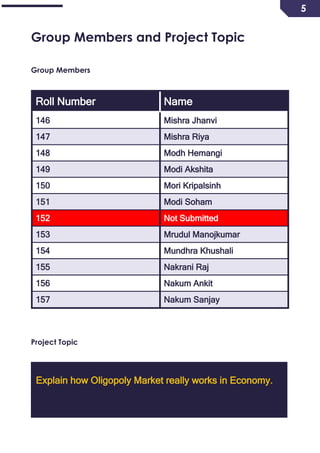
Group Members
Roll Number Name
146 Mishra Jhanvi
147 Mishra Riya
148 Modh Hemangi
149 Modi Akshita
150 Mori Kripalsinh
151 Modi Soham
152 Not Submitted
153 Mrudul Manojkumar
154 Mundhra Khushali
155 Nakrani Raj
156 Nakum Ankit
157 Nakum Sanjay
Project Topic
Explain how Oligopoly Market really works in Economy.
6
7
Introduction
In market economy, there are a variety of different systems that exist based on the
industry and the companies within the industry. It is important for any business to know
what kind of a market they are in while making pricing and production related decisions
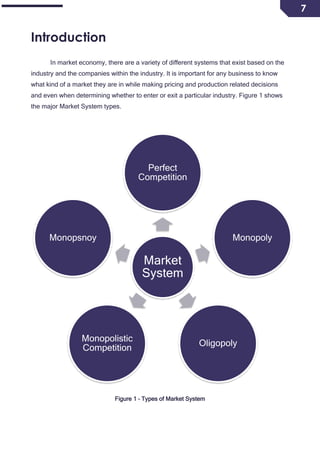
and even when determining whether to enter or exit a particular industry. Figure 1 shows
the major Market System types.
Figure 1 – Types of Market System
Market
System
Perfect
Competition
Monopoly
Oligopoly
Monopolistic
Competition
Monopsnoy
8
Perfect Competition
Perfect competition is a market system characterized by many different buyers and
sellers. In the classic theoretical definition of perfect competition, there are an infinite
number of buyers and sellers. With so many market players, it is impossible for any one
participant to alter the prevailing price in the market. If they attempt to do so, buyers and
sellers have infinite alternatives to pursue.
Monopoly
A monopoly is the exact opposite form of market system as perfect competition. In a
pure monopoly, there is only one producer of a particular good or service, and generally no
reasonable substitute. In such a market system, the monopolist is able to charge whatever
price they wish due to the absence of competition, but their overall revenue will be limited
by the ability or willingness of customers to pay their price.
Oligopoly
An oligopoly is similar in many ways to a monopoly. The primary difference is that rather
than having only one producer of a good or service, there are a handful of producers, or at
least a handful of producers that make up a dominant majority of the production in the
market system. While oligopolists do not have the same pricing power as monopolists, it is
possible, without diligent government regulation, that oligopolists will collude with one
another to set prices in the same way a monopolist would.
Monopolistic Competition
Monopolistic competition is a type of market system combining elements of a monopoly
and perfect competition. Like a perfectly competitive market system, there are numerous
competitors in the market. The difference is that each competitor is sufficiently
differentiated from the others that some can charge greater prices than a perfectly
competitive firm. An example of monopolistic competition is the market for music. While
there are many artists, each artist is different and is not perfectly substitutible with another
artist.
Monopsony
Market systems are not only differentiated according to the number of suppliers in the
market. They may also be differentiated according to the number of buyers. Whereas a
perfectly competitive market theoretically has an infinite number of buyers and sellers, a
monopsony has only one buyer for a particular good or service, giving that buyer
significant power in determining the price of the products produced.
9
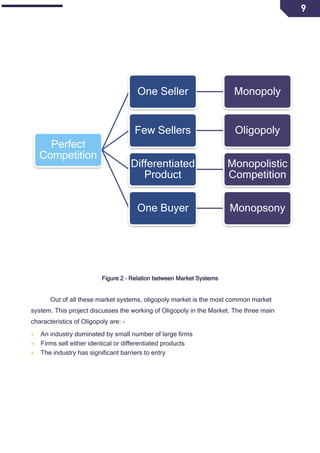
Figure 2 – Relation between Market Systems
Out of all these market systems, oligopoly market is the most common market
system. This project discusses the working of Oligopoly in the Market. The three main
characteristics of Oligopoly are: -
 An industry dominated by small number of large firms
 Firms sell either identical or differentiated products
 The industry has significant barriers to entry
Perfect
Competition
One Seller Monopoly
Few Sellers Oligopoly
Differentiated
Product
Monopolistic
Competition
One Buyer Monopsony
10
11
Examples of Oligopoly Market
The term ‘Oligopoly’ has been derived from the two Greek Words – ‘Oligi’ meaning
few and ‘Polein’ meaning to sell. Oligopoly is a market structure in which there are only a
few sellers of same or differentiated products. Oligopolies in history include steel
manufacturers, oil companies, rail roads, tire manufacturing, grocery store chains, wireless
carriers. In India, examples of Oligopoly Markets are: -
 Automobile Market
 Cement Industry
 Steel Industry
 Aluminum Industry
 Telecommunication Industry
“Duopoly is a special case of oligopoly in which there are only two sellers.”
Under Duopoly it is assumed that the product sold by the two sellers are
homogeneous and there is no reasonable substitute available for it. Some examples
where two companies control a large proportion of a market are: -
 Soft Drink Market  Pepsi and Coca-Cola
 Commercial Large Aircraft Market  Boeing and Airbus
 Computer Microchip Market  Intel and AMD
12
13
Identifying an Oligopoly
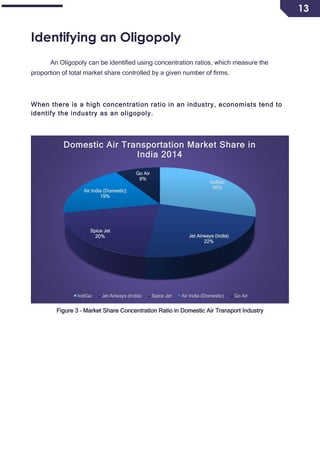
An Oligopoly can be identified using concentration ratios, which measure the
proportion of total market share controlled by a given number of firms.
When there is a high concentration ratio in an industry, economists tend to
identify the industry as an oligopoly.
Figure 3 – Market Share Concentration Ratio in Domestic Air Transport Industry
IndiGo
30%
Jet Airways (India)
22%
Spice Jet
20%
Air India (Domestic)
19%
Go Air
9%
Domestic Air Transportation Market Share in
India 2014
IndiGo Jet Airways (India) Spice Jet Air India (Domestic) Go Air
14
15
Characteristics of an Oligopoly
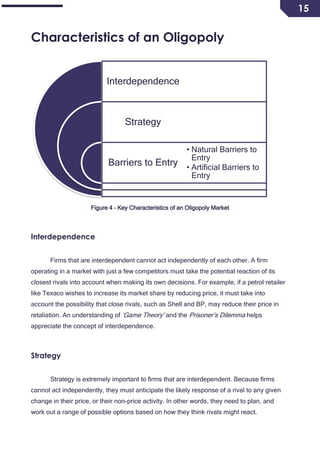
Figure 4 – Key Characteristics of an Oligopoly Market
Interdependence
Firms that are interdependent cannot act independently of each other. A firm
operating in a market with just a few competitors must take the potential reaction of its
closest rivals into account when making its own decisions. For example, if a petrol retailer
like Texaco wishes to increase its market share by reducing price, it must take into
account the possibility that close rivals, such as Shell and BP, may reduce their price in
retaliation. An understanding of ‘Game Theory’ and the Prisoner’s Dilemma helps
appreciate the concept of interdependence.
Strategy
Strategy is extremely important to firms that are interdependent. Because firms
cannot act independently, they must anticipate the likely response of a rival to any given
change in their price, or their non-price activity. In other words, they need to plan, and
work out a range of possible options based on how they think rivals might react.
Interdependence
Strategy
Barriers to Entry
• Natural Barriers to
Entry
• Artificial Barriers to
Entry
16
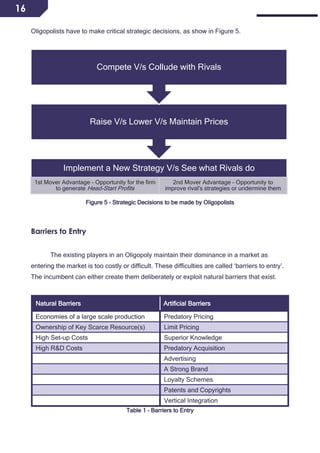
Oligopolists have to make critical strategic decisions, as show in Figure 5.
Figure 5 – Strategic Decisions to be made by Oligopolists
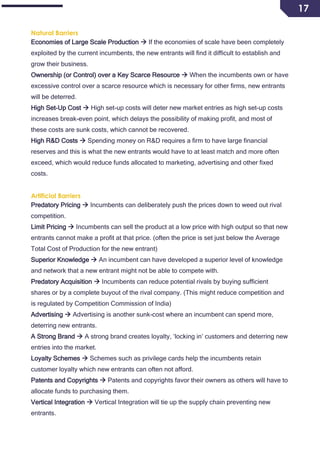
Barriers to Entry
The existing players in an Oligopoly maintain their dominance in a market as
entering the market is too costly or difficult. These difficulties are called ‘barriers to entry’.
The incumbent can either create them deliberately or exploit natural barriers that exist.
Natural Barriers Artificial Barriers
Economies of a large scale production Predatory Pricing
Ownership of Key Scarce Resource(s) Limit Pricing
High Set-up Costs Superior Knowledge
High R&D Costs Predatory Acquisition
Advertising
A Strong Brand
Loyalty Schemes
Patents and Copyrights
Vertical Integration
Table 1 – Barriers to Entry
Implement a New Strategy V/s See what Rivals do
1st Mover Advantage - Opportunity for the firm
to generate Head-Start Profits
2nd Mover Advantage - Opportunity to
improve rival's strategies or undermine them
Raise V/s Lower V/s Maintain Prices
Compete V/s Collude with Rivals
17
Natural Barriers
Economies of Large Scale Production  If the economies of scale have been completely
exploited by the current incumbents, the new entrants will find it difficult to establish and
grow their business.
Ownership (or Control) over a Key Scarce Resource  When the incumbents own or have
excessive control over a scarce resource which is necessary for other firms, new entrants
will be deterred.
High Set-Up Cost  High set-up costs will deter new market entries as high set-up costs
increases break-even point, which delays the possibility of making profit, and most of
these costs are sunk costs, which cannot be recovered.
High R&D Costs  Spending money on R&D requires a firm to have large financial
reserves and this is what the new entrants would have to at least match and more often
exceed, which would reduce funds allocated to marketing, advertising and other fixed
costs.
Artificial Barriers
Predatory Pricing  Incumbents can deliberately push the prices down to weed out rival
competition.
Limit Pricing  Incumbents can sell the product at a low price with high output so that new
entrants cannot make a profit at that price. (often the price is set just below the Average
Total Cost of Production for the new entrant)
Superior Knowledge  An incumbent can have developed a superior level of knowledge
and network that a new entrant might not be able to compete with.
Predatory Acquisition  Incumbents can reduce potential rivals by buying sufficient
shares or by a complete buyout of the rival company. (This might reduce competition and
is regulated by Competition Commission of India)
Advertising  Advertising is another sunk-cost where an incumbent can spend more,
deterring new entrants.
A Strong Brand  A strong brand creates loyalty, ‘locking in’ customers and deterring new
entries into the market.
Loyalty Schemes  Schemes such as privilege cards help the incumbents retain
customer loyalty which new entrants can often not afford.
Patents and Copyrights  Patents and copyrights favor their owners as others will have to
allocate funds to purchasing them.
Vertical Integration  Vertical Integration will tie up the supply chain preventing new
entrants.
18
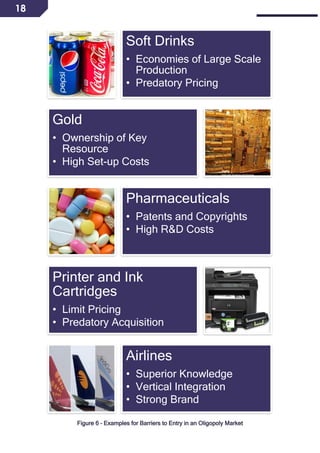
Figure 6 – Examples for Barriers to Entry in an Oligopoly Market
Soft Drinks
• Economies of Large Scale
Production
• Predatory Pricing
Gold
• Ownership of Key
Resource
• High Set-up Costs
Pharmaceuticals
• Patents and Copyrights
• High R&D Costs
Printer and Ink
Cartridges
• Limit Pricing
• Predatory Acquisition
Airlines
• Superior Knowledge
• Vertical Integration
• Strong Brand
19
Collusive Oligopolies
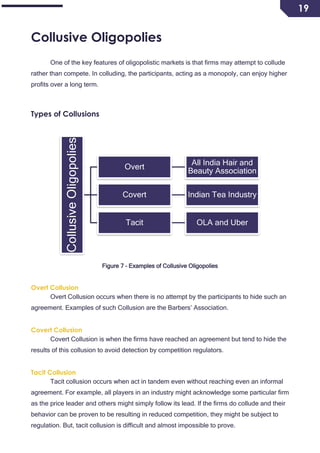
One of the key features of oligopolistic markets is that firms may attempt to collude
rather than compete. In colluding, the participants, acting as a monopoly, can enjoy higher
profits over a long term.
Types of Collusions
Figure 7 – Examples of Collusive Oligopolies
Overt Collusion
Overt Collusion occurs when there is no attempt by the participants to hide such an
agreement. Examples of such Collusion are the Barbers’ Association.
Covert Collusion
Covert Collusion is when the firms have reached an agreement but tend to hide the
results of this collusion to avoid detection by competition regulators.
Tacit Collusion
Tacit collusion occurs when act in tandem even without reaching even an informal
agreement. For example, all players in an industry might acknowledge some particular firm
as the price leader and others might simply follow its lead. If the firms do collude and their
behavior can be proven to be resulting in reduced competition, they might be subject to
regulation. But, tacit collusion is difficult and almost impossible to prove.
CollusiveOligopolies
Overt
All India Hair and
Beauty Association
Covert Indian Tea Industry
Tacit OLA and Uber
20
21
Competitive Oligopolies
When competing, Oligopolists prefer non-price competition in order to avoid price
wars. A price reduction may achieve strategic benefits, such as gaining market share, or
deterring entry, but the danger is that rivals will simply reduce their prices in response.
This leads to little or no gain, but can lead to falling revenues and profits. Hence, a far
more beneficial strategy may be to undertake non-price competition.
Pricing Strategies
Oligopolies may pursue the following pricing strategies: -
 Oligopolists may use predatory pricing to force rivals out of the market. This means
keeping price artificially low, and often below the full cost of production.
 They may also operate a limit-pricing strategy to deter entrants, which is also called
entry forestalling price.
 Oligopolists may collude with rivals and raise price together, but this may attract new
entrants.
 Cost-plus pricing is a straightforward pricing method, where a firm sets a price by
calculating average production costs and then adding a fixed mark-up to achieve a
desired profit level. Cost-plus pricing is also called rule of thumb pricing.
Non-Pricing Strategies
Non-price competition is the favored strategy for oligopolists because price competition
can lead to destructive price wars – examples include:
 Trying to improve quality and after sales servicing, such as offering extended
guarantees.
 Spending on advertising, sponsorship and product placement - also called hidden
advertising – is very significant to many oligopolists. The UK's football Premiership has
long been sponsored by firms in oligopolies, including Barclays Bank and Carling.
 Sales promotion, such as buy-one-get-one-free (BOGOF), is associated with the large
supermarkets, which is a highly oligopolistic market, dominated by three or four large
chains.
 Loyalty schemes, which are common in the supermarket sector, such as Sainsbury’s
Nectar Card and Tesco’s Club Card.
22
Each strategy can be evaluated in terms of:
 How successful is it likely to be?
 Will rivals be able to copy the strategy?
 Will the firms get a 1st - mover advantage?
 How expensive is it to introduce the strategy?
 How long will it take to work?
Price Stickiness
The theory of oligopoly suggests that, once a price has been determined, will stick it
at this price. This is largely because firms cannot pursue independent strategies. For
example, if an airline raises the price of its tickets from London to New York, rivals will not
follow suit and the airline will lose revenue - the demand curve for the price increase is
relatively elastic. Rivals have no need to follow suit because it is to their competitive
advantage to keep their prices as they are.
However, if the airline lowers its price, rivals would be forced to follow suit and drop
their prices in response. Again, the airline will lose sales revenue and market share. The
demand curve is relatively inelastic in this context.
Kinked Demand Curve
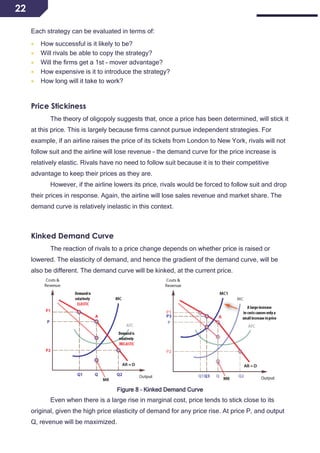
The reaction of rivals to a price change depends on whether price is raised or
lowered. The elasticity of demand, and hence the gradient of the demand curve, will be
also be different. The demand curve will be kinked, at the current price.
Figure 8 – Kinked Demand Curve
Even when there is a large rise in marginal cost, price tends to stick close to its
original, given the high price elasticity of demand for any price rise. At price P, and output
Q, revenue will be maximized.
23
Maximizing Profits
If marginal revenue and marginal costs are added it is possible to show that profits
will also be maximized at price P. Profits will always be maximized when MC = MR, and so
long as MC cuts MR in its vertical portion, then profit maximization is still at P.
Furthermore, if MC changes in the vertical portion of the MR curve, price still sticks at P.
Even when MC moves out of the vertical portion, the effect on price is minimal, and
consumers will not gain the benefit of any cost reduction.
Game Theory
Pricing strategies can also be looked at in terms of game theory; that is in terms of
strategies and payoffs. There are three possible price strategies, with different pay-offs
and risks:
 Raise price
 Lower price
 Keep price constant
The choice of strategy will depend upon the pay-offs, which depends upon the
actions of competitors. Raising price or lowering price could lead to a beneficial pay-off,
but both strategies can lead to losses, which could be potentially disastrous. In short,
changing price is too risky to undertake.
Therefore, although keeping price constant will not lead to the single best outcome,
it may be the least risky strategy for an oligopolist.
The Prisoner’s Dilemma
There is a tendency for cartels to form because co-operation is likely to be highly
rewarding. Co-operation reduces the uncertainty associated with the mutual
interdependence of rivals in an oligopolistic market. While cartels are ‘unlawful’ in most
countries, they may still operate, with members concealing their unlawful behavior. Cartels
are designed to protect the interests of members, and the interests of consumers may
suffer because of:
 Higher prices or hidden prices, such as the hidden charges in credit card transactions
 Lower output
 Restricted choice or other limiting conditions associated with the transaction
A classic game called the Prisoner's Dilemma is often used to demonstrate the
interdependence of oligopolists.
24
25
Evaluation of Oligopolies
Oligopolies are significant because they generate a considerable share of the our
national income, and they dominate many sectors of the economy.
Disadvantages of Oligopolies
Oligopolies can be criticized on a number of obvious grounds, including:
 High concentration reduces consumer choice.
 Cartel-like behavior reduces competition and can lead to higher prices and reduced
output.
 Given the lack of competition, oligopolists may be free to engage in the manipulation of
consumer decision making. By making decisions more complex - such as financial
decisions about mortgages - individual consumers fall back on heuristics and rule of
thumb processes, which can lead to decision making bias and irrational behaviour,
including making purchases which add no utility or even harm the individual consumer.
 Firms can be prevented from entering a market because of deliberate barriers to entry.
 There is a potential loss of economic welfare.
 Oligopolists may be allocative and productively inefficient.
Advantages of Oligopolies
However, oligopolies may provide the following benefits:
 Oligopolies may adopt a highly competitive strategy, in which case they can generate
similar benefits to more competitive market structures, such as lower prices. Even
though there are a few firms, making the market uncompetitive, their behavior may be
highly competitive.
 Oligopolists may be dynamically efficient in terms of innovation and new product and
process development. The super-normal profits they generate may be used to
innovate, in which case the consumer may gain.
 Price stability may bring advantages to consumers and the macro-economy because it
helps consumers plan ahead and stabilizes their expenditure, which may help stabilize
the trade cycle.

Oligopoly Market

  • 1.
    Micro Economics Practical Assignment Class:F.Y. – B | Group: 146 – 157 Roll No.: 153 | Name: Mrudul Manojkumar
  • 2.
  • 3.
    3 TABLE OF CONTENTS GroupMembers and Project Topic __________________________________5 Group Members ________________________________________________________5 Project Topic __________________________________________________________5 Introduction ____________________________________________________7 Perfect Competition ___________________________________________________8 Monopoly ___________________________________________________________8 Oligopoly____________________________________________________________8 Monopolistic Competition _______________________________________________8 Monopsony __________________________________________________________8 Examples of Oligopoly Market _____________________________________11 Identifying an Oligopoly __________________________________________13 Characteristics of an Oligopoly ____________________________________15 Interdependence ______________________________________________________15 Strategy _____________________________________________________________15 Barriers to Entry _______________________________________________________16 Natural Barriers______________________________________________________17 Artificial Barriers _____________________________________________________17 Collusive Oligopolies ____________________________________________19 Types of Collusions ____________________________________________________19 Overt Collusion ______________________________________________________19 Covert Collusion _____________________________________________________19 Tacit Collusion ______________________________________________________19 Competitive Oligopolies__________________________________________21 Pricing Strategies ______________________________________________________21 Non-Pricing Strategies __________________________________________________21 Price Stickiness _______________________________________________________22 Kinked Demand Curve __________________________________________________22 Maximizing Profits _____________________________________________________23 Game Theory _________________________________________________________23 The Prisoner’s Dilemma_________________________________________________23 Evaluation of Oligopolies _________________________________________25 Disadvantages of Oligopolies_____________________________________________25 Advantages of Oligopolies _______________________________________________25
  • 4.
  • 5.
    5 Group Members andProject Topic Group Members Roll Number Name 146 Mishra Jhanvi 147 Mishra Riya 148 Modh Hemangi 149 Modi Akshita 150 Mori Kripalsinh 151 Modi Soham 152 Not Submitted 153 Mrudul Manojkumar 154 Mundhra Khushali 155 Nakrani Raj 156 Nakum Ankit 157 Nakum Sanjay Project Topic Explain how Oligopoly Market really works in Economy.
  • 6.
  • 7.
    7 Introduction In market economy,there are a variety of different systems that exist based on the industry and the companies within the industry. It is important for any business to know what kind of a market they are in while making pricing and production related decisions and even when determining whether to enter or exit a particular industry. Figure 1 shows the major Market System types. Figure 1 – Types of Market System Market System Perfect Competition Monopoly Oligopoly Monopolistic Competition Monopsnoy
  • 8.
    8 Perfect Competition Perfect competitionis a market system characterized by many different buyers and sellers. In the classic theoretical definition of perfect competition, there are an infinite number of buyers and sellers. With so many market players, it is impossible for any one participant to alter the prevailing price in the market. If they attempt to do so, buyers and sellers have infinite alternatives to pursue. Monopoly A monopoly is the exact opposite form of market system as perfect competition. In a pure monopoly, there is only one producer of a particular good or service, and generally no reasonable substitute. In such a market system, the monopolist is able to charge whatever price they wish due to the absence of competition, but their overall revenue will be limited by the ability or willingness of customers to pay their price. Oligopoly An oligopoly is similar in many ways to a monopoly. The primary difference is that rather than having only one producer of a good or service, there are a handful of producers, or at least a handful of producers that make up a dominant majority of the production in the market system. While oligopolists do not have the same pricing power as monopolists, it is possible, without diligent government regulation, that oligopolists will collude with one another to set prices in the same way a monopolist would. Monopolistic Competition Monopolistic competition is a type of market system combining elements of a monopoly and perfect competition. Like a perfectly competitive market system, there are numerous competitors in the market. The difference is that each competitor is sufficiently differentiated from the others that some can charge greater prices than a perfectly competitive firm. An example of monopolistic competition is the market for music. While there are many artists, each artist is different and is not perfectly substitutible with another artist. Monopsony Market systems are not only differentiated according to the number of suppliers in the market. They may also be differentiated according to the number of buyers. Whereas a perfectly competitive market theoretically has an infinite number of buyers and sellers, a monopsony has only one buyer for a particular good or service, giving that buyer significant power in determining the price of the products produced.
  • 9.
    9 Figure 2 –Relation between Market Systems Out of all these market systems, oligopoly market is the most common market system. This project discusses the working of Oligopoly in the Market. The three main characteristics of Oligopoly are: -  An industry dominated by small number of large firms  Firms sell either identical or differentiated products  The industry has significant barriers to entry Perfect Competition One Seller Monopoly Few Sellers Oligopoly Differentiated Product Monopolistic Competition One Buyer Monopsony
  • 10.
  • 11.
    11 Examples of OligopolyMarket The term ‘Oligopoly’ has been derived from the two Greek Words – ‘Oligi’ meaning few and ‘Polein’ meaning to sell. Oligopoly is a market structure in which there are only a few sellers of same or differentiated products. Oligopolies in history include steel manufacturers, oil companies, rail roads, tire manufacturing, grocery store chains, wireless carriers. In India, examples of Oligopoly Markets are: -  Automobile Market  Cement Industry  Steel Industry  Aluminum Industry  Telecommunication Industry “Duopoly is a special case of oligopoly in which there are only two sellers.” Under Duopoly it is assumed that the product sold by the two sellers are homogeneous and there is no reasonable substitute available for it. Some examples where two companies control a large proportion of a market are: -  Soft Drink Market  Pepsi and Coca-Cola  Commercial Large Aircraft Market  Boeing and Airbus  Computer Microchip Market  Intel and AMD
  • 12.
  • 13.
    13 Identifying an Oligopoly AnOligopoly can be identified using concentration ratios, which measure the proportion of total market share controlled by a given number of firms. When there is a high concentration ratio in an industry, economists tend to identify the industry as an oligopoly. Figure 3 – Market Share Concentration Ratio in Domestic Air Transport Industry IndiGo 30% Jet Airways (India) 22% Spice Jet 20% Air India (Domestic) 19% Go Air 9% Domestic Air Transportation Market Share in India 2014 IndiGo Jet Airways (India) Spice Jet Air India (Domestic) Go Air
  • 14.
  • 15.
    15 Characteristics of anOligopoly Figure 4 – Key Characteristics of an Oligopoly Market Interdependence Firms that are interdependent cannot act independently of each other. A firm operating in a market with just a few competitors must take the potential reaction of its closest rivals into account when making its own decisions. For example, if a petrol retailer like Texaco wishes to increase its market share by reducing price, it must take into account the possibility that close rivals, such as Shell and BP, may reduce their price in retaliation. An understanding of ‘Game Theory’ and the Prisoner’s Dilemma helps appreciate the concept of interdependence. Strategy Strategy is extremely important to firms that are interdependent. Because firms cannot act independently, they must anticipate the likely response of a rival to any given change in their price, or their non-price activity. In other words, they need to plan, and work out a range of possible options based on how they think rivals might react. Interdependence Strategy Barriers to Entry • Natural Barriers to Entry • Artificial Barriers to Entry
  • 16.
    16 Oligopolists have tomake critical strategic decisions, as show in Figure 5. Figure 5 – Strategic Decisions to be made by Oligopolists Barriers to Entry The existing players in an Oligopoly maintain their dominance in a market as entering the market is too costly or difficult. These difficulties are called ‘barriers to entry’. The incumbent can either create them deliberately or exploit natural barriers that exist. Natural Barriers Artificial Barriers Economies of a large scale production Predatory Pricing Ownership of Key Scarce Resource(s) Limit Pricing High Set-up Costs Superior Knowledge High R&D Costs Predatory Acquisition Advertising A Strong Brand Loyalty Schemes Patents and Copyrights Vertical Integration Table 1 – Barriers to Entry Implement a New Strategy V/s See what Rivals do 1st Mover Advantage - Opportunity for the firm to generate Head-Start Profits 2nd Mover Advantage - Opportunity to improve rival's strategies or undermine them Raise V/s Lower V/s Maintain Prices Compete V/s Collude with Rivals
  • 17.
    17 Natural Barriers Economies ofLarge Scale Production  If the economies of scale have been completely exploited by the current incumbents, the new entrants will find it difficult to establish and grow their business. Ownership (or Control) over a Key Scarce Resource  When the incumbents own or have excessive control over a scarce resource which is necessary for other firms, new entrants will be deterred. High Set-Up Cost  High set-up costs will deter new market entries as high set-up costs increases break-even point, which delays the possibility of making profit, and most of these costs are sunk costs, which cannot be recovered. High R&D Costs  Spending money on R&D requires a firm to have large financial reserves and this is what the new entrants would have to at least match and more often exceed, which would reduce funds allocated to marketing, advertising and other fixed costs. Artificial Barriers Predatory Pricing  Incumbents can deliberately push the prices down to weed out rival competition. Limit Pricing  Incumbents can sell the product at a low price with high output so that new entrants cannot make a profit at that price. (often the price is set just below the Average Total Cost of Production for the new entrant) Superior Knowledge  An incumbent can have developed a superior level of knowledge and network that a new entrant might not be able to compete with. Predatory Acquisition  Incumbents can reduce potential rivals by buying sufficient shares or by a complete buyout of the rival company. (This might reduce competition and is regulated by Competition Commission of India) Advertising  Advertising is another sunk-cost where an incumbent can spend more, deterring new entrants. A Strong Brand  A strong brand creates loyalty, ‘locking in’ customers and deterring new entries into the market. Loyalty Schemes  Schemes such as privilege cards help the incumbents retain customer loyalty which new entrants can often not afford. Patents and Copyrights  Patents and copyrights favor their owners as others will have to allocate funds to purchasing them. Vertical Integration  Vertical Integration will tie up the supply chain preventing new entrants.
  • 18.
    18 Figure 6 –Examples for Barriers to Entry in an Oligopoly Market Soft Drinks • Economies of Large Scale Production • Predatory Pricing Gold • Ownership of Key Resource • High Set-up Costs Pharmaceuticals • Patents and Copyrights • High R&D Costs Printer and Ink Cartridges • Limit Pricing • Predatory Acquisition Airlines • Superior Knowledge • Vertical Integration • Strong Brand
  • 19.
    19 Collusive Oligopolies One ofthe key features of oligopolistic markets is that firms may attempt to collude rather than compete. In colluding, the participants, acting as a monopoly, can enjoy higher profits over a long term. Types of Collusions Figure 7 – Examples of Collusive Oligopolies Overt Collusion Overt Collusion occurs when there is no attempt by the participants to hide such an agreement. Examples of such Collusion are the Barbers’ Association. Covert Collusion Covert Collusion is when the firms have reached an agreement but tend to hide the results of this collusion to avoid detection by competition regulators. Tacit Collusion Tacit collusion occurs when act in tandem even without reaching even an informal agreement. For example, all players in an industry might acknowledge some particular firm as the price leader and others might simply follow its lead. If the firms do collude and their behavior can be proven to be resulting in reduced competition, they might be subject to regulation. But, tacit collusion is difficult and almost impossible to prove. CollusiveOligopolies Overt All India Hair and Beauty Association Covert Indian Tea Industry Tacit OLA and Uber
  • 20.
  • 21.
    21 Competitive Oligopolies When competing,Oligopolists prefer non-price competition in order to avoid price wars. A price reduction may achieve strategic benefits, such as gaining market share, or deterring entry, but the danger is that rivals will simply reduce their prices in response. This leads to little or no gain, but can lead to falling revenues and profits. Hence, a far more beneficial strategy may be to undertake non-price competition. Pricing Strategies Oligopolies may pursue the following pricing strategies: -  Oligopolists may use predatory pricing to force rivals out of the market. This means keeping price artificially low, and often below the full cost of production.  They may also operate a limit-pricing strategy to deter entrants, which is also called entry forestalling price.  Oligopolists may collude with rivals and raise price together, but this may attract new entrants.  Cost-plus pricing is a straightforward pricing method, where a firm sets a price by calculating average production costs and then adding a fixed mark-up to achieve a desired profit level. Cost-plus pricing is also called rule of thumb pricing. Non-Pricing Strategies Non-price competition is the favored strategy for oligopolists because price competition can lead to destructive price wars – examples include:  Trying to improve quality and after sales servicing, such as offering extended guarantees.  Spending on advertising, sponsorship and product placement - also called hidden advertising – is very significant to many oligopolists. The UK's football Premiership has long been sponsored by firms in oligopolies, including Barclays Bank and Carling.  Sales promotion, such as buy-one-get-one-free (BOGOF), is associated with the large supermarkets, which is a highly oligopolistic market, dominated by three or four large chains.  Loyalty schemes, which are common in the supermarket sector, such as Sainsbury’s Nectar Card and Tesco’s Club Card.
  • 22.
    22 Each strategy canbe evaluated in terms of:  How successful is it likely to be?  Will rivals be able to copy the strategy?  Will the firms get a 1st - mover advantage?  How expensive is it to introduce the strategy?  How long will it take to work? Price Stickiness The theory of oligopoly suggests that, once a price has been determined, will stick it at this price. This is largely because firms cannot pursue independent strategies. For example, if an airline raises the price of its tickets from London to New York, rivals will not follow suit and the airline will lose revenue - the demand curve for the price increase is relatively elastic. Rivals have no need to follow suit because it is to their competitive advantage to keep their prices as they are. However, if the airline lowers its price, rivals would be forced to follow suit and drop their prices in response. Again, the airline will lose sales revenue and market share. The demand curve is relatively inelastic in this context. Kinked Demand Curve The reaction of rivals to a price change depends on whether price is raised or lowered. The elasticity of demand, and hence the gradient of the demand curve, will be also be different. The demand curve will be kinked, at the current price. Figure 8 – Kinked Demand Curve Even when there is a large rise in marginal cost, price tends to stick close to its original, given the high price elasticity of demand for any price rise. At price P, and output Q, revenue will be maximized.
  • 23.
    23 Maximizing Profits If marginalrevenue and marginal costs are added it is possible to show that profits will also be maximized at price P. Profits will always be maximized when MC = MR, and so long as MC cuts MR in its vertical portion, then profit maximization is still at P. Furthermore, if MC changes in the vertical portion of the MR curve, price still sticks at P. Even when MC moves out of the vertical portion, the effect on price is minimal, and consumers will not gain the benefit of any cost reduction. Game Theory Pricing strategies can also be looked at in terms of game theory; that is in terms of strategies and payoffs. There are three possible price strategies, with different pay-offs and risks:  Raise price  Lower price  Keep price constant The choice of strategy will depend upon the pay-offs, which depends upon the actions of competitors. Raising price or lowering price could lead to a beneficial pay-off, but both strategies can lead to losses, which could be potentially disastrous. In short, changing price is too risky to undertake. Therefore, although keeping price constant will not lead to the single best outcome, it may be the least risky strategy for an oligopolist. The Prisoner’s Dilemma There is a tendency for cartels to form because co-operation is likely to be highly rewarding. Co-operation reduces the uncertainty associated with the mutual interdependence of rivals in an oligopolistic market. While cartels are ‘unlawful’ in most countries, they may still operate, with members concealing their unlawful behavior. Cartels are designed to protect the interests of members, and the interests of consumers may suffer because of:  Higher prices or hidden prices, such as the hidden charges in credit card transactions  Lower output  Restricted choice or other limiting conditions associated with the transaction A classic game called the Prisoner's Dilemma is often used to demonstrate the interdependence of oligopolists.
  • 24.
  • 25.
    25 Evaluation of Oligopolies Oligopoliesare significant because they generate a considerable share of the our national income, and they dominate many sectors of the economy. Disadvantages of Oligopolies Oligopolies can be criticized on a number of obvious grounds, including:  High concentration reduces consumer choice.  Cartel-like behavior reduces competition and can lead to higher prices and reduced output.  Given the lack of competition, oligopolists may be free to engage in the manipulation of consumer decision making. By making decisions more complex - such as financial decisions about mortgages - individual consumers fall back on heuristics and rule of thumb processes, which can lead to decision making bias and irrational behaviour, including making purchases which add no utility or even harm the individual consumer.  Firms can be prevented from entering a market because of deliberate barriers to entry.  There is a potential loss of economic welfare.  Oligopolists may be allocative and productively inefficient. Advantages of Oligopolies However, oligopolies may provide the following benefits:  Oligopolies may adopt a highly competitive strategy, in which case they can generate similar benefits to more competitive market structures, such as lower prices. Even though there are a few firms, making the market uncompetitive, their behavior may be highly competitive.  Oligopolists may be dynamically efficient in terms of innovation and new product and process development. The super-normal profits they generate may be used to innovate, in which case the consumer may gain.  Price stability may bring advantages to consumers and the macro-economy because it helps consumers plan ahead and stabilizes their expenditure, which may help stabilize the trade cycle.