UNIVERSITY OF MYSORE
MANASAGANGOTHRI
FOURTH SEMESTER
Paper : Information Systems and Services
Seminar on : Information Policy
Presented to,
Sunil Kumar, M.
Lecturer Presented By
DOC in Library and Information Science Shalini B.G
Manasagangotri, 2nd year MLISC
Mysuru
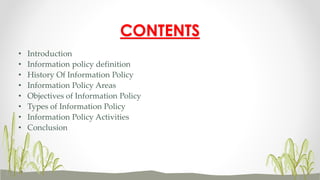
• Introduction
• Information policy definition
• History Of Information Policy
• Information Policy Areas
• Objectives of Information Policy
• Types of Information Policy
• Information Policy Activities
• Conclusion
CONTENTS
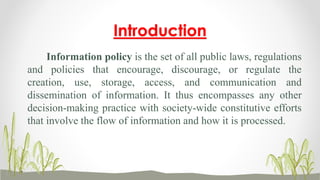
Introduction
Information policy is the set of all public laws, regulations
and policies that encourage, discourage, or regulate the
creation, use, storage, access, and communication and
dissemination of information. It thus encompasses any other
decision-making practice with society-wide constitutive efforts
that involve the flow of information and how it is processed.
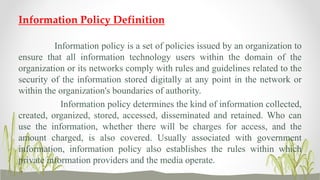
Information Policy Definition
Information policy is a set of policies issued by an organization to
ensure that all information technology users within the domain of the
organization or its networks comply with rules and guidelines related to the
security of the information stored digitally at any point in the network or
within the organization's boundaries of authority.
Information policy determines the kind of information collected,
created, organized, stored, accessed, disseminated and retained. Who can
use the information, whether there will be charges for access, and the
amount charged, is also covered. Usually associated with government
information, information policy also establishes the rules within which
private information providers and the media operate.
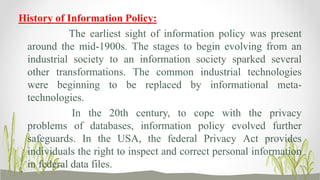
History of Information Policy:
The earliest sight of information policy was present
around the mid-1900s. The stages to begin evolving from an
industrial society to an information society sparked several
other transformations. The common industrial technologies
were beginning to be replaced by informational meta-
technologies.
In the 20th century, to cope with the privacy
problems of databases, information policy evolved further
safeguards. In the USA, the federal Privacy Act provides
individuals the right to inspect and correct personal information
in federal data files.
Information policy includes the following areas:
• Literacy
• Privatization and distribution of government
• Information
• Freedom of information access
• Protection of personal privacy
• Intellectual property rights
• Retention of archival copies of material
• Citizen's charter of information rights
Objectives of Information Policy
• To strengthen internal control and prevent unauthorized and improper access to data,
thereby ensuring the appropriate protection of information assets
• To appropriately protect the confidentiality and integrity of information assets
• To ensure that information is not revealed to unauthorized third parties during the
process of transmission or as a result of unintentional actions
• To ensure that all information security accidents or suspected security flaws have
appropriate reporting mechanisms so that superiors are notified and these incidents
are appropriately investigated and handled
Types of Information Policy:
The types of information policy can be separated into two different categories.
There are:-
1. Issues
2. Convergence
1. Issues: There are some issues around organizational
information polices, which are the interaction between human
beings and technology for using information, the issue to proceed
information policy itself, whether to-down or middle-up-down, is
the best way to approach information policy in an organization.
2. Convergence: Convergence essentially combines all forms of
media, telecommunications, broadcasting, and computing by the
use of a single technology: digital computers. It integrates diverse
technological systems in the hopes of improving performance of
similar tasks.
Security vs. freedom of information:
• A persistent debate concerning the government role in information policy
is the separation of security and freedom of information. Legislation such
as the Uniting and Strengthening America by Providing Appropriate Tools
Required to Intercept and Obstruct Terrorism Act of 2001 is an example of
security taking precedence over civil liberties. The USAPA affected several
surveillance and privacy laws to include;
• Wire Tapping which requires there be probable cause for real-time
interception of voice and data communication.
• Electronic Communications Privacy Act(ECPA) regulates government
access to email and other electronic communications.
• Foreign Intelligence Surveillance Act (FISA) authorizes the government
to carry out electronic surveillance against any person, including
Americans.
Information Policy Activities
• A policy is conditioned on the political, economic, social, and cultural
milieu. Policies are value in a number of ways such as they standardize
activities, facilitate
• decision making,
• minimize confusion,
• coordinate the activities of various units,
• conserve time in training.
• It comprehends a set of basic issues which are infrastructure
development,
• information services development,
• utilization of new technologies,
• manpower development and other general recommendations.
Conclusion :
Information policy is playing a greater role in the economy
leading to the production of goods and services, as well as selling them
directly to consumers . The cost of information varies from a tangible
good in that initial costs of the first unit are large and fixed; however,
after that, marginal costs are relatively low . As an increase from the
information services, information can be paralleled to that of
manufacturing several years ago .
Information policy sunil sir

Information policy sunil sir

  • 1.
    UNIVERSITY OF MYSORE MANASAGANGOTHRI FOURTHSEMESTER Paper : Information Systems and Services Seminar on : Information Policy Presented to, Sunil Kumar, M. Lecturer Presented By DOC in Library and Information Science Shalini B.G Manasagangotri, 2nd year MLISC Mysuru
  • 3.
    • Introduction • Informationpolicy definition • History Of Information Policy • Information Policy Areas • Objectives of Information Policy • Types of Information Policy • Information Policy Activities • Conclusion CONTENTS
  • 4.
    Introduction Information policy isthe set of all public laws, regulations and policies that encourage, discourage, or regulate the creation, use, storage, access, and communication and dissemination of information. It thus encompasses any other decision-making practice with society-wide constitutive efforts that involve the flow of information and how it is processed.
  • 5.
    Information Policy Definition Informationpolicy is a set of policies issued by an organization to ensure that all information technology users within the domain of the organization or its networks comply with rules and guidelines related to the security of the information stored digitally at any point in the network or within the organization's boundaries of authority. Information policy determines the kind of information collected, created, organized, stored, accessed, disseminated and retained. Who can use the information, whether there will be charges for access, and the amount charged, is also covered. Usually associated with government information, information policy also establishes the rules within which private information providers and the media operate.
  • 6.
    History of InformationPolicy: The earliest sight of information policy was present around the mid-1900s. The stages to begin evolving from an industrial society to an information society sparked several other transformations. The common industrial technologies were beginning to be replaced by informational meta- technologies. In the 20th century, to cope with the privacy problems of databases, information policy evolved further safeguards. In the USA, the federal Privacy Act provides individuals the right to inspect and correct personal information in federal data files.
  • 7.
    Information policy includesthe following areas: • Literacy • Privatization and distribution of government • Information • Freedom of information access • Protection of personal privacy • Intellectual property rights • Retention of archival copies of material • Citizen's charter of information rights
  • 8.
    Objectives of InformationPolicy • To strengthen internal control and prevent unauthorized and improper access to data, thereby ensuring the appropriate protection of information assets • To appropriately protect the confidentiality and integrity of information assets • To ensure that information is not revealed to unauthorized third parties during the process of transmission or as a result of unintentional actions • To ensure that all information security accidents or suspected security flaws have appropriate reporting mechanisms so that superiors are notified and these incidents are appropriately investigated and handled
  • 9.
    Types of InformationPolicy: The types of information policy can be separated into two different categories. There are:- 1. Issues 2. Convergence
  • 10.
    1. Issues: Thereare some issues around organizational information polices, which are the interaction between human beings and technology for using information, the issue to proceed information policy itself, whether to-down or middle-up-down, is the best way to approach information policy in an organization. 2. Convergence: Convergence essentially combines all forms of media, telecommunications, broadcasting, and computing by the use of a single technology: digital computers. It integrates diverse technological systems in the hopes of improving performance of similar tasks.
  • 11.
    Security vs. freedomof information: • A persistent debate concerning the government role in information policy is the separation of security and freedom of information. Legislation such as the Uniting and Strengthening America by Providing Appropriate Tools Required to Intercept and Obstruct Terrorism Act of 2001 is an example of security taking precedence over civil liberties. The USAPA affected several surveillance and privacy laws to include; • Wire Tapping which requires there be probable cause for real-time interception of voice and data communication. • Electronic Communications Privacy Act(ECPA) regulates government access to email and other electronic communications. • Foreign Intelligence Surveillance Act (FISA) authorizes the government to carry out electronic surveillance against any person, including Americans.
  • 12.
    Information Policy Activities •A policy is conditioned on the political, economic, social, and cultural milieu. Policies are value in a number of ways such as they standardize activities, facilitate • decision making, • minimize confusion, • coordinate the activities of various units, • conserve time in training. • It comprehends a set of basic issues which are infrastructure development, • information services development, • utilization of new technologies, • manpower development and other general recommendations.
  • 13.
    Conclusion : Information policyis playing a greater role in the economy leading to the production of goods and services, as well as selling them directly to consumers . The cost of information varies from a tangible good in that initial costs of the first unit are large and fixed; however, after that, marginal costs are relatively low . As an increase from the information services, information can be paralleled to that of manufacturing several years ago .