1
Hello!
Maryam Mehboob
Student of punjab university gujranwala campus
From IBA department
2
Socialization
and the life
course
“I think when you are
younger, you need to
socialize and be with
people your own
age.
4
Place your screenshot here
5
Table of contents
6
⬗ Socialization
⬗ Role of socialization
⬗ The self and socialization
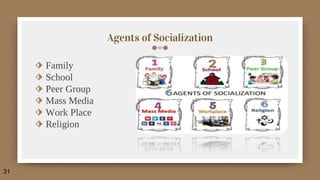
⬗ Agents of socialization
⬗ Socialization across the life
course
⬗ Social policy and socialization
Socialization
Process by which individuals acquire the knowledge, language,
social skills and values to conform to the norms and roles
required for integration into a society .
Example:
A baby learns language, norms and values to survive in his
society as he grows up.
7
Organizational Socialization
The process through which a new employee “learns the ropes”
by becoming sensitive to the explicit and implicit norms and
rules of behavior.
Example:
training provided to the new employees
8
1. Role of
socialization
Let’s start with contents of it.
Role of socialization
⬗ Environment: The impact of isolation
Isabelle and genie: two cases
Primate studies
⬗ The Influence of Heredity
Studies of Identical Twins
10
Role of socialization
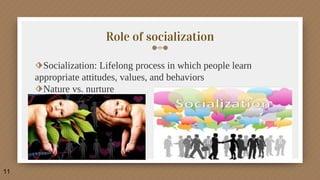
⬗Socialization: Lifelong process in which people learn
appropriate attitudes, values, and behaviors
⬗Nature vs. nurture
11
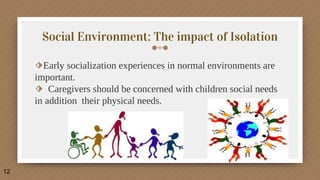
Social Environment: The impact of Isolation
⬗Early socialization experiences in normal environments are
important.
⬗ Caregivers should be concerned with children social needs
in addition their physical needs.
12
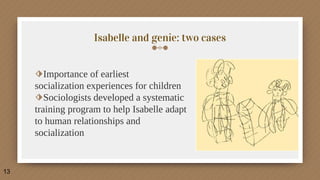
Isabelle and genie: two cases
⬗Importance of earliest
socialization experiences for children
⬗Sociologists developed a systematic
training program to help Isabelle adapt
to human relationships and
socialization
13
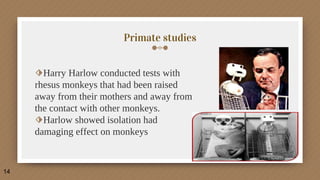
Primate studies
⬗Harry Harlow conducted tests with
rhesus monkeys that had been raised
away from their mothers and away from
the contact with other monkeys.
⬗Harlow showed isolation had
damaging effect on monkeys
14
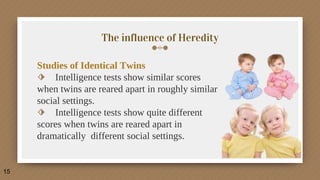
The influence of Heredity
Studies of Identical Twins
⬗ Intelligence tests show similar scores
when twins are reared apart in roughly similar
social settings.
⬗ Intelligence tests show quite different
scores when twins are reared apart in
dramatically different social settings.
15
2. The Self &
Socialization
16
What is self?
⬗George Herbert mead, sociologist recognize the
concept of self.
⬗Self is a distinct identity that sets us apart from
others. It is not a static phenomenon it continues to
develop and changes throughout lives.
⬗There are two approaches of self:
 Sociological approach
 Psychological approach
17
Sociological approach to self
⬗There are four sociological approaches of self which are:
 Cooley: Looking-Glass Self
 Mead: The Stages of Self
 Mead: the theory of self
 Goffman: presentation of the self
18
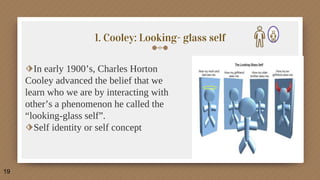
1. Cooley: Looking- glass self
⬗In early 1900’s, Charles Horton
Cooley advanced the belief that we
learn who we are by interacting with
other’s a phenomenon he called the
“looking-glass self”.
⬗Self identity or self concept
19
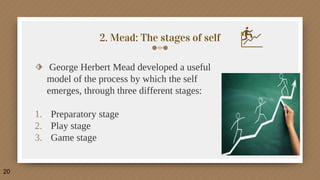
2. Mead: The stages of self
⬗ George Herbert Mead developed a useful
model of the process by which the self
emerges, through three different stages:
1. Preparatory stage
2. Play stage
3. Game stage
20
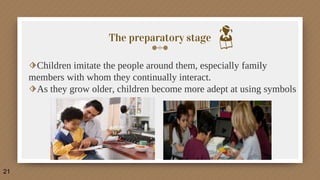
The preparatory stage
⬗Children imitate the people around them, especially family
members with whom they continually interact.
⬗As they grow older, children become more adept at using symbols
21
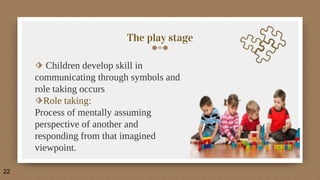
The play stage
⬗ Children develop skill in
communicating through symbols and
role taking occurs
⬗Role taking:
Process of mentally assuming
perspective of another and
responding from that imagined
viewpoint.
22
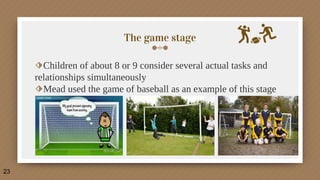
The game stage
⬗Children of about 8 or 9 consider several actual tasks and
relationships simultaneously
⬗Mead used the game of baseball as an example of this stage
23
3. Mead: theory of self
⬗Self begins as privileged, central
position in a person’s world
⬗As the person matures, the self
changes and begins to reflect greater
concern about reactions of others
24
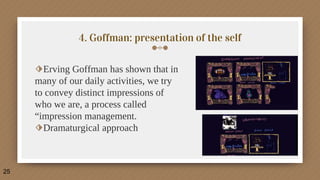
4. Goffman: presentation of the self
⬗Erving Goffman has shown that in
many of our daily activities, we try
to convey distinct impressions of
who we are, a process called
“impression management.
⬗Dramaturgical approach
25
Psychological approaches to the self
⬗Psychologists have also shared interest in the
development of the self.
⬗ -These psychologists include Sigmund Freud and
Jean Piaget.
26
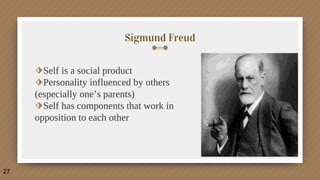
Sigmund Freud
⬗Self is a social product
⬗Personality influenced by others
(especially one’s parents)
⬗Self has components that work in
opposition to each other
27
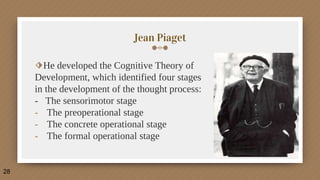
Jean Piaget
⬗He developed the Cognitive Theory of
Development, which identified four stages
in the development of the thought process:
- The sensorimotor stage
- The preoperational stage
- The concrete operational stage
- The formal operational stage
28
3. Agents of
socialization
Let’s start with the agencies of
socialization.
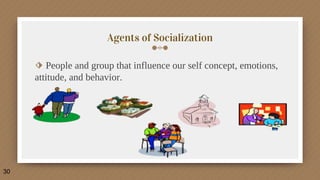
Agents of Socialization
⬗ People and group that influence our self concept, emotions,
attitude, and behavior.
30
Agents of Socialization
⬗ Family
⬗ School
⬗ Peer Group
⬗ Mass Media
⬗ Work Place
⬗ Religion
31
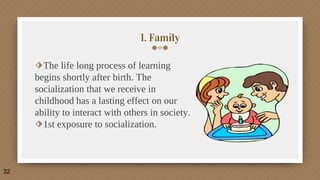
1. Family
⬗The life long process of learning
begins shortly after birth. The
socialization that we receive in
childhood has a lasting effect on our
ability to interact with others in society.
⬗1st exposure to socialization.
32
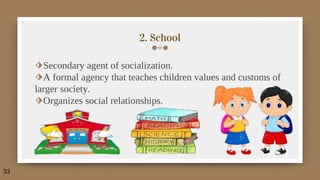
2. School
⬗Secondary agent of socialization.
⬗A formal agency that teaches children values and customs of
larger society.
⬗Organizes social relationships.
33
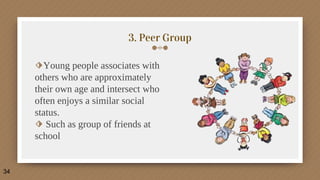
3. Peer Group
⬗Young people associates with
others who are approximately
their own age and intersect who
often enjoys a similar social
status.
⬗ Such as group of friends at
school
34
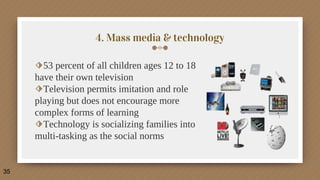
4. Mass media & technology
⬗53 percent of all children ages 12 to 18
have their own television
⬗Television permits imitation and role
playing but does not encourage more
complex forms of learning
⬗Technology is socializing families into
multi-tasking as the social norms
35
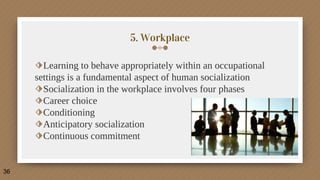
5. Workplace
⬗Learning to behave appropriately within an occupational
settings is a fundamental aspect of human socialization
⬗Socialization in the workplace involves four phases
⬗Career choice
⬗Conditioning
⬗Anticipatory socialization
⬗Continuous commitment
36
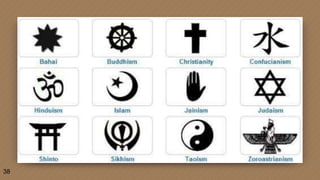
6. Religion
⬗Religion plays a major role in socialization of most
Americans
⬗70% of Americans belongs to a local congregation and 2 in
every 5 Americans attend a religious service weekly.
⬗Religious especially influence morality but also ideas about
dress, speech and manners that are appropriate
37
38
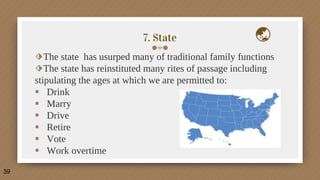
7. State
⬗The state has usurped many of traditional family functions
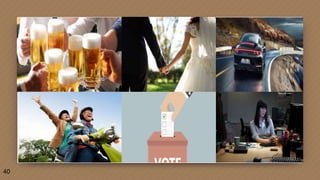
⬗The state has reinstituted many rites of passage including
stipulating the ages at which we are permitted to:
 Drink
 Marry
 Drive
 Retire
 Vote
 Work overtime
39
40
4. Socialization
across the life
course
41
LIFE COURSE
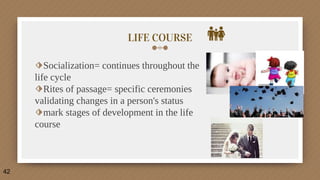
⬗Socialization= continues throughout the
life cycle
⬗Rites of passage= specific ceremonies
validating changes in a person's status
⬗mark stages of development in the life
course
42
LIFE STAGES
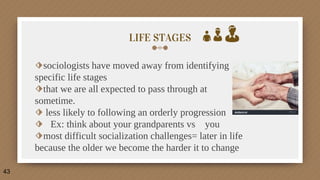
⬗sociologists have moved away from identifying
specific life stages
⬗that we are all expected to pass through at
sometime.
⬗ less likely to following an orderly progression
⬗ Ex: think about your grandparents vs you
⬗most difficult socialization challenges= later in life
because the older we become the harder it to change
43
FUNCTIONALIST APPROACH: Disengagement Theory
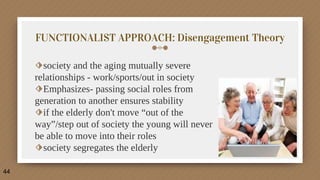
⬗society and the aging mutually severe
relationships - work/sports/out in society
⬗Emphasizes- passing social roles from
generation to another ensures stability
⬗if the elderly don't move “out of the
way”/step out of society the young will never
be able to move into their roles
⬗society segregates the elderly
44
Symbolic Interactionist Approach: Activity Theory
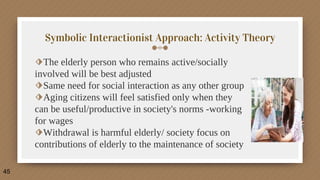
⬗The elderly person who remains active/socially
involved will be best adjusted
⬗Same need for social interaction as any other group
⬗Aging citizens will feel satisfied only when they
can be useful/productive in society's norms -working
for wages
⬗Withdrawal is harmful elderly/ society focus on
contributions of elderly to the maintenance of society
45
Conflict Approach
⬗goes against the disengagement suffers more when and
activity theory they become older
⬗Age=another factor of unequal sharing of power
46
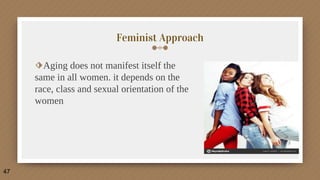
Feminist Approach
⬗Aging does not manifest itself the
same in all women. it depends on the
race, class and sexual orientation of the
women
47
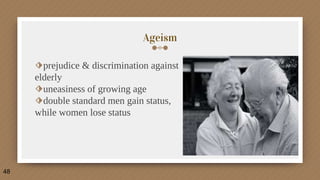
Ageism
⬗prejudice & discrimination against
elderly
⬗uneasiness of growing age
⬗double standard men gain status,
while women lose status
48
Types of Socialization
There are two Types of socialization occurs throughout the life course:
1. Anticipatory socialization:
First time, you are introduce to a new culture/ setoff norms, usually
takes place in your younger years (school years)
 rehearse for future positions
 helps everything runs smoothly
2. Resocialization (opposite to anticipatory socialization)
Must unlearn former behaviour, this can occur if you assume new
social/ occupational positions or move to another region
49
Total Institutions
⬗Perfect example of resocialization
⬗refers to institutions that regulate all aspects of a person's
life under a single authority
⬗provide for all the needs/cut off from society
⬗miniature society
50
Goffman's four common traits of institutions
⬗All aspects of life occurs in the same place and under the control of
a single person (usually the highest authority)
⬗Any activities held within the institution are conducted in the
company of those at the same level/ circumstances. Grouped with
those at the same resocialization level
⬗The authorities make all the rules and schedule the activities
without asking the group (participants)
⬗All aspects of life are designed to achieve the mission statement of
the total institution Ex prison
51
5. Social policy
and socialization
Let’s start with the case study
about child care around the
world
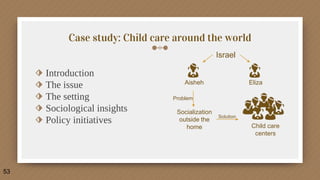
Case study: Child care around the world
⬗ Introduction
⬗ The issue
⬗ The setting
⬗ Sociological insights
⬗ Policy initiatives
53
Israel
Aisheh Eliza
Child care
centers
Socialization
outside the
home
Problem
Solution
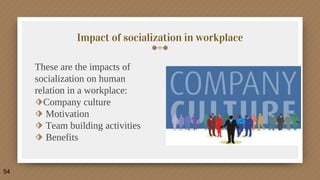
Impact of socialization in workplace
These are the impacts of
socialization on human
relation in a workplace:
⬗Company culture
⬗ Motivation
⬗ Team building activities
⬗ Benefits
54
Let’s review some concepts
Role of Socialization
How socialization affects the
persons? It is explained through
experiments of different
sociologists.
The Self and Socialization
What we are? How we interact with
others? The concept of self was
explained by three different
sociologists with proper stages.
Agents of Socialization
Who are involved in the circle of
socialization? From which we
learn about how to interact with
others.
55
Socialization throughout
the life course
How we socialize in whole life
from younger to older? And kinds
of socialization.
Social policy
Case study about child care around
the world that we can socialize
children in an outside world.
Impact of socialization
on workplace
It affects the organization human
relations.and it have somebenefits
and drawbacks in the workplace.
56
Thanks!
Any questions?

Socialization and the life course

  • 1.
  • 2.
    Hello! Maryam Mehboob Student ofpunjab university gujranwala campus From IBA department 2
  • 3.
  • 4.
    “I think whenyou are younger, you need to socialize and be with people your own age. 4
  • 5.
  • 6.
    Table of contents 6 ⬗Socialization ⬗ Role of socialization ⬗ The self and socialization ⬗ Agents of socialization ⬗ Socialization across the life course ⬗ Social policy and socialization
  • 7.
    Socialization Process by whichindividuals acquire the knowledge, language, social skills and values to conform to the norms and roles required for integration into a society . Example: A baby learns language, norms and values to survive in his society as he grows up. 7
  • 8.
    Organizational Socialization The processthrough which a new employee “learns the ropes” by becoming sensitive to the explicit and implicit norms and rules of behavior. Example: training provided to the new employees 8
  • 9.
    1. Role of socialization Let’sstart with contents of it.
  • 10.
    Role of socialization ⬗Environment: The impact of isolation Isabelle and genie: two cases Primate studies ⬗ The Influence of Heredity Studies of Identical Twins 10
  • 11.
    Role of socialization ⬗Socialization:Lifelong process in which people learn appropriate attitudes, values, and behaviors ⬗Nature vs. nurture 11
  • 12.
    Social Environment: Theimpact of Isolation ⬗Early socialization experiences in normal environments are important. ⬗ Caregivers should be concerned with children social needs in addition their physical needs. 12
  • 13.
    Isabelle and genie:two cases ⬗Importance of earliest socialization experiences for children ⬗Sociologists developed a systematic training program to help Isabelle adapt to human relationships and socialization 13
  • 14.
    Primate studies ⬗Harry Harlowconducted tests with rhesus monkeys that had been raised away from their mothers and away from the contact with other monkeys. ⬗Harlow showed isolation had damaging effect on monkeys 14
  • 15.
    The influence ofHeredity Studies of Identical Twins ⬗ Intelligence tests show similar scores when twins are reared apart in roughly similar social settings. ⬗ Intelligence tests show quite different scores when twins are reared apart in dramatically different social settings. 15
  • 16.
    2. The Self& Socialization 16
  • 17.
    What is self? ⬗GeorgeHerbert mead, sociologist recognize the concept of self. ⬗Self is a distinct identity that sets us apart from others. It is not a static phenomenon it continues to develop and changes throughout lives. ⬗There are two approaches of self:  Sociological approach  Psychological approach 17
  • 18.
    Sociological approach toself ⬗There are four sociological approaches of self which are:  Cooley: Looking-Glass Self  Mead: The Stages of Self  Mead: the theory of self  Goffman: presentation of the self 18
  • 19.
    1. Cooley: Looking-glass self ⬗In early 1900’s, Charles Horton Cooley advanced the belief that we learn who we are by interacting with other’s a phenomenon he called the “looking-glass self”. ⬗Self identity or self concept 19
  • 20.
    2. Mead: Thestages of self ⬗ George Herbert Mead developed a useful model of the process by which the self emerges, through three different stages: 1. Preparatory stage 2. Play stage 3. Game stage 20
  • 21.
    The preparatory stage ⬗Childrenimitate the people around them, especially family members with whom they continually interact. ⬗As they grow older, children become more adept at using symbols 21
  • 22.
    The play stage ⬗Children develop skill in communicating through symbols and role taking occurs ⬗Role taking: Process of mentally assuming perspective of another and responding from that imagined viewpoint. 22
  • 23.
    The game stage ⬗Childrenof about 8 or 9 consider several actual tasks and relationships simultaneously ⬗Mead used the game of baseball as an example of this stage 23
  • 24.
    3. Mead: theoryof self ⬗Self begins as privileged, central position in a person’s world ⬗As the person matures, the self changes and begins to reflect greater concern about reactions of others 24
  • 25.
    4. Goffman: presentationof the self ⬗Erving Goffman has shown that in many of our daily activities, we try to convey distinct impressions of who we are, a process called “impression management. ⬗Dramaturgical approach 25
  • 26.
    Psychological approaches tothe self ⬗Psychologists have also shared interest in the development of the self. ⬗ -These psychologists include Sigmund Freud and Jean Piaget. 26
  • 27.
    Sigmund Freud ⬗Self isa social product ⬗Personality influenced by others (especially one’s parents) ⬗Self has components that work in opposition to each other 27
  • 28.
    Jean Piaget ⬗He developedthe Cognitive Theory of Development, which identified four stages in the development of the thought process: - The sensorimotor stage - The preoperational stage - The concrete operational stage - The formal operational stage 28
  • 29.
    3. Agents of socialization Let’sstart with the agencies of socialization.
  • 30.
    Agents of Socialization ⬗People and group that influence our self concept, emotions, attitude, and behavior. 30
  • 31.
    Agents of Socialization ⬗Family ⬗ School ⬗ Peer Group ⬗ Mass Media ⬗ Work Place ⬗ Religion 31
  • 32.
    1. Family ⬗The lifelong process of learning begins shortly after birth. The socialization that we receive in childhood has a lasting effect on our ability to interact with others in society. ⬗1st exposure to socialization. 32
  • 33.
    2. School ⬗Secondary agentof socialization. ⬗A formal agency that teaches children values and customs of larger society. ⬗Organizes social relationships. 33
  • 34.
    3. Peer Group ⬗Youngpeople associates with others who are approximately their own age and intersect who often enjoys a similar social status. ⬗ Such as group of friends at school 34
  • 35.
    4. Mass media& technology ⬗53 percent of all children ages 12 to 18 have their own television ⬗Television permits imitation and role playing but does not encourage more complex forms of learning ⬗Technology is socializing families into multi-tasking as the social norms 35
  • 36.
    5. Workplace ⬗Learning tobehave appropriately within an occupational settings is a fundamental aspect of human socialization ⬗Socialization in the workplace involves four phases ⬗Career choice ⬗Conditioning ⬗Anticipatory socialization ⬗Continuous commitment 36
  • 37.
    6. Religion ⬗Religion playsa major role in socialization of most Americans ⬗70% of Americans belongs to a local congregation and 2 in every 5 Americans attend a religious service weekly. ⬗Religious especially influence morality but also ideas about dress, speech and manners that are appropriate 37
  • 38.
  • 39.
    7. State ⬗The statehas usurped many of traditional family functions ⬗The state has reinstituted many rites of passage including stipulating the ages at which we are permitted to:  Drink  Marry  Drive  Retire  Vote  Work overtime 39
  • 40.
  • 41.
  • 42.
    LIFE COURSE ⬗Socialization= continuesthroughout the life cycle ⬗Rites of passage= specific ceremonies validating changes in a person's status ⬗mark stages of development in the life course 42
  • 43.
    LIFE STAGES ⬗sociologists havemoved away from identifying specific life stages ⬗that we are all expected to pass through at sometime. ⬗ less likely to following an orderly progression ⬗ Ex: think about your grandparents vs you ⬗most difficult socialization challenges= later in life because the older we become the harder it to change 43
  • 44.
    FUNCTIONALIST APPROACH: DisengagementTheory ⬗society and the aging mutually severe relationships - work/sports/out in society ⬗Emphasizes- passing social roles from generation to another ensures stability ⬗if the elderly don't move “out of the way”/step out of society the young will never be able to move into their roles ⬗society segregates the elderly 44
  • 45.
    Symbolic Interactionist Approach:Activity Theory ⬗The elderly person who remains active/socially involved will be best adjusted ⬗Same need for social interaction as any other group ⬗Aging citizens will feel satisfied only when they can be useful/productive in society's norms -working for wages ⬗Withdrawal is harmful elderly/ society focus on contributions of elderly to the maintenance of society 45
  • 46.
    Conflict Approach ⬗goes againstthe disengagement suffers more when and activity theory they become older ⬗Age=another factor of unequal sharing of power 46
  • 47.
    Feminist Approach ⬗Aging doesnot manifest itself the same in all women. it depends on the race, class and sexual orientation of the women 47
  • 48.
    Ageism ⬗prejudice & discriminationagainst elderly ⬗uneasiness of growing age ⬗double standard men gain status, while women lose status 48
  • 49.
    Types of Socialization Thereare two Types of socialization occurs throughout the life course: 1. Anticipatory socialization: First time, you are introduce to a new culture/ setoff norms, usually takes place in your younger years (school years)  rehearse for future positions  helps everything runs smoothly 2. Resocialization (opposite to anticipatory socialization) Must unlearn former behaviour, this can occur if you assume new social/ occupational positions or move to another region 49
  • 50.
    Total Institutions ⬗Perfect exampleof resocialization ⬗refers to institutions that regulate all aspects of a person's life under a single authority ⬗provide for all the needs/cut off from society ⬗miniature society 50
  • 51.
    Goffman's four commontraits of institutions ⬗All aspects of life occurs in the same place and under the control of a single person (usually the highest authority) ⬗Any activities held within the institution are conducted in the company of those at the same level/ circumstances. Grouped with those at the same resocialization level ⬗The authorities make all the rules and schedule the activities without asking the group (participants) ⬗All aspects of life are designed to achieve the mission statement of the total institution Ex prison 51
  • 52.
    5. Social policy andsocialization Let’s start with the case study about child care around the world
  • 53.
    Case study: Childcare around the world ⬗ Introduction ⬗ The issue ⬗ The setting ⬗ Sociological insights ⬗ Policy initiatives 53 Israel Aisheh Eliza Child care centers Socialization outside the home Problem Solution
  • 54.
    Impact of socializationin workplace These are the impacts of socialization on human relation in a workplace: ⬗Company culture ⬗ Motivation ⬗ Team building activities ⬗ Benefits 54
  • 55.
    Let’s review someconcepts Role of Socialization How socialization affects the persons? It is explained through experiments of different sociologists. The Self and Socialization What we are? How we interact with others? The concept of self was explained by three different sociologists with proper stages. Agents of Socialization Who are involved in the circle of socialization? From which we learn about how to interact with others. 55 Socialization throughout the life course How we socialize in whole life from younger to older? And kinds of socialization. Social policy Case study about child care around the world that we can socialize children in an outside world. Impact of socialization on workplace It affects the organization human relations.and it have somebenefits and drawbacks in the workplace.
  • 56.