Society and Culture Session 2
 
Please send me by email the following  information about you: Last name, First Name Email address Course and Year  Hobbies Do you work? If so, where and how many hours a week
What are your educational goals? What do you hope to gain from this course?
Study Tips Helpful tips to improve  reading comprehension   Review study questions Read module, view power point presentations and actively searching  concepts and ideas discussed in  study questions, outline and review 3. Answer study questions 4. Take the quiz online
Sociology Sociology  is the systematic study of how people interact in social groups.
Human Interaction & Communication Exchange  Cooperation  Competition  Conflict
Social Groups Social groups  are created through  interaction  and serve specific  functions  in society and for individuals.  Within  social groups  we each have a certain  role  to play based on our  status  within the group.  Social groups  are the “building blocks” of society and provide structure and organization.
Sociology Sociology  can help us to better understand  social problems .  Sociology  can help us to predict and understand  social change .
 
The Sociological Imagination
What is Sociology? Sociology  is the systematic study of the relationship between the individual and society and of the consequences of difference.
Key Components of Sociology Systematic Study  Individual  Agency  Society  The consequences of difference Social Inequality
The Sociological Imagination The Sociological Imagination  – an awareness of the relationship between an individual and the wider society.  C. Wright Mills  1916-1962
The Sociological Imagination Mills set forth his own conception  of how a social scientist should  undertake the work. He conveys a sense of what it means to be an intellectual who concentrates on the  social nature of man and who seeks  that which is significant.
First  of all, a good scholar  does not split work from life. Both are part of a seriously  accepted unity.
Second , a good scholar must  keep a file.This file is a compendium of personal, professional, and  intellectual experiences .
Third,  a good intellectual engages in continual review of thoughts and experiences.
Fourth , a good intellectual may find a truly bad book as intellectually stimulating and  conducive to thinking as a good book.
Fifth,  there must be an attitude of playfulness toward phrases, words, and ideas.  Along with  this attitude one must have a  fierce drive to make sense out  of the world.
Sixth, the imagination is stimulated  by assuming a willingness to view the world from the perspective of others.
Seventh,  one should not  be afraid ,in the preliminary stages of speculation, to think in terms of imaginative extremes.
Eighth,  one should not hesitate to  express ideas in language which is as simple and direct as one can make it.  Ideas are affected by the manner  of their expression. An imagination  which is encased in deadening language will be a deadened imagination.
Sociology and the Social Sciences Natural   science : study of physical features of nature and the ways they interact and change Social   science : study of social features of humans and the ways they interact and change Science:  body of knowledge obtained by methods based on systematic observation
Sociology and Common Sense Sociologists do not accept something as fact because “everyone knows it”  Findings are tested by researchers, analyzed in relation to other data, and evaluated with sociological theory
Auguste Comte (1798-1857)   French philosopher  Coined the term “sociology”  Argued that the  scientific method  could be used to understand social stability and social change
Harriet Martineau (1802-1876) Social critic and reformer  Analyzed working conditions in England and the US  Translated Comte’s works from French to English  Only recently recognized in the field of Sociology
The Founders of Sociology Karl Marx  Emile Durkheim  Max Weber
Karl Marx (1818-1883) Alienation  Exploitation  Social Class  Bourgeoisie  Proletariat  Capitalism
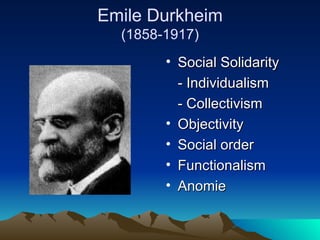
Emile Durkheim (1858-1917) Social Solidarity  - Individualism  - Collectivism  Objectivity  Social order  Functionalism  Anomie
Max Weber (1864-1920)   Social organization and institutions  - Societies  - Governments  - Bureaucracies
The Rise of Modern Sociology At the turn of the twentieth century there was tremendous social change occurring in the United States
Immigration  Population growth  Industrialization  Urbanization  Race riots  Labor strikes
Early American Sociologists W.E.B. DuBois  Jane Addams
W.E.B. DuBois (1868-1963)   The Social Survey  Exposed racial discrimination in Philadelphia  Social Darwinism
Jane Addams (1860-1935)   Hull House  Chicago  Worked to improve the lives of newly arrived immigrants
What Is  Sociological Theory? Theory : a set of statements  that seeks to explain problems, actions, or behavior
The Functionalist Perspective Functionalism :  a sociological approach that emphasizes the way in which the parts of a society are structured to maintain its stability.  Society includes social structures or institutions:  - family  - education  - government  - religion  - economy
The Conflict Perspective A sociological approach that assumes that social behavior is best understood in terms of tension between groups over power or the allocation of resources, including housing, money, access to services, and political representation.
The Interactionist Perspective A sociological approach that generalizes about everyday forms of social interaction in order to explain society as a whole.
To conclude: Sociologists want to know: Why people behave the way they do Why they form groups Why they go to war Why they worship, marry, vote and  all such things that happen when  people interact with one another
That: Humans  are Self aware   Social Behavior shaped by groups
Society: System of interaction: individuals, groups, institutions.  Human Beings "oriented" towards one another: Shared understandings, Meaningful  interaction  The  Social  as an "emergent reality"  :  - Peter Berger
Please stand by for the next calss

Socio

  • 1.
  • 2.
  • 3.
    Please send meby email the following information about you: Last name, First Name Email address Course and Year Hobbies Do you work? If so, where and how many hours a week
  • 4.
    What are youreducational goals? What do you hope to gain from this course?
  • 5.
    Study Tips Helpfultips to improve reading comprehension Review study questions Read module, view power point presentations and actively searching concepts and ideas discussed in study questions, outline and review 3. Answer study questions 4. Take the quiz online
  • 6.
    Sociology Sociology is the systematic study of how people interact in social groups.
  • 7.
    Human Interaction &Communication Exchange Cooperation Competition Conflict
  • 8.
    Social Groups Socialgroups are created through interaction and serve specific functions in society and for individuals. Within social groups we each have a certain role to play based on our status within the group. Social groups are the “building blocks” of society and provide structure and organization.
  • 9.
    Sociology Sociology can help us to better understand social problems . Sociology can help us to predict and understand social change .
  • 10.
  • 11.
  • 12.
    What is Sociology?Sociology is the systematic study of the relationship between the individual and society and of the consequences of difference.
  • 13.
    Key Components ofSociology Systematic Study Individual Agency Society The consequences of difference Social Inequality
  • 14.
    The Sociological ImaginationThe Sociological Imagination – an awareness of the relationship between an individual and the wider society. C. Wright Mills 1916-1962
  • 15.
    The Sociological ImaginationMills set forth his own conception of how a social scientist should undertake the work. He conveys a sense of what it means to be an intellectual who concentrates on the social nature of man and who seeks that which is significant.
  • 16.
    First ofall, a good scholar does not split work from life. Both are part of a seriously accepted unity.
  • 17.
    Second , agood scholar must keep a file.This file is a compendium of personal, professional, and intellectual experiences .
  • 18.
    Third, agood intellectual engages in continual review of thoughts and experiences.
  • 19.
    Fourth , agood intellectual may find a truly bad book as intellectually stimulating and conducive to thinking as a good book.
  • 20.
    Fifth, theremust be an attitude of playfulness toward phrases, words, and ideas. Along with this attitude one must have a fierce drive to make sense out of the world.
  • 21.
    Sixth, the imaginationis stimulated by assuming a willingness to view the world from the perspective of others.
  • 22.
    Seventh, oneshould not be afraid ,in the preliminary stages of speculation, to think in terms of imaginative extremes.
  • 23.
    Eighth, oneshould not hesitate to express ideas in language which is as simple and direct as one can make it. Ideas are affected by the manner of their expression. An imagination which is encased in deadening language will be a deadened imagination.
  • 24.
    Sociology and theSocial Sciences Natural science : study of physical features of nature and the ways they interact and change Social science : study of social features of humans and the ways they interact and change Science: body of knowledge obtained by methods based on systematic observation
  • 25.
    Sociology and CommonSense Sociologists do not accept something as fact because “everyone knows it” Findings are tested by researchers, analyzed in relation to other data, and evaluated with sociological theory
  • 26.
    Auguste Comte (1798-1857) French philosopher Coined the term “sociology” Argued that the scientific method could be used to understand social stability and social change
  • 27.
    Harriet Martineau (1802-1876)Social critic and reformer Analyzed working conditions in England and the US Translated Comte’s works from French to English Only recently recognized in the field of Sociology
  • 28.
    The Founders ofSociology Karl Marx Emile Durkheim Max Weber
  • 29.
    Karl Marx (1818-1883)Alienation Exploitation Social Class Bourgeoisie Proletariat Capitalism
  • 30.
    Emile Durkheim (1858-1917)Social Solidarity - Individualism - Collectivism Objectivity Social order Functionalism Anomie
  • 31.
    Max Weber (1864-1920) Social organization and institutions - Societies - Governments - Bureaucracies
  • 32.
    The Rise ofModern Sociology At the turn of the twentieth century there was tremendous social change occurring in the United States
  • 33.
    Immigration Populationgrowth Industrialization Urbanization Race riots Labor strikes
  • 34.
    Early American SociologistsW.E.B. DuBois Jane Addams
  • 35.
    W.E.B. DuBois (1868-1963) The Social Survey Exposed racial discrimination in Philadelphia Social Darwinism
  • 36.
    Jane Addams (1860-1935) Hull House Chicago Worked to improve the lives of newly arrived immigrants
  • 37.
    What Is Sociological Theory? Theory : a set of statements that seeks to explain problems, actions, or behavior
  • 38.
    The Functionalist PerspectiveFunctionalism : a sociological approach that emphasizes the way in which the parts of a society are structured to maintain its stability. Society includes social structures or institutions: - family - education - government - religion - economy
  • 39.
    The Conflict PerspectiveA sociological approach that assumes that social behavior is best understood in terms of tension between groups over power or the allocation of resources, including housing, money, access to services, and political representation.
  • 40.
    The Interactionist PerspectiveA sociological approach that generalizes about everyday forms of social interaction in order to explain society as a whole.
  • 41.
    To conclude: Sociologistswant to know: Why people behave the way they do Why they form groups Why they go to war Why they worship, marry, vote and all such things that happen when people interact with one another
  • 42.
    That: Humans are Self aware Social Behavior shaped by groups
  • 43.
    Society: System ofinteraction: individuals, groups, institutions. Human Beings "oriented" towards one another: Shared understandings, Meaningful interaction The Social as an "emergent reality" : - Peter Berger
  • 44.
    Please stand byfor the next calss