








Chapter 1, Part 1: The
Sociological Perspectives

 Text in red designates an important
 concept or idea, that will most likely
      reappear on some form of
assessment…I would definitely write it
                 down
The Sociological Perspective
This perspective stresses the broader social context of behavior by
looking at individuals’ social location-
• employment
• income
• education
• gender
• age
• race
by considering external influences—people’s experiences—which are
internalized and become part of a person’s thinking and motivations.

We are able to see the links between what people do and the social
settings that shape their behavior.

© 2012 Pearson
Education, Inc. All rights
reserved.
Sociology and Other Sciences
      • Science is the systematic methods used to obtain
        knowledge and the knowledge obtained by those
        methods.
      • It can be divided into the natural sciences and the
        social sciences.
      • Sociology is defined as “the scientific study of
        society and human behavior.”
      • The natural sciences attempt to
        comprehend, explain, and predict events in our
        natural environment.

© 2012 Pearson
Education, Inc. All rights
reserved.
Social Sciences
– Social sciences attempt to objectively study the social
  world.
            – Anthropology is the sister discipline of sociology that
              attempts to understand culture (a people’s total way of life) by
              focusing primarily on tribal people. This is giving way
              though, to study of groups in industrialized settings.
            – Economics analyzes the production, distribution, and
              allocation of the material goods and services of a society.
            – Political science focuses on politics or government.
            – Psychology concentrates on processes that occur within the
              individual.
            – Sociology is similar to the other social sciences in some
              ways, but it is distinct because it looks at all social
              institutions, focuses on industrialized societies, and looks at
              external factors which influence people.
© 2012 Pearson
Education, Inc. All rights
reserved.
All Sciences have certain goals…
          – The first goal is to explain why something happens.
          – The second goal is to make generalizations by looking for
            patterns, recurring characteristics, or events.
          – The third goal is to predict what will happen in the
            future, given current knowledge.
          – To achieve these goals, scientists must move beyond
            common sense and rely on conclusions based on
            systematic study.


© 2012 Pearson
Education, Inc. All rights
reserved.
EVIDENCE THAT SUPPORTS
SOCIOLOGY AS A SCIENCE.
1.It’s possible to discover the laws that
  control and shape the behaviour of
            people in society.
2. Science isn’t there to tell us why something came into
                             being.
 3. Science is there to explain how things relate to each
                      other, using laws.
4. The main task of Sociology is to discover general laws of
                       social development;
i) Laws of co-existence: looking at the relationship between
                         parts of society;
 ii) Laws of succession: what are the laws that govern social
                              change?
Origins of Sociology
– Sociology developed in the middle of the nineteenth
  century when European social observers began to use
  scientific methods to test their ideas.
– The following four factors led to its development:
           – The social upheaval in Europe as a result of the Industrial Revolution,
             which led to changes in the way people lived their lives;
           – The political revolutions in America and France, which encouraged
             people to rethink their ideas about social life;
           – The development of imperialism—as the Europeans conquered other
             nations, they came in contact with different cultures and began to ask
             why cultures varied;
           – The success of the natural sciences, which created a desire to apply
             scientific methods in order to find answers for the questions being
 © 2012      raised about the social world.
          Pearson
 Education, Inc. All rights
 reserved.
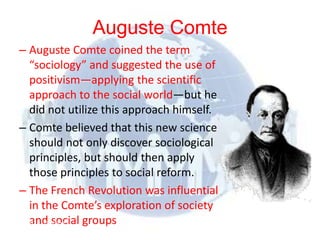
Auguste Comte
– Auguste Comte coined the term
   “sociology” and suggested the use of
   positivism—applying the scientific
   approach to the social world—but he
   did not utilize this approach himself.
– Comte believed that this new science
   should not only discover sociological
   principles, but should then apply
   those principles to social reform.
– The French Revolution was influential
   in the Comte’s exploration of society
   and social groups
© 2012 Pearson
Education, Inc. All rights
reserved.
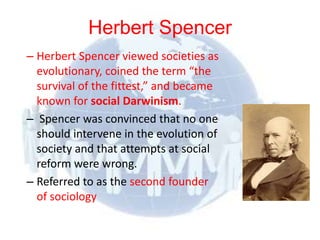
Herbert Spencer
  – Herbert Spencer viewed societies as
    evolutionary, coined the term “the
    survival of the fittest,” and became
    known for social Darwinism.
  – Spencer was convinced that no one
    should intervene in the evolution of
    society and that attempts at social
    reform were wrong.
  – Referred to as the second founder
    of sociology
© 2012 Pearson
Education, Inc. All rights
reserved.
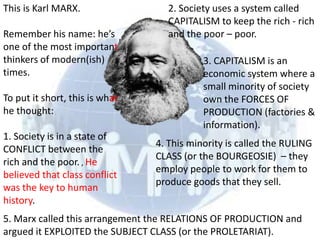
This is Karl MARX.                2. Society uses a system called
                                  CAPITALISM to keep the rich - rich
Remember his name: he’s           and the poor – poor.
one of the most important
thinkers of modern(ish)                    3. CAPITALISM is an
times.                                     economic system where a
                                           small minority of society
To put it short, this is what              own the FORCES OF
he thought:                                PRODUCTION (factories &
                                           information).
1. Society is in a state of
                                4. This minority is called the RULING
CONFLICT between the
                                CLASS (or the BOURGEOSIE) – they
rich and the poor. , He
                                employ people to work for them to
believed that class conflict
                                produce goods that they sell.
was the key to human
history.
5. Marx called this arrangement the RELATIONS OF PRODUCTION and
argued it EXPLOITED the SUBJECT CLASS (or the PROLETARIAT).
Karl Marx
  – Marx believed that the conflict and
    struggle would end only with a
    revolution by the working class.


© 2012 Pearson
Education, Inc. All rights
reserved.
Dennis the peasant


© 2012 How does this illustrate class conflict? Who are the bourgeoisie and
         Pearson
Education, Inc. All rights   who are the proletariat?
reserved.
Partying with MARXISM.
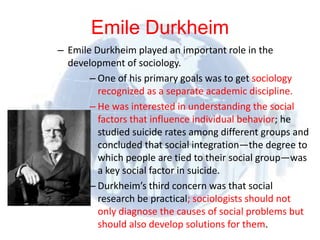
Emile Durkheim
              – Emile Durkheim played an important role in the
                   development of sociology.
                           – One of his primary goals was to get sociology
                             recognized as a separate academic discipline.
                           – He was interested in understanding the social
                             factors that influence individual behavior; he
                             studied suicide rates among different groups and
                             concluded that social integration—the degree to
                             which people are tied to their social group—was
                             a key social factor in suicide.
                           – Durkheim’s third concern was that social
                             research be practical; sociologists should not
                             only diagnose the causes of social problems but
© 2012 Pearson
Education, Inc. All rights
                             should also develop solutions for them.
reserved.
How American’s Commit Suicide


© 2012 Pearson
Education, Inc. All rights
reserved.
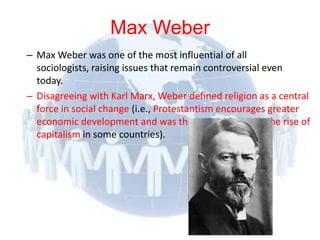
Max Weber
  – Max Weber was one of the most influential of all
    sociologists, raising issues that remain controversial even
    today.
  – Disagreeing with Karl Marx, Weber defined religion as a central
    force in social change (i.e., Protestantism encourages greater
    economic development and was the central factor in the rise of
    capitalism in some countries).


© 2012 Pearson
Education, Inc. All rights
reserved.
The Protestant System
– The Protestant belief system encouraged its
  members to embrace change.
– Protestants sought “signs” that they were in God’s
  will; financial success became a major sign. The
  more money they made, the more secure they were
  about their religious standing.
– Weber called this behavior the Protestant ethic; he
  called their readiness to invest capital in order to
  make more money the spirit of capitalism.
Values in Sociological Research
 – Weber advocated that sociological research
   should be value free (personal values or biases
   should not influence social research) and
   objective (totally neutral).
       – Sociologists agree that objectivity is a proper goal, but
         acknowledge that no one can escape values entirely.
       – Replication is when a study is repeated to see if the same
         results are found. It is one means to avoid the distortions that
         values can cause.

The Sociological Perspective part 1

  • 1.
    Chapter 1, Part1: The Sociological Perspectives Text in red designates an important concept or idea, that will most likely reappear on some form of assessment…I would definitely write it down
  • 2.
    The Sociological Perspective Thisperspective stresses the broader social context of behavior by looking at individuals’ social location- • employment • income • education • gender • age • race by considering external influences—people’s experiences—which are internalized and become part of a person’s thinking and motivations. We are able to see the links between what people do and the social settings that shape their behavior. © 2012 Pearson Education, Inc. All rights reserved.
  • 3.
    Sociology and OtherSciences • Science is the systematic methods used to obtain knowledge and the knowledge obtained by those methods. • It can be divided into the natural sciences and the social sciences. • Sociology is defined as “the scientific study of society and human behavior.” • The natural sciences attempt to comprehend, explain, and predict events in our natural environment. © 2012 Pearson Education, Inc. All rights reserved.
  • 4.
    Social Sciences – Socialsciences attempt to objectively study the social world. – Anthropology is the sister discipline of sociology that attempts to understand culture (a people’s total way of life) by focusing primarily on tribal people. This is giving way though, to study of groups in industrialized settings. – Economics analyzes the production, distribution, and allocation of the material goods and services of a society. – Political science focuses on politics or government. – Psychology concentrates on processes that occur within the individual. – Sociology is similar to the other social sciences in some ways, but it is distinct because it looks at all social institutions, focuses on industrialized societies, and looks at external factors which influence people. © 2012 Pearson Education, Inc. All rights reserved.
  • 5.
    All Sciences havecertain goals… – The first goal is to explain why something happens. – The second goal is to make generalizations by looking for patterns, recurring characteristics, or events. – The third goal is to predict what will happen in the future, given current knowledge. – To achieve these goals, scientists must move beyond common sense and rely on conclusions based on systematic study. © 2012 Pearson Education, Inc. All rights reserved.
  • 7.
  • 8.
    1.It’s possible todiscover the laws that control and shape the behaviour of people in society.
  • 9.
    2. Science isn’tthere to tell us why something came into being. 3. Science is there to explain how things relate to each other, using laws.
  • 10.
    4. The maintask of Sociology is to discover general laws of social development; i) Laws of co-existence: looking at the relationship between parts of society; ii) Laws of succession: what are the laws that govern social change?
  • 11.
    Origins of Sociology –Sociology developed in the middle of the nineteenth century when European social observers began to use scientific methods to test their ideas. – The following four factors led to its development: – The social upheaval in Europe as a result of the Industrial Revolution, which led to changes in the way people lived their lives; – The political revolutions in America and France, which encouraged people to rethink their ideas about social life; – The development of imperialism—as the Europeans conquered other nations, they came in contact with different cultures and began to ask why cultures varied; – The success of the natural sciences, which created a desire to apply scientific methods in order to find answers for the questions being © 2012 raised about the social world. Pearson Education, Inc. All rights reserved.
  • 12.
    Auguste Comte – AugusteComte coined the term “sociology” and suggested the use of positivism—applying the scientific approach to the social world—but he did not utilize this approach himself. – Comte believed that this new science should not only discover sociological principles, but should then apply those principles to social reform. – The French Revolution was influential in the Comte’s exploration of society and social groups © 2012 Pearson Education, Inc. All rights reserved.
  • 13.
    Herbert Spencer – Herbert Spencer viewed societies as evolutionary, coined the term “the survival of the fittest,” and became known for social Darwinism. – Spencer was convinced that no one should intervene in the evolution of society and that attempts at social reform were wrong. – Referred to as the second founder of sociology © 2012 Pearson Education, Inc. All rights reserved.
  • 14.
    This is KarlMARX. 2. Society uses a system called CAPITALISM to keep the rich - rich Remember his name: he’s and the poor – poor. one of the most important thinkers of modern(ish) 3. CAPITALISM is an times. economic system where a small minority of society To put it short, this is what own the FORCES OF he thought: PRODUCTION (factories & information). 1. Society is in a state of 4. This minority is called the RULING CONFLICT between the CLASS (or the BOURGEOSIE) – they rich and the poor. , He employ people to work for them to believed that class conflict produce goods that they sell. was the key to human history. 5. Marx called this arrangement the RELATIONS OF PRODUCTION and argued it EXPLOITED the SUBJECT CLASS (or the PROLETARIAT).
  • 15.
    Karl Marx – Marx believed that the conflict and struggle would end only with a revolution by the working class. © 2012 Pearson Education, Inc. All rights reserved.
  • 16.
    Dennis the peasant ©2012 How does this illustrate class conflict? Who are the bourgeoisie and Pearson Education, Inc. All rights who are the proletariat? reserved.
  • 18.
  • 19.
    Emile Durkheim – Emile Durkheim played an important role in the development of sociology. – One of his primary goals was to get sociology recognized as a separate academic discipline. – He was interested in understanding the social factors that influence individual behavior; he studied suicide rates among different groups and concluded that social integration—the degree to which people are tied to their social group—was a key social factor in suicide. – Durkheim’s third concern was that social research be practical; sociologists should not only diagnose the causes of social problems but © 2012 Pearson Education, Inc. All rights should also develop solutions for them. reserved.
  • 20.
    How American’s CommitSuicide © 2012 Pearson Education, Inc. All rights reserved.
  • 21.
    Max Weber – Max Weber was one of the most influential of all sociologists, raising issues that remain controversial even today. – Disagreeing with Karl Marx, Weber defined religion as a central force in social change (i.e., Protestantism encourages greater economic development and was the central factor in the rise of capitalism in some countries). © 2012 Pearson Education, Inc. All rights reserved.
  • 22.
    The Protestant System –The Protestant belief system encouraged its members to embrace change. – Protestants sought “signs” that they were in God’s will; financial success became a major sign. The more money they made, the more secure they were about their religious standing. – Weber called this behavior the Protestant ethic; he called their readiness to invest capital in order to make more money the spirit of capitalism.
  • 23.
    Values in SociologicalResearch – Weber advocated that sociological research should be value free (personal values or biases should not influence social research) and objective (totally neutral). – Sociologists agree that objectivity is a proper goal, but acknowledge that no one can escape values entirely. – Replication is when a study is repeated to see if the same results are found. It is one means to avoid the distortions that values can cause.