

10/4/2013Internet Marketing and E-Commerce
Some definitions/terminology
10/4/2013Internet Marketing and E-Commerce
 Brick-and-Mortar company
 Mouse-and-click company
 Dot-com Bubble (2000) – Bust (2001)
 Advertising Online
 Any online paid activity showing/displaying a profit/non-profit making
company/firm/organization’s name/logo.
 Search Engine Marketing
 The act of marketing a website via search engines, whether through
improving rank in listing, purchasing paid listing, or a combination of both.
 Advergame
 A combination of online advertising and gaming, where the user sees the
products and services in the game itself.
 Affiliate program
 A link to an e-tailor’s website, put in by firms to make a commission on all
purchases by referred customers.
Some definitions/terminology
10/4/2013Internet Marketing and E-Commerce
 AIDA Model
 Behavioral Targeting
 Occurs when software tracks a users’ movement through a website
and then sends appropriate web content at a moment’s notice.
 Content filtering
 A process by which user may block unwanted materials.
 Cyber squatting
 A type of trademark violation that involves the registration of
domains that resemble or duplicate the names of existing
corporations or other entities.
 Dis-intermediation
 The process of eliminating traditional intermediaries.
 GPRS
 General packet radio services
Some definitions/terminology
10/4/2013Internet Marketing and E-Commerce
 Interstitial Ad
 Advertisement that appear while the publishers’ content is loading.
 iPOS terminals
 Small customer-facing machines near the brick-and-mortar cash
register, used to record a buyer’s signature for a credit card
transaction.
 Permission Marketing
 When users voluntarily agree to receive commercial e-mail about
topics that might be interested to them.
 Pareto Principle
 80-20 principle
 RFID
 Radio frequency identification
 Spoofing
 Phishing activities
Some definitions/terminology
10/4/2013Internet Marketing and E-Commerce
 User Generated Content
 Online reviews, consumer rating, post/comments on
company wall, online forum/complaint by consumers
 Online Aggregators
 Flipcart, Amazon, eBay, etc.
 Advergame
 A combination of online advertising and gaming, where the
user sees the products and services in the game itself.
 Affiliate program
 A link to an e-tailor’s website, put in by firms to make a
commission on all purchases by referred customers.
E-Marketing’s Past: Web 1.0
 The Internet started in 1969 as the ARPANET, a network for
academic and military use.
 Web pages and browsers appeared in 1993.
 Only at organizational level.
 One way communication.
 The first generation of e-business was like a gold rush.
 Between 2000 and 2002, more than 500 Internet firms shut
down in the U.S. (dot-com bust)
 By Q4 2003, almost 60% of public dot-coms were
profitable.
10/4/2013Internet Marketing and E-Commerce
E-Marketing Today: Web 2.0
 Web 2.0 technologies connect people with each
other through social media, which have created
opportunities and challenges for marketers.
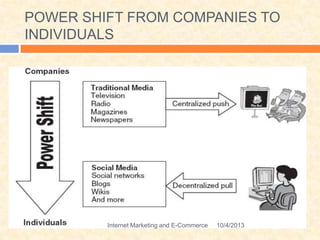
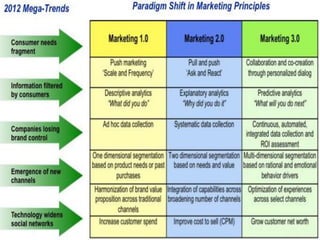
 Power shift from sellers to buyers.
 Consumers trust each other more than
companies.
 Market and media fragmentation.
 Online connections are critical
10/4/2013Internet Marketing and E-Commerce
POWER SHIFT FROM COMPANIES TO
INDIVIDUALS
10/4/2013Internet Marketing and E-Commerce
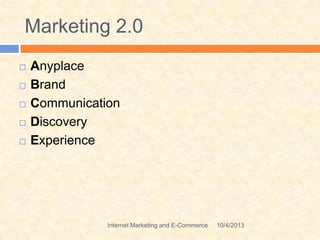
Marketing 2.0
10/4/2013Internet Marketing and E-Commerce
 Anyplace
 Brand
 Communication
 Discovery
 Experience
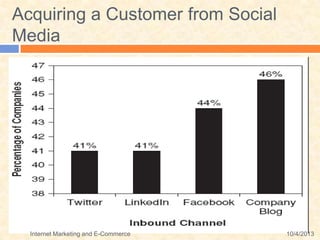
Acquiring a Customer from Social
Media
10/4/2013Internet Marketing and E-Commerce
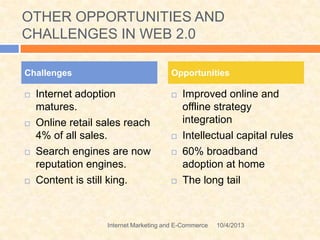
OTHER OPPORTUNITIES AND
CHALLENGES IN WEB 2.0
 Internet adoption
matures.
 Online retail sales reach
4% of all sales.
 Search engines are now
reputation engines.
 Content is still king.
 Improved online and
offline strategy
integration
 Intellectual capital rules
 60% broadband
adoption at home
 The long tail
Challenges Opportunities
10/4/2013Internet Marketing and E-Commerce
The Future: Web 3.0
 Lines between traditional and new media are blurring.
 Appliances are converging and becoming “smart.”
 Wireless networking is increasing.
 Semantic web will provide worldwide access to data on
demand without effort.
10/4/2013Internet Marketing and E-Commerce
How do experts characterize Web
3.0?
 Semantic web will be achieved and the mobile
device will be the primary Internet connection
tool by 2020 (Pew study).
 Interactive media will cannibalize traditional
media (Forrester Research).
 Web 3.0 will ultimately be seen as applications
which are pieced together…run on any
device…are very fast…are distributed virtually
(Eric Schmidt of Google).
10/4/2013
Internet Marketing and E-Commerce
QUESTIONS?
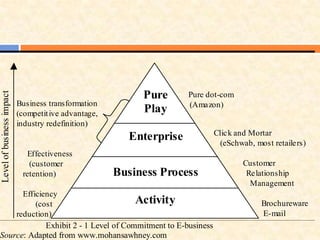
Pure
Play
Enterprise
Business Process
Activity
Pure dot-com
(Amazon)
Click and Mortar
(eSchwab, most retailers)
Customer
Relationship
Management
Brochureware
E-mail
Levelofbusinessimpact
Business transformation
(competitive advantage,
industry redefinition)
Effectiveness
(customer
retention)
Efficiency
(cost
reduction)
Exhibit 2 - 1 Level of Commitment to E-business
Source: Adapted from www.mohansawhney.com

Chapter 1 introduction and basic definitions

  • 1.
  • 2.
    Some definitions/terminology 10/4/2013Internet Marketingand E-Commerce  Brick-and-Mortar company  Mouse-and-click company  Dot-com Bubble (2000) – Bust (2001)  Advertising Online  Any online paid activity showing/displaying a profit/non-profit making company/firm/organization’s name/logo.  Search Engine Marketing  The act of marketing a website via search engines, whether through improving rank in listing, purchasing paid listing, or a combination of both.  Advergame  A combination of online advertising and gaming, where the user sees the products and services in the game itself.  Affiliate program  A link to an e-tailor’s website, put in by firms to make a commission on all purchases by referred customers.
  • 3.
    Some definitions/terminology 10/4/2013Internet Marketingand E-Commerce  AIDA Model  Behavioral Targeting  Occurs when software tracks a users’ movement through a website and then sends appropriate web content at a moment’s notice.  Content filtering  A process by which user may block unwanted materials.  Cyber squatting  A type of trademark violation that involves the registration of domains that resemble or duplicate the names of existing corporations or other entities.  Dis-intermediation  The process of eliminating traditional intermediaries.  GPRS  General packet radio services
  • 4.
    Some definitions/terminology 10/4/2013Internet Marketingand E-Commerce  Interstitial Ad  Advertisement that appear while the publishers’ content is loading.  iPOS terminals  Small customer-facing machines near the brick-and-mortar cash register, used to record a buyer’s signature for a credit card transaction.  Permission Marketing  When users voluntarily agree to receive commercial e-mail about topics that might be interested to them.  Pareto Principle  80-20 principle  RFID  Radio frequency identification  Spoofing  Phishing activities
  • 5.
    Some definitions/terminology 10/4/2013Internet Marketingand E-Commerce  User Generated Content  Online reviews, consumer rating, post/comments on company wall, online forum/complaint by consumers  Online Aggregators  Flipcart, Amazon, eBay, etc.  Advergame  A combination of online advertising and gaming, where the user sees the products and services in the game itself.  Affiliate program  A link to an e-tailor’s website, put in by firms to make a commission on all purchases by referred customers.
  • 6.
    E-Marketing’s Past: Web1.0  The Internet started in 1969 as the ARPANET, a network for academic and military use.  Web pages and browsers appeared in 1993.  Only at organizational level.  One way communication.  The first generation of e-business was like a gold rush.  Between 2000 and 2002, more than 500 Internet firms shut down in the U.S. (dot-com bust)  By Q4 2003, almost 60% of public dot-coms were profitable. 10/4/2013Internet Marketing and E-Commerce
  • 7.
    E-Marketing Today: Web2.0  Web 2.0 technologies connect people with each other through social media, which have created opportunities and challenges for marketers.  Power shift from sellers to buyers.  Consumers trust each other more than companies.  Market and media fragmentation.  Online connections are critical 10/4/2013Internet Marketing and E-Commerce
  • 8.
    POWER SHIFT FROMCOMPANIES TO INDIVIDUALS 10/4/2013Internet Marketing and E-Commerce
  • 9.
    Marketing 2.0 10/4/2013Internet Marketingand E-Commerce  Anyplace  Brand  Communication  Discovery  Experience
  • 10.
    Acquiring a Customerfrom Social Media 10/4/2013Internet Marketing and E-Commerce
  • 11.
    OTHER OPPORTUNITIES AND CHALLENGESIN WEB 2.0  Internet adoption matures.  Online retail sales reach 4% of all sales.  Search engines are now reputation engines.  Content is still king.  Improved online and offline strategy integration  Intellectual capital rules  60% broadband adoption at home  The long tail Challenges Opportunities 10/4/2013Internet Marketing and E-Commerce
  • 12.
    The Future: Web3.0  Lines between traditional and new media are blurring.  Appliances are converging and becoming “smart.”  Wireless networking is increasing.  Semantic web will provide worldwide access to data on demand without effort. 10/4/2013Internet Marketing and E-Commerce
  • 13.
    10/4/2013Internet Marketing andE-Commerce How do experts characterize Web 3.0?  Semantic web will be achieved and the mobile device will be the primary Internet connection tool by 2020 (Pew study).  Interactive media will cannibalize traditional media (Forrester Research).  Web 3.0 will ultimately be seen as applications which are pieced together…run on any device…are very fast…are distributed virtually (Eric Schmidt of Google).
  • 14.
  • 15.
  • 16.
    Pure Play Enterprise Business Process Activity Pure dot-com (Amazon) Clickand Mortar (eSchwab, most retailers) Customer Relationship Management Brochureware E-mail Levelofbusinessimpact Business transformation (competitive advantage, industry redefinition) Effectiveness (customer retention) Efficiency (cost reduction) Exhibit 2 - 1 Level of Commitment to E-business Source: Adapted from www.mohansawhney.com