E-Marketing 4/E Judy Strauss, Adel I. El-Ansary, and Raymond Frost Chapter 4: Global Markets
Chapter 4 Objectives After reading Chapter 4 you will be able to: Discuss overall trends in in Internet access, usage, and purchasing around the world.  Define emerging economies and explain the vital role of information technology in economic development. Outline how e-marketers apply market similarity and analyze online purchase and payment behaviors in planning market entry opportunities.
Chapter 4 Objectives, cont. Describe how e-marketing strategy is influenced by computer and telephone access, credit card availability, attitudes toward Internet use, slow connection speeds, Web site design, and electricity problems. Review the special challenges of e-marketing on the wireless Internet in the context of emerging economies. Discuss the controversy related to the Digital Divide.
The FIFA Story Federation Int érnationalé de Football Association (FIFA) partnered with Yahoo to create the most popular sports site in history. FIFAworldcup.com was seen by 3.7 million people from 17 countries May 1-June 23, 2002. Site offered continual updates of information, photos and video highlights. Do you think FIFA’s subscription model ($4.95-$19.95) for video access would work for U.S. sports events? Which ones?
Worldwide Internet Usage Ex. 4.1 shows that there were over 785 million Internet users worldwide. Worldwide usage more than doubled from 2000-2004. Asia, with 243 million users, has the highest number of users. North America has the highest penetration of users, almost 70%.
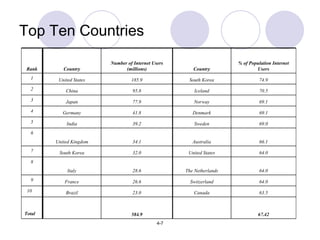
Internet Use Varies by Country The world’s largest online markets are the U.S. (186 million users) and China (96 million users). The top 10 countries account for 62.4% of all global users. Some smaller countries, such as South Korea and Iceland have the highest penetration, over 70% of their populations.
Top Ten Countries 67.42 584.9 Total 63.5 Canada 23.0 Brazil 10 64.0 Switzerland 26.6 France 9 64.0 The Netherlands 28.6 Italy 8 64.0 United States 32.0 South Korea 7 66.1 Australia 34.1 United Kingdom 6 69.0 Sweden 39.2 India 5 69.1 Denmark 41.8 Germany 4 69.1 Norway 77.9 Japan 3 70.5 Iceland 95.8 China 2 74.9 South Korea 185.9 United States 1 % of Population Internet Users Country Number of Internet Users (millions) Country Rank
Developed Economies Developed countries are highly industrialized, use technology to increase efficiency, and have a high GDP per capita. Western European countries North American countries Japan Australia & New Zealand Developed countries are ideal for the e-marketing activities discussed in the text.
Emerging Economies Have low levels of GDP per capita and are experiencing rapid economic growth. Emerging economies can be found on every continent. China Central & Southeast Asian countries Mexico, Central & South America Baltic States & Eastern Europe African countries
Technology plays an important role. The Internet accelerates the process of economic growth through diffusion of new technologies. Bangalore, India is the center of India’s explosive growth in software and IT. Greatest obstacles to e-commerce in emerging economies include: Slow connection speeds Costs of domestic phone calls ISP costs Lack of local content and content in one’s own language
Credit Cards & E-Commerce Payments Convenience and ease of transactions are two of the Internet’s greatest benefits. Credit cards and secure online payment systems are the basis for Web-based transactions in developed countries. Marketers must analyze relevant buyer behaviors within a market. Number of credit cards in circulation. Consumer attitudes toward credit.
Technological Readiness Influences Marketing Limited access to and use of computers and telephones. High Internet connection costs. Slow Internet connections speeds. Unpredictable power supplies.
Computers & Telephones Computer access is unevenly distributed throughout the world. Exhibit 4.8 shows computer ownership data for selected countries. Many consumers in countries with emerging economies access the Internet from free-standing shops, rather than homes. Telephones (and connectivity) can be scarce and expensive.
Internet Connection Costs Dial-up is still the most common way to connect to the Internet worldwide. Broadband and mobile phone connections are developing quickly. Dial-up connection charges vary considerably in emerging economies.
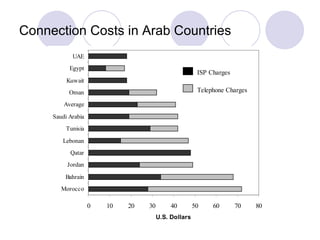
Connection Costs in Arab Countries
Connection Speed & Web Design Most Internet connections in the developing world are still dial-up. Connection speed has significant implications for Web site design. Graphics usage Sound Google’s simple, text-only format supports rapid downloads worldwide. High speed access is gaining momentum worldwide.
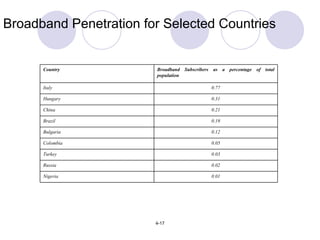
Broadband Penetration for Selected Countries 0.01 Nigeria 0.02 Russia 0.03 Turkey 0.05 Colombia 0.12 Bulgaria 0.19 Brazil 0.21 China 0.31 Hungary 0.77 Italy Broadband Subscribers as a percentage of total population Country
Other Issues Electrical problems can pose another challenge for e-marketers. Lack of electricity can force an e-business offline. Explosive diffusion of cellular telephones is changing e-marketing dramatically. Countries with emerging economies can leapfrog industrial countries in terms of usage. Short messaging service (SMS) is very popular worldwide.
The Digital Divide E-marketers must consider the social environment in which e-business operates. Disparities with regard to technology access can create a digital divide between countries or populations. The digital divide raises challenging questions for global policy, international business and entrepreneurship.

E Marketing Ch4 Global Markets

  • 1.
    E-Marketing 4/E JudyStrauss, Adel I. El-Ansary, and Raymond Frost Chapter 4: Global Markets
  • 2.
    Chapter 4 ObjectivesAfter reading Chapter 4 you will be able to: Discuss overall trends in in Internet access, usage, and purchasing around the world. Define emerging economies and explain the vital role of information technology in economic development. Outline how e-marketers apply market similarity and analyze online purchase and payment behaviors in planning market entry opportunities.
  • 3.
    Chapter 4 Objectives,cont. Describe how e-marketing strategy is influenced by computer and telephone access, credit card availability, attitudes toward Internet use, slow connection speeds, Web site design, and electricity problems. Review the special challenges of e-marketing on the wireless Internet in the context of emerging economies. Discuss the controversy related to the Digital Divide.
  • 4.
    The FIFA StoryFederation Int érnationalé de Football Association (FIFA) partnered with Yahoo to create the most popular sports site in history. FIFAworldcup.com was seen by 3.7 million people from 17 countries May 1-June 23, 2002. Site offered continual updates of information, photos and video highlights. Do you think FIFA’s subscription model ($4.95-$19.95) for video access would work for U.S. sports events? Which ones?
  • 5.
    Worldwide Internet UsageEx. 4.1 shows that there were over 785 million Internet users worldwide. Worldwide usage more than doubled from 2000-2004. Asia, with 243 million users, has the highest number of users. North America has the highest penetration of users, almost 70%.
  • 6.
    Internet Use Variesby Country The world’s largest online markets are the U.S. (186 million users) and China (96 million users). The top 10 countries account for 62.4% of all global users. Some smaller countries, such as South Korea and Iceland have the highest penetration, over 70% of their populations.
  • 7.
    Top Ten Countries67.42 584.9 Total 63.5 Canada 23.0 Brazil 10 64.0 Switzerland 26.6 France 9 64.0 The Netherlands 28.6 Italy 8 64.0 United States 32.0 South Korea 7 66.1 Australia 34.1 United Kingdom 6 69.0 Sweden 39.2 India 5 69.1 Denmark 41.8 Germany 4 69.1 Norway 77.9 Japan 3 70.5 Iceland 95.8 China 2 74.9 South Korea 185.9 United States 1 % of Population Internet Users Country Number of Internet Users (millions) Country Rank
  • 8.
    Developed Economies Developedcountries are highly industrialized, use technology to increase efficiency, and have a high GDP per capita. Western European countries North American countries Japan Australia & New Zealand Developed countries are ideal for the e-marketing activities discussed in the text.
  • 9.
    Emerging Economies Havelow levels of GDP per capita and are experiencing rapid economic growth. Emerging economies can be found on every continent. China Central & Southeast Asian countries Mexico, Central & South America Baltic States & Eastern Europe African countries
  • 10.
    Technology plays animportant role. The Internet accelerates the process of economic growth through diffusion of new technologies. Bangalore, India is the center of India’s explosive growth in software and IT. Greatest obstacles to e-commerce in emerging economies include: Slow connection speeds Costs of domestic phone calls ISP costs Lack of local content and content in one’s own language
  • 11.
    Credit Cards &E-Commerce Payments Convenience and ease of transactions are two of the Internet’s greatest benefits. Credit cards and secure online payment systems are the basis for Web-based transactions in developed countries. Marketers must analyze relevant buyer behaviors within a market. Number of credit cards in circulation. Consumer attitudes toward credit.
  • 12.
    Technological Readiness InfluencesMarketing Limited access to and use of computers and telephones. High Internet connection costs. Slow Internet connections speeds. Unpredictable power supplies.
  • 13.
    Computers & TelephonesComputer access is unevenly distributed throughout the world. Exhibit 4.8 shows computer ownership data for selected countries. Many consumers in countries with emerging economies access the Internet from free-standing shops, rather than homes. Telephones (and connectivity) can be scarce and expensive.
  • 14.
    Internet Connection CostsDial-up is still the most common way to connect to the Internet worldwide. Broadband and mobile phone connections are developing quickly. Dial-up connection charges vary considerably in emerging economies.
  • 15.
    Connection Costs inArab Countries
  • 16.
    Connection Speed &Web Design Most Internet connections in the developing world are still dial-up. Connection speed has significant implications for Web site design. Graphics usage Sound Google’s simple, text-only format supports rapid downloads worldwide. High speed access is gaining momentum worldwide.
  • 17.
    Broadband Penetration forSelected Countries 0.01 Nigeria 0.02 Russia 0.03 Turkey 0.05 Colombia 0.12 Bulgaria 0.19 Brazil 0.21 China 0.31 Hungary 0.77 Italy Broadband Subscribers as a percentage of total population Country
  • 18.
    Other Issues Electricalproblems can pose another challenge for e-marketers. Lack of electricity can force an e-business offline. Explosive diffusion of cellular telephones is changing e-marketing dramatically. Countries with emerging economies can leapfrog industrial countries in terms of usage. Short messaging service (SMS) is very popular worldwide.
  • 19.
    The Digital DivideE-marketers must consider the social environment in which e-business operates. Disparities with regard to technology access can create a digital divide between countries or populations. The digital divide raises challenging questions for global policy, international business and entrepreneurship.