
E-MARKETING, 6TH
EDITION
JUDY STRAUSS AND RAYMOND FROST
Chapter 10 - Price - The Online Value
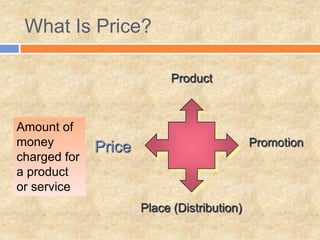
What Is Price?
Promotion
Place (Distribution)
Price
Product
Amount of
money
charged for
a product
or service
The VideoEgg Story
 The video and rich media advertising company was founded in
2004 by 3 Yale graduate students.
 VideoEgg delivers ads to social networking sites, video sites,
and gaming applications.
 VideoEgg created AdFrames, which allow video viewers to roll
over and watch ad-sponsored content.
 Online advertising is bought and sold on a CPM (cost per 1,000
impressions) or pay-per-click model (PPC).
 In contrast, VideoEgg charges advertisers based on user
engagement (roll over action) with the ad.
 VideoEgg’s innovative pricing scheme is $0.75 per roll over,
which it splits 60/40% with the site owner.
 Price is the sum of all values that buyers exchange
for the benefits of a good or service.
 Throughout history, prices were negotiated; fixed
price policies are a modern idea.
 The Internet is taking us back to an era of dynamic
pricing--varying prices for individual customers.
 The internet also allows for price transparency--
both buyers and sellers can view prices online.
The Internet Changes Pricing
Strategies
Buyer & Seller Perspectives: Buyer
View
 The meaning of price depends on the viewpoint of
the buyer and the seller.
 Buyer’s costs may include money, time, energy, and
psychic costs.
 But they often enjoy many online cost savings:
 The Net is convenient and fast.
 Self-service saves time.
 One-stop shopping and integration save time.
 Automation saves energy.
 The shift in power from seller to buyer affects pricing
strategies.
 In the B2B market, buyers bid for excess inventory.
 In the B2G market, government buyers request proposals
for materials and labor.
 Buyers set prices and sellers decide whether to
accept the prices in a reverse auction.
 Buyer power online is also based on the huge
quantity of information and products available on the
Web.
 Beware of “the winner’s curse”
Buyer Control
Buyer & Seller Perspectives: Seller
View
 The seller’s perspective includes internal and
external factors.
 Internal factors include pricing objectives, marketing
mix strategy, and information technology
 Pricing objectives may be: profit oriented; market
oriented; competition oriented
 The Internet is only one sales channel and must be
used in concert with other marketing mix elements.
 Information technology can place both upward and
downward pressure on prices.
 Firms can save money by using internet technology
for internal processes.
 Self-service order processing.
 Just-in-time inventory.
 Overhead.
 Customer service.
 Printing and mailing.
 Digital product distribution.
The Internet Puts Downward Pressure
on Prices
The Internet Puts Upward Pressure on
Prices
 Online customer service is an expensive
competitive necessity.
 Distribution and shipping costs.
 Affiliate programs add commission costs.
 Site development and maintenance.
 Customer acquisition costs (CAC).
 The average CAC for early online retailing was $82.
 Market structure and market efficiency affect pricing
strategy.
 The seller’s ability to set prices varies by market
type:
 Pure competition.
 Monopolistic competition.
 Oligopolistic competition.
 Pure monopoly.
 If price transparency results in a completely efficient
market, sellers will have no control over online
prices.
External Factors Affect Online
Pricing
Efficient Markets
 A market is efficient when customers have equal
access to information about products, prices, and
distribution.
 In an efficient market, one would expect to find:
 Lower prices.
 High price elasticity.
 Frequent price changes.
 Smaller price changes.
 Narrow price dispersion between highest and lowest price
for a product.
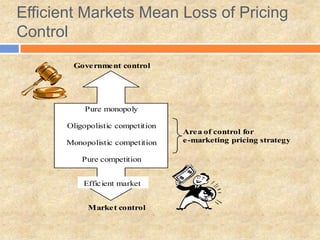
Efficient Markets Mean Loss of Pricing
Control
Pure monopoly
Oligopolistic competition
Monopolistic competition
Pure competition
Government control
Market control
Area of control for
e-marketing pricing strategy
Efficient market
 External market factors place downward pressure on
prices and contribute to efficiency.
 Shopping agents such as PriceScan.
 High price elasticity.
 Reverse auctions.
 Tax-free zones.
 Venture capital.
 Competition.
 Frequent price changes.
 Smaller price change increments.
Is the Net an Efficient Market?
 The internet does not act like an efficient
market regarding narrow price dispersion.
 In two studies, greater price spread was found
for online purchases than for offline
purchases.
 Price dispersion may occur because many
buyers do not know about or use shopping
agents.
Is the Net an Inefficient Market?
 Price dispersion may also relate to other issues:
 Brand strength.
 Online pricing.
 Delivery options.
 Time-sensitive shoppers.
 Differentiation.
 Switching costs.
 Second-generation shopping agents.
 The internet is not an efficient market.
Payment Options
 Electronic money uses the internet and computers to
exchange payments electronically.
 Other off-line e-money payment systems include:
 Smart chips.
 Payment by cell phone.
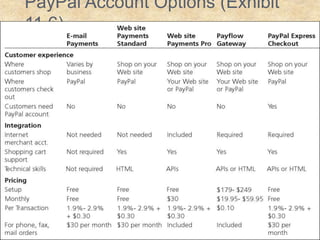
 PayPal has become the industry standard with over
84 million accounts worldwide.
PayPal Account Options (Exhibit
11.6)
 Price setting has become an art as much as a
science.
 How marketers apply pricing strategy is as important
as how much they charge.
 Marketers can employ all traditional pricing
strategies to the online environment.
Pricing Strategies
Fixed Pricing
 Fixed pricing (menu pricing) is when
everyone pays the same price.
 Two common fixed pricing strategies are:
Price leadership.
Promotional pricing.
Dynamic Pricing
 Dynamic pricing is the strategy of offering
different prices to different customers.
 Firms use dynamic pricing strategy to optimize
inventory management and to segment
customers.
 Airlines have long used dynamic pricing to price
air travel.
 There are 2 types of dynamic pricing:
 Segmented pricing.
 Negotiation.
 Pricing levels are set based on order size, timing,
demand, supply, or other factors.
 Segmented pricing is becoming more common as
firms collect more behavioral information.
 Segmented pricing can be effective when:
 The market is segmentable.
 Pricing reflects value perceptions of the segment.
 Segments exhibit different demand behavior.
 The firm must be careful not to upset customers.
Segmented Pricing
 Geographic segment pricing
 Pricing differs by geographic area.
 May vary by country.
 May reflect higher costs of transportation, tariffs,
margins, etc.
 Value segment pricing
 Recognition that not all customers provide equal value to
the firm.
 Pareto principle: 80% of a firm’s business comes from
the top 20% of customers.
 Customer value segments
Segmented Pricing, cont.
Negotiated Pricing and Auctions
 Through negotiation, the price is set more
than once in a back-and-forth discussion.
 Online auctions such as eBay utilize
negotiated pricing.
In the C2C market, consumers enjoy the sport
and community while others are just looking
for a good deal.
B2B auctions are an effective way to unload
surplus inventory.
Renting Software
 Software companies sometimes
decide to rent rather than sell
software to customers.
 Renting software is analogous to
leasing cars.
 Salesforce.com rents a leading CRM
software system.
Prepare “Radiohead: Music at
Your Own Price” case for
tomorrow class.

Chapter 10 price - the online value

  • 1.
    E-MARKETING, 6TH EDITION JUDY STRAUSSAND RAYMOND FROST Chapter 10 - Price - The Online Value
  • 2.
    What Is Price? Promotion Place(Distribution) Price Product Amount of money charged for a product or service
  • 3.
    The VideoEgg Story The video and rich media advertising company was founded in 2004 by 3 Yale graduate students.  VideoEgg delivers ads to social networking sites, video sites, and gaming applications.  VideoEgg created AdFrames, which allow video viewers to roll over and watch ad-sponsored content.  Online advertising is bought and sold on a CPM (cost per 1,000 impressions) or pay-per-click model (PPC).  In contrast, VideoEgg charges advertisers based on user engagement (roll over action) with the ad.  VideoEgg’s innovative pricing scheme is $0.75 per roll over, which it splits 60/40% with the site owner.
  • 4.
     Price isthe sum of all values that buyers exchange for the benefits of a good or service.  Throughout history, prices were negotiated; fixed price policies are a modern idea.  The Internet is taking us back to an era of dynamic pricing--varying prices for individual customers.  The internet also allows for price transparency-- both buyers and sellers can view prices online. The Internet Changes Pricing Strategies
  • 5.
    Buyer & SellerPerspectives: Buyer View  The meaning of price depends on the viewpoint of the buyer and the seller.  Buyer’s costs may include money, time, energy, and psychic costs.  But they often enjoy many online cost savings:  The Net is convenient and fast.  Self-service saves time.  One-stop shopping and integration save time.  Automation saves energy.
  • 6.
     The shiftin power from seller to buyer affects pricing strategies.  In the B2B market, buyers bid for excess inventory.  In the B2G market, government buyers request proposals for materials and labor.  Buyers set prices and sellers decide whether to accept the prices in a reverse auction.  Buyer power online is also based on the huge quantity of information and products available on the Web.  Beware of “the winner’s curse” Buyer Control
  • 7.
    Buyer & SellerPerspectives: Seller View  The seller’s perspective includes internal and external factors.  Internal factors include pricing objectives, marketing mix strategy, and information technology  Pricing objectives may be: profit oriented; market oriented; competition oriented  The Internet is only one sales channel and must be used in concert with other marketing mix elements.  Information technology can place both upward and downward pressure on prices.
  • 8.
     Firms cansave money by using internet technology for internal processes.  Self-service order processing.  Just-in-time inventory.  Overhead.  Customer service.  Printing and mailing.  Digital product distribution. The Internet Puts Downward Pressure on Prices
  • 9.
    The Internet PutsUpward Pressure on Prices  Online customer service is an expensive competitive necessity.  Distribution and shipping costs.  Affiliate programs add commission costs.  Site development and maintenance.  Customer acquisition costs (CAC).  The average CAC for early online retailing was $82.
  • 10.
     Market structureand market efficiency affect pricing strategy.  The seller’s ability to set prices varies by market type:  Pure competition.  Monopolistic competition.  Oligopolistic competition.  Pure monopoly.  If price transparency results in a completely efficient market, sellers will have no control over online prices. External Factors Affect Online Pricing
  • 11.
    Efficient Markets  Amarket is efficient when customers have equal access to information about products, prices, and distribution.  In an efficient market, one would expect to find:  Lower prices.  High price elasticity.  Frequent price changes.  Smaller price changes.  Narrow price dispersion between highest and lowest price for a product.
  • 12.
    Efficient Markets MeanLoss of Pricing Control Pure monopoly Oligopolistic competition Monopolistic competition Pure competition Government control Market control Area of control for e-marketing pricing strategy Efficient market
  • 13.
     External marketfactors place downward pressure on prices and contribute to efficiency.  Shopping agents such as PriceScan.  High price elasticity.  Reverse auctions.  Tax-free zones.  Venture capital.  Competition.  Frequent price changes.  Smaller price change increments. Is the Net an Efficient Market?
  • 14.
     The internetdoes not act like an efficient market regarding narrow price dispersion.  In two studies, greater price spread was found for online purchases than for offline purchases.  Price dispersion may occur because many buyers do not know about or use shopping agents. Is the Net an Inefficient Market?
  • 15.
    Is the Netan Inefficient Market?  Price dispersion may also relate to other issues:  Brand strength.  Online pricing.  Delivery options.  Time-sensitive shoppers.  Differentiation.  Switching costs.  Second-generation shopping agents.  The internet is not an efficient market.
  • 16.
    Payment Options  Electronicmoney uses the internet and computers to exchange payments electronically.  Other off-line e-money payment systems include:  Smart chips.  Payment by cell phone.  PayPal has become the industry standard with over 84 million accounts worldwide.
  • 17.
    PayPal Account Options(Exhibit 11.6)
  • 18.
     Price settinghas become an art as much as a science.  How marketers apply pricing strategy is as important as how much they charge.  Marketers can employ all traditional pricing strategies to the online environment. Pricing Strategies
  • 19.
    Fixed Pricing  Fixedpricing (menu pricing) is when everyone pays the same price.  Two common fixed pricing strategies are: Price leadership. Promotional pricing.
  • 20.
    Dynamic Pricing  Dynamicpricing is the strategy of offering different prices to different customers.  Firms use dynamic pricing strategy to optimize inventory management and to segment customers.  Airlines have long used dynamic pricing to price air travel.  There are 2 types of dynamic pricing:  Segmented pricing.  Negotiation.
  • 21.
     Pricing levelsare set based on order size, timing, demand, supply, or other factors.  Segmented pricing is becoming more common as firms collect more behavioral information.  Segmented pricing can be effective when:  The market is segmentable.  Pricing reflects value perceptions of the segment.  Segments exhibit different demand behavior.  The firm must be careful not to upset customers. Segmented Pricing
  • 22.
     Geographic segmentpricing  Pricing differs by geographic area.  May vary by country.  May reflect higher costs of transportation, tariffs, margins, etc.  Value segment pricing  Recognition that not all customers provide equal value to the firm.  Pareto principle: 80% of a firm’s business comes from the top 20% of customers.  Customer value segments Segmented Pricing, cont.
  • 23.
    Negotiated Pricing andAuctions  Through negotiation, the price is set more than once in a back-and-forth discussion.  Online auctions such as eBay utilize negotiated pricing. In the C2C market, consumers enjoy the sport and community while others are just looking for a good deal. B2B auctions are an effective way to unload surplus inventory.
  • 24.
    Renting Software  Softwarecompanies sometimes decide to rent rather than sell software to customers.  Renting software is analogous to leasing cars.  Salesforce.com rents a leading CRM software system.
  • 25.
    Prepare “Radiohead: Musicat Your Own Price” case for tomorrow class.