1-1


Welcome to E-MARKETING 2009
Lecture 4: A WORLD OF E-MARKETING OPPORTUNITIES


    E-MARKETING 5/E (JUDY STRAUSS AND RAYMOND
    FROST)
    Chapter 4


 Bangor Business   Dr. Marwan Khammash
  School/Wi2
Lecture 4 Objectives
4-2


          After lecture 4, you will be able to:
             Discuss overall trends in Internet access, usage, and
              purchasing around the world.
             Define emerging economies and explain the vital role
              of information technology in economic development.
             Outline how e-marketers apply market similarity and
              analyze online purchase and payment behaviors in
              planning market entry opportunities.
Lecture 4 Objectives, cont.
4-3


           Describe how e-marketing strategy is influenced by
            computer and telephone access, credit card availability,
            attitudes toward internet use, slow connection speeds, Web
            site design, and electricity problems.
           Review the special challenges of e-marketing on the wireless
            internet in the context of emerging economies.
           Discuss the controversy related to the Digital Divide.
           Explain why China is becoming a major market for e-
            marketing innovation and competition.
Idol Goes Global
4-4


        American Idol is broadcast in over 100
         countries.
        Its popularity has spawned 39 national
         versions in countries such as Ethiopia, the
         Philippines, and Russia.
        The sharing of popular culture has been
         enhanced by the convergence of TV, internet,
         mobile phones, and messaging services.
Idol Goes Global, cont.
4-5


          Check out international versions that are
           streamed over the internet:
               Music Idol in Bulgaria: http://musicidol.btv.bg/news/6
               Ethiopian Idol:
                http://www2.jumptv.com/seo/Ethiopian_Idols/Ethiopian_Idols.htm
               Indian Idol: http://sify.com/indianidol/
Overview of Global E-Marketing Issues
4-6


        The globe is literally a world of opportunities.
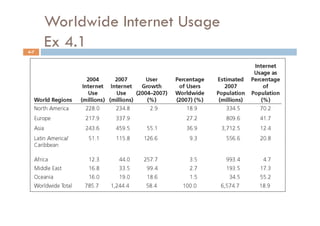
        Exhibit 4.1 shows that worldwide internet usage

         increased more than 58% from 2004 to 2007.
        Asia has the most internet users.

        Africa saw the greatest growth in internet use.

        North America has the highest penetration as a

         percent of the population.
Worldwide Internet Usage
4-7
      Ex 4.1
Internet Use Varies by Country
4-8


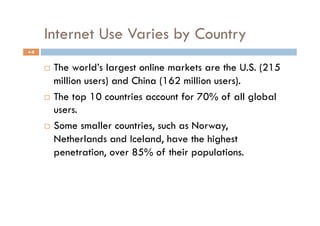
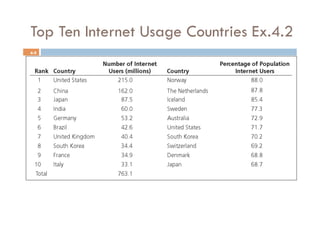
        The world’s largest online markets are the U.S. (215
         million users) and China (162 million users).
        The top 10 countries account for 70% of all global
         users.
        Some smaller countries, such as Norway,

         Netherlands and Iceland, have the highest
         penetration, over 85% of their populations.
Top Ten Internet Usage Countries Ex.4.2
4-9
Developed Economies
4-10


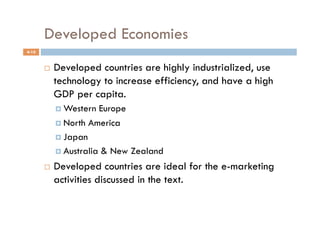
           Developed countries are highly industrialized, use
            technology to increase efficiency, and have a high
            GDP per capita.
              Western  Europe
              North America

              Japan

              Australia & New Zealand

           Developed countries are ideal for the e-marketing
            activities discussed in the text.
Emerging Economies
4-11


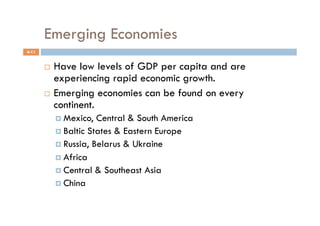
         Have low levels of GDP per capita and are
          experiencing rapid economic growth.
         Emerging economies can be found on every
          continent.
              Mexico,  Central & South America
              Baltic States & Eastern Europe
              Russia, Belarus & Ukraine
              Africa
              Central & Southeast Asia
              China
Importance of Information Technology
4-12


           The internet accelerates the process of economic
            growth through diffusion of new technologies.
              Bangalore, India is the center of India’s explosive
              growth in software and IT.
           Internet marketing differences in emerging
            economies include:
               Fewer computer users
               Limited credit card use
               Lack of secure online payment methods
               Unexpected power failures
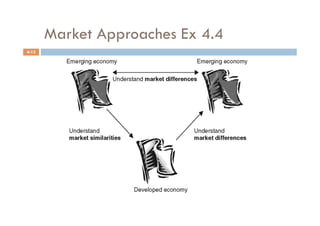
Market Approaches Ex 4.4
4-13
E-Commerce Payment and                                       Trust
4-14
        Issues
    E-commerce in emerging markets is often hampered by
     limited use of credit cards and lack of trust in safely
     conducting online transactions.
         Nepal,for example, is a cash-based economy and credit cards
         are scarce.
            For   local Nepalis, only Visa, MasterCard, and Himalayan Bank cards
               are accepted.
         InBolivia, only 2.3 percent of the population has a credit card.
         Credit card use is virtually non-existent in Ethiopia.
E-Commerce Payment and Trust Issues, cont.
4-15


           In addition to credit card usage, e-marketers
            working in emerging economies should understand
            attitudes toward online purchasing.
              A 2007 study in Lithuania found that 51% of internet
               users had not made an online purchase because they
               thought it was too risky.
              To overcome trust issues, eBanka, an internet bank, was
               established in the Czech Republic in 1998 to handle
               secure online purchases.
Technological Readiness Influences Marketing
4-16


         E-marketers must deal with daunting issues of basic
          technology:
           Limited access to and use of computers and telephones
           High internet connection costs
           Slow internet connections speeds
           Unpredictable power supplies
Computers & Telephones
4-17


         Computer access is unevenly distributed throughout
          the world.
         Exhibit 4.6 shows computer ownership data for

          selected countries.
              Ownership
                       ranges from 84% in Kuwait to 2% in Bangladesh
              and Uganda.
           Telephones (and connectivity) can be scarce and
            expensive.
              Many  consumers in countries with emerging economies access
              the internet from free-standing shops rather than homes.
Internet Connection Costs
4-18


         Countries with emerging economies often have
          higher internet-related business costs.
         Dial-up connection costs can vary considerably.

         Broadband connections are developing quickly.

              In 2002, 88 countries had broadband vs. 166 countries
               in 2006.
              Broadband connections are still expensive in most
               countries.
Wireless Internet Access
4-19


         At the end of 2007, there were 3.25 billion mobile
          phone subscriptions worldwide.
         Countries with emerging economies have
          leapfrogged industrial countries in terms of usage.
         Challenges of wireless e-marketing:

              Modification  of Web site content for small screens
              Text entry using tiny keypads

              Content development

              Pricing and secure payments
The Digital Divide
4-20


         E-marketers must consider the social environment in
          which e-business operates.
         Disparities with regard to technology access can
          create a digital divide between countries or
          populations.
         The digital divide raises challenging questions for

          global policy, international business, and
          entrepreneurship.
China: A View of the Future
4-21


         China is expected to be the largest economy in the
          world by 2015.
         China represents both the promise and challenge of
          e-marketing in emerging market economies.
              70%   of all Chinese internet users are under the age of
               30.
              China’s vibrant, growing online market requires
               adaption to success.
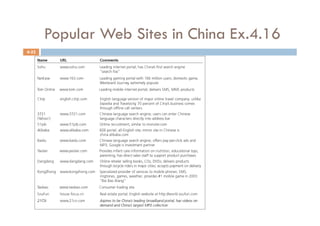
Popular Web Sites in China Ex.4.16
4-22
1-23


Welcome to E-MARKETING 2009
CHAPTER 6: E-MARKETING RESEARCH


   E-MARKETING 5/E (JUDY STRAUSS AND RAYMOND
   FROST)
   Chapter 6


Bangor Business   Dr. Marwan Khammash
 School/Wi2
Lecture 5 Objectives
5-2


          After attending lecture 5, you will be able to:
             Identify the three main sources of data that e-
              marketers use to address research problems.
             Discuss how and why e-marketers need to check the
              quality of research data gathered online.
             Explain why the internet is used as a contact
              method for primary research and describe the main
              internet-based approaches to primary research.
Lecture 5 Objectives, cont.
5-25


          Describe  several ways to monitor the Web for
           gathering desired information.
          Contrast client-side, server-side, and real-space
           approaches to data collection.
          Highlight four important methods of analysis that e-
           marketers can apply to data warehouse
           information.
The Purina Story
5-26


         Nestle Purina PetCare wanted to know whether their
          Web sites and online advertising increased off-line
          behavior.
         Nestle Purina developed 3 research questions:

              Are  our buyers using our branded Web sites?
              Should we invest in other Web sites?

              If so, where should we place the advertising?
The Purina Story, cont.
5-27


           They combined online and off-line shopping panel data
            and found that:
              Banner   click-through rate was low (0.06%).
              31% of subjects who were exposed to both online and off-
               line advertising mentioned Purina.
              The high exposure group mentioned Purina more than the
               low exposure group.
              Home/health and living sites received the most visits from
               their customers.
           Can you think of other Web sites besides petsmart.com
            and about.com that would be appropriate for Purina
            PetCare ads?
Data Drive Strategy
5-28


         Organizations are drowning in data.
         E-marketers must determine how to glean insights

          from billions of bytes of data.
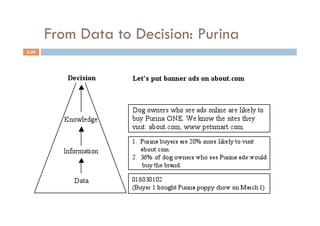
         Marketing insight occurs somewhere between

          information and knowledge.
         Purina, for example, sorts through hundreds of

          millions of pieces of data about 21.5 million
          consumers to make decisions.
From Data to Decision: Purina
5-29
Marketing Knowledge Management
5-30


         Knowledge management is the process of managing
          the creation, use, and dissemination of knowledge.
         Data, information, and knowledge are shared with
          internal decision makers, partners, channel
          members, and sometimes customers.
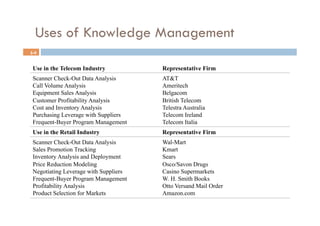
         Examples of the uses of knowledge management

          can be found in Exhibit 6.3.
Uses of Knowledge Management
5-9


 Use in the Telecom Industry           Representative Firm
 Scanner Check-Out Data Analysis       AT&T
 Call Volume Analysis                  Ameritech
 Equipment Sales Analysis              Belgacom
 Customer Profitability Analysis       British Telecom
 Cost and Inventory Analysis           Telestra Australia
 Purchasing Leverage with Suppliers    Telecom Ireland
 Frequent-Buyer Program Management     Telecom Italia
 Use in the Retail Industry            Representative Firm
 Scanner Check-Out Data Analysis       Wal-Mart
 Sales Promotion Tracking              Kmart
 Inventory Analysis and Deployment     Sears
 Price Reduction Modeling              Osco/Savon Drugs
 Negotiating Leverage with Suppliers   Casino Supermarkets
 Frequent-Buyer Program Management     W. H. Smith Books
 Profitability Analysis                Otto Versand Mail Order
 Product Selection for Markets         Amazon.com
The Electronic Marketing Information System
5-32


           Marketers manage knowledge through a marketing
            information system (MIS).
              Many   firms store data in databases and data warehouses.
           The internet and other technologies have facilitated
            data collection.
              Secondary  data provides information about competitors,
               consumers, economic environment, etc.
              Marketers use the Net and other technologies to collect
               primary data about consumers.
Source 1: Internal Records
5-33


           Accounting, finance, production, and marketing
            personnel collect and analyze data.
              Salesdata
              Customer characteristics and behavior
                    Universal product codes
                    Tracking of user movements through web pages
Source 2: Secondary Data
5-34


         Can be collected more quickly and less expensively
          than primary data.
         Secondary data may not meet e-marketer’s
          information needs.
              Data was gathered for a different purpose.
              Quality of secondary data may be unknown.

              Data may be old.

           Marketers continually gather business intelligence by
            scanning the macroenvironment.
Public and Private Data Sources
5-35


           Publicly generated data
              U.S.Patent Office
              CIA World Factbook
              American Marketing Association
              Wikipedia

           Privately generated data
              comScore
              ForresterResearch
              Nielsen/NetRatings

           Commercial online databases
Source 3: Primary Data
5-36


         Primary data are information gathered for the first
          time to solve a particular problem.
         Primary data collection enhanced by the internet:
              Experiments
              Focusgroups
              Observation
              Survey research
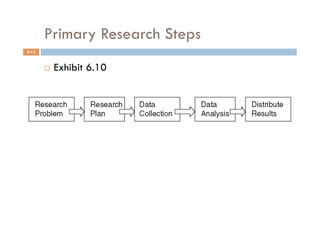
Primary Research Steps
5-15


           Exhibit 6.10
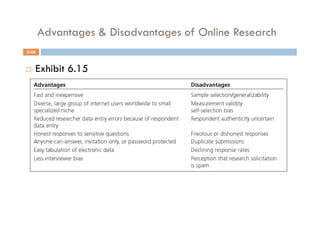
Advantages & Disadvantages of Online Research
5-38


    Exhibit 6.15
Ethics of Online Research
5-39


         Companies conducting research on the Web often
          give respondents a gift or fee for participating.
         Other ethical concerns include:

              Respondents  are increasingly upset at getting unsolicited e-
               mail requests for survey participation.
              “Harvesting” of e-mail addresses from newsgroups without
               permission.
              “Surveys” for the sole purpose of building a database.

              Privacy of user data.
Monitoring the Social Media
5-40


         Companies must now monitor numerous web pages,
          blogs, and photo sites in order to learn what is
          being said about their brands or executives.
         Companies can hire public relations firms or online

          reputation management firms to help.
         They can also set up automated monitoring systems

          using e-mail, RSS feeds, or special software.
Other Technology-Enabled Approaches
5-41


           Client-side Data Collection
              Cookies

              Use PC meter with panel of users to track the user
              clickstream.
           Server-side Data Collection
              Sitelog software
              Real-time profiling tracks users’ movements through a
               Web site.
Real-Space Approaches
5-42


         Data collection occurs at off-line points of purchase.
         Real-space techniques include bar code scanners and

          credit card terminals.
         Catalina Marketing uses the UPC for promotional

          purposes at grocery stores.
Marketing Databases & Data Warehouses
5-43


         Product databases hold information about product
          features, prices, and inventory levels; customer
          databases hold information about customer
          characteristics.
         Data warehouses are repositories for the entire

          organization’s historical data, not just for marketing
          data.
         Data are stored in the data warehouse system and
          used for analysis by marketing decision makers.
Data Analysis and Distribution
5-44


           Four important types of analysis for marketing
            decision making include:
              Data mining
              Customer profiling

              RFM (recency, frequency, monetary value) analysis

              Report generating
Knowledge Management Metrics
5-45


           Two metrics are currently in widespread use:
              ROI:  total cost savings divided by total cost of the
               installation.
              Total Cost of Ownership (TCO): includes cost of
               hardware, software, labor, and cost savings.

E Marketing Lecture Part 2

  • 1.
    1-1 Welcome to E-MARKETING2009 Lecture 4: A WORLD OF E-MARKETING OPPORTUNITIES E-MARKETING 5/E (JUDY STRAUSS AND RAYMOND FROST) Chapter 4 Bangor Business Dr. Marwan Khammash School/Wi2
  • 2.
    Lecture 4 Objectives 4-2   After lecture 4, you will be able to:   Discuss overall trends in Internet access, usage, and purchasing around the world.   Define emerging economies and explain the vital role of information technology in economic development.   Outline how e-marketers apply market similarity and analyze online purchase and payment behaviors in planning market entry opportunities.
  • 3.
    Lecture 4 Objectives,cont. 4-3   Describe how e-marketing strategy is influenced by computer and telephone access, credit card availability, attitudes toward internet use, slow connection speeds, Web site design, and electricity problems.   Review the special challenges of e-marketing on the wireless internet in the context of emerging economies.   Discuss the controversy related to the Digital Divide.   Explain why China is becoming a major market for e- marketing innovation and competition.
  • 4.
    Idol Goes Global 4-4   American Idol is broadcast in over 100 countries.   Its popularity has spawned 39 national versions in countries such as Ethiopia, the Philippines, and Russia.   The sharing of popular culture has been enhanced by the convergence of TV, internet, mobile phones, and messaging services.
  • 5.
    Idol Goes Global,cont. 4-5   Check out international versions that are streamed over the internet:   Music Idol in Bulgaria: http://musicidol.btv.bg/news/6   Ethiopian Idol: http://www2.jumptv.com/seo/Ethiopian_Idols/Ethiopian_Idols.htm   Indian Idol: http://sify.com/indianidol/
  • 6.
    Overview of GlobalE-Marketing Issues 4-6   The globe is literally a world of opportunities.   Exhibit 4.1 shows that worldwide internet usage increased more than 58% from 2004 to 2007.   Asia has the most internet users.   Africa saw the greatest growth in internet use.   North America has the highest penetration as a percent of the population.
  • 7.
  • 8.
    Internet Use Variesby Country 4-8   The world’s largest online markets are the U.S. (215 million users) and China (162 million users).   The top 10 countries account for 70% of all global users.   Some smaller countries, such as Norway, Netherlands and Iceland, have the highest penetration, over 85% of their populations.
  • 9.
    Top Ten InternetUsage Countries Ex.4.2 4-9
  • 10.
    Developed Economies 4-10   Developed countries are highly industrialized, use technology to increase efficiency, and have a high GDP per capita.   Western Europe   North America   Japan   Australia & New Zealand   Developed countries are ideal for the e-marketing activities discussed in the text.
  • 11.
    Emerging Economies 4-11   Have low levels of GDP per capita and are experiencing rapid economic growth.   Emerging economies can be found on every continent.   Mexico, Central & South America   Baltic States & Eastern Europe   Russia, Belarus & Ukraine   Africa   Central & Southeast Asia   China
  • 12.
    Importance of InformationTechnology 4-12   The internet accelerates the process of economic growth through diffusion of new technologies.   Bangalore, India is the center of India’s explosive growth in software and IT.   Internet marketing differences in emerging economies include:   Fewer computer users   Limited credit card use   Lack of secure online payment methods   Unexpected power failures
  • 13.
  • 14.
    E-Commerce Payment and Trust 4-14 Issues   E-commerce in emerging markets is often hampered by limited use of credit cards and lack of trust in safely conducting online transactions.   Nepal,for example, is a cash-based economy and credit cards are scarce.   For local Nepalis, only Visa, MasterCard, and Himalayan Bank cards are accepted.   InBolivia, only 2.3 percent of the population has a credit card.   Credit card use is virtually non-existent in Ethiopia.
  • 15.
    E-Commerce Payment andTrust Issues, cont. 4-15   In addition to credit card usage, e-marketers working in emerging economies should understand attitudes toward online purchasing.   A 2007 study in Lithuania found that 51% of internet users had not made an online purchase because they thought it was too risky.   To overcome trust issues, eBanka, an internet bank, was established in the Czech Republic in 1998 to handle secure online purchases.
  • 16.
    Technological Readiness InfluencesMarketing 4-16   E-marketers must deal with daunting issues of basic technology:   Limited access to and use of computers and telephones   High internet connection costs   Slow internet connections speeds   Unpredictable power supplies
  • 17.
    Computers & Telephones 4-17   Computer access is unevenly distributed throughout the world.   Exhibit 4.6 shows computer ownership data for selected countries.   Ownership ranges from 84% in Kuwait to 2% in Bangladesh and Uganda.   Telephones (and connectivity) can be scarce and expensive.   Many consumers in countries with emerging economies access the internet from free-standing shops rather than homes.
  • 18.
    Internet Connection Costs 4-18   Countries with emerging economies often have higher internet-related business costs.   Dial-up connection costs can vary considerably.   Broadband connections are developing quickly.   In 2002, 88 countries had broadband vs. 166 countries in 2006.   Broadband connections are still expensive in most countries.
  • 19.
    Wireless Internet Access 4-19   At the end of 2007, there were 3.25 billion mobile phone subscriptions worldwide.   Countries with emerging economies have leapfrogged industrial countries in terms of usage.   Challenges of wireless e-marketing:   Modification of Web site content for small screens   Text entry using tiny keypads   Content development   Pricing and secure payments
  • 20.
    The Digital Divide 4-20   E-marketers must consider the social environment in which e-business operates.   Disparities with regard to technology access can create a digital divide between countries or populations.   The digital divide raises challenging questions for global policy, international business, and entrepreneurship.
  • 21.
    China: A Viewof the Future 4-21   China is expected to be the largest economy in the world by 2015.   China represents both the promise and challenge of e-marketing in emerging market economies.   70% of all Chinese internet users are under the age of 30.   China’s vibrant, growing online market requires adaption to success.
  • 22.
    Popular Web Sitesin China Ex.4.16 4-22
  • 23.
    1-23 Welcome to E-MARKETING2009 CHAPTER 6: E-MARKETING RESEARCH E-MARKETING 5/E (JUDY STRAUSS AND RAYMOND FROST) Chapter 6 Bangor Business Dr. Marwan Khammash School/Wi2
  • 24.
    Lecture 5 Objectives 5-2   After attending lecture 5, you will be able to:   Identify the three main sources of data that e- marketers use to address research problems.   Discuss how and why e-marketers need to check the quality of research data gathered online.   Explain why the internet is used as a contact method for primary research and describe the main internet-based approaches to primary research.
  • 25.
    Lecture 5 Objectives,cont. 5-25   Describe several ways to monitor the Web for gathering desired information.   Contrast client-side, server-side, and real-space approaches to data collection.   Highlight four important methods of analysis that e- marketers can apply to data warehouse information.
  • 26.
    The Purina Story 5-26   Nestle Purina PetCare wanted to know whether their Web sites and online advertising increased off-line behavior.   Nestle Purina developed 3 research questions:   Are our buyers using our branded Web sites?   Should we invest in other Web sites?   If so, where should we place the advertising?
  • 27.
    The Purina Story,cont. 5-27   They combined online and off-line shopping panel data and found that:   Banner click-through rate was low (0.06%).   31% of subjects who were exposed to both online and off- line advertising mentioned Purina.   The high exposure group mentioned Purina more than the low exposure group.   Home/health and living sites received the most visits from their customers.   Can you think of other Web sites besides petsmart.com and about.com that would be appropriate for Purina PetCare ads?
  • 28.
    Data Drive Strategy 5-28   Organizations are drowning in data.   E-marketers must determine how to glean insights from billions of bytes of data.   Marketing insight occurs somewhere between information and knowledge.   Purina, for example, sorts through hundreds of millions of pieces of data about 21.5 million consumers to make decisions.
  • 29.
    From Data toDecision: Purina 5-29
  • 30.
    Marketing Knowledge Management 5-30   Knowledge management is the process of managing the creation, use, and dissemination of knowledge.   Data, information, and knowledge are shared with internal decision makers, partners, channel members, and sometimes customers.   Examples of the uses of knowledge management can be found in Exhibit 6.3.
  • 31.
    Uses of KnowledgeManagement 5-9 Use in the Telecom Industry Representative Firm Scanner Check-Out Data Analysis AT&T Call Volume Analysis Ameritech Equipment Sales Analysis Belgacom Customer Profitability Analysis British Telecom Cost and Inventory Analysis Telestra Australia Purchasing Leverage with Suppliers Telecom Ireland Frequent-Buyer Program Management Telecom Italia Use in the Retail Industry Representative Firm Scanner Check-Out Data Analysis Wal-Mart Sales Promotion Tracking Kmart Inventory Analysis and Deployment Sears Price Reduction Modeling Osco/Savon Drugs Negotiating Leverage with Suppliers Casino Supermarkets Frequent-Buyer Program Management W. H. Smith Books Profitability Analysis Otto Versand Mail Order Product Selection for Markets Amazon.com
  • 32.
    The Electronic MarketingInformation System 5-32   Marketers manage knowledge through a marketing information system (MIS).   Many firms store data in databases and data warehouses.   The internet and other technologies have facilitated data collection.   Secondary data provides information about competitors, consumers, economic environment, etc.   Marketers use the Net and other technologies to collect primary data about consumers.
  • 33.
    Source 1: InternalRecords 5-33   Accounting, finance, production, and marketing personnel collect and analyze data.   Salesdata   Customer characteristics and behavior   Universal product codes   Tracking of user movements through web pages
  • 34.
    Source 2: SecondaryData 5-34   Can be collected more quickly and less expensively than primary data.   Secondary data may not meet e-marketer’s information needs.   Data was gathered for a different purpose.   Quality of secondary data may be unknown.   Data may be old.   Marketers continually gather business intelligence by scanning the macroenvironment.
  • 35.
    Public and PrivateData Sources 5-35   Publicly generated data   U.S.Patent Office   CIA World Factbook   American Marketing Association   Wikipedia   Privately generated data   comScore   ForresterResearch   Nielsen/NetRatings   Commercial online databases
  • 36.
    Source 3: PrimaryData 5-36   Primary data are information gathered for the first time to solve a particular problem.   Primary data collection enhanced by the internet:   Experiments   Focusgroups   Observation   Survey research
  • 37.
    Primary Research Steps 5-15   Exhibit 6.10
  • 38.
    Advantages & Disadvantagesof Online Research 5-38   Exhibit 6.15
  • 39.
    Ethics of OnlineResearch 5-39   Companies conducting research on the Web often give respondents a gift or fee for participating.   Other ethical concerns include:   Respondents are increasingly upset at getting unsolicited e- mail requests for survey participation.   “Harvesting” of e-mail addresses from newsgroups without permission.   “Surveys” for the sole purpose of building a database.   Privacy of user data.
  • 40.
    Monitoring the SocialMedia 5-40   Companies must now monitor numerous web pages, blogs, and photo sites in order to learn what is being said about their brands or executives.   Companies can hire public relations firms or online reputation management firms to help.   They can also set up automated monitoring systems using e-mail, RSS feeds, or special software.
  • 41.
    Other Technology-Enabled Approaches 5-41   Client-side Data Collection   Cookies   Use PC meter with panel of users to track the user clickstream.   Server-side Data Collection   Sitelog software   Real-time profiling tracks users’ movements through a Web site.
  • 42.
    Real-Space Approaches 5-42   Data collection occurs at off-line points of purchase.   Real-space techniques include bar code scanners and credit card terminals.   Catalina Marketing uses the UPC for promotional purposes at grocery stores.
  • 43.
    Marketing Databases &Data Warehouses 5-43   Product databases hold information about product features, prices, and inventory levels; customer databases hold information about customer characteristics.   Data warehouses are repositories for the entire organization’s historical data, not just for marketing data.   Data are stored in the data warehouse system and used for analysis by marketing decision makers.
  • 44.
    Data Analysis andDistribution 5-44   Four important types of analysis for marketing decision making include:   Data mining   Customer profiling   RFM (recency, frequency, monetary value) analysis   Report generating
  • 45.
    Knowledge Management Metrics 5-45   Two metrics are currently in widespread use:   ROI: total cost savings divided by total cost of the installation.   Total Cost of Ownership (TCO): includes cost of hardware, software, labor, and cost savings.