

E-MARKETING, 6TH
EDITION
JUDY STRAUSS AND RAYMOND FROST
Chapter 6 – E-Marketing Research
The Purina Story
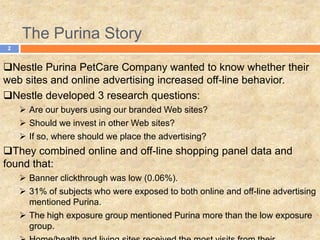
Nestle Purina PetCare Company wanted to know whether their
web sites and online advertising increased off-line behavior.
Nestle developed 3 research questions:
 Are our buyers using our branded Web sites?
 Should we invest in other Web sites?
 If so, where should we place the advertising?
They combined online and off-line shopping panel data and
found that:
 Banner clickthrough was low (0.06%).
 31% of subjects who were exposed to both online and off-line advertising
mentioned Purina.
 The high exposure group mentioned Purina more than the low exposure
group.
2
Data Drives Strategy
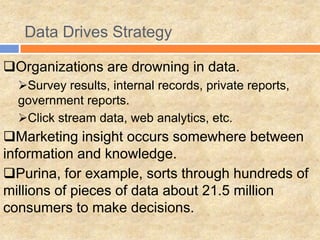
Organizations are drowning in data.
Survey results, internal records, private reports,
government reports.
Click stream data, web analytics, etc.
Marketing insight occurs somewhere between
information and knowledge.
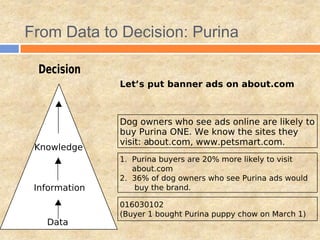
Purina, for example, sorts through hundreds of
millions of pieces of data about 21.5 million
consumers to make decisions.
From Data to Decision: Purina
Marketing Knowledge Management
Knowledge management is the process of
managing the creation, use and dissemination of
knowledge.
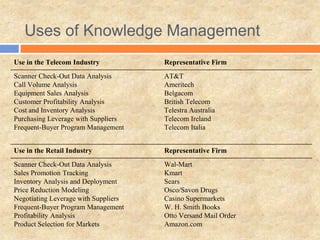
Examples of the uses of knowledge
management can be found in Exhibit 6.4.
Uses of Knowledge Management
Wal-Mart
Kmart
Sears
Osco/Savon Drugs
Casino Supermarkets
W. H. Smith Books
Otto Versand Mail Order
Amazon.com
Scanner Check-Out Data Analysis
Sales Promotion Tracking
Inventory Analysis and Deployment
Price Reduction Modeling
Negotiating Leverage with Suppliers
Frequent-Buyer Program Management
Profitability Analysis
Product Selection for Markets
Representative FirmUse in the Retail Industry
AT&T
Ameritech
Belgacom
British Telecom
Telestra Australia
Telecom Ireland
Telecom Italia
Scanner Check-Out Data Analysis
Call Volume Analysis
Equipment Sales Analysis
Customer Profitability Analysis
Cost and Inventory Analysis
Purchasing Leverage with Suppliers
Frequent-Buyer Program Management
Representative FirmUse in the Telecom Industry
The Marketing Information System
Marketers manage knowledge through a
marketing information system (MIS).
Many firms store data in databases and data
warehouses.
The Internet and other technologies have
facilitated data collection.
Secondary data provides information about
competitors, consumers, the economic
environment, etc.
Marketers use the Net and other technologies to
collect primary data about consumers.
Soures of data: Internal records
Accounting, finance, production and marketing
personnel collect and analyze data.
Nonmarketing data, such as sales and advertising
spending
Sales force data
Conversion rate, ads effectiveness, tracking customer
behavior
Customer characteristics and behavior
Universal product codes
Tracking of user movements through web pages
Secondary data
Can be collected more quickly and less
expensively than primary data.
Secondary data may not meet e-marketer’s
information needs.
Data were gathered for a different purpose.
Quality of secondary data may be unknown.
Data may be old.
Marketers continually gather business
intelligence by scanning the environment.
Public and Private Data Sources
•Publicly generated data
• U.S. Patent Office
• American Marketing Association
• Social Media Database
•Privately generated data
• Well Known Expert’s Blog - Seth Godin’s Blog
• Forrester Research
• Nielsen/NetRatings
• Pew Research Center
•Online databases
Competitive Intelligence
 Analyzing the industry in which a firm operates as a
input to the firms' strategic positioning to
understand competitors vulnerability
 Sources
 Competitors press release
 New product launch
 New alliances
 Co-brands
 Trade show activity
 Social media conversations
 Web site logs
 Third-party industry specific sites
Information Quality
 Advise to be objective, especially before using
information on web pages
 Control for cultural differences
 Don’t get distracted by website design
 Discover the website’s author identity
 Try to determine whether the site author is an
authority is an authority on the web site topic
 Check to see when site was last updated
 Determine how comprehensive the site is
 Try to establish triangulation
 Check to site content for accuracy
NO SITE IS COMPETE
AND ACCURATE!!!
Primary Data
Two electronic sources of primary data
collection:
Internet
Real space
Primary data collection on the Net:
Experiments
Focus groups
In-depth interviews
Survey research
Real-space data collection refers to technology-
enabled gathering of information offline.
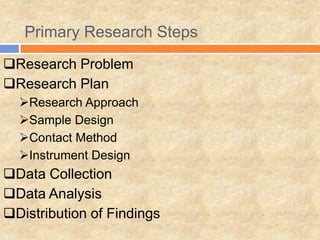
Primary Research Steps
Research Problem
Research Plan
Research Approach
Sample Design
Contact Method
Instrument Design
Data Collection
Data Analysis
Distribution of Findings
Online Research Advantages & Disadvantages
Advantages
Can be fast and inexpensive.
Surveys may reduce data entry errors.
Respondents may answer more honestly and
openly.
Disadvantages
Sample representativeness.
Measurement validity.
Respondent authenticity.
Researchers are using online panels to combat
sampling and response problems.
Other Technology-Enabled Approaches
•Client-side Data Collection
• Cookies
• Use PC meter with panel of users to track the user
clickstream.
•Server-side Data Collection
• Data log software
• Real-time profiling tracks users’ movements through
a web site.
Real-Space Data Collection, Storage, and Analysis
•Offline data collection may be combined with
online data.
•Transaction processing databases move data
from other databases to a data warehouse.
•Data collected can be analyzed to help make
marketing decisions.
• Data Mining
• Customer Profiling
• Recency, Frequency, Monetary (RFM) Analysis
• Report Generating

Chapter 6 e-marketing research

  • 1.
    E-MARKETING, 6TH EDITION JUDY STRAUSSAND RAYMOND FROST Chapter 6 – E-Marketing Research
  • 2.
    The Purina Story NestlePurina PetCare Company wanted to know whether their web sites and online advertising increased off-line behavior. Nestle developed 3 research questions:  Are our buyers using our branded Web sites?  Should we invest in other Web sites?  If so, where should we place the advertising? They combined online and off-line shopping panel data and found that:  Banner clickthrough was low (0.06%).  31% of subjects who were exposed to both online and off-line advertising mentioned Purina.  The high exposure group mentioned Purina more than the low exposure group. 2
  • 3.
    Data Drives Strategy Organizationsare drowning in data. Survey results, internal records, private reports, government reports. Click stream data, web analytics, etc. Marketing insight occurs somewhere between information and knowledge. Purina, for example, sorts through hundreds of millions of pieces of data about 21.5 million consumers to make decisions.
  • 4.
    From Data toDecision: Purina
  • 5.
    Marketing Knowledge Management Knowledgemanagement is the process of managing the creation, use and dissemination of knowledge. Examples of the uses of knowledge management can be found in Exhibit 6.4.
  • 6.
    Uses of KnowledgeManagement Wal-Mart Kmart Sears Osco/Savon Drugs Casino Supermarkets W. H. Smith Books Otto Versand Mail Order Amazon.com Scanner Check-Out Data Analysis Sales Promotion Tracking Inventory Analysis and Deployment Price Reduction Modeling Negotiating Leverage with Suppliers Frequent-Buyer Program Management Profitability Analysis Product Selection for Markets Representative FirmUse in the Retail Industry AT&T Ameritech Belgacom British Telecom Telestra Australia Telecom Ireland Telecom Italia Scanner Check-Out Data Analysis Call Volume Analysis Equipment Sales Analysis Customer Profitability Analysis Cost and Inventory Analysis Purchasing Leverage with Suppliers Frequent-Buyer Program Management Representative FirmUse in the Telecom Industry
  • 7.
    The Marketing InformationSystem Marketers manage knowledge through a marketing information system (MIS). Many firms store data in databases and data warehouses. The Internet and other technologies have facilitated data collection. Secondary data provides information about competitors, consumers, the economic environment, etc. Marketers use the Net and other technologies to collect primary data about consumers.
  • 8.
    Soures of data:Internal records Accounting, finance, production and marketing personnel collect and analyze data. Nonmarketing data, such as sales and advertising spending Sales force data Conversion rate, ads effectiveness, tracking customer behavior Customer characteristics and behavior Universal product codes Tracking of user movements through web pages
  • 9.
    Secondary data Can becollected more quickly and less expensively than primary data. Secondary data may not meet e-marketer’s information needs. Data were gathered for a different purpose. Quality of secondary data may be unknown. Data may be old. Marketers continually gather business intelligence by scanning the environment.
  • 10.
    Public and PrivateData Sources •Publicly generated data • U.S. Patent Office • American Marketing Association • Social Media Database •Privately generated data • Well Known Expert’s Blog - Seth Godin’s Blog • Forrester Research • Nielsen/NetRatings • Pew Research Center •Online databases
  • 11.
    Competitive Intelligence  Analyzingthe industry in which a firm operates as a input to the firms' strategic positioning to understand competitors vulnerability  Sources  Competitors press release  New product launch  New alliances  Co-brands  Trade show activity  Social media conversations  Web site logs  Third-party industry specific sites
  • 12.
    Information Quality  Adviseto be objective, especially before using information on web pages  Control for cultural differences  Don’t get distracted by website design  Discover the website’s author identity  Try to determine whether the site author is an authority is an authority on the web site topic  Check to see when site was last updated  Determine how comprehensive the site is  Try to establish triangulation  Check to site content for accuracy
  • 13.
    NO SITE ISCOMPETE AND ACCURATE!!!
  • 14.
    Primary Data Two electronicsources of primary data collection: Internet Real space Primary data collection on the Net: Experiments Focus groups In-depth interviews Survey research Real-space data collection refers to technology- enabled gathering of information offline.
  • 15.
    Primary Research Steps ResearchProblem Research Plan Research Approach Sample Design Contact Method Instrument Design Data Collection Data Analysis Distribution of Findings
  • 16.
    Online Research Advantages& Disadvantages Advantages Can be fast and inexpensive. Surveys may reduce data entry errors. Respondents may answer more honestly and openly. Disadvantages Sample representativeness. Measurement validity. Respondent authenticity. Researchers are using online panels to combat sampling and response problems.
  • 17.
    Other Technology-Enabled Approaches •Client-sideData Collection • Cookies • Use PC meter with panel of users to track the user clickstream. •Server-side Data Collection • Data log software • Real-time profiling tracks users’ movements through a web site.
  • 18.
    Real-Space Data Collection,Storage, and Analysis •Offline data collection may be combined with online data. •Transaction processing databases move data from other databases to a data warehouse. •Data collected can be analyzed to help make marketing decisions. • Data Mining • Customer Profiling • Recency, Frequency, Monetary (RFM) Analysis • Report Generating