Introduction to E-
             Marketing
            Instructor: Dr. Rizwan Ahmed
                       University of Central Punjab (UCP)
                     Faculty of Management Studies (FMS)


Referece Text:
Chapter 1 of “eMarketing Excellence” 3rd Edition, 2008, by Dave Chaffey & PR
Smith, Elsveir Science
The eWorld
• The Wired up world
  –   Internet continues to grow with almost 2 billion users
  –   Billions of dollars worth money flows through wires
  –   Electronic technologies are evolving rapidly
  –   The connected world
       • Everyone is connected, and everything will be connected through
           –   Computer (desktop, laptop)
           –   Mobile (PDAs, Tablets, Cell phones)
           –   Interactive digital tv
           –   Interactive kiosks
           –   Convergence of devices
  – Huge implications for businesses and customers
  – Future of competitive advantage lies in e-world
Understanding e-Environment
– E-Defintions
– Types of E-Commerce
– E-Marketing Mix
– E-models
  •   E-Marketplaces
  •   E-Revenue models
  •   E-Communication models
  •   E-Buying models
– E-Customers
– E-Channels & Devices
E-Definitions
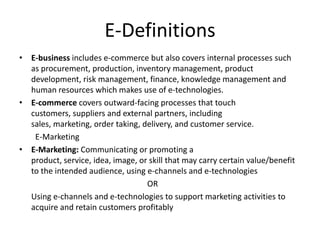
• E-business includes e-commerce but also covers internal processes such
  as procurement, production, inventory management, product
  development, risk management, finance, knowledge management and
  human resources which makes use of e-technologies.
• E-commerce covers outward-facing processes that touch
  customers, suppliers and external partners, including
  sales, marketing, order taking, delivery, and customer service.
   E-Marketing
• E-Marketing: Communicating or promoting a
  product, service, idea, image, or skill that may carry certain value/benefit
  to the intended audience, using e-channels and e-technologies
                                   OR
  Using e-channels and e-technologies to support marketing activities to
  acquire and retain customers profitably
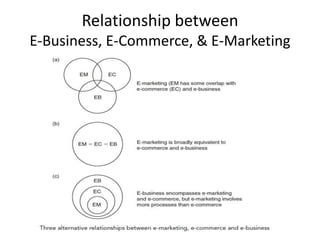
Relationship between
E-Business, E-Commerce, & E-Marketing
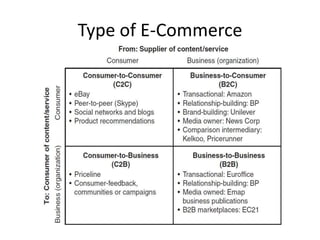
Type of E-Commerce
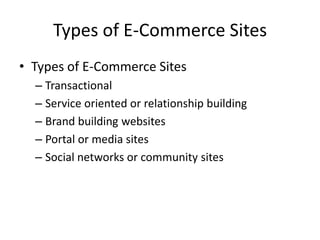
Types of E-Commerce Sites
• Types of E-Commerce Sites
  – Transactional
  – Service oriented or relationship building
  – Brand building websites
  – Portal or media sites
  – Social networks or community sites
E-Marketing: The Dynamic Dialog
•   The dynamic dialog with customer
     – The UK Chartered Institute of Marketing (CIM) define marketing as
          • ‘The management process responsible for identifying, anticipating and satisfying
            customer needs profitably ’
     – How E-Marketing helps a dynamic dialog?
     – Identify Needs from
          • comments, suggestions, requests, complains via email, discussion boards, chat
            rooms, other social interactions
          • sales data
          • online surveys
          • secondary sources
     – Anticipate Customer Needs by
          • Talking to them
          • Profiling
     – Satisfy Customer Needs by
          • Quick response
          • Quick deliveries and status updates
          • Value added services
          • After sales services
E-Marketing Objectives: The 5-S Model
• Objectives of E-Marketing (the 5S Model)
  – Needs clear objectives
  – Sell: Grow market share, find new
    markets, develop new products, develop new
    markets
  – Serve: customer services is everything
  – Speak: talk, listen, and get closer
  – Save: money, time and effort
  – Sizzle: build your brand, enhance you image
Sell: Internet as a Sales Tool
• Anything can be sold
  online
• Some products and
  services are researched
  online but bought offline
   – So, mixed model selling
     is a must for most
     business (online
     lead, offline sale)
• Point of purchase and
  point of consumption can
  be different (e.g. tickets
  buying)
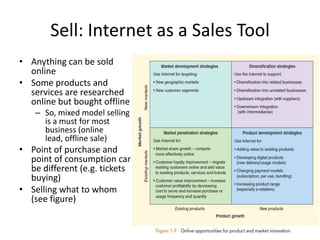
• Selling what to whom
  (see figure)
– Serve: Internet as Customer Service Tool
   • Web presence can be used to add value for a customer
     at pre-sale, during sale, and after sale support
   • Answer customer queries
   • Help customers
   • Status updates
   • Helps building switching costs
– Speak: Internet as a communication tool
   • Convey your message
   • Listen, talk, and get closer to customer and suppliers
   • Directly understand customers’
     attitudes, behaviors, interests, buying patterns
– Save: Internet as a cost reduction tool
   • Money, time and effort
   • customer service cost, transaction cost, printing and
     stationary cost, distribution cost, sourcing
     cost, communication
   • Customer Service Saving: FedEx (2-5), Dell (5-10),
   • Transaction cost: over the counter (1 USD) vs. online (1 cent)
   • Self service: Ultralase let customer select the type treatment
   • Sorucing: GE saves millions through online sourcing
   • Printing: reports, manuals, brochures,
   • Space: less storage space needed with paperless
     environment
   • Communication: email, chat, internet phone
– Sizzle: Internet as a brand building tool
   • Sometimes brand image is only real difference between
     same products
   • Build trust, recognition and relationship
Reference Text

Chapter 1 of “eMarketing Excellence” 3rd
  Edition, 2008, by Dave Chaffey & PR
  Smith, Elsveir Science

01 introduction to e-marketing

  • 1.
    Introduction to E- Marketing Instructor: Dr. Rizwan Ahmed University of Central Punjab (UCP) Faculty of Management Studies (FMS) Referece Text: Chapter 1 of “eMarketing Excellence” 3rd Edition, 2008, by Dave Chaffey & PR Smith, Elsveir Science
  • 2.
    The eWorld • TheWired up world – Internet continues to grow with almost 2 billion users – Billions of dollars worth money flows through wires – Electronic technologies are evolving rapidly – The connected world • Everyone is connected, and everything will be connected through – Computer (desktop, laptop) – Mobile (PDAs, Tablets, Cell phones) – Interactive digital tv – Interactive kiosks – Convergence of devices – Huge implications for businesses and customers – Future of competitive advantage lies in e-world
  • 3.
    Understanding e-Environment – E-Defintions –Types of E-Commerce – E-Marketing Mix – E-models • E-Marketplaces • E-Revenue models • E-Communication models • E-Buying models – E-Customers – E-Channels & Devices
  • 4.
    E-Definitions • E-business includese-commerce but also covers internal processes such as procurement, production, inventory management, product development, risk management, finance, knowledge management and human resources which makes use of e-technologies. • E-commerce covers outward-facing processes that touch customers, suppliers and external partners, including sales, marketing, order taking, delivery, and customer service. E-Marketing • E-Marketing: Communicating or promoting a product, service, idea, image, or skill that may carry certain value/benefit to the intended audience, using e-channels and e-technologies OR Using e-channels and e-technologies to support marketing activities to acquire and retain customers profitably
  • 5.
  • 6.
  • 7.
    Types of E-CommerceSites • Types of E-Commerce Sites – Transactional – Service oriented or relationship building – Brand building websites – Portal or media sites – Social networks or community sites
  • 8.
    E-Marketing: The DynamicDialog • The dynamic dialog with customer – The UK Chartered Institute of Marketing (CIM) define marketing as • ‘The management process responsible for identifying, anticipating and satisfying customer needs profitably ’ – How E-Marketing helps a dynamic dialog? – Identify Needs from • comments, suggestions, requests, complains via email, discussion boards, chat rooms, other social interactions • sales data • online surveys • secondary sources – Anticipate Customer Needs by • Talking to them • Profiling – Satisfy Customer Needs by • Quick response • Quick deliveries and status updates • Value added services • After sales services
  • 9.
    E-Marketing Objectives: The5-S Model • Objectives of E-Marketing (the 5S Model) – Needs clear objectives – Sell: Grow market share, find new markets, develop new products, develop new markets – Serve: customer services is everything – Speak: talk, listen, and get closer – Save: money, time and effort – Sizzle: build your brand, enhance you image
  • 10.
    Sell: Internet asa Sales Tool • Anything can be sold online • Some products and services are researched online but bought offline – So, mixed model selling is a must for most business (online lead, offline sale) • Point of purchase and point of consumption can be different (e.g. tickets buying) • Selling what to whom (see figure)
  • 11.
    – Serve: Internetas Customer Service Tool • Web presence can be used to add value for a customer at pre-sale, during sale, and after sale support • Answer customer queries • Help customers • Status updates • Helps building switching costs – Speak: Internet as a communication tool • Convey your message • Listen, talk, and get closer to customer and suppliers • Directly understand customers’ attitudes, behaviors, interests, buying patterns
  • 12.
    – Save: Internetas a cost reduction tool • Money, time and effort • customer service cost, transaction cost, printing and stationary cost, distribution cost, sourcing cost, communication • Customer Service Saving: FedEx (2-5), Dell (5-10), • Transaction cost: over the counter (1 USD) vs. online (1 cent) • Self service: Ultralase let customer select the type treatment • Sorucing: GE saves millions through online sourcing • Printing: reports, manuals, brochures, • Space: less storage space needed with paperless environment • Communication: email, chat, internet phone – Sizzle: Internet as a brand building tool • Sometimes brand image is only real difference between same products • Build trust, recognition and relationship
  • 13.
    Reference Text Chapter 1of “eMarketing Excellence” 3rd Edition, 2008, by Dave Chaffey & PR Smith, Elsveir Science