CHAPTER 1
The
Architecture
of
8086
INTRODUCTION
 Need to know the learning of x86 family of
microprocessors
 Understand the architecture of the 8086
 8086 is a processor catering to 16-bit data (D0 to D15) and
having a 20-bit address (A0 to A19)
 8086 is a 16-bit processor internally & externally
 means its data bus width as well as the bit size of its
internal data registers is 16
 it can even access external source 16 bits
 it also has the capacity to access and work on 8-bit data.
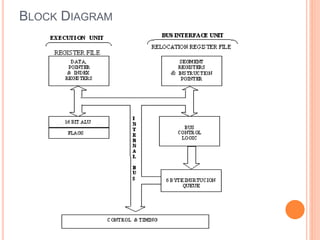
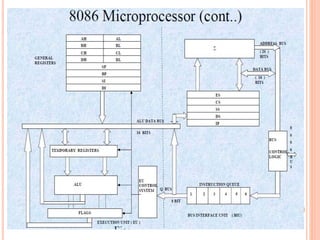
BLOCK DIAGRAM
1.3 BUS INTERFACE UNIT
This unit is responsible for
 Address Calculations
 pre-fetching instructions for the queue and sequencing
instructions one by one.
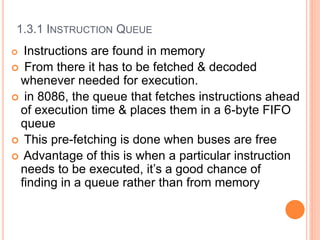
1.3.1 INSTRUCTION QUEUE
 Instructions are found in memory
 From there it has to be fetched & decoded
whenever needed for execution.
 in 8086, the queue that fetches instructions ahead
of execution time & places them in a 6-byte FIFO
queue
 This pre-fetching is done when buses are free
 Advantage of this is when a particular instruction
needs to be executed, it’s a good chance of
finding in a queue rather than from memory
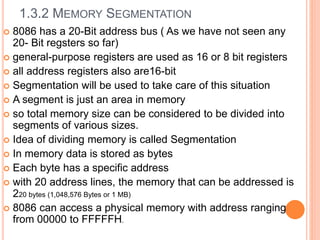
1.3.2 MEMORY SEGMENTATION
 8086 has a 20-Bit address bus ( As we have not seen any
20- Bit regsters so far)
 general-purpose registers are used as 16 or 8 bit registers
 all address registers also are16-bit
 Segmentation will be used to take care of this situation
 A segment is just an area in memory
 so total memory size can be considered to be divided into
segments of various sizes.
 Idea of dividing memory is called Segmentation
 In memory data is stored as bytes
 Each byte has a specific address
 with 20 address lines, the memory that can be addressed is
220 bytes (1,048,576 Bytes or 1 MB)
 8086 can access a physical memory with address ranging
from 00000 to FFFFFH.
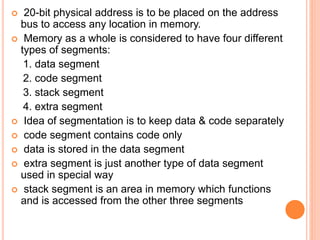
 20-bit physical address is to be placed on the address
bus to access any location in memory.
 Memory as a whole is considered to have four different
types of segments:
1. data segment
2. code segment
3. stack segment
4. extra segment
 Idea of segmentation is to keep data & code separately
 code segment contains code only
 data is stored in the data segment
 extra segment is just another type of data segment
used in special way
 stack segment is an area in memory which functions
and is accessed from the other three segments
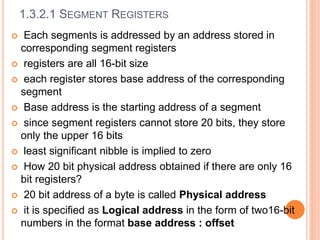
1.3.2.1 SEGMENT REGISTERS
 Each segments is addressed by an address stored in
corresponding segment registers
 registers are all 16-bit size
 each register stores base address of the corresponding
segment
 Base address is the starting address of a segment
 since segment registers cannot store 20 bits, they store
only the upper 16 bits
 least significant nibble is implied to zero
 How 20 bit physical address obtained if there are only 16
bit registers?
 20 bit address of a byte is called Physical address
 it is specified as Logical address in the form of two16-bit
numbers in the format base address : offset
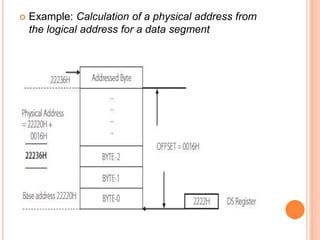
 Example: Calculation of a physical address from
the logical address for a data segment
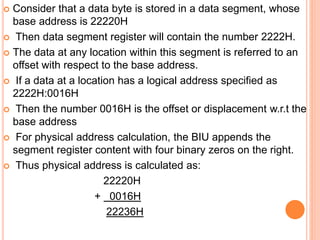
 Consider that a data byte is stored in a data segment, whose
base address is 22220H
 Then data segment register will contain the number 2222H.
 The data at any location within this segment is referred to an
offset with respect to the base address.
 If a data at a location has a logical address specified as
2222H:0016H
 Then the number 0016H is the offset or displacement w.r.t the
base address
 For physical address calculation, the BIU appends the
segment register content with four binary zeros on the right.
 Thus physical address is calculated as:
22220H
+ 0016H
22236H
 Similar in case for the other segments
 offsets are limited to 16Bits
 means that the maximum size possible for a segment is
only 216 or 64KB
 Hence every memory reference by the 8086 will use one of
the segment registers (i.e DS, ES, SS, or CS)
 combined to form an offset to determine the physical
address being accessed.
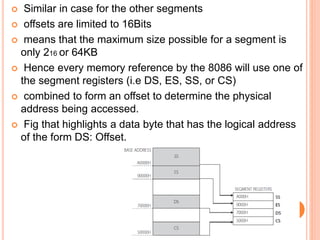
 Fig that highlights a data byte that has the logical address
of the form DS: Offset.
 Code segment is the area of memory where code alone is
stored.
 offsets in the code segment are referenced by Instruction
Pointer. ( a 16-Bit register)
 IP sequences the instructions and points to the next
instruction to be executed.
 If an instruction byte has to be fetched from memory, the
bus interface unit performs the address calculation using
the contents of CS registers & the IP
 This 20-bit address is then placed on the address bus and
the instruction byte is fetched.
 Hence the logical address for an instruction is of the form
CS:IP
1.3.2.2 CODE SEGMENT & INSTRUCTION POINTER
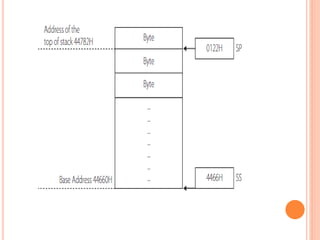
 Stack is an area in memory and data is generally pushed &
popped out of the stack
 8086 also uses LIFO stack
 There is a 16-Bit register called Stack Pointer, which points
to the top of the stack
 Stack segment is like other segment
 upper 16 bits of its base address is available in the SS
register
 A stack address of the form 4466H: 0122H means that the
SS register contains 4466H
 stack pointer contains the number 0122H
 So the physical address of the top of the stack is
44660H + 0122H = 44782H
1.3.2.3 STACK SEGMENT AND STACK POINTER
 Both segments store data
 Extra segment register to store the upper 16 bits of
the base address of the extra segment.
 offset within the data segment is also termed as ‘
effective address’
 effective address calculations depends on effect of
mode of answering.
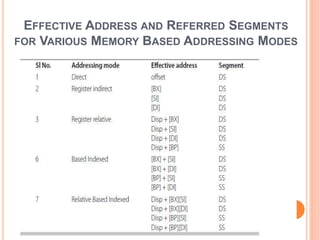
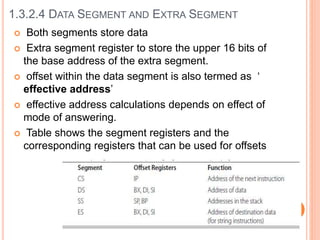
 Table shows the segment registers and the
corresponding registers that can be used for offsets
1.3.2.4 DATA SEGMENT AND EXTRA SEGMENT
ADVANTAGES OF SEGMENTATION
 All address registers are only 16 bit long, though the
physical address is 20 bits
 All address are re-locatable
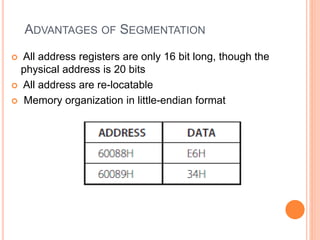
 Memory organization in little-endian format
 In order for computations in assembly language, we need
an Opcode & Operands
 Opcode stands for Operation Code
 Opcode specifies the operation to be performed
 Opcodes operate on data, which are called the Operands
 The way in which operands are specified in an assembly
language is called its “Addressing Mode”.
 Operands can be in registers, in memory or may be in the
instruction itself.
 in case of two operands, one of them can be in memory,
but the other will have to be placed in a register
 data types should match, that is, source, and destination
should both be either bytes or words
1.4 ADDRESSING MODES
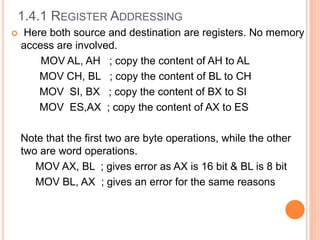
 Here both source and destination are registers. No memory
access are involved.
MOV AL, AH ; copy the content of AH to AL
MOV CH, BL ; copy the content of BL to CH
MOV SI, BX ; copy the content of BX to SI
MOV ES,AX ; copy the content of AX to ES
Note that the first two are byte operations, while the other
two are word operations.
MOV AX, BL ; gives error as AX is 16 bit & BL is 8 bit
MOV BL, AX ; gives an error for the same reasons
1.4.1 REGISTER ADDRESSING
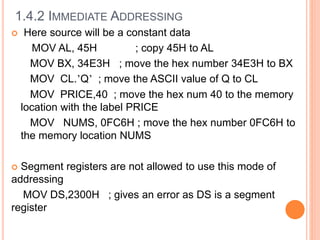
 Here source will be a constant data
MOV AL, 45H ; copy 45H to AL
MOV BX, 34E3H ; move the hex number 34E3H to BX
MOV CL.’Q’ ; move the ASCII value of Q to CL
MOV PRICE,40 ; move the hex num 40 to the memory
location with the label PRICE
MOV NUMS, 0FC6H ; move the hex number 0FC6H to
the memory location NUMS
 Segment registers are not allowed to use this mode of
addressing
MOV DS,2300H ; gives an error as DS is a segment
register
1.4.2 IMMEDIATE ADDRESSING
 Here, either the source or the destination will be a memory address
MOV AX, [2345H] ; move word location 2345H to AX
MOV [1089H], AL ; the byte in AL is moved to location 1086H
 MOV AX , PRICE
 MOV COST,AL
PRICE and COST are labels for memory addresses
1.4.3 DIRECT ADDRESSING
1.4.4REGISTER INDIRECT ADDRESSING
 In this mode , the address of the data is held in a register
 Effective address
 EA=EA= { [BX] / [DI] /[SI]}
 MOV AL,[BX] ; move into AL the content of the location
whose address is in BX
 MOV [SI], CL ;move the content of CL to the address
pointed by SI
 MOV [DI],AX ; move the content of AX to the address
pointed by DI
 In third instruction, AX contains two bytes, so the content
of AL will be moved to the address pointed by DI.
 The content of AH will be moved to the address [D+1]
 Show the location of data in memory, after the
execution of each of these instructions , if the
content of registers are as given
DS= 1112H , AX= EE78H and BX=3400H
MOV [0422H], AL
MOV [0424H],AX
MOV [BX] ,AX
EXAMPLE
1.4.5 REGISTER RELATIVE ADDRESSING
 In relative addressing mode , a number or
displacement is part of the effective address
 EA ={[BX] /[DI] /[SI] /[BP]} + 8 bit or 16 bit displacement
 The displacement can be a 16 bit signed/unsigned
number or an 8 bit sign extended number.
 MOV CL ,10[BX] ; move the content of the address
specified by adding the content of BX and 10
 Like
 MOV CL, [BX+10]
 MOV CL, [BX]+10
1.4.6 BASED INDEXED MODE
 In this mode ,an index register and a base register
together carry the effective address .
 The content of these two registers are added and called
the effective address.
 MOV AL,[BX][SI] ; move the content of the effective
address pointed by [BX] and [SI] into AL
 MOV [BX][DI],CX ;move the content of CX to the effective
address pointed by [BX] and [SI]
1.4.7 RELATIVE BASED INDEXED MODE
 The ‘effective address is the sum of the two registers
and a displacement .
 MOV DL ,5[BX][DI]
 MOV 5[BP][SI], AX
 MOV CL ,COST[BX[[SI]
EXAMPLE
 Find the address of physical memory for the
following instructions if the content of the
required registers are as given below
SS =2344 H, DS =4022H ,
BX =0200H,BP=1402H ,SI=4442H
i)MOV CL,1234H[SI]
i)MOV AL,5[SI[[BP]
EFFECTIVE ADDRESS AND REFERRED SEGMENTS
FOR VARIOUS MEMORY BASED ADDRESSING MODES

Chapter 1 archietecture of 8086

  • 1.
  • 2.
    INTRODUCTION  Need toknow the learning of x86 family of microprocessors  Understand the architecture of the 8086  8086 is a processor catering to 16-bit data (D0 to D15) and having a 20-bit address (A0 to A19)  8086 is a 16-bit processor internally & externally  means its data bus width as well as the bit size of its internal data registers is 16  it can even access external source 16 bits  it also has the capacity to access and work on 8-bit data.
  • 3.
  • 5.
    1.3 BUS INTERFACEUNIT This unit is responsible for  Address Calculations  pre-fetching instructions for the queue and sequencing instructions one by one.
  • 6.
    1.3.1 INSTRUCTION QUEUE Instructions are found in memory  From there it has to be fetched & decoded whenever needed for execution.  in 8086, the queue that fetches instructions ahead of execution time & places them in a 6-byte FIFO queue  This pre-fetching is done when buses are free  Advantage of this is when a particular instruction needs to be executed, it’s a good chance of finding in a queue rather than from memory
  • 7.
    1.3.2 MEMORY SEGMENTATION 8086 has a 20-Bit address bus ( As we have not seen any 20- Bit regsters so far)  general-purpose registers are used as 16 or 8 bit registers  all address registers also are16-bit  Segmentation will be used to take care of this situation  A segment is just an area in memory  so total memory size can be considered to be divided into segments of various sizes.  Idea of dividing memory is called Segmentation  In memory data is stored as bytes  Each byte has a specific address  with 20 address lines, the memory that can be addressed is 220 bytes (1,048,576 Bytes or 1 MB)  8086 can access a physical memory with address ranging from 00000 to FFFFFH.
  • 8.
     20-bit physicaladdress is to be placed on the address bus to access any location in memory.  Memory as a whole is considered to have four different types of segments: 1. data segment 2. code segment 3. stack segment 4. extra segment  Idea of segmentation is to keep data & code separately  code segment contains code only  data is stored in the data segment  extra segment is just another type of data segment used in special way  stack segment is an area in memory which functions and is accessed from the other three segments
  • 9.
    1.3.2.1 SEGMENT REGISTERS Each segments is addressed by an address stored in corresponding segment registers  registers are all 16-bit size  each register stores base address of the corresponding segment  Base address is the starting address of a segment  since segment registers cannot store 20 bits, they store only the upper 16 bits  least significant nibble is implied to zero  How 20 bit physical address obtained if there are only 16 bit registers?  20 bit address of a byte is called Physical address  it is specified as Logical address in the form of two16-bit numbers in the format base address : offset
  • 10.
     Example: Calculationof a physical address from the logical address for a data segment
  • 11.
     Consider thata data byte is stored in a data segment, whose base address is 22220H  Then data segment register will contain the number 2222H.  The data at any location within this segment is referred to an offset with respect to the base address.  If a data at a location has a logical address specified as 2222H:0016H  Then the number 0016H is the offset or displacement w.r.t the base address  For physical address calculation, the BIU appends the segment register content with four binary zeros on the right.  Thus physical address is calculated as: 22220H + 0016H 22236H
  • 12.
     Similar incase for the other segments  offsets are limited to 16Bits  means that the maximum size possible for a segment is only 216 or 64KB  Hence every memory reference by the 8086 will use one of the segment registers (i.e DS, ES, SS, or CS)  combined to form an offset to determine the physical address being accessed.  Fig that highlights a data byte that has the logical address of the form DS: Offset.
  • 13.
     Code segmentis the area of memory where code alone is stored.  offsets in the code segment are referenced by Instruction Pointer. ( a 16-Bit register)  IP sequences the instructions and points to the next instruction to be executed.  If an instruction byte has to be fetched from memory, the bus interface unit performs the address calculation using the contents of CS registers & the IP  This 20-bit address is then placed on the address bus and the instruction byte is fetched.  Hence the logical address for an instruction is of the form CS:IP 1.3.2.2 CODE SEGMENT & INSTRUCTION POINTER
  • 14.
     Stack isan area in memory and data is generally pushed & popped out of the stack  8086 also uses LIFO stack  There is a 16-Bit register called Stack Pointer, which points to the top of the stack  Stack segment is like other segment  upper 16 bits of its base address is available in the SS register  A stack address of the form 4466H: 0122H means that the SS register contains 4466H  stack pointer contains the number 0122H  So the physical address of the top of the stack is 44660H + 0122H = 44782H 1.3.2.3 STACK SEGMENT AND STACK POINTER
  • 16.
     Both segmentsstore data  Extra segment register to store the upper 16 bits of the base address of the extra segment.  offset within the data segment is also termed as ‘ effective address’  effective address calculations depends on effect of mode of answering.  Table shows the segment registers and the corresponding registers that can be used for offsets 1.3.2.4 DATA SEGMENT AND EXTRA SEGMENT
  • 17.
    ADVANTAGES OF SEGMENTATION All address registers are only 16 bit long, though the physical address is 20 bits  All address are re-locatable  Memory organization in little-endian format
  • 18.
     In orderfor computations in assembly language, we need an Opcode & Operands  Opcode stands for Operation Code  Opcode specifies the operation to be performed  Opcodes operate on data, which are called the Operands  The way in which operands are specified in an assembly language is called its “Addressing Mode”.  Operands can be in registers, in memory or may be in the instruction itself.  in case of two operands, one of them can be in memory, but the other will have to be placed in a register  data types should match, that is, source, and destination should both be either bytes or words 1.4 ADDRESSING MODES
  • 19.
     Here bothsource and destination are registers. No memory access are involved. MOV AL, AH ; copy the content of AH to AL MOV CH, BL ; copy the content of BL to CH MOV SI, BX ; copy the content of BX to SI MOV ES,AX ; copy the content of AX to ES Note that the first two are byte operations, while the other two are word operations. MOV AX, BL ; gives error as AX is 16 bit & BL is 8 bit MOV BL, AX ; gives an error for the same reasons 1.4.1 REGISTER ADDRESSING
  • 20.
     Here sourcewill be a constant data MOV AL, 45H ; copy 45H to AL MOV BX, 34E3H ; move the hex number 34E3H to BX MOV CL.’Q’ ; move the ASCII value of Q to CL MOV PRICE,40 ; move the hex num 40 to the memory location with the label PRICE MOV NUMS, 0FC6H ; move the hex number 0FC6H to the memory location NUMS  Segment registers are not allowed to use this mode of addressing MOV DS,2300H ; gives an error as DS is a segment register 1.4.2 IMMEDIATE ADDRESSING
  • 21.
     Here, eitherthe source or the destination will be a memory address MOV AX, [2345H] ; move word location 2345H to AX MOV [1089H], AL ; the byte in AL is moved to location 1086H  MOV AX , PRICE  MOV COST,AL PRICE and COST are labels for memory addresses 1.4.3 DIRECT ADDRESSING
  • 22.
    1.4.4REGISTER INDIRECT ADDRESSING In this mode , the address of the data is held in a register  Effective address  EA=EA= { [BX] / [DI] /[SI]}  MOV AL,[BX] ; move into AL the content of the location whose address is in BX  MOV [SI], CL ;move the content of CL to the address pointed by SI  MOV [DI],AX ; move the content of AX to the address pointed by DI  In third instruction, AX contains two bytes, so the content of AL will be moved to the address pointed by DI.  The content of AH will be moved to the address [D+1]
  • 23.
     Show thelocation of data in memory, after the execution of each of these instructions , if the content of registers are as given DS= 1112H , AX= EE78H and BX=3400H MOV [0422H], AL MOV [0424H],AX MOV [BX] ,AX EXAMPLE
  • 24.
    1.4.5 REGISTER RELATIVEADDRESSING  In relative addressing mode , a number or displacement is part of the effective address  EA ={[BX] /[DI] /[SI] /[BP]} + 8 bit or 16 bit displacement  The displacement can be a 16 bit signed/unsigned number or an 8 bit sign extended number.  MOV CL ,10[BX] ; move the content of the address specified by adding the content of BX and 10  Like  MOV CL, [BX+10]  MOV CL, [BX]+10
  • 25.
    1.4.6 BASED INDEXEDMODE  In this mode ,an index register and a base register together carry the effective address .  The content of these two registers are added and called the effective address.  MOV AL,[BX][SI] ; move the content of the effective address pointed by [BX] and [SI] into AL  MOV [BX][DI],CX ;move the content of CX to the effective address pointed by [BX] and [SI]
  • 26.
    1.4.7 RELATIVE BASEDINDEXED MODE  The ‘effective address is the sum of the two registers and a displacement .  MOV DL ,5[BX][DI]  MOV 5[BP][SI], AX  MOV CL ,COST[BX[[SI]
  • 27.
    EXAMPLE  Find theaddress of physical memory for the following instructions if the content of the required registers are as given below SS =2344 H, DS =4022H , BX =0200H,BP=1402H ,SI=4442H i)MOV CL,1234H[SI] i)MOV AL,5[SI[[BP]
  • 28.
    EFFECTIVE ADDRESS ANDREFERRED SEGMENTS FOR VARIOUS MEMORY BASED ADDRESSING MODES