Nerve Cells & Nerve Impulses The Cells of the Nervous System
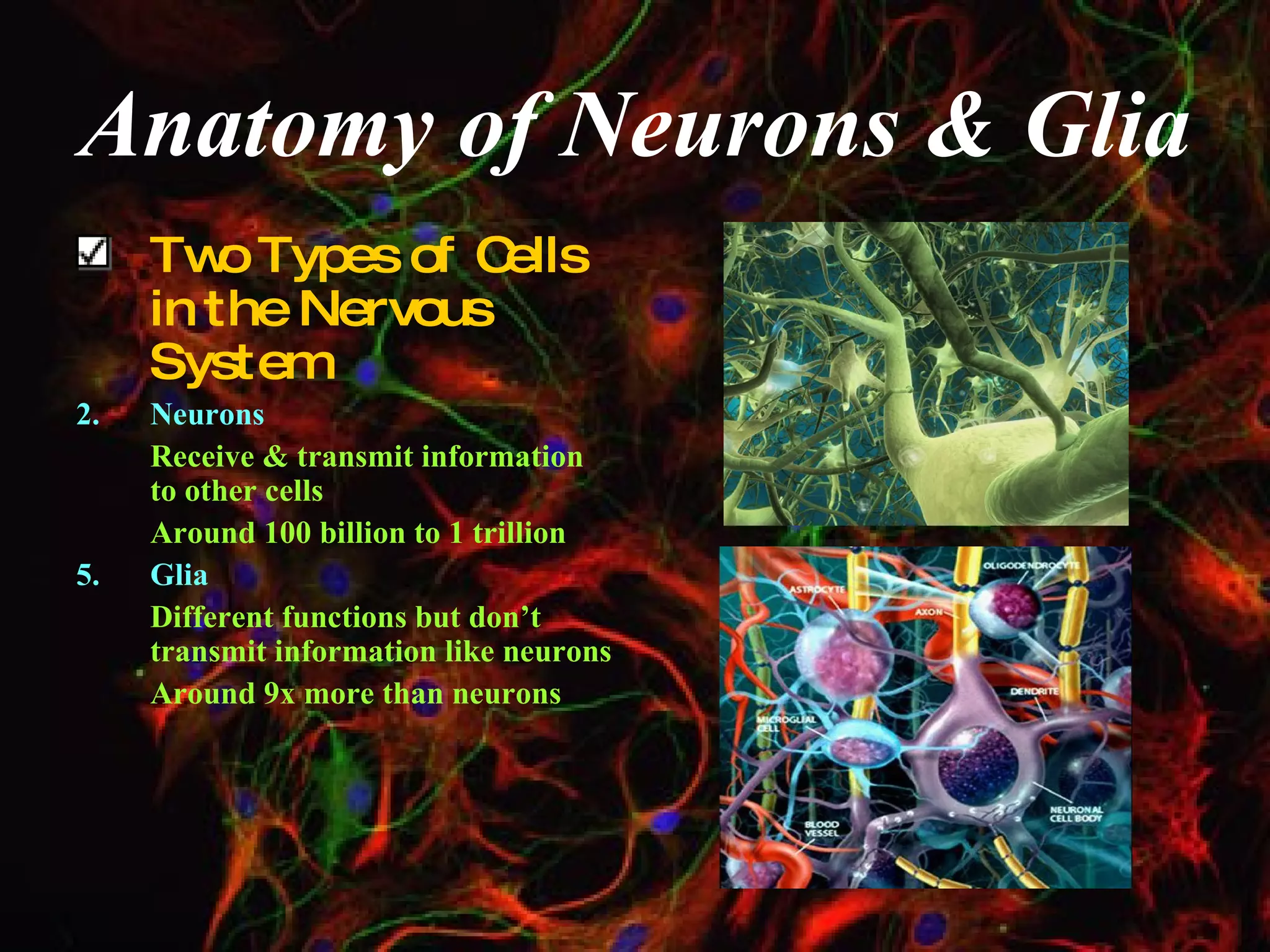
Anatomy of Neurons & Glia Two Types of Cells in the Nervous System Neurons Receive & transmit information to other cells Around 100 billion to 1 trillion Glia Different functions but don’t transmit information like neurons Around 9x more than neurons
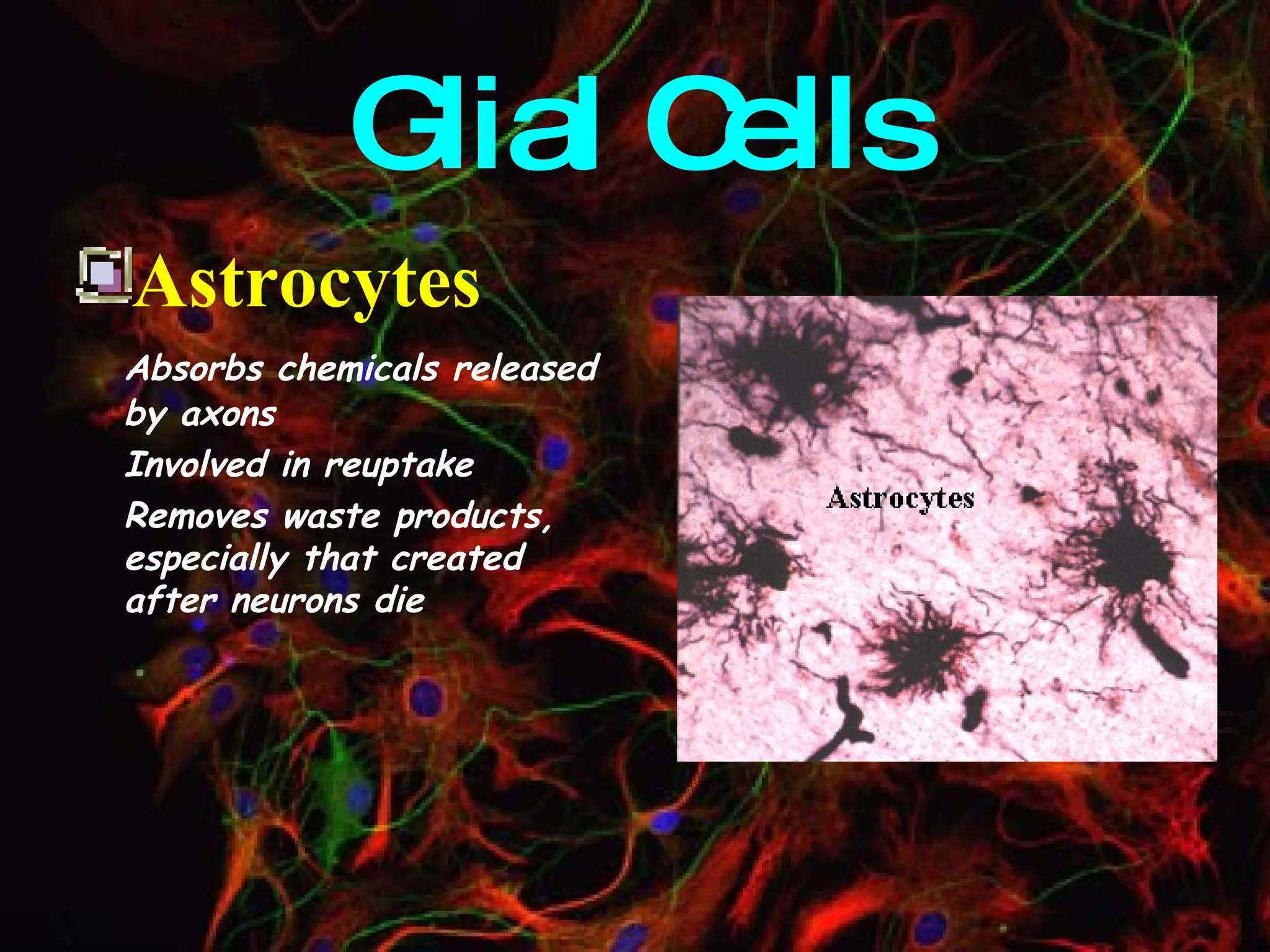
Glial Cells Astrocytes Absorbs chemicals released by axons Involved in reuptake Removes waste products, especially that created after neurons die
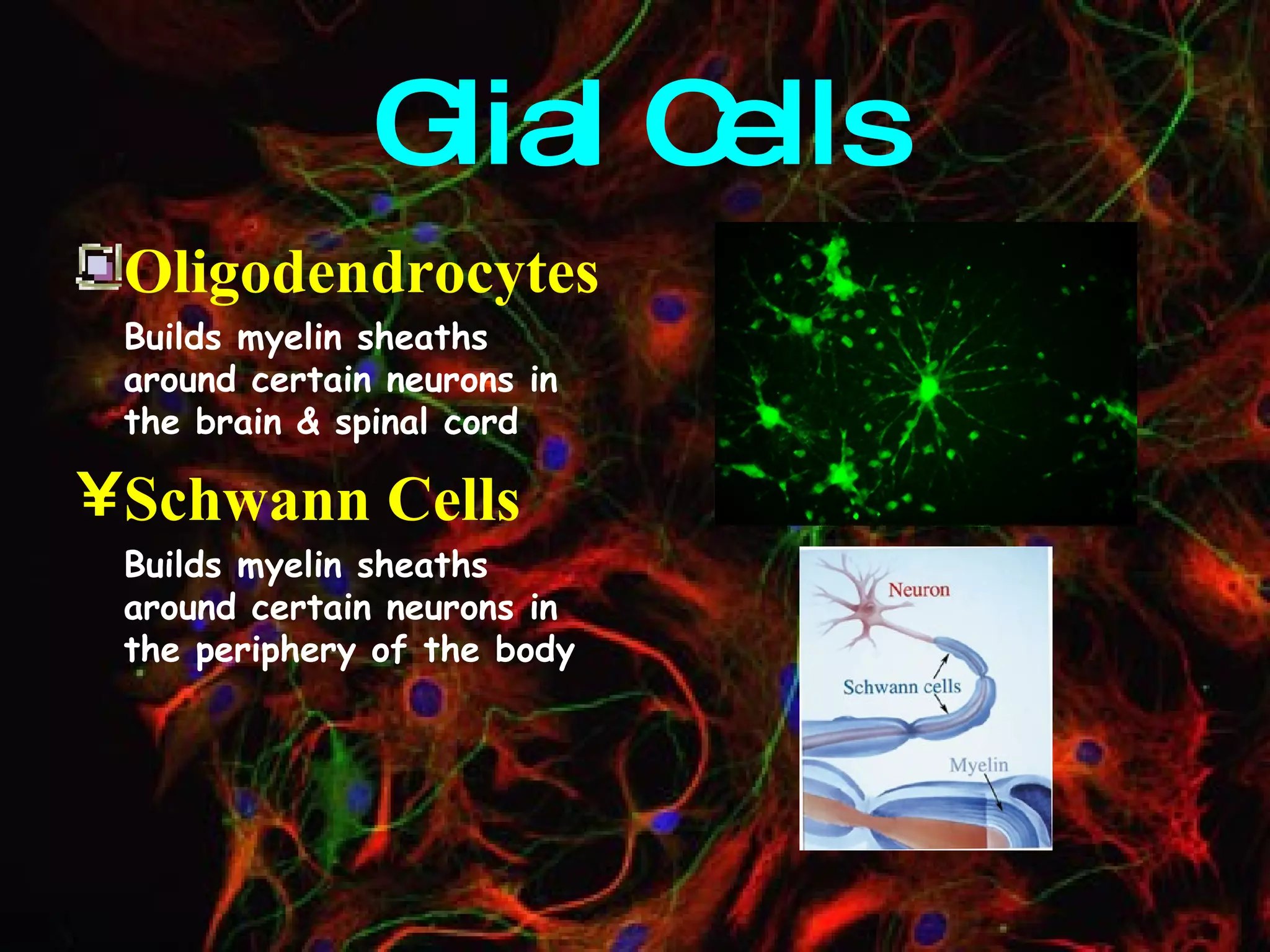
Glial Cells Oligodendrocytes Builds myelin sheaths around certain neurons in the brain & spinal cord Schwann Cells Builds myelin sheaths around certain neurons in the periphery of the body
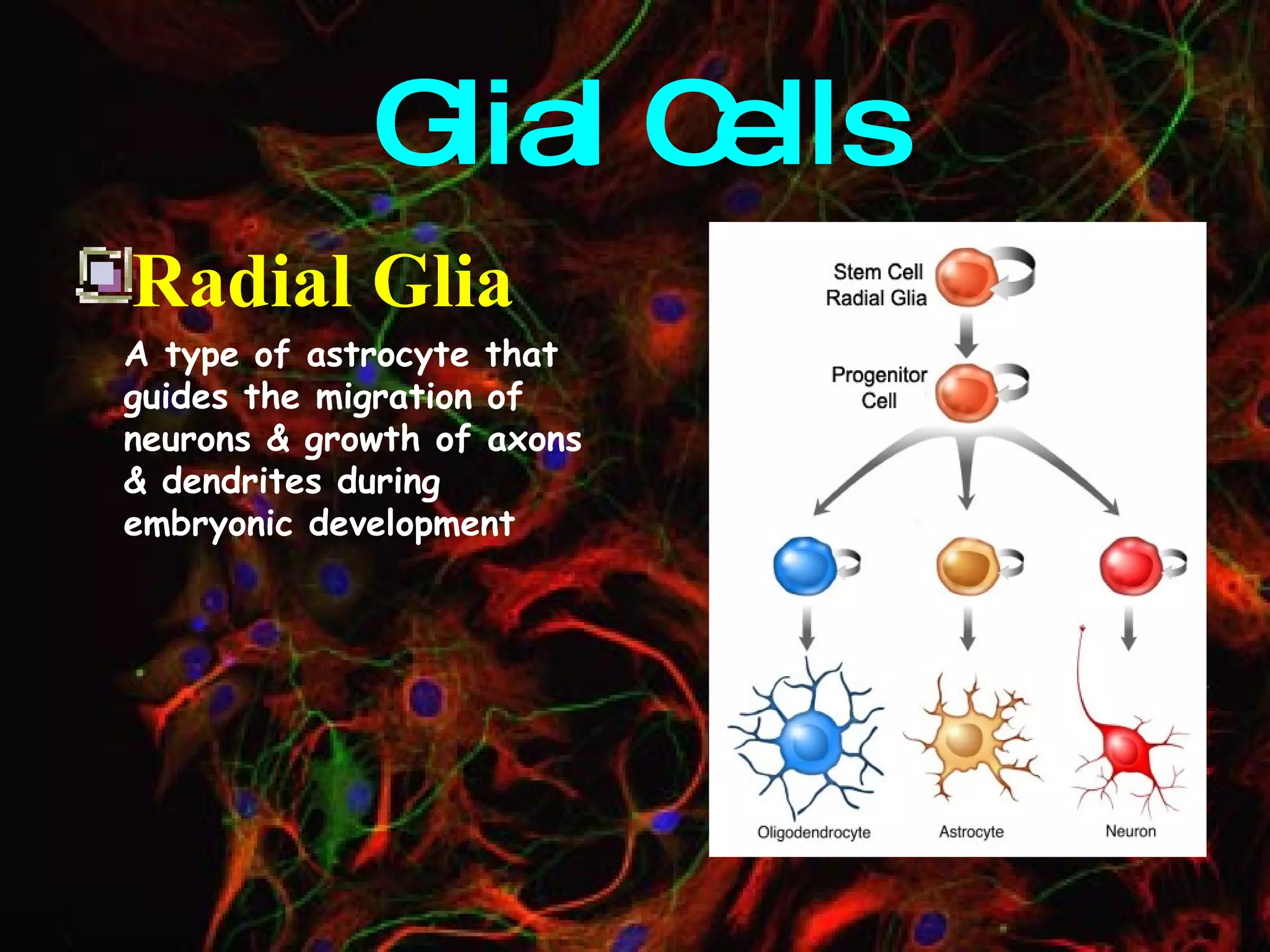
Glial Cells Radial Glia A type of astrocyte that guides the migration of neurons & growth of axons & dendrites during embryonic development
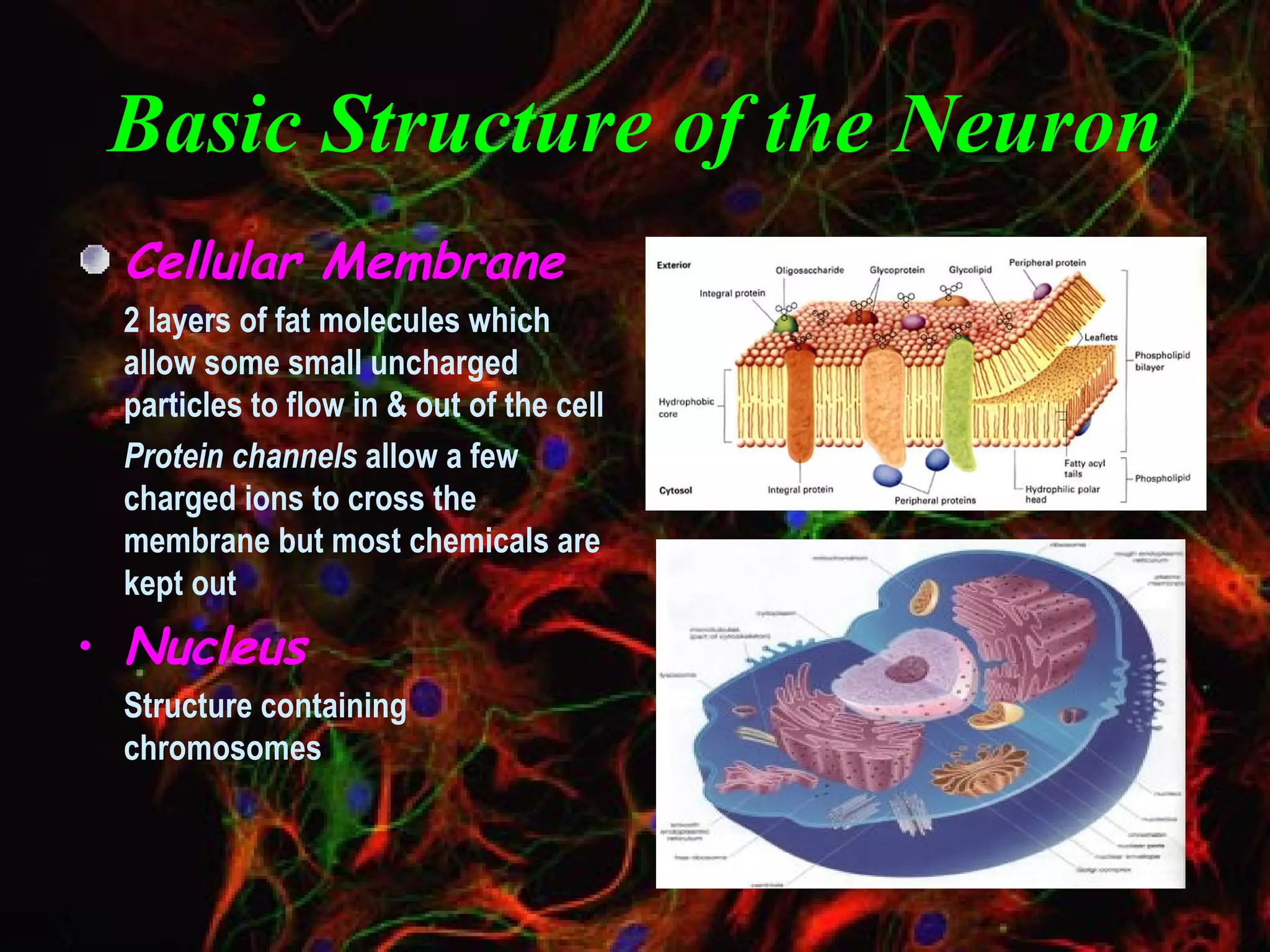
Basic Structure of the Neuron Cellular Membrane 2 layers of fat molecules which allow some small uncharged particles to flow in & out of the cell Protein channels  allow a few charged ions to cross the membrane but most chemicals are kept out Nucleus Structure containing chromosomes
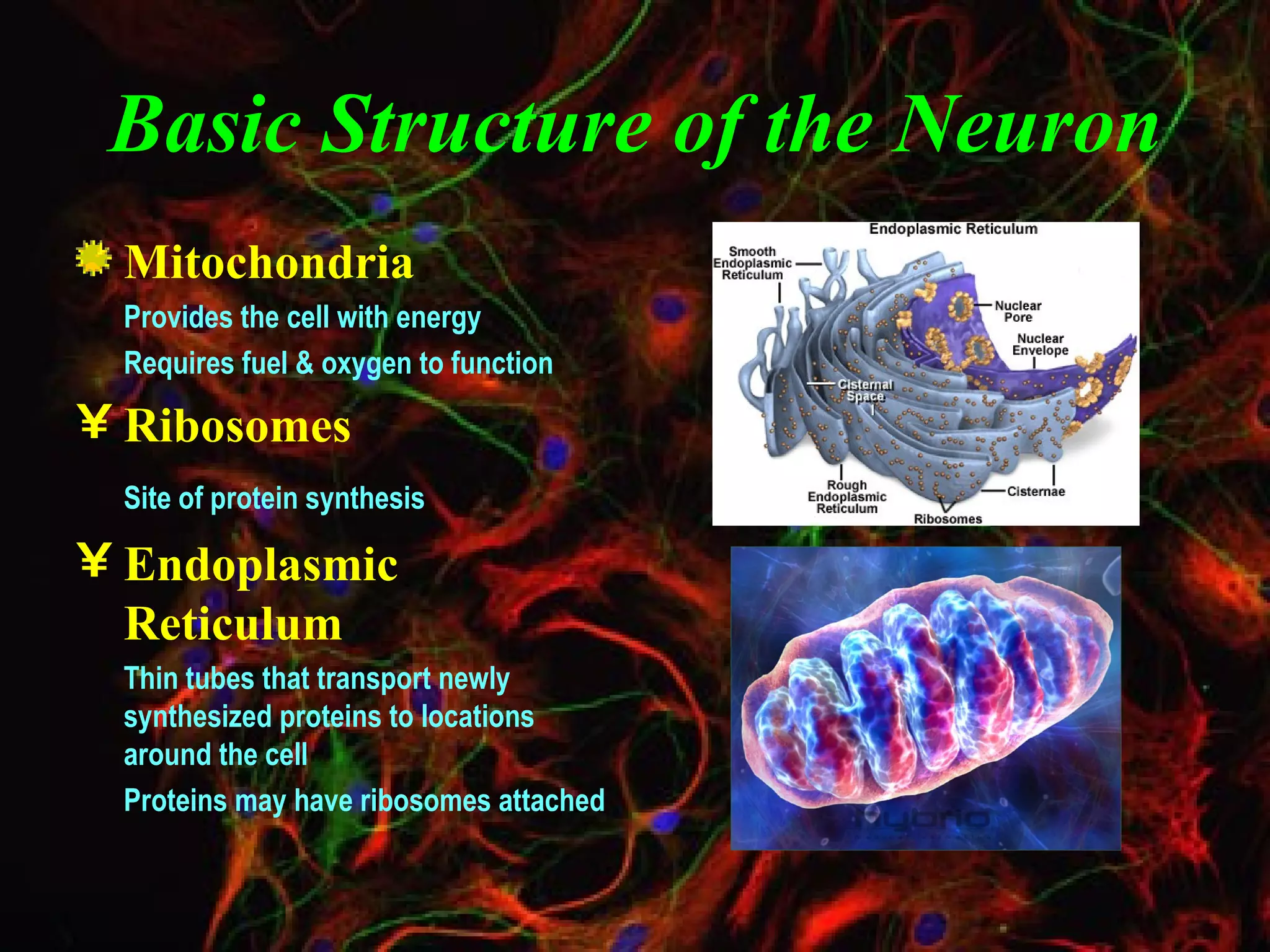
Basic Structure of the Neuron Mitochondria Provides the cell with energy Requires fuel & oxygen to function Ribosomes Site of protein synthesis Endoplasmic Reticulum Thin tubes that transport newly synthesized proteins to locations around the cell Proteins may have ribosomes attached
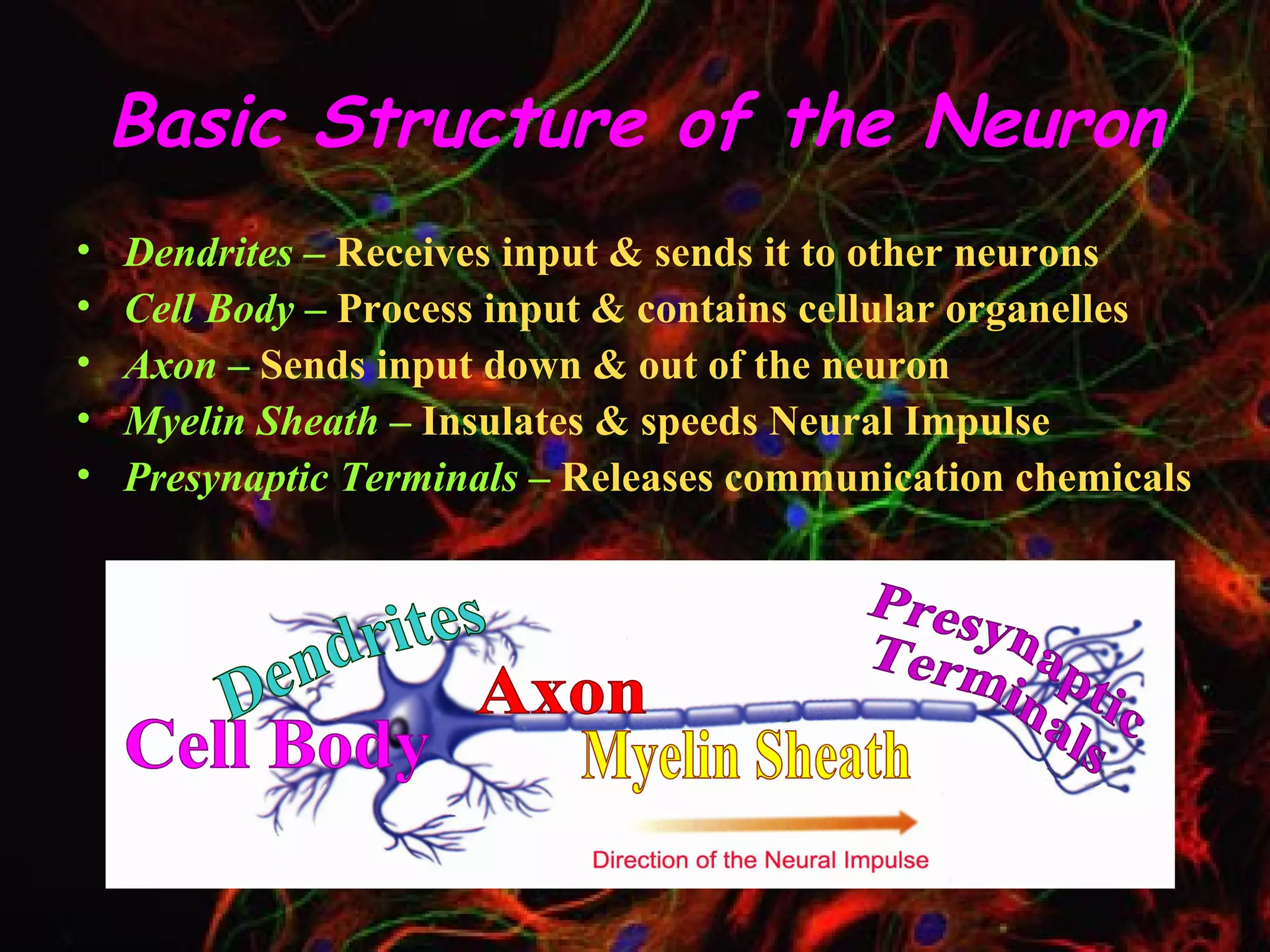
Basic Structure of the Neuron Dendrites –  Receives input & sends it to other neurons Cell Body –  Process input & contains cellular organelles Axon –  Sends input down & out of the neuron Myelin Sheath –  Insulates & speeds Neural Impulse Presynaptic Terminals –  Releases communication chemicals Dendrites Cell Body Axon Myelin Sheath Presynaptic Terminals
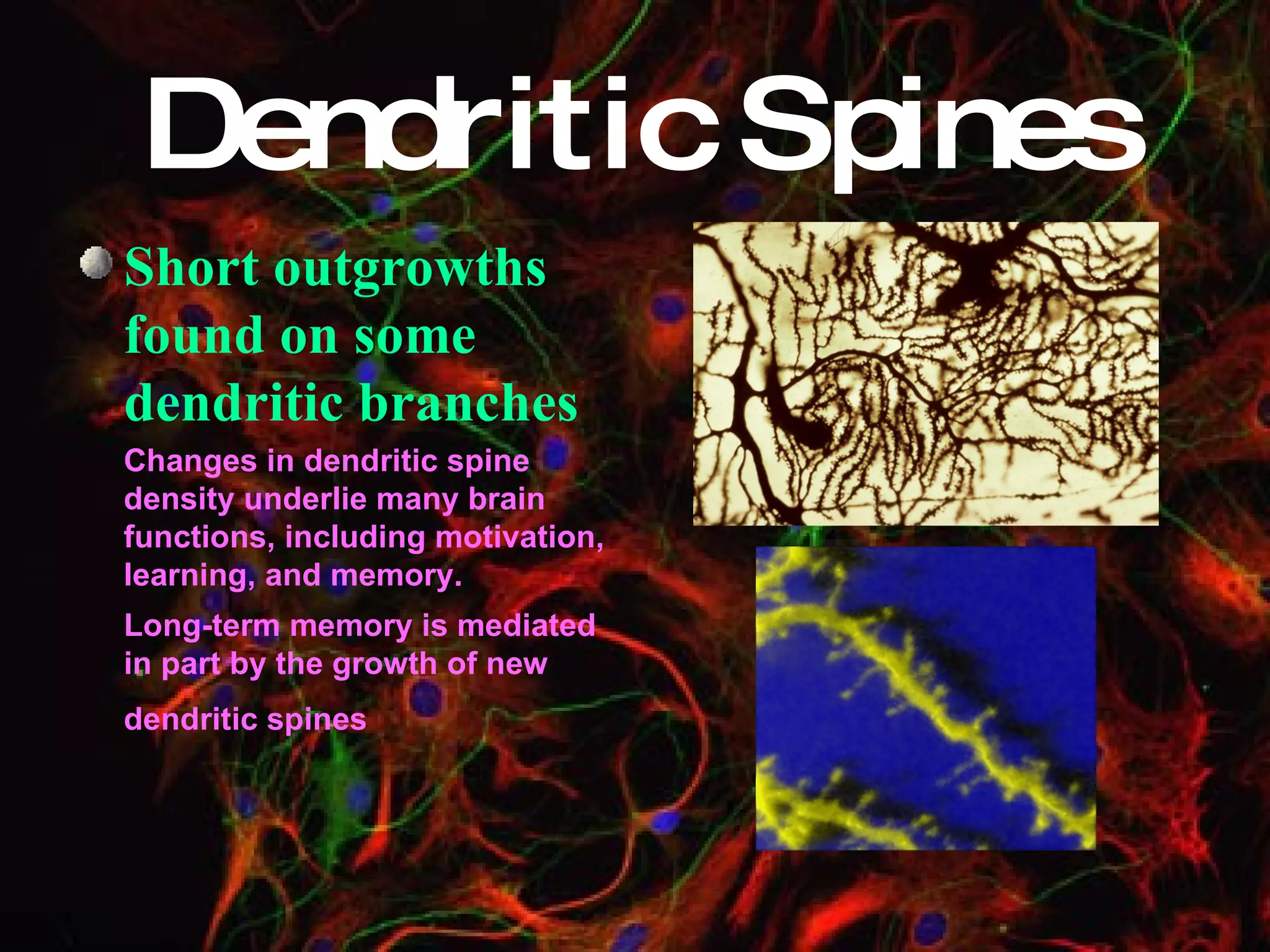
Dendritic Spines Short outgrowths found on some dendritic branches Changes in dendritic spine density underlie many brain functions, including motivation, learning, and memory.   Long-term memory is mediated in part by the growth of new dendritic spines
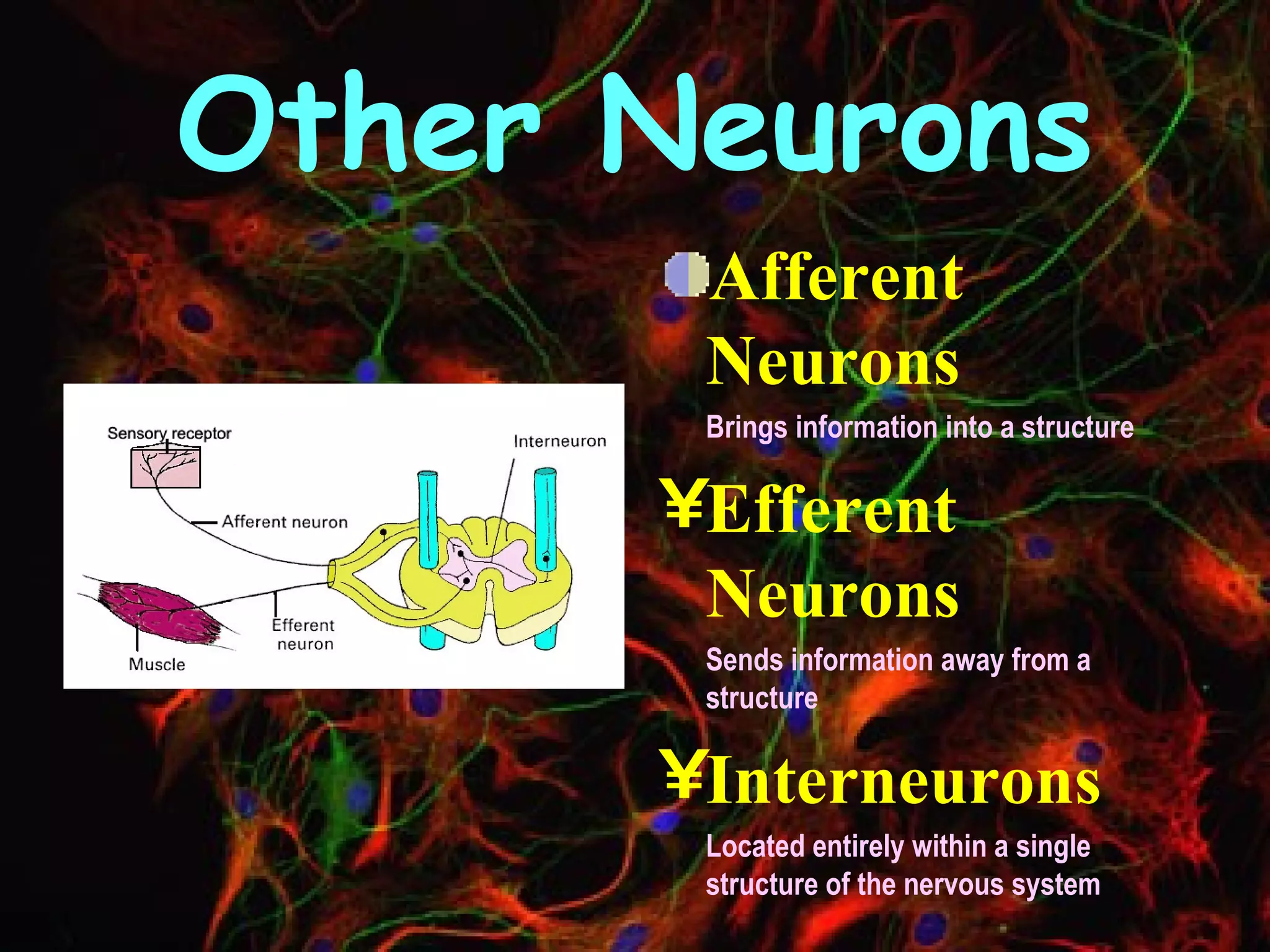
Other Neurons Afferent Neurons Brings information into a structure Efferent Neurons Sends information away from a structure Interneurons Located entirely within a single structure of the nervous system
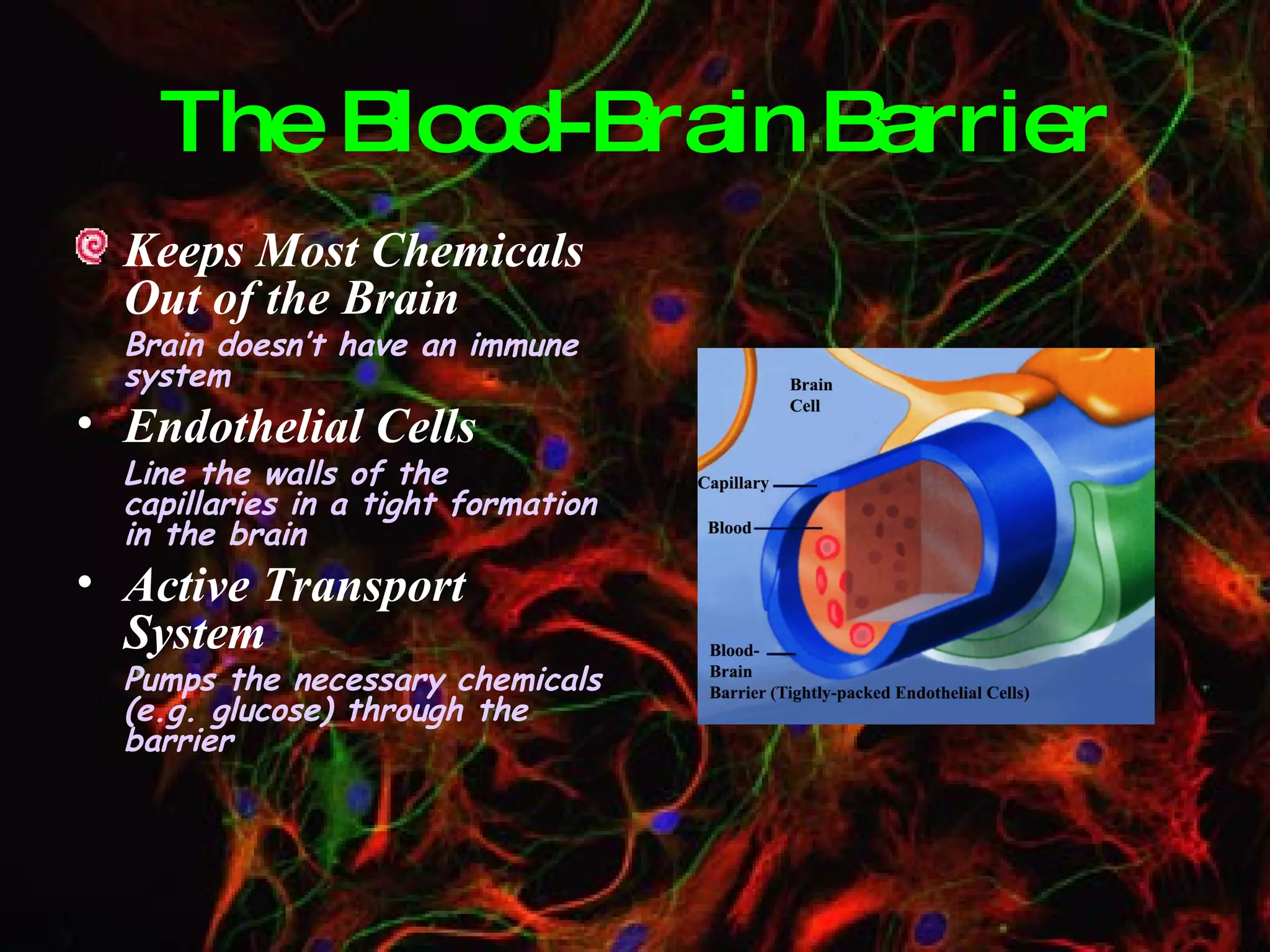
The Blood-Brain Barrier Keeps Most Chemicals Out of the Brain Brain doesn’t have an immune system Endothelial Cells Line the walls of the capillaries in a tight formation in the brain Active Transport System Pumps the necessary chemicals (e.g. glucose) through the barrier
The Neural Impulse Important Terms Electrical Gradient –  the difference in the electrical charge inside & outside of the cell Polarization –  difference between an electrical charge between 2 locations Resting Potential –  when the electrical voltage is negatively higher inside relative to the outside Selective Permeability –  a cellular membrane that allows some, not all, molecules to pass freely Sodium-Potassium Pump –  a protein complex on the neural membrane that transports 3 sodium ions outside of the cell while drawing 2 potassium ions into the cell in active transport Concentration Gradient –  the difference in the distribution of ions between the inside & outside of the membrane Hyperpolarization –  when the negative charge inside of the axon increases Depolarization –  when the negative charge inside of the axon decreases Threshold of Excitation –  the level that a depolarization must reach for an action potential to occur Action Potential –  when depolarization meets or goes beyond the threshold of excitation All-or-none Law –  a neuron must have enough stimulation of a certain type to fire or it will not fire Refractory Period –  period immediately after an action potential when the neuron will resist another action potential
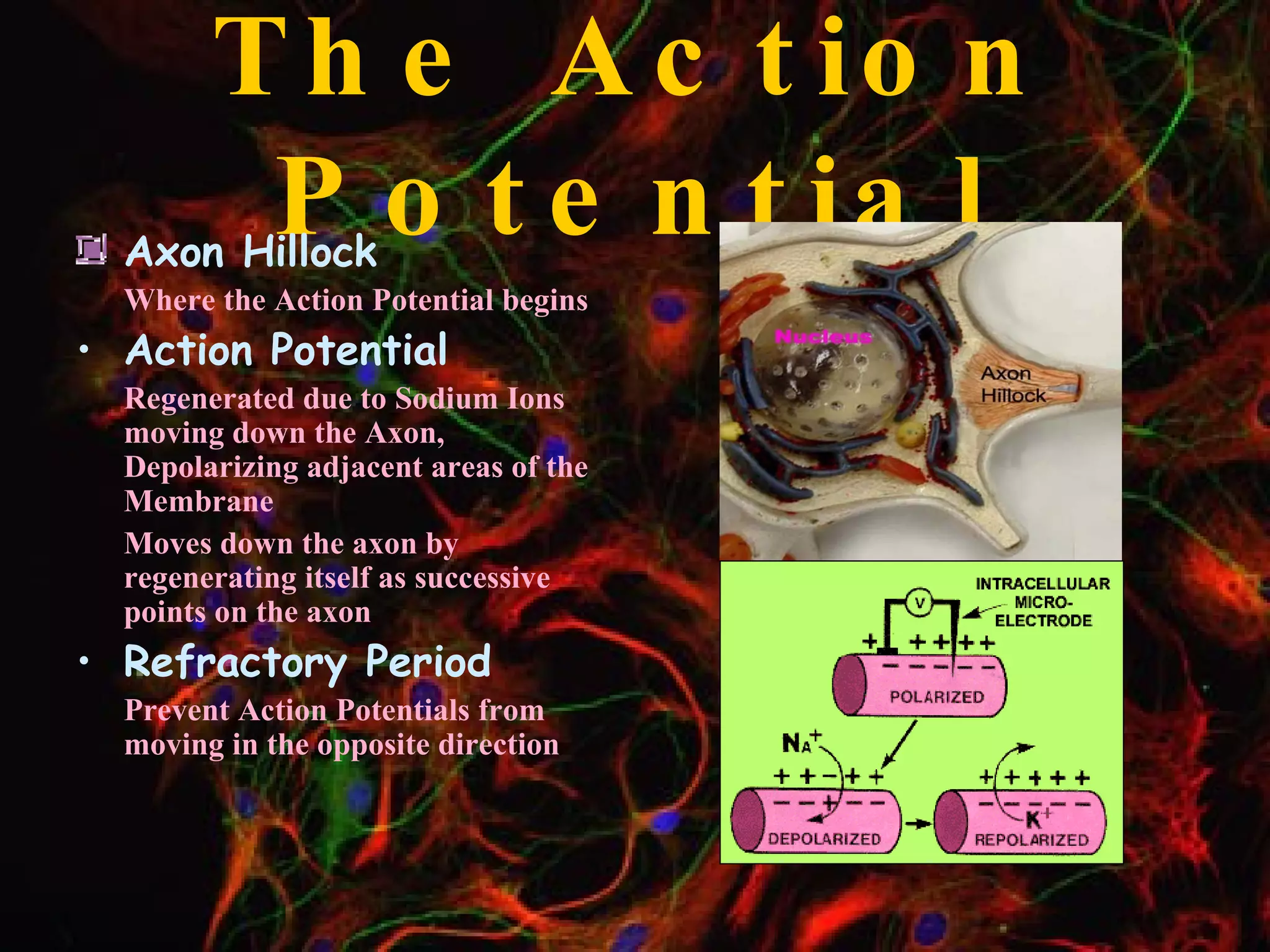
The Action Potential Axon Hillock Where the Action Potential begins Action Potential Regenerated due to Sodium Ions moving down the Axon, Depolarizing adjacent areas of the Membrane Moves down the axon by regenerating itself as successive points on the axon Refractory Period Prevent Action Potentials from moving in the opposite direction
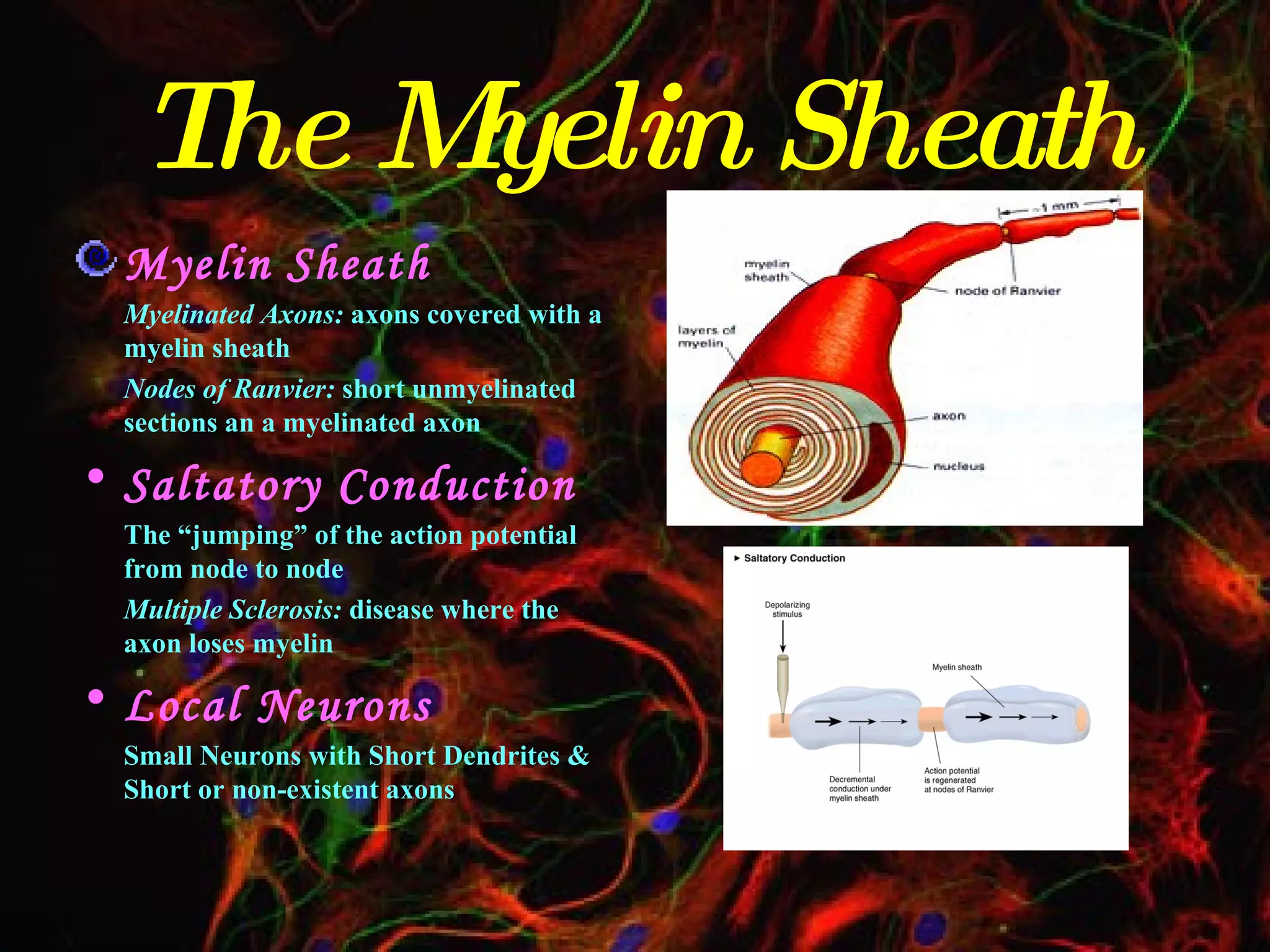
The Myelin Sheath Myelin Sheath Myelinated Axons:  axons covered with a myelin sheath Nodes of Ranvier:  short unmyelinated sections an a myelinated axon Saltatory Conduction The “jumping” of the action potential from node to node Multiple Sclerosis:  disease where the axon loses myelin Local Neurons Small Neurons with Short Dendrites & Short or non-existent axons

Chapter 02: Genetics & Behavior

  • 1.
    Nerve Cells &Nerve Impulses The Cells of the Nervous System
  • 2.
    Anatomy of Neurons& Glia Two Types of Cells in the Nervous System Neurons Receive & transmit information to other cells Around 100 billion to 1 trillion Glia Different functions but don’t transmit information like neurons Around 9x more than neurons
  • 3.
    Glial Cells AstrocytesAbsorbs chemicals released by axons Involved in reuptake Removes waste products, especially that created after neurons die
  • 4.
    Glial Cells OligodendrocytesBuilds myelin sheaths around certain neurons in the brain & spinal cord Schwann Cells Builds myelin sheaths around certain neurons in the periphery of the body
  • 5.
    Glial Cells RadialGlia A type of astrocyte that guides the migration of neurons & growth of axons & dendrites during embryonic development
  • 6.
    Basic Structure ofthe Neuron Cellular Membrane 2 layers of fat molecules which allow some small uncharged particles to flow in & out of the cell Protein channels allow a few charged ions to cross the membrane but most chemicals are kept out Nucleus Structure containing chromosomes
  • 7.
    Basic Structure ofthe Neuron Mitochondria Provides the cell with energy Requires fuel & oxygen to function Ribosomes Site of protein synthesis Endoplasmic Reticulum Thin tubes that transport newly synthesized proteins to locations around the cell Proteins may have ribosomes attached
  • 8.
    Basic Structure ofthe Neuron Dendrites – Receives input & sends it to other neurons Cell Body – Process input & contains cellular organelles Axon – Sends input down & out of the neuron Myelin Sheath – Insulates & speeds Neural Impulse Presynaptic Terminals – Releases communication chemicals Dendrites Cell Body Axon Myelin Sheath Presynaptic Terminals
  • 9.
    Dendritic Spines Shortoutgrowths found on some dendritic branches Changes in dendritic spine density underlie many brain functions, including motivation, learning, and memory. Long-term memory is mediated in part by the growth of new dendritic spines
  • 10.
    Other Neurons AfferentNeurons Brings information into a structure Efferent Neurons Sends information away from a structure Interneurons Located entirely within a single structure of the nervous system
  • 11.
    The Blood-Brain BarrierKeeps Most Chemicals Out of the Brain Brain doesn’t have an immune system Endothelial Cells Line the walls of the capillaries in a tight formation in the brain Active Transport System Pumps the necessary chemicals (e.g. glucose) through the barrier
  • 12.
    The Neural ImpulseImportant Terms Electrical Gradient – the difference in the electrical charge inside & outside of the cell Polarization – difference between an electrical charge between 2 locations Resting Potential – when the electrical voltage is negatively higher inside relative to the outside Selective Permeability – a cellular membrane that allows some, not all, molecules to pass freely Sodium-Potassium Pump – a protein complex on the neural membrane that transports 3 sodium ions outside of the cell while drawing 2 potassium ions into the cell in active transport Concentration Gradient – the difference in the distribution of ions between the inside & outside of the membrane Hyperpolarization – when the negative charge inside of the axon increases Depolarization – when the negative charge inside of the axon decreases Threshold of Excitation – the level that a depolarization must reach for an action potential to occur Action Potential – when depolarization meets or goes beyond the threshold of excitation All-or-none Law – a neuron must have enough stimulation of a certain type to fire or it will not fire Refractory Period – period immediately after an action potential when the neuron will resist another action potential
  • 13.
    The Action PotentialAxon Hillock Where the Action Potential begins Action Potential Regenerated due to Sodium Ions moving down the Axon, Depolarizing adjacent areas of the Membrane Moves down the axon by regenerating itself as successive points on the axon Refractory Period Prevent Action Potentials from moving in the opposite direction
  • 14.
    The Myelin SheathMyelin Sheath Myelinated Axons: axons covered with a myelin sheath Nodes of Ranvier: short unmyelinated sections an a myelinated axon Saltatory Conduction The “jumping” of the action potential from node to node Multiple Sclerosis: disease where the axon loses myelin Local Neurons Small Neurons with Short Dendrites & Short or non-existent axons