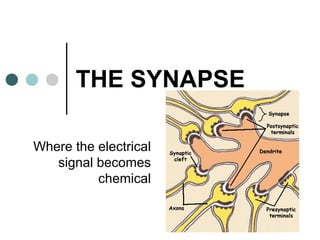
THE SYNAPSE
Where the electrical
signal becomes
chemical
Nervous System Divisions
 We discussed the nervous system as
an input-output device both on the
cellular level and system level
 Remember that there are three types
of neural cells:
sensory neurons take in signals
interneurons process signals
motor neurons send out signals
Synaptic transmission: communication between neurons
 The synapse is the meeting
point between two neurons.
 The outgoing signal from the
presynaptic neuron is
passed to the postsynaptic
neuron.
 The signal comes from the
presynaptic (axon / dendrite)
and goes into the postsynaptic
(axon / dendrite)
 There are two kinds of synapses that
connect neurons.
 Electrical synapses are direct connections
between neurons.
 Chemical synapses are small gaps
between neurons where chemicals are
triggered to diffuse.
Electrical vs. Chemical Synapses
Electrical Synapses
 Pores connect the
two cells.
 Ions from the
presynaptic action
potential diffuse
directly into the
postsynaptic neuron.
 These signals are
transmitted fast!
Chemical Synapse
 When the action potential reaches the synapse,
it triggers the release of little bubbles called
vesicles.
 The vesicles contain chemical signals called
neurotransmitters. They are bigger, and
diffuse slower, than ions.
 Neurotransmitters must be received by specific
receptors in the post-synaptic neuron.
Chemical Synapse
1. Action potential in presynaptic neuron.
2. Vesicle release is triggered.
3. Neurotransmitters release into synapse.
4. Neurotransmitters bind to receptors.
5. Ion channels are triggered to open.
1. Action potential arrives at
terminal button
Membrane receptor
for neurotransmitter
Vesicle storing
neurotransmitter
© 2008 Paul Billiet ODWS
Ca2+
Ca2+
Ca2+
Ca2+
2. Vesicles fuse
with membrane
3. Neurotransmitter is
released; diffuses across
gap.
© 2008 Paul Billiet ODWS
5. Ion channels are
triggered to open
4. Neurotransmitter
binds to receptors on
the postsynaptic neuron
© 2008 Paul Billiet ODWS
7. Neurotransmitter
destroyed by
enzymes in the cleft.
Stops signal being
perpetuated.
6. Action potential
generated which
travels down the
postsynaptic cell.
© 2008 Paul Billiet ODWS
Why Chemical Synapses?
 Chemical synapses are slower than
electrical synapses, so why does our
body rely on them?
 Check out your handout on
neurotransmitters to see some ideas.

The Synapse

  • 1.
    THE SYNAPSE Where theelectrical signal becomes chemical
  • 2.
    Nervous System Divisions We discussed the nervous system as an input-output device both on the cellular level and system level  Remember that there are three types of neural cells: sensory neurons take in signals interneurons process signals motor neurons send out signals
  • 3.
  • 4.
     The synapseis the meeting point between two neurons.  The outgoing signal from the presynaptic neuron is passed to the postsynaptic neuron.  The signal comes from the presynaptic (axon / dendrite) and goes into the postsynaptic (axon / dendrite)
  • 5.
     There aretwo kinds of synapses that connect neurons.  Electrical synapses are direct connections between neurons.  Chemical synapses are small gaps between neurons where chemicals are triggered to diffuse. Electrical vs. Chemical Synapses
  • 6.
  • 7.
    Electrical Synapses  Poresconnect the two cells.  Ions from the presynaptic action potential diffuse directly into the postsynaptic neuron.  These signals are transmitted fast!
  • 8.
    Chemical Synapse  Whenthe action potential reaches the synapse, it triggers the release of little bubbles called vesicles.  The vesicles contain chemical signals called neurotransmitters. They are bigger, and diffuse slower, than ions.  Neurotransmitters must be received by specific receptors in the post-synaptic neuron.
  • 9.
    Chemical Synapse 1. Actionpotential in presynaptic neuron. 2. Vesicle release is triggered. 3. Neurotransmitters release into synapse. 4. Neurotransmitters bind to receptors. 5. Ion channels are triggered to open.
  • 10.
    1. Action potentialarrives at terminal button Membrane receptor for neurotransmitter Vesicle storing neurotransmitter © 2008 Paul Billiet ODWS
  • 11.
    Ca2+ Ca2+ Ca2+ Ca2+ 2. Vesicles fuse withmembrane 3. Neurotransmitter is released; diffuses across gap. © 2008 Paul Billiet ODWS
  • 12.
    5. Ion channelsare triggered to open 4. Neurotransmitter binds to receptors on the postsynaptic neuron © 2008 Paul Billiet ODWS
  • 13.
    7. Neurotransmitter destroyed by enzymesin the cleft. Stops signal being perpetuated. 6. Action potential generated which travels down the postsynaptic cell. © 2008 Paul Billiet ODWS
  • 15.
    Why Chemical Synapses? Chemical synapses are slower than electrical synapses, so why does our body rely on them?  Check out your handout on neurotransmitters to see some ideas.