Purposes and Payoffs of Listening Learn Relate Influence Play Help Purposes Payoffs
Stages of Listening Process Listening is not the same as hearing Hearing is passive, listening is active Five stages Receiving Understanding Remembering Evaluating Responding
Stages of Listening - Receiving Hearing and attending to verbal and nonverbal  Focus Attention on Speaker’s Verbal and Nonverbal Cues (volume, rate, expressions) Avoid Distractions Focus on Speaker, Not What You’ll Say Next Avoid Interrupting—maintain your role Microsoft Image
Learning and deciphering meaning, thoughts and emotional tone expressed Relate New Information to What You Know See Speaker’s Point of View Ask Questions for Clarification Paraphrase Speaker’s Ideas Stages of Listening - Understanding
Remembering and Retaining Needs to take place to have listening occur Memory is reconstructive, not reproductive Identify Central Ideas and Major Support Summarize the Message Repeat Names and Key Concepts Stages of Listening - Remembering Microsoft Image
Judging and criticizing Evaluation of the message  Resist Premature Evaluation Give Speaker Benefit of the Doubt Distinguish Facts from Inferences Identify Speaker’s Biases and/or Prejudices Stages of Listening - Evaluating
Two Phases:  during and after message Support the Speaker with Back-Channeling Express Support for Speaker Respond Honestly Even in Disagreement Own Your Responses Provide a Supportive Atmosphere Stages of Listening - Responding
Listening is a Collection of Skills All Five Stages Overlap Listening is Never Perfect Listening is Situational Implications of the Model of Listening Microsoft Image
Styles of Listening  Empathic and Objective Do you need to understand, identify with speaker or hold to real world objectives? Punctuate from Speaker’s Point of View See as speaker does Engage in Equal, Two-Way Conversations Eliminate barriers (physical and psychological) Seek to Understand Thoughts and Feelings Avoid “Offensive Listening” Looking for bits and pieces to attack with Strive to be Objective, look at context Microsoft Image
Styles of Listening Nonjudgmental and Critical Keep Open Mind, suspend judgment Avoid Filtering or Oversimplifying Hear the entire message, not just the good parts Recognize Own Biases Don’t let your own thoughts, attitudes, culture interfere with taking it from speaker’s POV Avoid Uncritical Listening Listen to everything, ask for adequate info before judging Microsoft Image
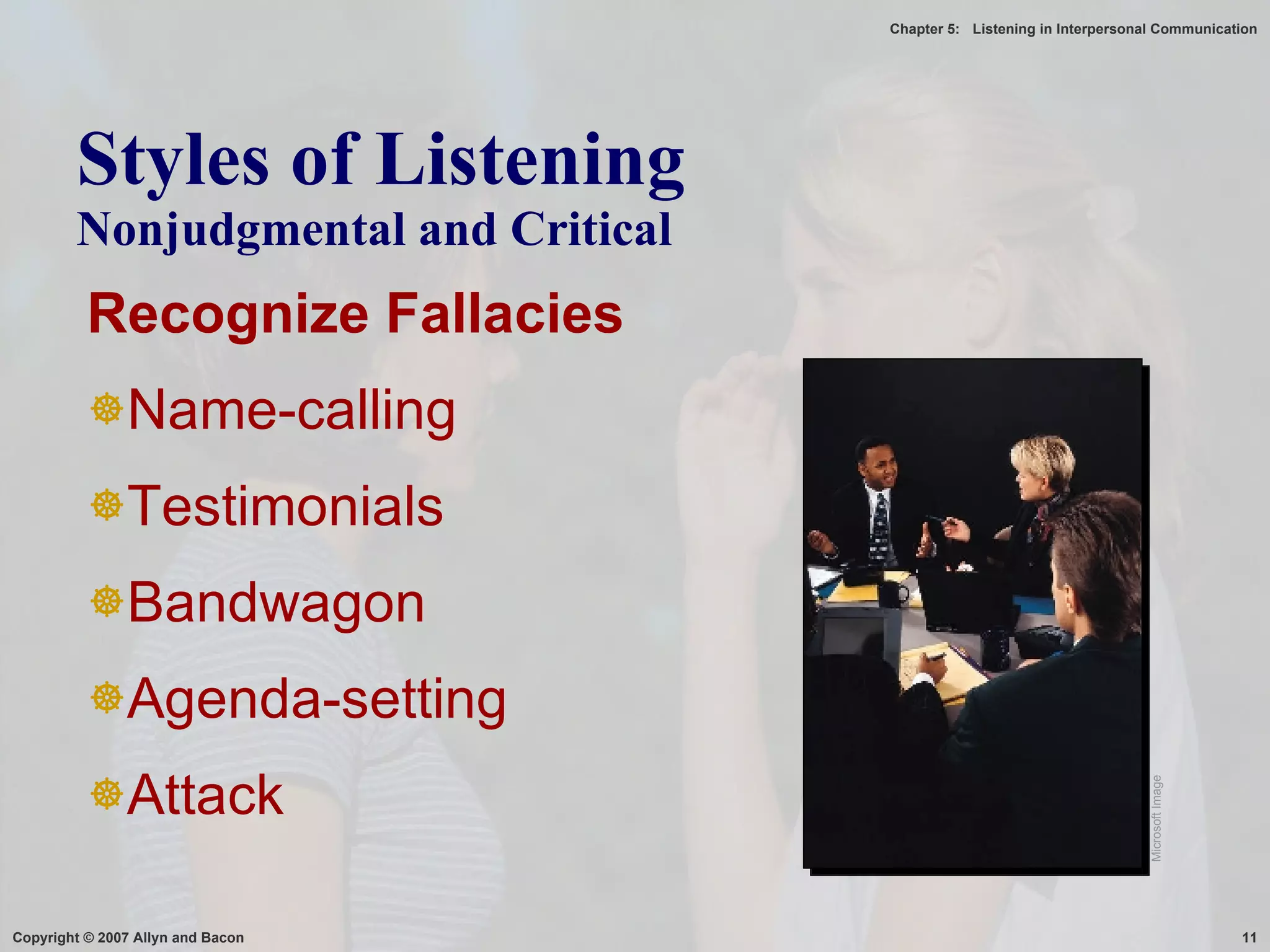
Styles of Listening Nonjudgmental and Critical Recognize Fallacies Name-calling Testimonials Bandwagon Agenda-setting Attack Microsoft Image
Styles of Listening  Surface and Depth Surface:  literal meaning Depth:  beyond surface Focus on Verbal and Nonverbal Listen for Content and Relational Messages Note Statements that Refer Back to Speaker Don’t Disregard Literal Meanings
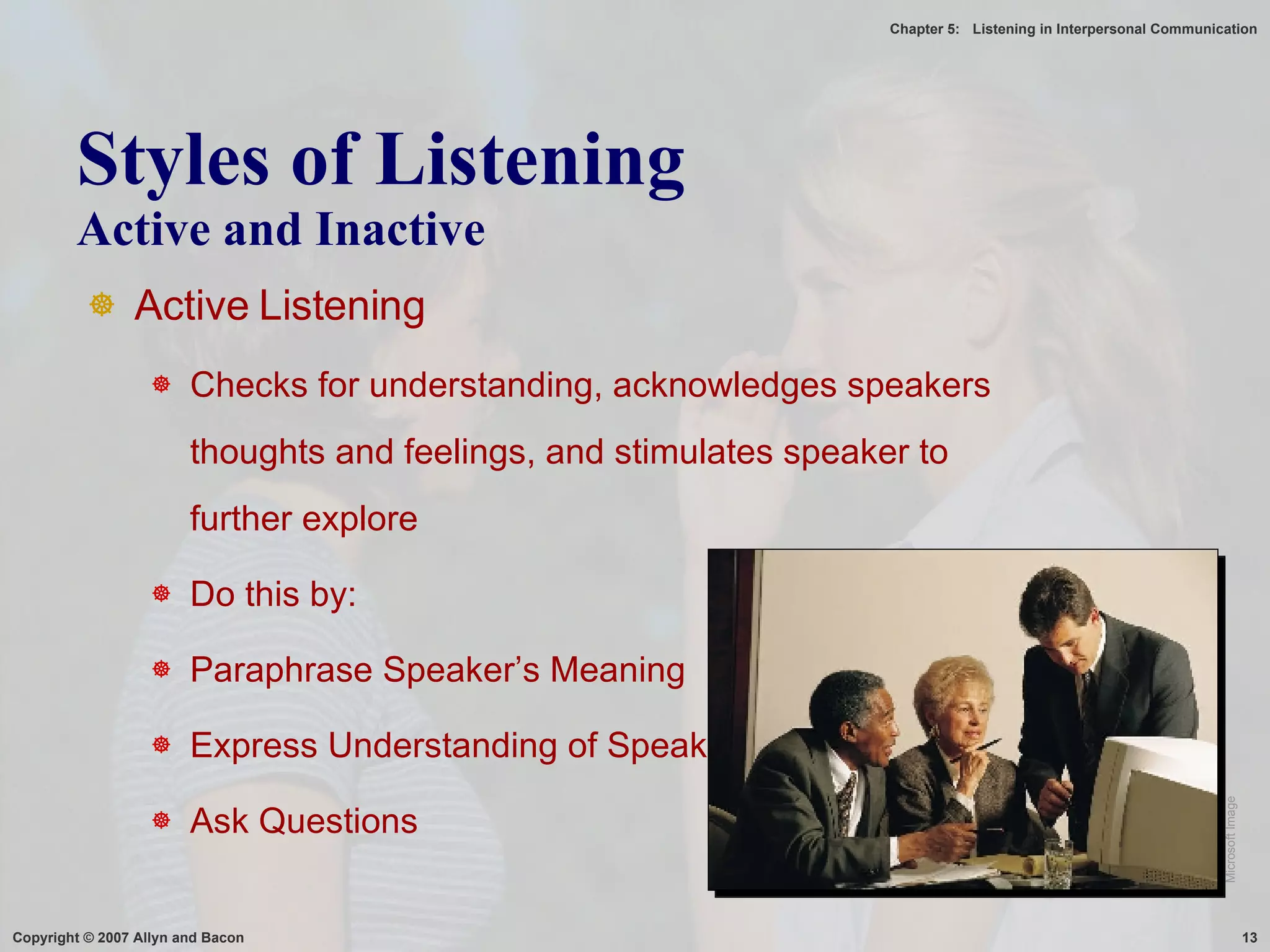
Styles of Listening  Active and Inactive Active Listening Checks for understanding, acknowledges speakers thoughts and feelings, and stimulates speaker to further explore Do this by: Paraphrase Speaker’s Meaning Express Understanding of Speaker’s Feelings Ask Questions Microsoft Image
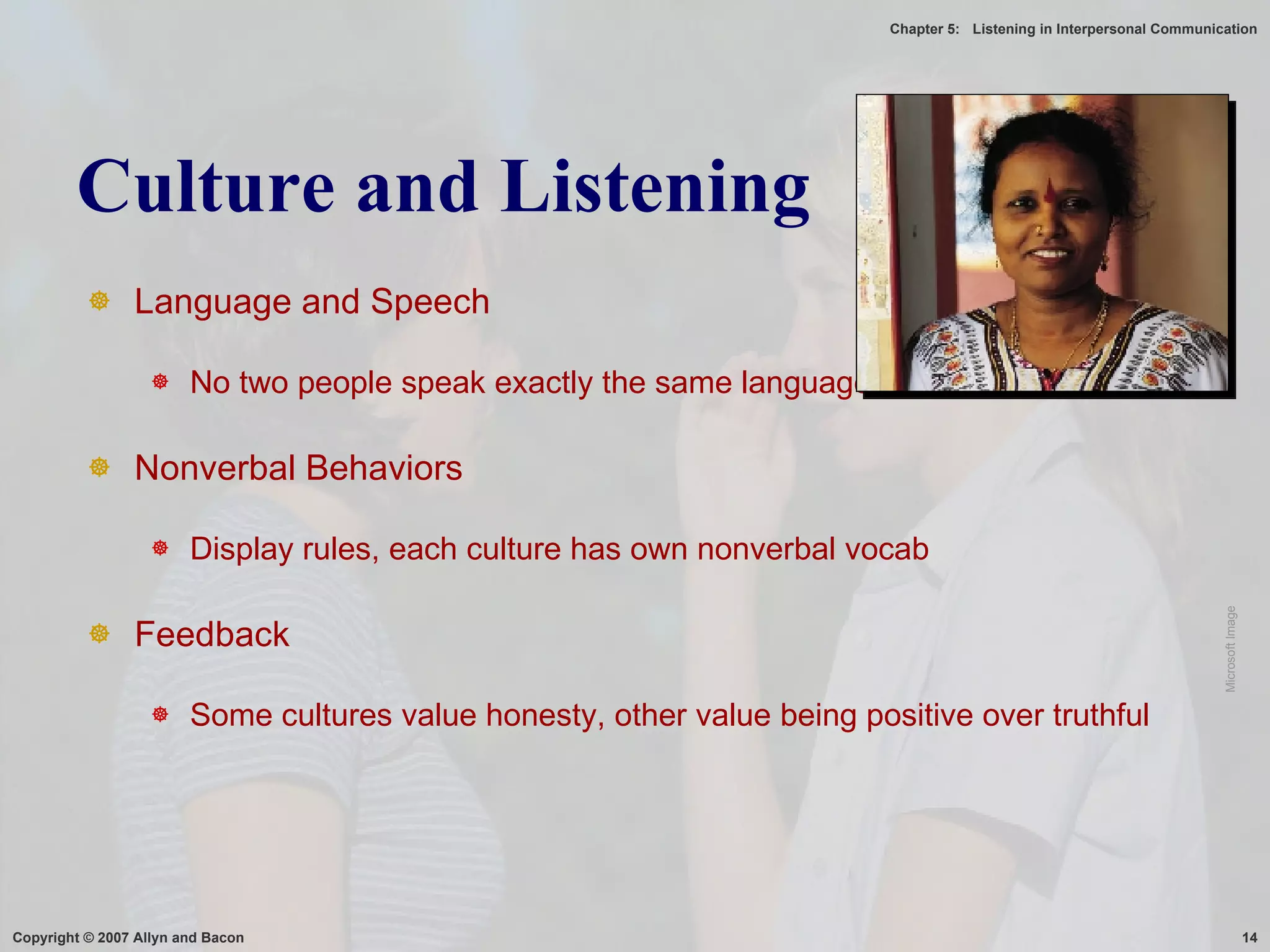
Culture and Listening Language and Speech No two people speak exactly the same language Nonverbal Behaviors Display rules, each culture has own nonverbal vocab Feedback Some cultures value honesty, other value being positive over truthful Microsoft Image
Gender and Listening Achieve Different Ends Women listen to connect, men listen to gain respect and establish dominance Demonstrate Listening Differently Women engage in more eye contact and give more feedback Time Spent Listening Men listen to women less than women listen to men Differences Changing Rapidly Result of socialization; two different sets of learned behavior Microsoft Image
Accent Complement Contradict Control Repeat And Substitute For… … Verbal Communication Nonverbal Communication is Used to… Microsoft Image
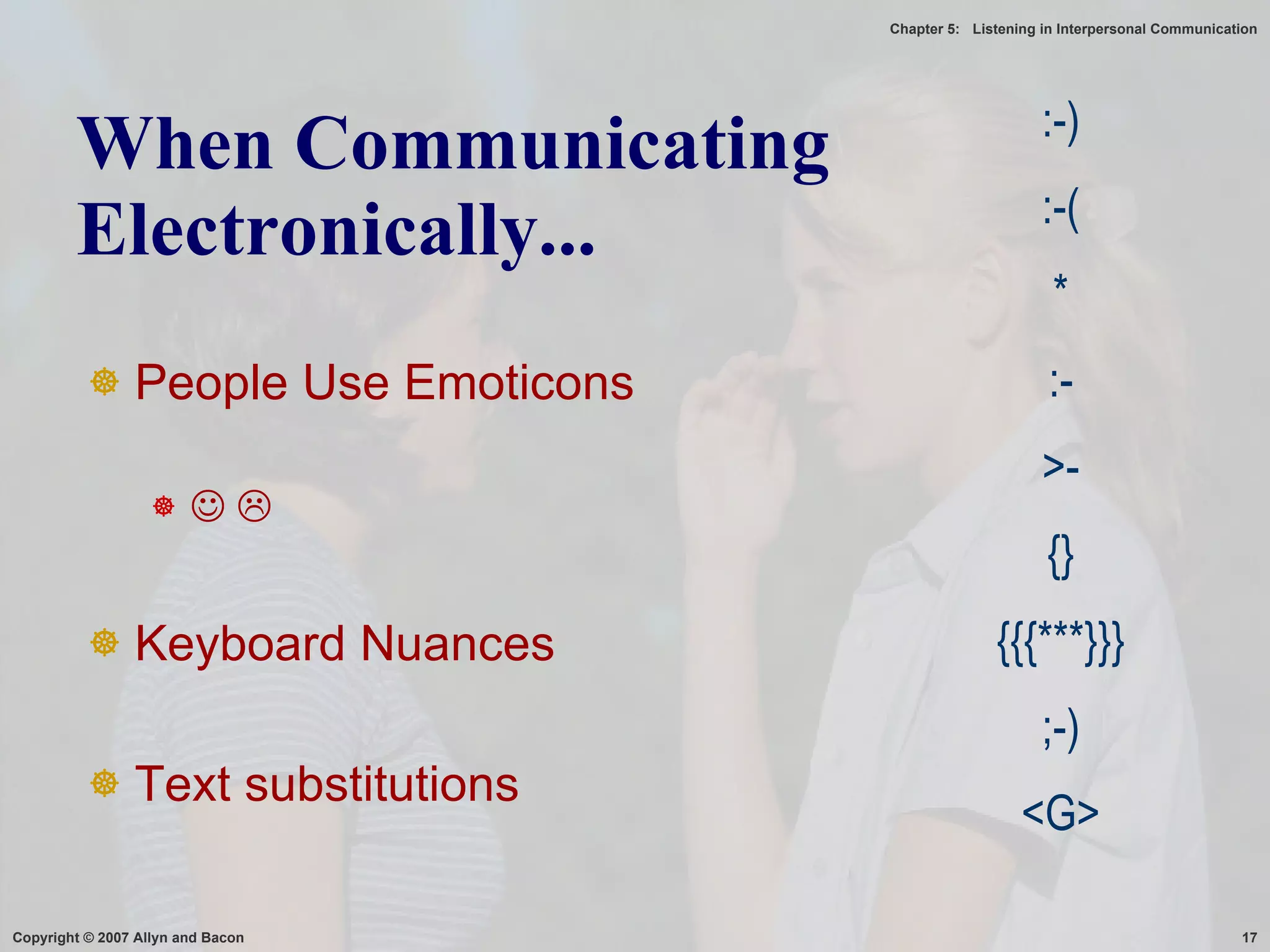
When Communicating Electronically... People Use Emoticons       Keyboard Nuances Text substitutions :-) :-( * :- >- {} {{{***}}} ;-) <G>
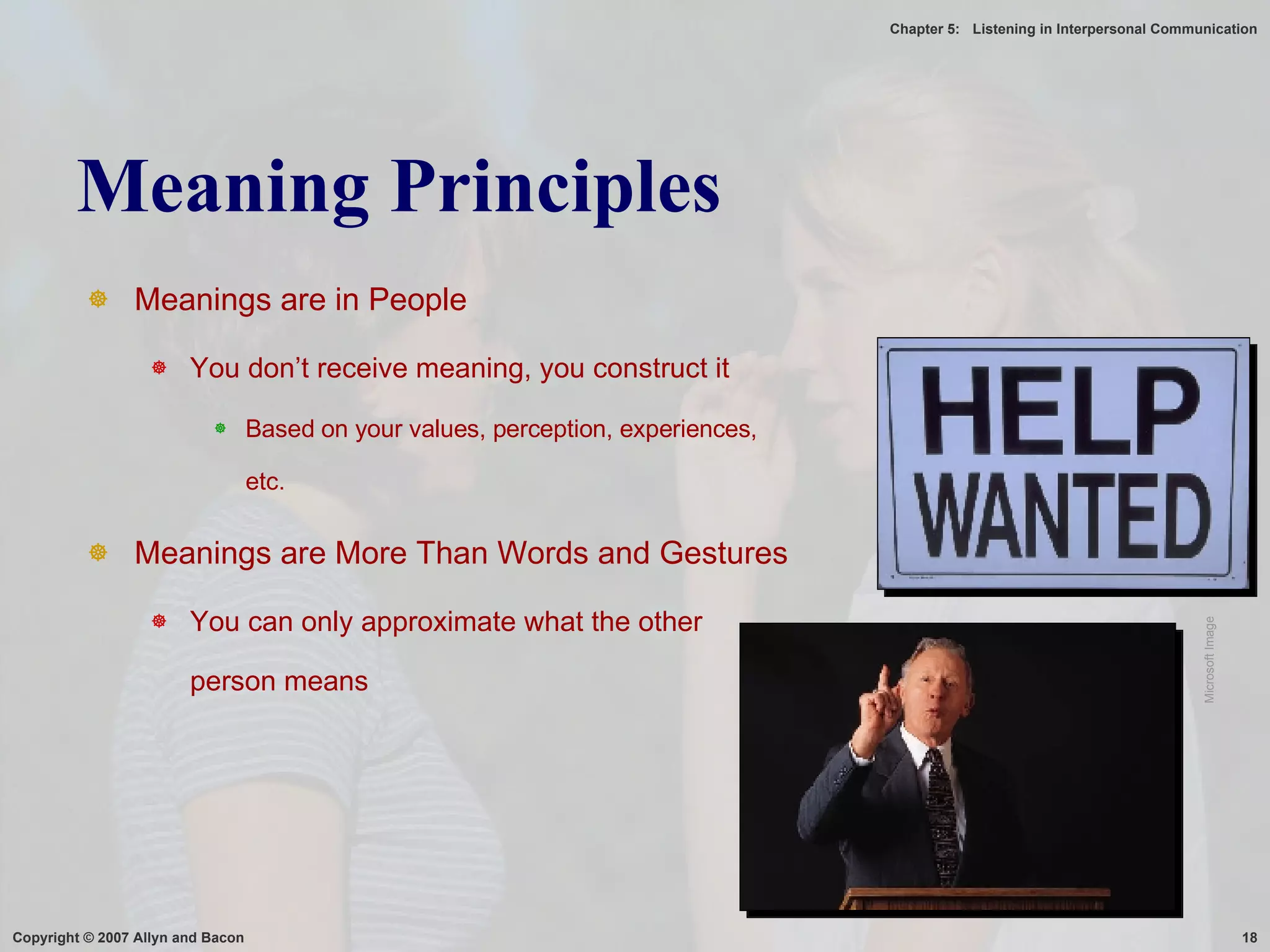
Meaning Principles Meanings are in People You don’t receive meaning, you construct it Based on your values, perception, experiences, etc. Meanings are More Than Words and Gestures You can only approximate what the other person means Microsoft Image
Messages and Meanings  (continued) Meanings are Unique No two people ever derive the exact same meaning Meanings are Context-Based Some words have different meanings in different situations Fat/phat, cool/cool, hoe/ho, etc Microsoft Image
Message Principles Messages are Packaged Nonverbal and verbal are packaged together Look for a match between the two, or re-evaluate Messages are Rule-Governed Norms about what is appropriate, grammar Messages Vary in Abstraction General or abstract, some confusion can arise Microsoft Image
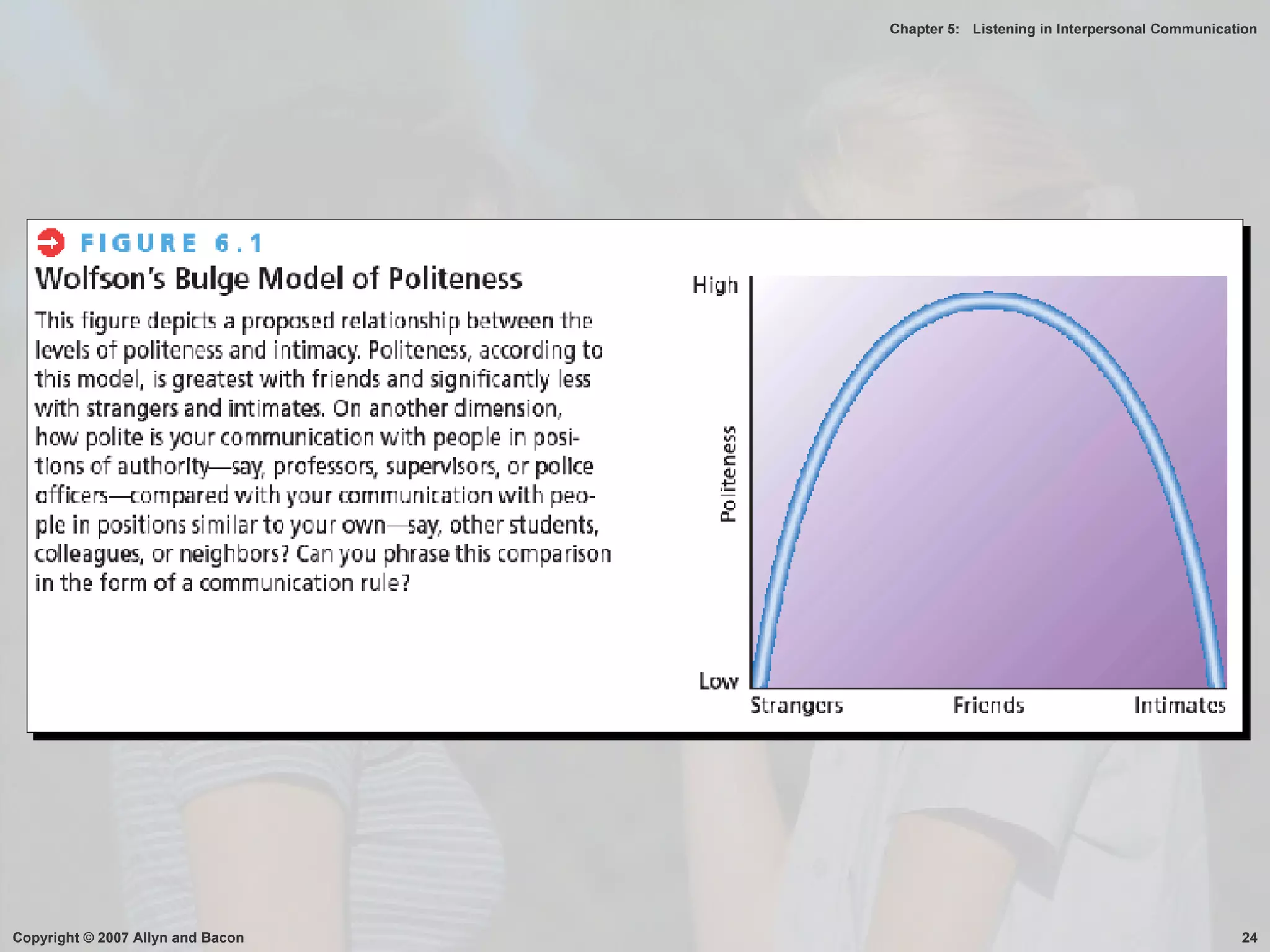
Messages Vary in Politeness  Desirable Trait Across Most Cultures Gender Differences Women’s speech is more polite than men’s How we treat strangers vs. how we treat intimates or friends
Messages and Netiquette Read the FAQs Don’t Shout—ALL CAPS Lurk Before Speaking or Contributing Don’t Contribute to Traffic Jams Be Brief Microsoft Image
Messages and Netiquette  (continued) No Commercial Communication Treat Newbies Kindly Don’t Spam Don’t Flame Don’t Use Offensive Language Microsoft Image
 
Messages Vary in Inclusion Excluding Talk - Language & Topics Not Shared Another language, hushed tone, stop talking upon entrance Inclusive Talk - Seeking Others’ Perspective, Providing Unfamiliar Details, Confirming Responses
Messages Vary in Directness Advantages of Indirect Messages Express Desire without Offending Seeking Compliments Disadvantages of Indirect Messages Win-lose situations more likely Create Problems with Understanding Gender and Cultural Differences Men are more indirect when going against the masculine stereotype Some cultures prefer indirect to direct language
Messages Vary in Assertiveness Nonassertiveness Lack of assertiveness in all or some communication “ You Win, I lose” Aggressiveness Care about self and not the other “ I Win, You Lose” Assertiveness Act in best interest without infringing on the other person “ I Win, You Win” Microsoft Image
 
Principles for Increasing Assertive Communication Analyze Assertive Communication Rehearse Assertive Communication
Communicate Assertively Describe the Problem State How it Affects You Propose Solutions Confirm Understanding Microsoft Image
Language Symbolizes Reality Intensional Orientation Labels First, Actual Second Buy it for the label Extensional Orientation Actual First, Label Second Meet someone and then classify them Microsoft Image
Language Symbolizes Reality  (continued) Cultural Identifiers Boy, Girl, Gay, Lesbian, African American, White, Hispanic, Chicano, Etc. Allness Six Blind Men and the Elephant Microsoft Image
Language Expresses Both Facts and Inferences Fact-Inference Confusion Act as though an inference is a factual statement Ex)  acting on what you think, not know Pragmatic Implications Puts together factual conclusions to make an inference Ex) sales manager gets fired Microsoft Image
Facts and Inferences Made Only After Observation Limited to What Has Been Observed Made Only by Observer About Past or Present Approach Certainty Subject to Verifiable Standards Made At Any Time Go Beyond What is Observed Made by Anyone May Be About Past, Present, or Future Vary in Probability Not Subject to Verifiable Standards Microsoft Image
Language Expresses Both Denotation and Connotation Denotation Dictionary/literal Connotation Snarl Words Purr Words Microsoft Image
Language Can Criticize and Praise Providing Honest Appraisal   Tell the Truth Consider How You Phrase Negative Appraisal Microsoft Image
Language Can Criticize and Praise Offering Criticism Focus on Event not Personality State Criticism Positively Own Your Thoughts and Feelings Be Clear Avoid Ordering Change Consider the Context
Language Can Criticize and Praise Giving Praise Use I-Messages Make Sure Affect Communicates Feelings Name the Behavior You’re Praising Take Culture Into Consideration
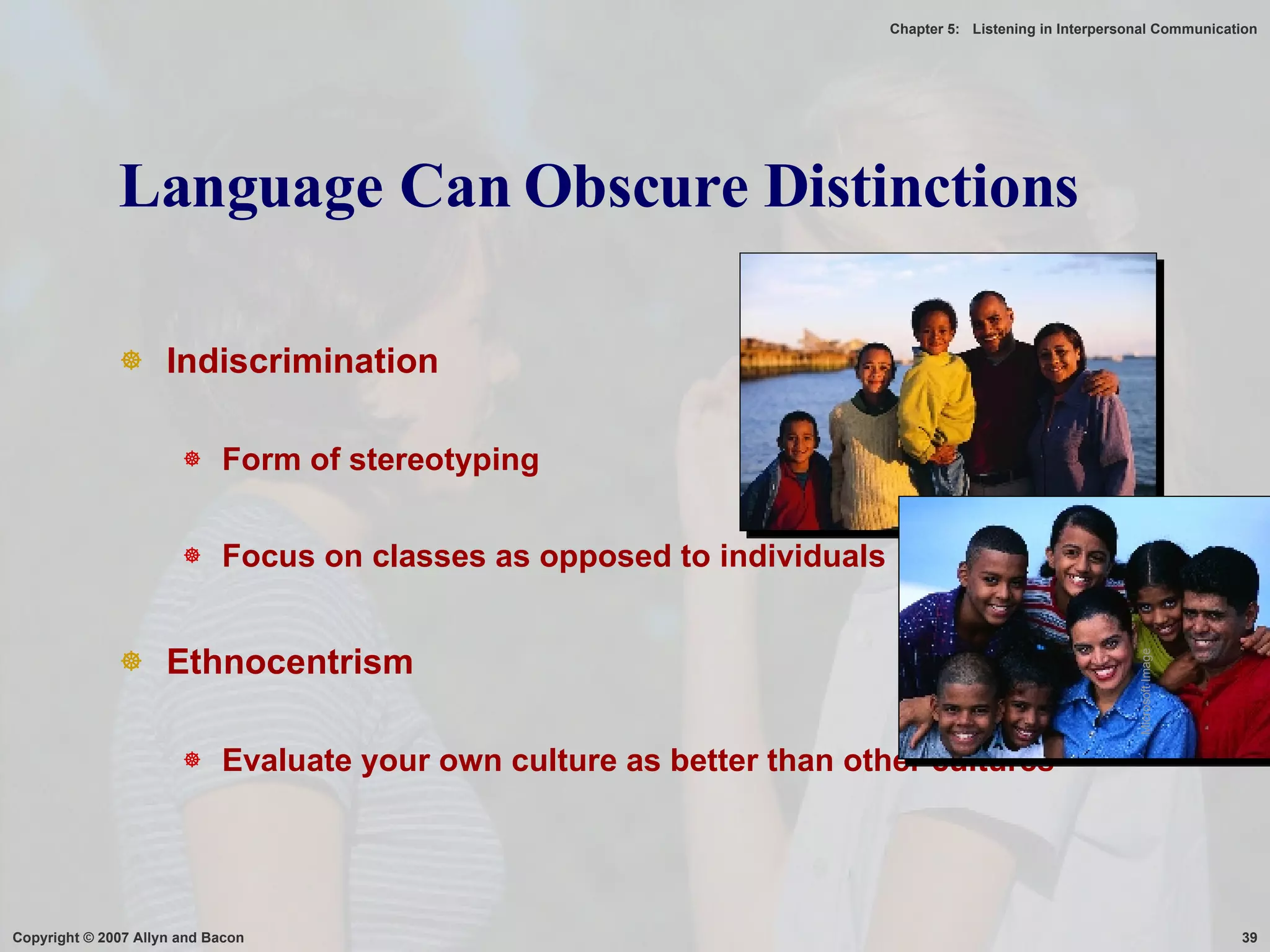
Language Can Obscure Distinctions Indiscrimination Form of stereotyping Focus on classes as opposed to individuals Ethnocentrism Evaluate your own culture as better than other cultures Microsoft Image
 
Language Can Obscure Distinctions Polarization Either/or fallacy Describe the world in extremes Static Evaluation Retain an evaluation despite changes in that person or thing
Language Can Confirm/Disconfirm Confirmation Communication pattern that acknowledges and accepts a person Disconfirmation Communication pattern that ignores a person’s presence Talking with the Grief Stricken Encourage them to share feelings, but don’t force Avoid forcing them to think of the bright side Microsoft Image
 
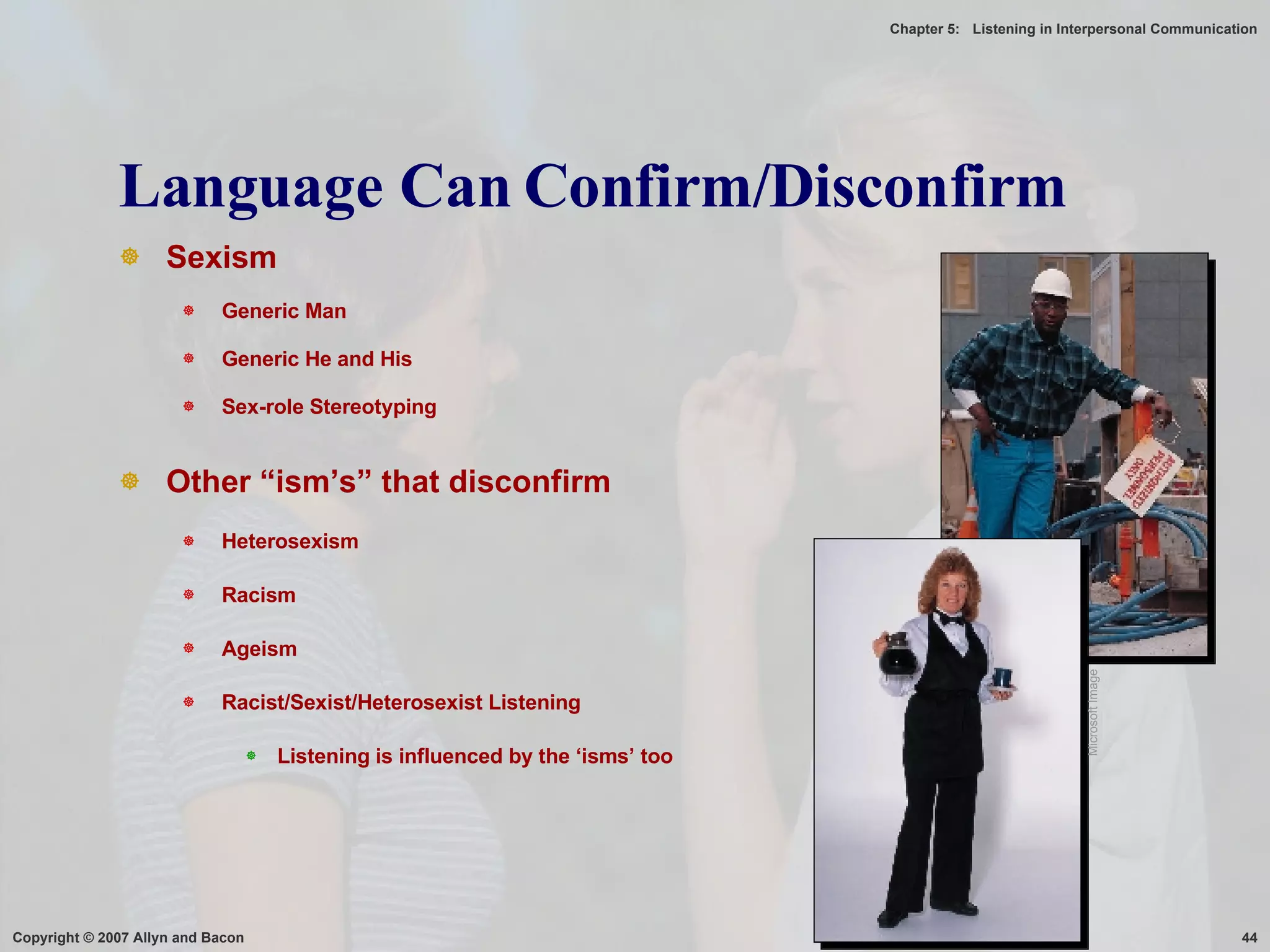
Language Can Confirm/Disconfirm Sexism Generic Man Generic He and His Sex-role Stereotyping Other “ism’s” that disconfirm Heterosexism Racism Ageism Racist/Sexist/Heterosexist Listening Listening is influenced by the ‘isms’ too Microsoft Image
Functions of Nonverbal Communication Impression Management Body size, skin color, dress, etc Forming and Defining Relationships Communicate closeness Signal dominance Structuring Conversation and Social Interaction Turn-taking cues Influence Signals truth or deception Emotional Expression Revealing emotions through nonverbals Microsoft Image
Body Communication Body Gestures
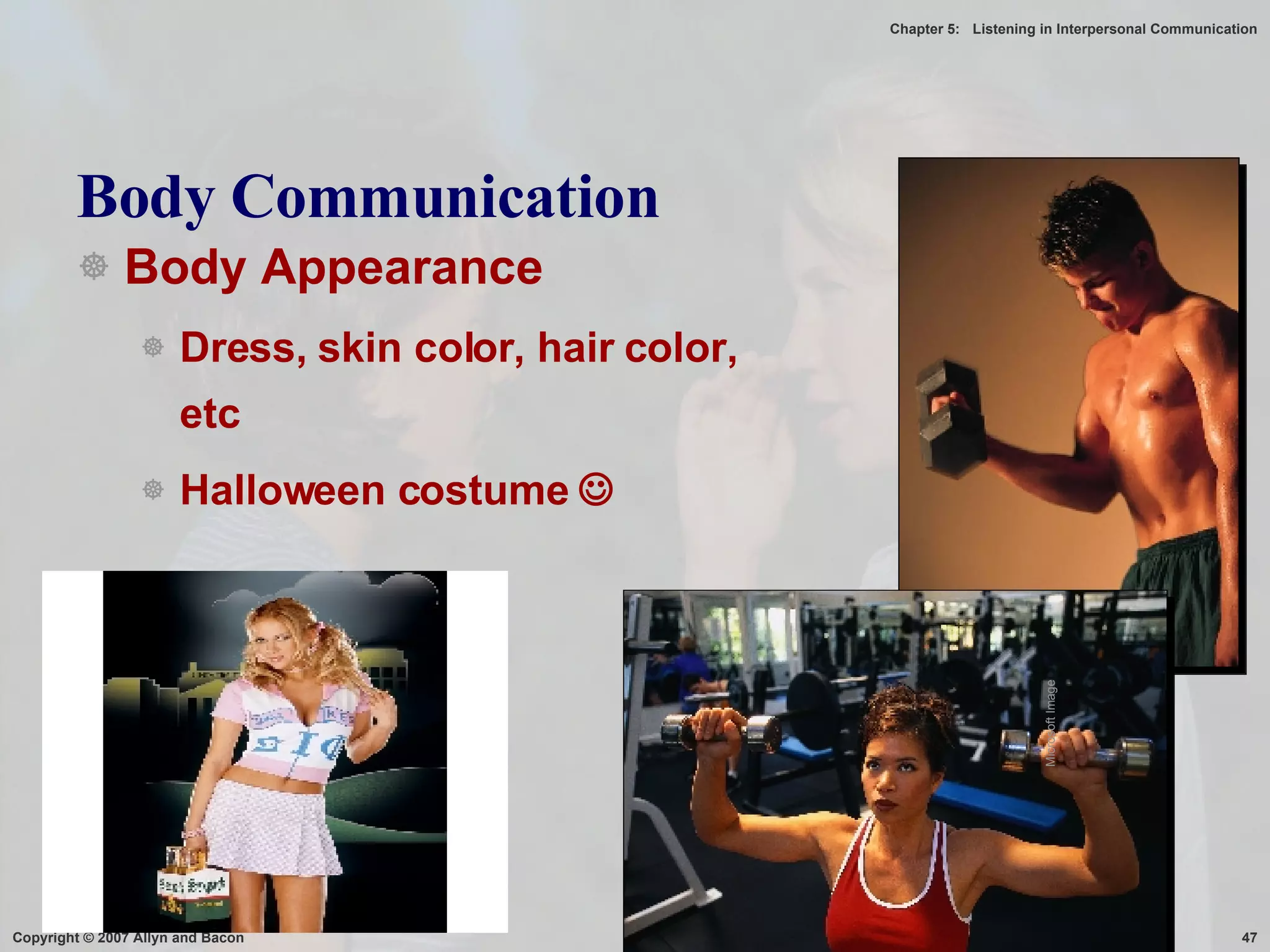
Body Communication Body Appearance Dress, skin color, hair color, etc Halloween costume   Microsoft Image
Facial Communication Signal Emotions Sadness Disgust Contempt Interest Happiness Surprise Fear Anger
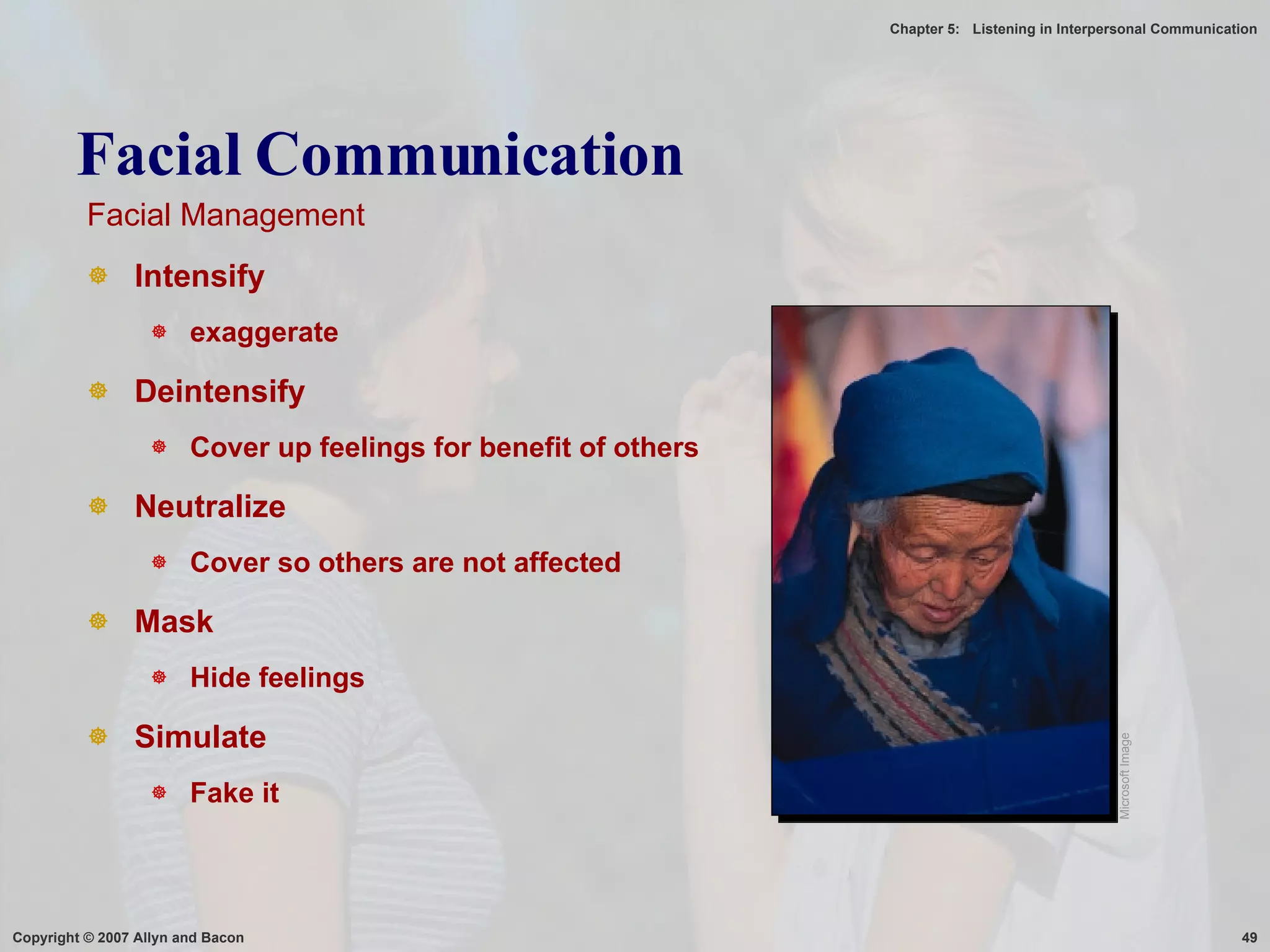
Facial Communication Facial Management Intensify exaggerate Deintensify Cover up feelings for benefit of others Neutralize Cover so others are not affected Mask Hide feelings Simulate Fake it Microsoft Image
Facial Communication Facial Feedback Facial Feedback Hypothesis Facial Expressions Influence Physiological Arousal Feeling and expressing increases arousal Influences what others think of you
Eye Communication:  Eye Contact   Monitor Feedback “ what do you think?”, signals attention Secure Attention and Interest Increasing eye contact to get more attention/interest Regulate or Control Conversation Signals turn-taking, initiates a new speaker Signal Nature of Relationship Positive or negative, “gaydar” Signal Status and Aggression Visual dominance, stare down Compensate for Distance Can overcome distances, express closeness
Eye Communication Eye Avoidance Privacy  Civil Inattention Turn attention away from public argument, PDA Pupil Dilation What happens to the pupil of the eye Interest Level:  enlarged pupil with higher interest level Attraction:  enlarged pupil with more attraction Microsoft Image
Touch Communication Meanings of Touch Positive Emotions Trust, similarity, informality Playfulness Deemphasizes emotions, lightens interaction Control Behaviors, thoughts, feelings of another Ritualistic Greetings/departures Task-Related Associated with a task Touch Avoidance Avoid touch in certain circumstances/from people Microsoft Image
Paralanguage What is Paralanguage? Rate Volume Pitch People Perception and Paralanguage Persuasion and Paralanguage Microsoft Image
Functions of Silence Time to Think Hurt Others Response to Anxiety Prevent Communication Communicate Emotional Responses Achieve Specific Effects Nothing to Say Microsoft Image
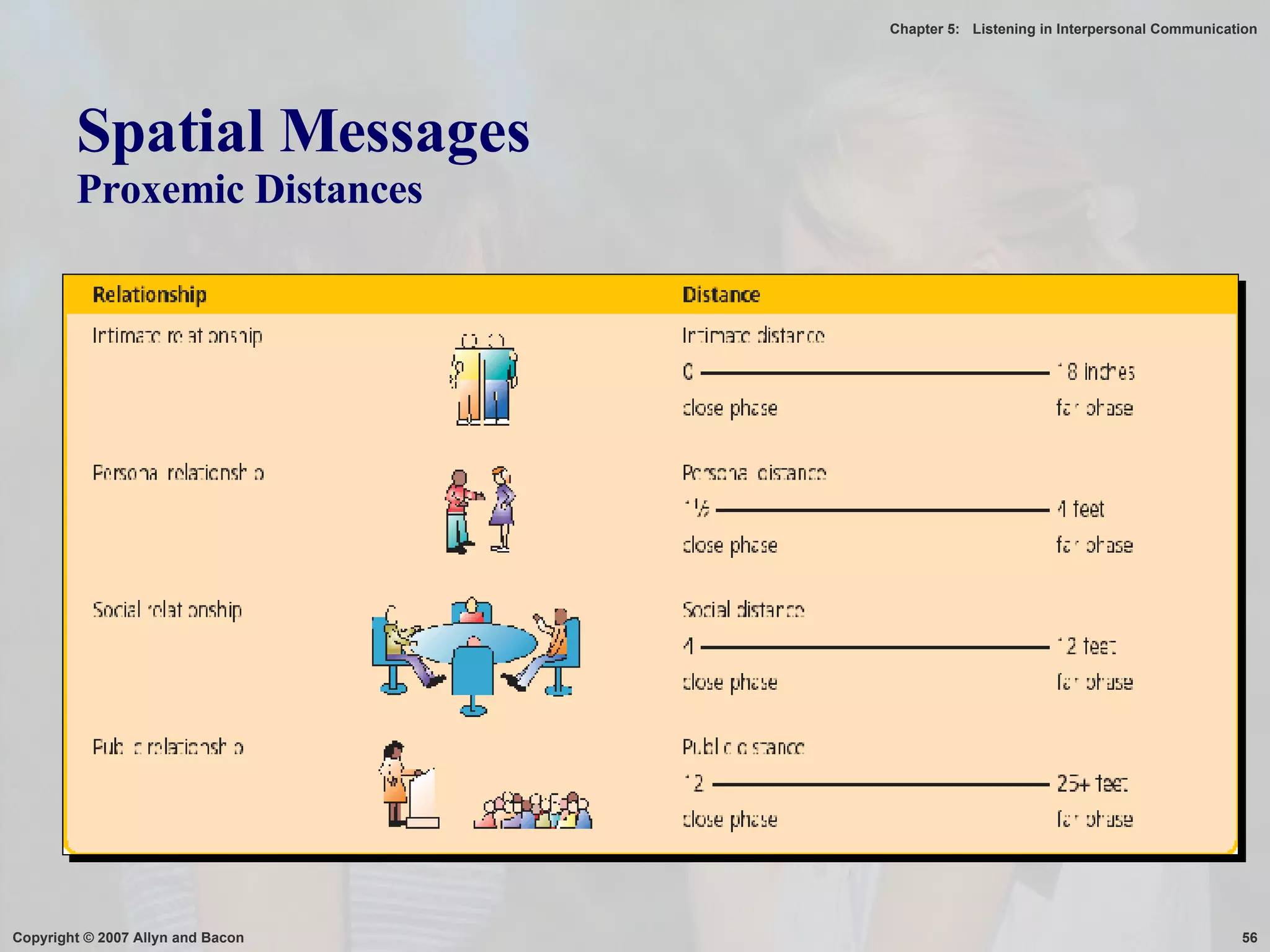
Spatial Messages Proxemic Distances
Spatial Messages Theories About Space Protection Theory Buffer zone around you, “your space” Equilibrium Theory Greater the intimacy, closer the distance Expectancy Violations Theory What happens as you increase/decrease distances wit someone who you are not intimate with
Spatial Messages Territoriality Primary Territories Your own: room, office, desk Secondary Territories Don’t belong to you, but you occupy:  table at the cafeteria, seat in class Public Territories Open to all:  restaurant, movie theater Microsoft Image
Spatial Messages Territoriality Markers Central Markers Reserves your place:  drink at the bar, books on your desk Boundary Markers Divide your territory from another’s:  checkout separator, arm rests Ear Markers Indicate possession:  trademarks, nameplates, monograms Territorial Encroachment Higher status people can invade the territory of a lower status person, but not vice versa
Artifactual Communication Space Decoration Color Communication Clothing and Body Adornment Microsoft Image
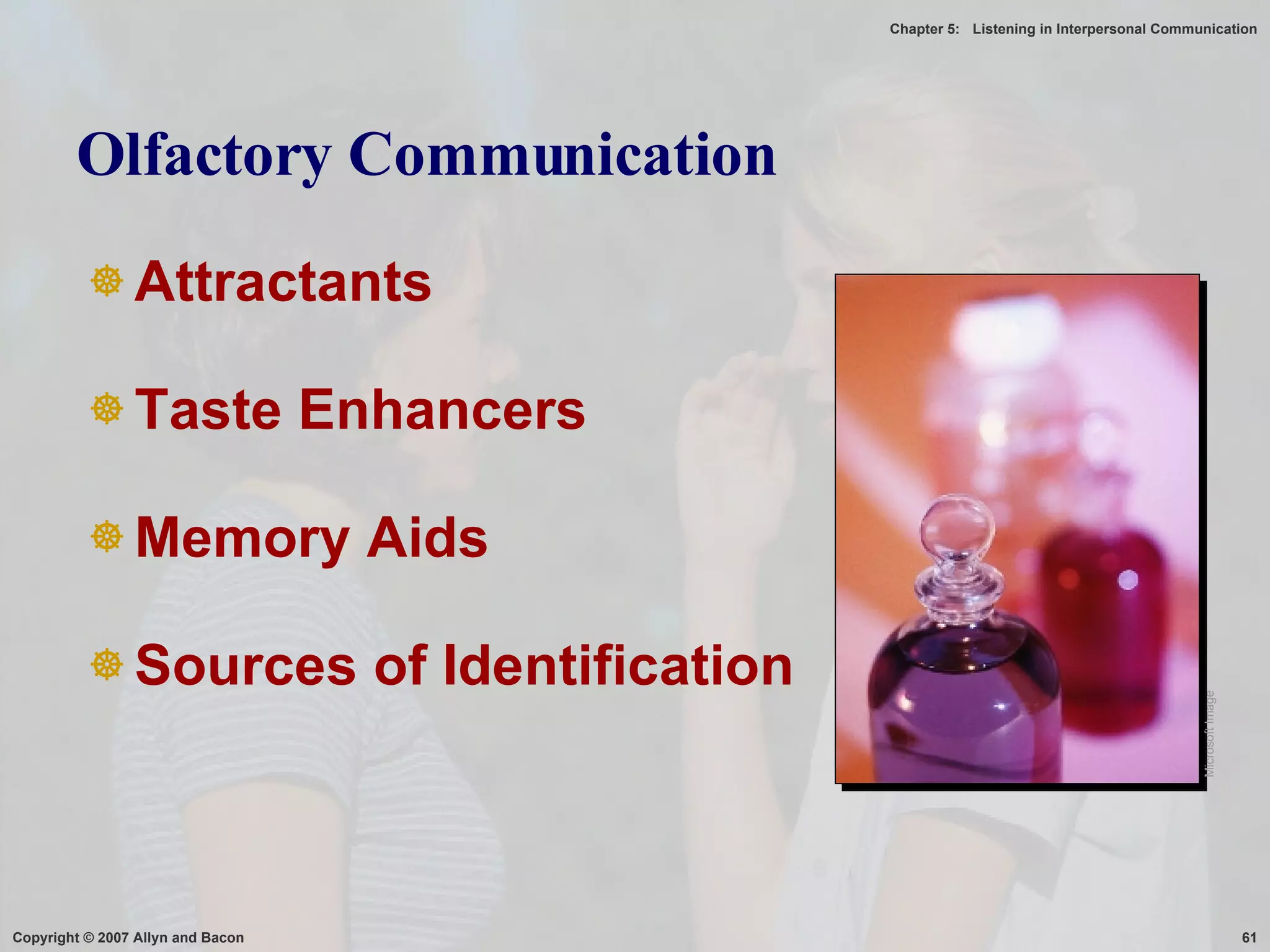
Olfactory Communication Attractants Taste Enhancers Memory Aids Sources of Identification Microsoft Image
Temporal Communication Psychological Time Past, Present, or Future Orientation Future Income Related to Future Time Orientation Microsoft Image
Nonverbal Communication and Culture Culture and Facial Expression Culture and Color Culture and Touch Culture, Paralanguage, and Silence
Nonverbal Communication and Culture Culture and Time Formal Time Informal Time Microsoft Image
Nonverbal Communication and Culture Monochronism and Polychronism

Chapters 5 8

  • 1.
    Purposes and Payoffsof Listening Learn Relate Influence Play Help Purposes Payoffs
  • 2.
    Stages of ListeningProcess Listening is not the same as hearing Hearing is passive, listening is active Five stages Receiving Understanding Remembering Evaluating Responding
  • 3.
    Stages of Listening- Receiving Hearing and attending to verbal and nonverbal Focus Attention on Speaker’s Verbal and Nonverbal Cues (volume, rate, expressions) Avoid Distractions Focus on Speaker, Not What You’ll Say Next Avoid Interrupting—maintain your role Microsoft Image
  • 4.
    Learning and decipheringmeaning, thoughts and emotional tone expressed Relate New Information to What You Know See Speaker’s Point of View Ask Questions for Clarification Paraphrase Speaker’s Ideas Stages of Listening - Understanding
  • 5.
    Remembering and RetainingNeeds to take place to have listening occur Memory is reconstructive, not reproductive Identify Central Ideas and Major Support Summarize the Message Repeat Names and Key Concepts Stages of Listening - Remembering Microsoft Image
  • 6.
    Judging and criticizingEvaluation of the message Resist Premature Evaluation Give Speaker Benefit of the Doubt Distinguish Facts from Inferences Identify Speaker’s Biases and/or Prejudices Stages of Listening - Evaluating
  • 7.
    Two Phases: during and after message Support the Speaker with Back-Channeling Express Support for Speaker Respond Honestly Even in Disagreement Own Your Responses Provide a Supportive Atmosphere Stages of Listening - Responding
  • 8.
    Listening is aCollection of Skills All Five Stages Overlap Listening is Never Perfect Listening is Situational Implications of the Model of Listening Microsoft Image
  • 9.
    Styles of Listening Empathic and Objective Do you need to understand, identify with speaker or hold to real world objectives? Punctuate from Speaker’s Point of View See as speaker does Engage in Equal, Two-Way Conversations Eliminate barriers (physical and psychological) Seek to Understand Thoughts and Feelings Avoid “Offensive Listening” Looking for bits and pieces to attack with Strive to be Objective, look at context Microsoft Image
  • 10.
    Styles of ListeningNonjudgmental and Critical Keep Open Mind, suspend judgment Avoid Filtering or Oversimplifying Hear the entire message, not just the good parts Recognize Own Biases Don’t let your own thoughts, attitudes, culture interfere with taking it from speaker’s POV Avoid Uncritical Listening Listen to everything, ask for adequate info before judging Microsoft Image
  • 11.
    Styles of ListeningNonjudgmental and Critical Recognize Fallacies Name-calling Testimonials Bandwagon Agenda-setting Attack Microsoft Image
  • 12.
    Styles of Listening Surface and Depth Surface: literal meaning Depth: beyond surface Focus on Verbal and Nonverbal Listen for Content and Relational Messages Note Statements that Refer Back to Speaker Don’t Disregard Literal Meanings
  • 13.
    Styles of Listening Active and Inactive Active Listening Checks for understanding, acknowledges speakers thoughts and feelings, and stimulates speaker to further explore Do this by: Paraphrase Speaker’s Meaning Express Understanding of Speaker’s Feelings Ask Questions Microsoft Image
  • 14.
    Culture and ListeningLanguage and Speech No two people speak exactly the same language Nonverbal Behaviors Display rules, each culture has own nonverbal vocab Feedback Some cultures value honesty, other value being positive over truthful Microsoft Image
  • 15.
    Gender and ListeningAchieve Different Ends Women listen to connect, men listen to gain respect and establish dominance Demonstrate Listening Differently Women engage in more eye contact and give more feedback Time Spent Listening Men listen to women less than women listen to men Differences Changing Rapidly Result of socialization; two different sets of learned behavior Microsoft Image
  • 16.
    Accent Complement ContradictControl Repeat And Substitute For… … Verbal Communication Nonverbal Communication is Used to… Microsoft Image
  • 17.
    When Communicating Electronically...People Use Emoticons   Keyboard Nuances Text substitutions :-) :-( * :- >- {} {{{***}}} ;-) <G>
  • 18.
    Meaning Principles Meaningsare in People You don’t receive meaning, you construct it Based on your values, perception, experiences, etc. Meanings are More Than Words and Gestures You can only approximate what the other person means Microsoft Image
  • 19.
    Messages and Meanings (continued) Meanings are Unique No two people ever derive the exact same meaning Meanings are Context-Based Some words have different meanings in different situations Fat/phat, cool/cool, hoe/ho, etc Microsoft Image
  • 20.
    Message Principles Messagesare Packaged Nonverbal and verbal are packaged together Look for a match between the two, or re-evaluate Messages are Rule-Governed Norms about what is appropriate, grammar Messages Vary in Abstraction General or abstract, some confusion can arise Microsoft Image
  • 21.
    Messages Vary inPoliteness Desirable Trait Across Most Cultures Gender Differences Women’s speech is more polite than men’s How we treat strangers vs. how we treat intimates or friends
  • 22.
    Messages and NetiquetteRead the FAQs Don’t Shout—ALL CAPS Lurk Before Speaking or Contributing Don’t Contribute to Traffic Jams Be Brief Microsoft Image
  • 23.
    Messages and Netiquette (continued) No Commercial Communication Treat Newbies Kindly Don’t Spam Don’t Flame Don’t Use Offensive Language Microsoft Image
  • 24.
  • 25.
    Messages Vary inInclusion Excluding Talk - Language & Topics Not Shared Another language, hushed tone, stop talking upon entrance Inclusive Talk - Seeking Others’ Perspective, Providing Unfamiliar Details, Confirming Responses
  • 26.
    Messages Vary inDirectness Advantages of Indirect Messages Express Desire without Offending Seeking Compliments Disadvantages of Indirect Messages Win-lose situations more likely Create Problems with Understanding Gender and Cultural Differences Men are more indirect when going against the masculine stereotype Some cultures prefer indirect to direct language
  • 27.
    Messages Vary inAssertiveness Nonassertiveness Lack of assertiveness in all or some communication “ You Win, I lose” Aggressiveness Care about self and not the other “ I Win, You Lose” Assertiveness Act in best interest without infringing on the other person “ I Win, You Win” Microsoft Image
  • 28.
  • 29.
    Principles for IncreasingAssertive Communication Analyze Assertive Communication Rehearse Assertive Communication
  • 30.
    Communicate Assertively Describethe Problem State How it Affects You Propose Solutions Confirm Understanding Microsoft Image
  • 31.
    Language Symbolizes RealityIntensional Orientation Labels First, Actual Second Buy it for the label Extensional Orientation Actual First, Label Second Meet someone and then classify them Microsoft Image
  • 32.
    Language Symbolizes Reality (continued) Cultural Identifiers Boy, Girl, Gay, Lesbian, African American, White, Hispanic, Chicano, Etc. Allness Six Blind Men and the Elephant Microsoft Image
  • 33.
    Language Expresses BothFacts and Inferences Fact-Inference Confusion Act as though an inference is a factual statement Ex) acting on what you think, not know Pragmatic Implications Puts together factual conclusions to make an inference Ex) sales manager gets fired Microsoft Image
  • 34.
    Facts and InferencesMade Only After Observation Limited to What Has Been Observed Made Only by Observer About Past or Present Approach Certainty Subject to Verifiable Standards Made At Any Time Go Beyond What is Observed Made by Anyone May Be About Past, Present, or Future Vary in Probability Not Subject to Verifiable Standards Microsoft Image
  • 35.
    Language Expresses BothDenotation and Connotation Denotation Dictionary/literal Connotation Snarl Words Purr Words Microsoft Image
  • 36.
    Language Can Criticizeand Praise Providing Honest Appraisal Tell the Truth Consider How You Phrase Negative Appraisal Microsoft Image
  • 37.
    Language Can Criticizeand Praise Offering Criticism Focus on Event not Personality State Criticism Positively Own Your Thoughts and Feelings Be Clear Avoid Ordering Change Consider the Context
  • 38.
    Language Can Criticizeand Praise Giving Praise Use I-Messages Make Sure Affect Communicates Feelings Name the Behavior You’re Praising Take Culture Into Consideration
  • 39.
    Language Can ObscureDistinctions Indiscrimination Form of stereotyping Focus on classes as opposed to individuals Ethnocentrism Evaluate your own culture as better than other cultures Microsoft Image
  • 40.
  • 41.
    Language Can ObscureDistinctions Polarization Either/or fallacy Describe the world in extremes Static Evaluation Retain an evaluation despite changes in that person or thing
  • 42.
    Language Can Confirm/DisconfirmConfirmation Communication pattern that acknowledges and accepts a person Disconfirmation Communication pattern that ignores a person’s presence Talking with the Grief Stricken Encourage them to share feelings, but don’t force Avoid forcing them to think of the bright side Microsoft Image
  • 43.
  • 44.
    Language Can Confirm/DisconfirmSexism Generic Man Generic He and His Sex-role Stereotyping Other “ism’s” that disconfirm Heterosexism Racism Ageism Racist/Sexist/Heterosexist Listening Listening is influenced by the ‘isms’ too Microsoft Image
  • 45.
    Functions of NonverbalCommunication Impression Management Body size, skin color, dress, etc Forming and Defining Relationships Communicate closeness Signal dominance Structuring Conversation and Social Interaction Turn-taking cues Influence Signals truth or deception Emotional Expression Revealing emotions through nonverbals Microsoft Image
  • 46.
  • 47.
    Body Communication BodyAppearance Dress, skin color, hair color, etc Halloween costume  Microsoft Image
  • 48.
    Facial Communication SignalEmotions Sadness Disgust Contempt Interest Happiness Surprise Fear Anger
  • 49.
    Facial Communication FacialManagement Intensify exaggerate Deintensify Cover up feelings for benefit of others Neutralize Cover so others are not affected Mask Hide feelings Simulate Fake it Microsoft Image
  • 50.
    Facial Communication FacialFeedback Facial Feedback Hypothesis Facial Expressions Influence Physiological Arousal Feeling and expressing increases arousal Influences what others think of you
  • 51.
    Eye Communication: Eye Contact Monitor Feedback “ what do you think?”, signals attention Secure Attention and Interest Increasing eye contact to get more attention/interest Regulate or Control Conversation Signals turn-taking, initiates a new speaker Signal Nature of Relationship Positive or negative, “gaydar” Signal Status and Aggression Visual dominance, stare down Compensate for Distance Can overcome distances, express closeness
  • 52.
    Eye Communication EyeAvoidance Privacy Civil Inattention Turn attention away from public argument, PDA Pupil Dilation What happens to the pupil of the eye Interest Level: enlarged pupil with higher interest level Attraction: enlarged pupil with more attraction Microsoft Image
  • 53.
    Touch Communication Meaningsof Touch Positive Emotions Trust, similarity, informality Playfulness Deemphasizes emotions, lightens interaction Control Behaviors, thoughts, feelings of another Ritualistic Greetings/departures Task-Related Associated with a task Touch Avoidance Avoid touch in certain circumstances/from people Microsoft Image
  • 54.
    Paralanguage What isParalanguage? Rate Volume Pitch People Perception and Paralanguage Persuasion and Paralanguage Microsoft Image
  • 55.
    Functions of SilenceTime to Think Hurt Others Response to Anxiety Prevent Communication Communicate Emotional Responses Achieve Specific Effects Nothing to Say Microsoft Image
  • 56.
  • 57.
    Spatial Messages TheoriesAbout Space Protection Theory Buffer zone around you, “your space” Equilibrium Theory Greater the intimacy, closer the distance Expectancy Violations Theory What happens as you increase/decrease distances wit someone who you are not intimate with
  • 58.
    Spatial Messages TerritorialityPrimary Territories Your own: room, office, desk Secondary Territories Don’t belong to you, but you occupy: table at the cafeteria, seat in class Public Territories Open to all: restaurant, movie theater Microsoft Image
  • 59.
    Spatial Messages TerritorialityMarkers Central Markers Reserves your place: drink at the bar, books on your desk Boundary Markers Divide your territory from another’s: checkout separator, arm rests Ear Markers Indicate possession: trademarks, nameplates, monograms Territorial Encroachment Higher status people can invade the territory of a lower status person, but not vice versa
  • 60.
    Artifactual Communication SpaceDecoration Color Communication Clothing and Body Adornment Microsoft Image
  • 61.
    Olfactory Communication AttractantsTaste Enhancers Memory Aids Sources of Identification Microsoft Image
  • 62.
    Temporal Communication PsychologicalTime Past, Present, or Future Orientation Future Income Related to Future Time Orientation Microsoft Image
  • 63.
    Nonverbal Communication andCulture Culture and Facial Expression Culture and Color Culture and Touch Culture, Paralanguage, and Silence
  • 64.
    Nonverbal Communication andCulture Culture and Time Formal Time Informal Time Microsoft Image
  • 65.
    Nonverbal Communication andCulture Monochronism and Polychronism