Chapter 1 What is Psychology?
Chapter Preview Defining Psychology Historical Foundations of Psychology Contemporary Approaches to Psychology Specializations and Careers in Psychology Application: Health and Wellness
Psychology: Defined The scientific study of behavior and mental processes Key components of this definition: Science Behavior Mental Processes
Psychology and  Common Sense Is psychology simply common sense? Sometimes yes, but sometimes no… Hindsight Bias Unexpected Findings
Positive Psychology Traditional focus on the negative aspects of human experience More than disordered  Positive Psychology Movement Experiences people value Traits associated with optimal functioning Positive group and civic values
Historical Approaches Western Philosophy Biology and Physiology Wilhelm Wundt (1832-1920) First Psychology Laboratory (1879) established at the University of Leipzig
Structuralism Wundt: Identify structures of the mind Research described dimensions of feeling: Pleasure / Displeasure Tension / Relaxation Excitement / Depression Methodology: Introspection
Functionalism William James and Pragmatism Identify the functions of the mind Focused on interactions with environment Adaptive significance: “Why?” Flow of thought:  Stream of consciousness
Psychology and Evolution Charles Darwin (1859) Natural Selection There exists a constant struggle for resources Nature will favor those traits that promote reproduction and survival Environmental changes alter evolution’s course
Contemporary Approaches Seven Current Psychological Perspectives Biological Behavioral Psychodynamic Humanistic Cognitive Evolutionary Sociocultural
The Biological Approach Focuses on the brain and nervous system Central to understanding behavior, thought, and emotion Neuroscience Structure, function, development, genetics, biochemistry of the nervous system Chapter 3: Biological Foundations of  Behavior
The Behavioral Approach Focuses on the environmental determinants  of observable behavior Notable Behaviorists: John Watson, B.F. Skinner Early conflicts with cognitive psychologists Chapter 7: Learning
The Psychodynamic Approach Emphasizes unconscious thought, conflict between internal drives and society, and early family experiences All influence behavior, thought, and emotion Notable Psychodynamic Theorists Sigmund Freud, Erik Erikson, Alfred Adler Chapter 11: Personality
The Humanistic Approach Focuses on positive human qualities, capacity for self-actualization, free will Developed in response to the behaviorist and psychodynamic approaches Notable Humanistic Theorists Carl Rogers, Abraham Maslow Chapter 11: Personality
The Cognitive Approach Emphasizes the importance of mental processes to problem solving, learning and memory Mental processes control behavior through memories, perceptions, and thinking Chapter 9: Thinking, Language, and  Intelligence
The Evolutionary Approach Emphasizes the relevance of evolutionary theory to all behavior and mental processes Current function reflects changes that occurred in response to ancestral environments Notable Evolutionary Psychologists David Buss, Leda Cosmides, John Tooby Chapter 3:  Biological Foundations of  Behavior
The Sociocultural Approach Examines how social and cultural environments influence behavior and mental processes In contrast to the evolutionary approach Studies differences between ethnic and cultural groups within a country Chapter 12: Social Psychology
Contemporary Approaches Seven Current Psychological Perspectives Biological Behavioral Psychodynamic Humanistic Cognitive Evolutionary Sociocultural
Critical Controversy: Altruism Altruism Defined Voluntary behavior intended to help others Not motivated by expectation of personal gain Altruism: The Evolutionary Approach Kin selection and inclusive fitness Altruism: The Sociocultural Approach Social relationships unfold over time
Areas of Specialization Specializations are  not  mutually exclusive Highlighted by “Intersections” in the text American Psychological Association Abbreviated: APA Currently 56 divisions / specializations
Areas of Specialization Physiological Psychology Behavioral Neuroscience Developmental Psychology Sensation and Perception
Areas of Specialization Cognitive Psychology Learning Motivation and Emotion Personality Psychology
Areas of Specialization Social Psychology Industrial and Organizational Psychology Clinical and Counseling Psychology Health Psychology
Areas of Specialization Community Psychology School and Educational Psychology Environmental Psychology Psychology of Women
Areas of Specialization Forensic Psychology Sport Psychology Cross-Cultural Psychology
Intersection:  Culture and Emotion Complete the “Happiness” scale in the text Sum your ratings and divide the total by 5 Higher scores = higher perceived happiness Despite numerous cultural differences,  most people report being happy But culture can impact perceived happiness
Intersection:  Culture and Emotion Individualistic Cultures Individuals viewed as unique and distinct from  their social group Value independence Collectivistic Cultures Emphasize social group and the individual’s  role within that group Value interdependence
Careers in Psychology What do psychologists do? And where? Business Social and Human Services Research Education Research Laboratories Clinical and Private Practice Settings
Careers in Psychology
Psychology:  Health and Wellness Psychology is concerned with Mind-Body  Connections The mind impacts the body Examples? The body impacts the mind Examples?
Chapter Summary Explain what psychology is and describe the positive  psychology movement. Discuss the roots and early scientific foundations of  psychology. Summarize the main themes of seven approaches to  psychology. Evaluate areas of specialization and careers in psychology. Describe the connections between the mind and the body.
Chapter Summary Defining Psychology The scientific study of behavior and mental processes Historical Foundations of Psychology Origins in philosophy and physiology Structuralism – Wilhelm Wundt Functionalism – William James Evolutionary Theory – Charles Darwin
Chapter Summary Contemporary Approaches to Psychology Seven current approaches – complementary Specializations and Careers in Psychology Business, social and human services, research Education, research, clinics and private practice Application: Health and Wellness The mind-body connection is a “two-way street”
Chapter 2 Psychology’s Scientific Method
Chapter Preview Psychology and the Scientific Method Research Settings and Methods Data Analysis and Interpretation Challenges: Research Ethics and Bias Application: Health and Wellness
What Makes  Psychology a Science? Scientific Approach Curiosity Skepticism Objectiveness Thinking critically Collaboration Peer-reviewed research Meta-analyses
The Scientific Attitude Curiosity Skepticism Objectivity Thinking Critically
Collaboration Peer Review Publication Research/Scholarly Journals Meta-Analysis
The Scientific Theory What is a Theory? What is a Scientific Theory? Broad idea or set of closely related ideas Attempts to explain observations Makes predictions about future events Connects observations and research
Scientific Method: Observation Operational Definitions Objective description of variables How will variables be measured?
Scientific Method: Hypothesis Formulate Hypothesis Testable prediction Derived from theory
Scientific Method: Research Collect Data Select participants Population  –  entire group of interest Sample  –  subset of population Random sampling Design Study / Select Research Method Analyze Data Data  –  all information collected in a study Use statistical procedures to understand data
Scientific Method: Conclusions What do the results mean? Statistical data analysis Replication of results (reliability) Revise theory?
Research: Terms & Settings What? Variable  –  anything that varies Where? “Artificial” world  –  laboratory setting Advantages and disadvantages? Real world - natural setting Advantages and disadvantages?
Descriptive Research Goal: Observe and Record Behavior Naturalistic observation Surveys and interviews Standardized tests Case studies
Observation The goal of observational research is to accurately describe behavior.  Naturalistic Observation: Investigates behavior in its natural environment. Participant Observation: Studies a group as a participant in the natural environment.
Descriptive Methods Strengths Study behavior in context May see behavior that would not occur in a lab Systematically record events Record events too risky or unethical to create in a lab Weaknesses Absence of control Researcher’ presence may alter behaviors Possible invasion of privacy
Campus Bash Fun Using the principles of naturalistic observations, you will observe behavior as it occurs in its natural environment. You may utilize either of the following methods for observation Naturalistic Observation: Investigates behavior in its natural environment. Participant Observation: Studies a group as a participant in the natural environment. Describe the context of the behavior, making note of the social roles and norms of the situation and people within.
Campus Bash Fun, con’t Describe any incidence of conformity that you may have observed Here are some ideas for your observation: details about the setting and costumes (e.g., location, number of people present, lighting, background noise, dirty clothes) physical and demographic features of the main "actors” non-verbal behaviors (e.g., personal space, territoriality, gestures, eye contact, tone of voice) verbal exchanges Compose your observations in a 1 page paper that you will turn in on Friday.
How Does the Social Situation Affect Our Behavior? Social Standards of Behavior Social Roles Social Norms Conformity change in behavior, belief, or both to fit the group Norms:  influence our behavior to do what is expected or “normal” Mode of responding (written vs. spoken) Status lesser or higher
How Does the Social Situation Affect Our Behavior? Compliance Compliance gaining strategies: FITD: start small, keep getting buy in, then assume compliance DITF:  ask big, want small Low-Ball: get compliance with an attractive less costly investment then renigging on it.  Car sales Social loafing:  evil of the group project, diffusion of responsibility Bystander effect
Descriptive Research Goal: Observe and Record Behavior Naturalistic observation Surveys and interviews Standardized tests Case studies
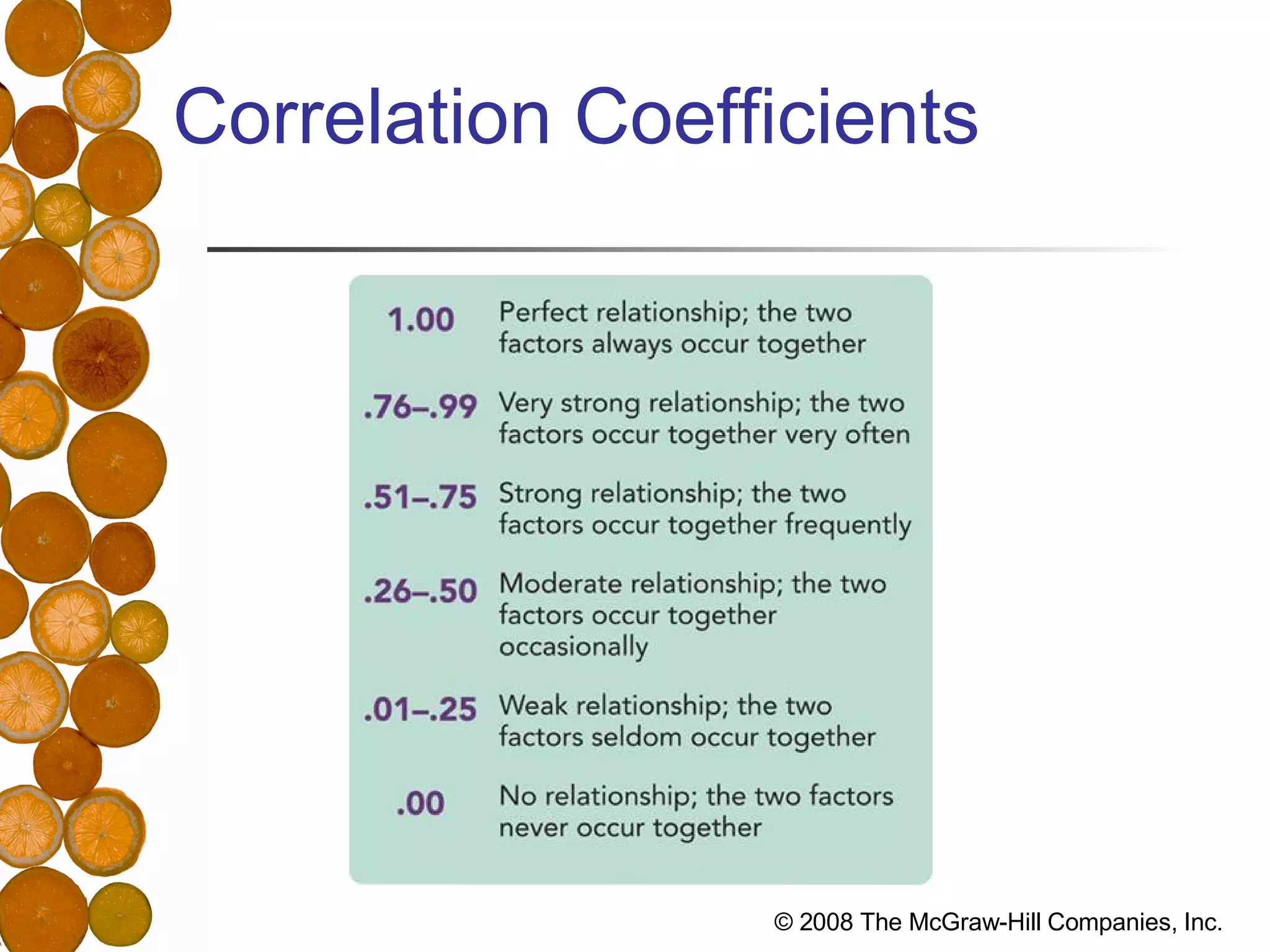
Correlational Research Goal: Identify Relationships Correlation coefficient:  r -1.00 ≤  r  ≤ 1.00 Strength of relationship: # Direction of relationship: + / -
Correlation Coefficients
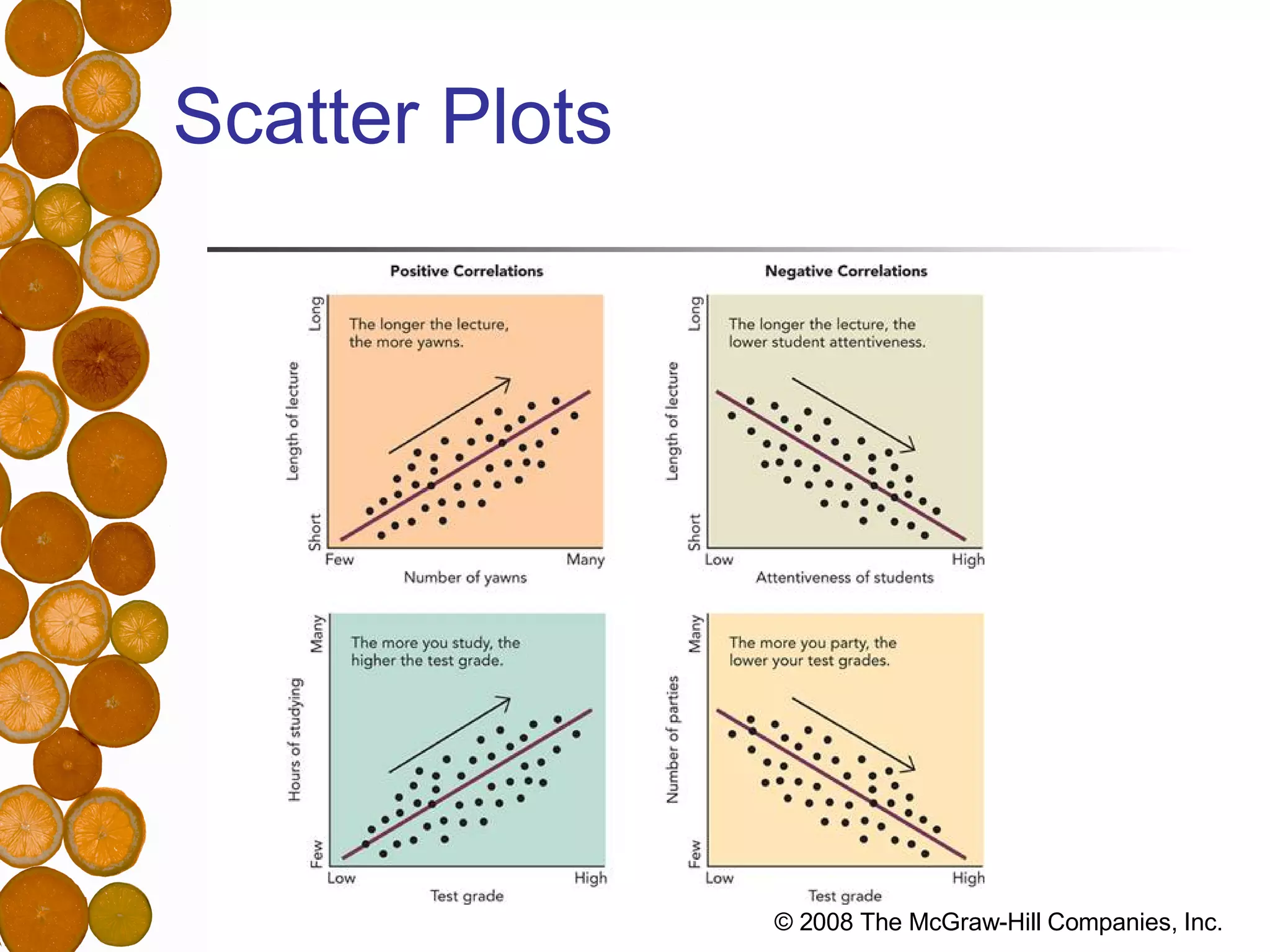
Scatter Plots
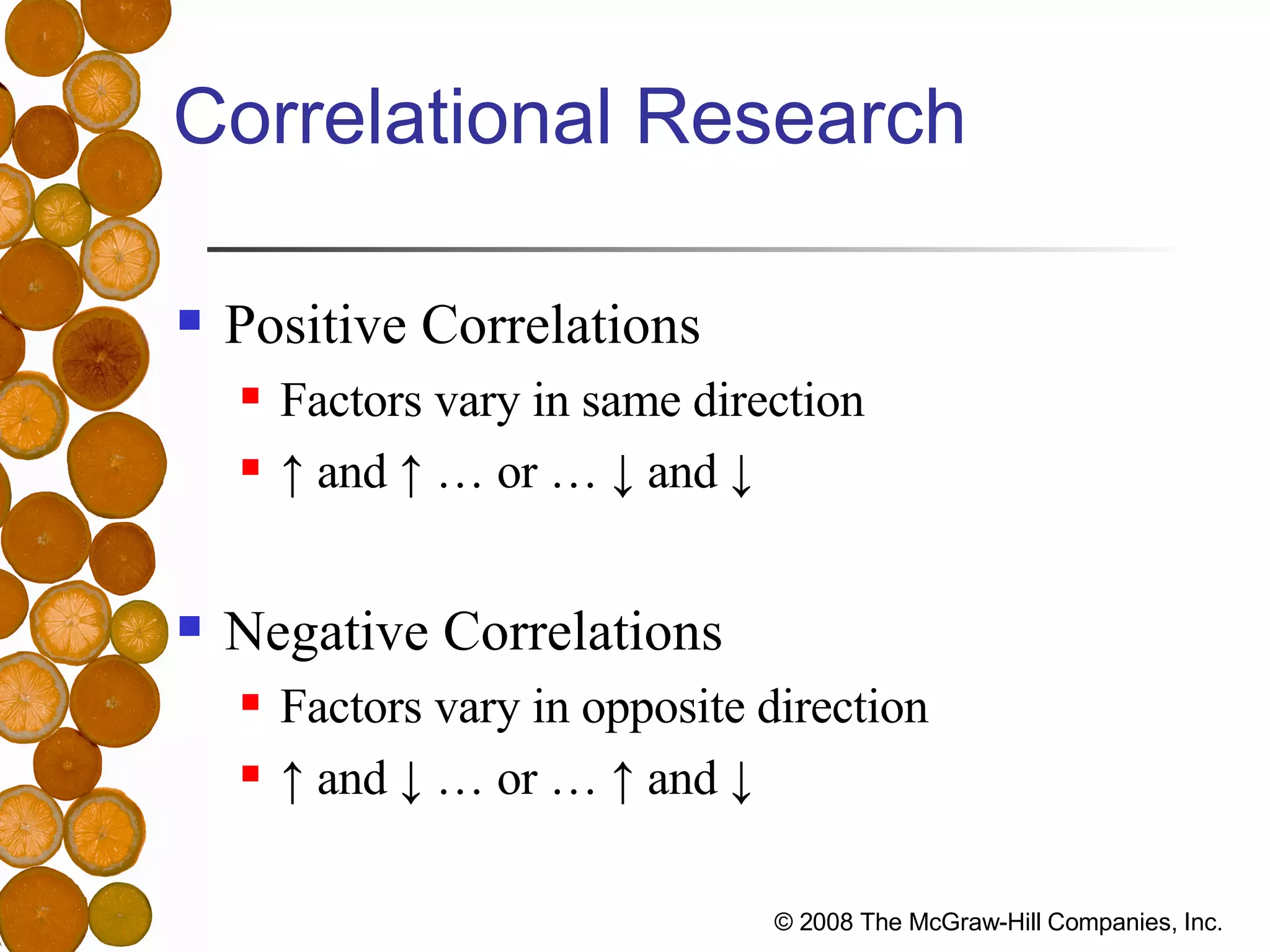
Correlational Research  Positive Correlations Factors vary in same direction ↑ and ↑ … or … ↓ and ↓ Negative Correlations Factors vary in opposite direction ↑ and ↓ … or … ↑ and ↓
Correlation and Causation Correlation  does not  equal causation Third Variable Problem Multivariate approach Longitudinal design Advantages and Disadvantages of Correlational Research
Experimental Research Goal: Determine Causation Random Sampling and Assignment Independent Variable(s)  –  Manipulation Dependent Variable(s)  –  Measurement
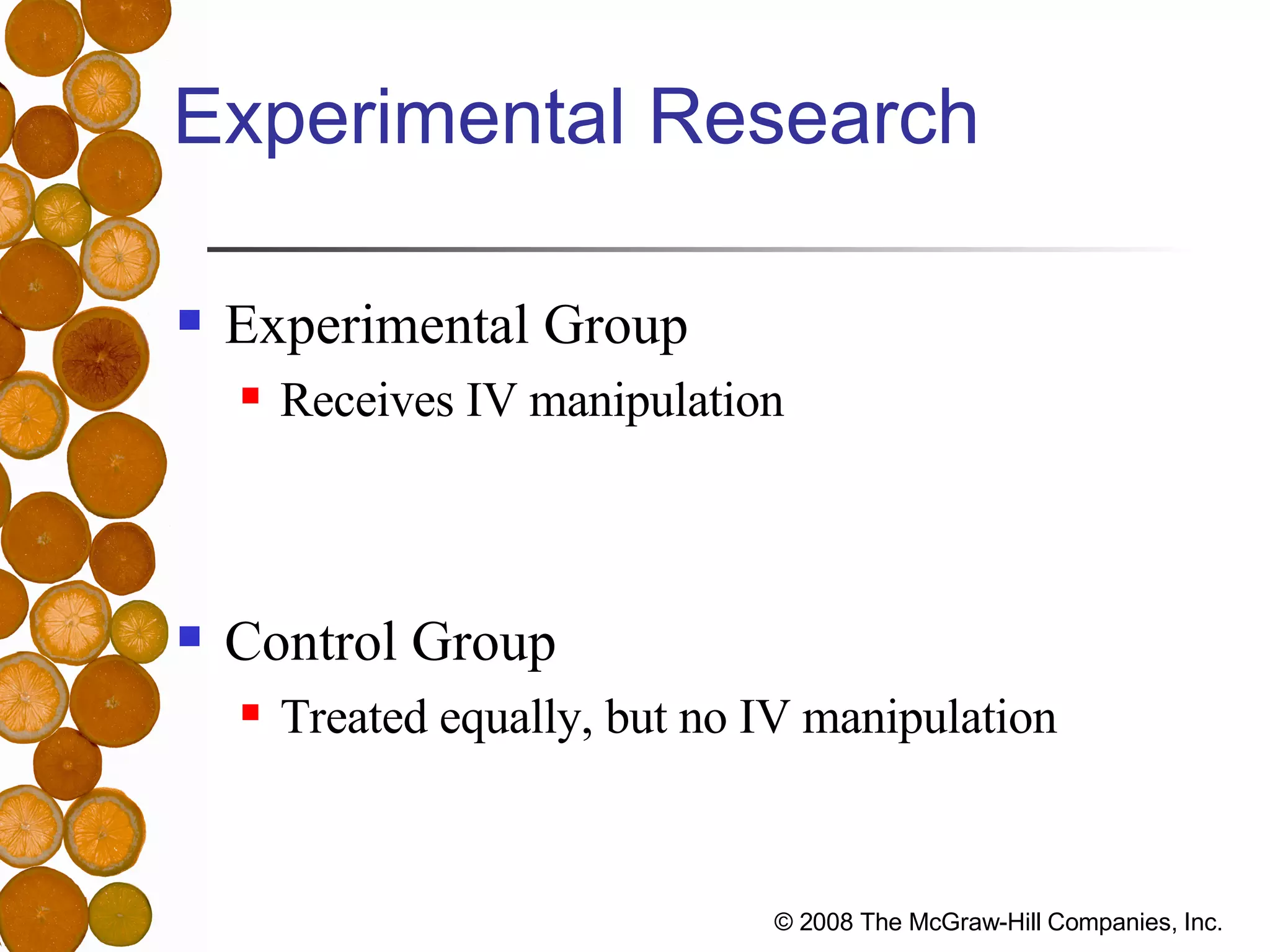
Experimental Research Experimental Group Receives IV manipulation Control Group Treated equally, but no IV manipulation
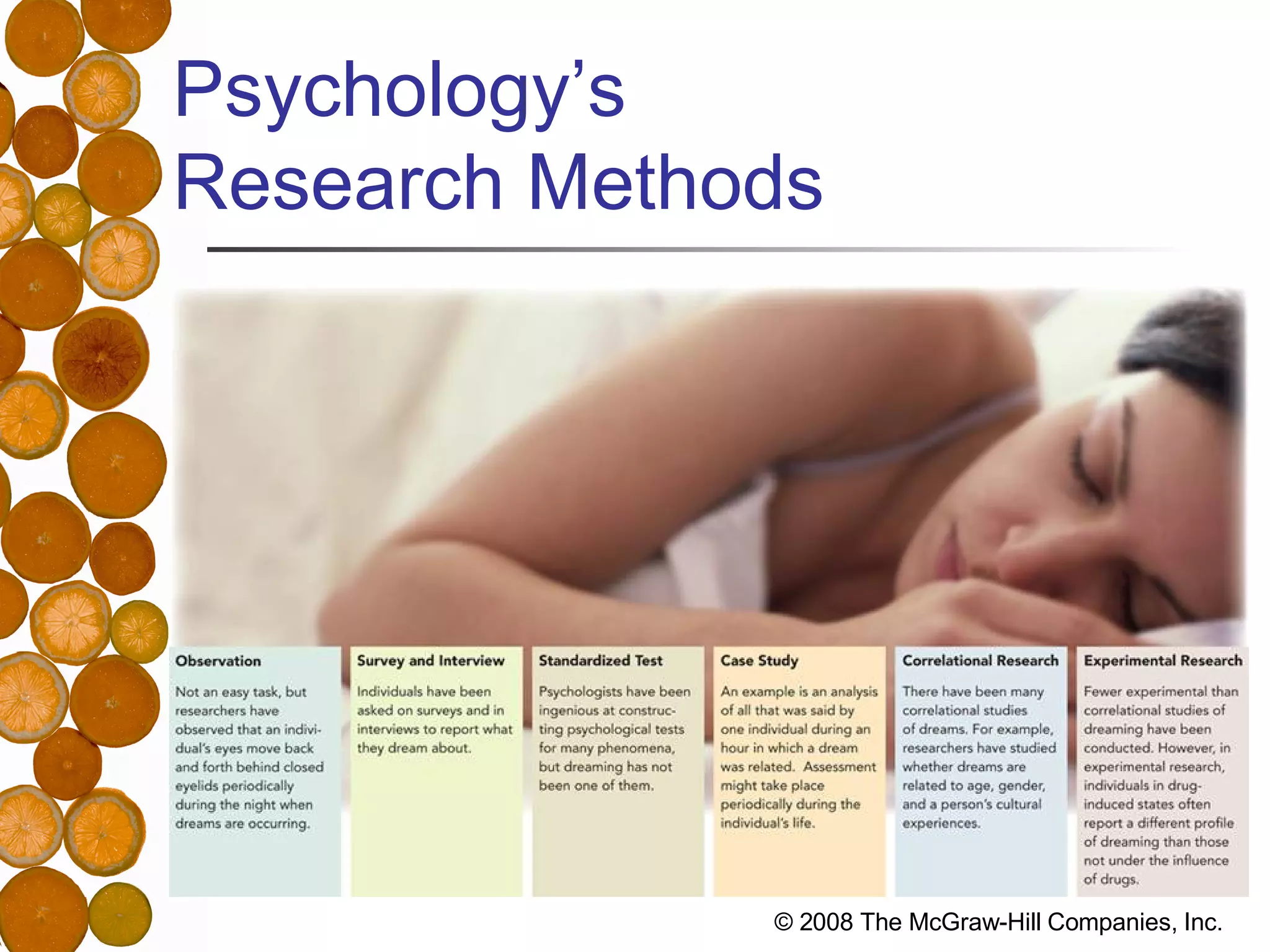
Psychology’s  Research Methods Insert figure 2.4 here
Validity Ecological validity Representative of real world issues? Do results generalize to the real world? Internal validity Are DV changes the result of IV manipulation? Bias? Logical errors?
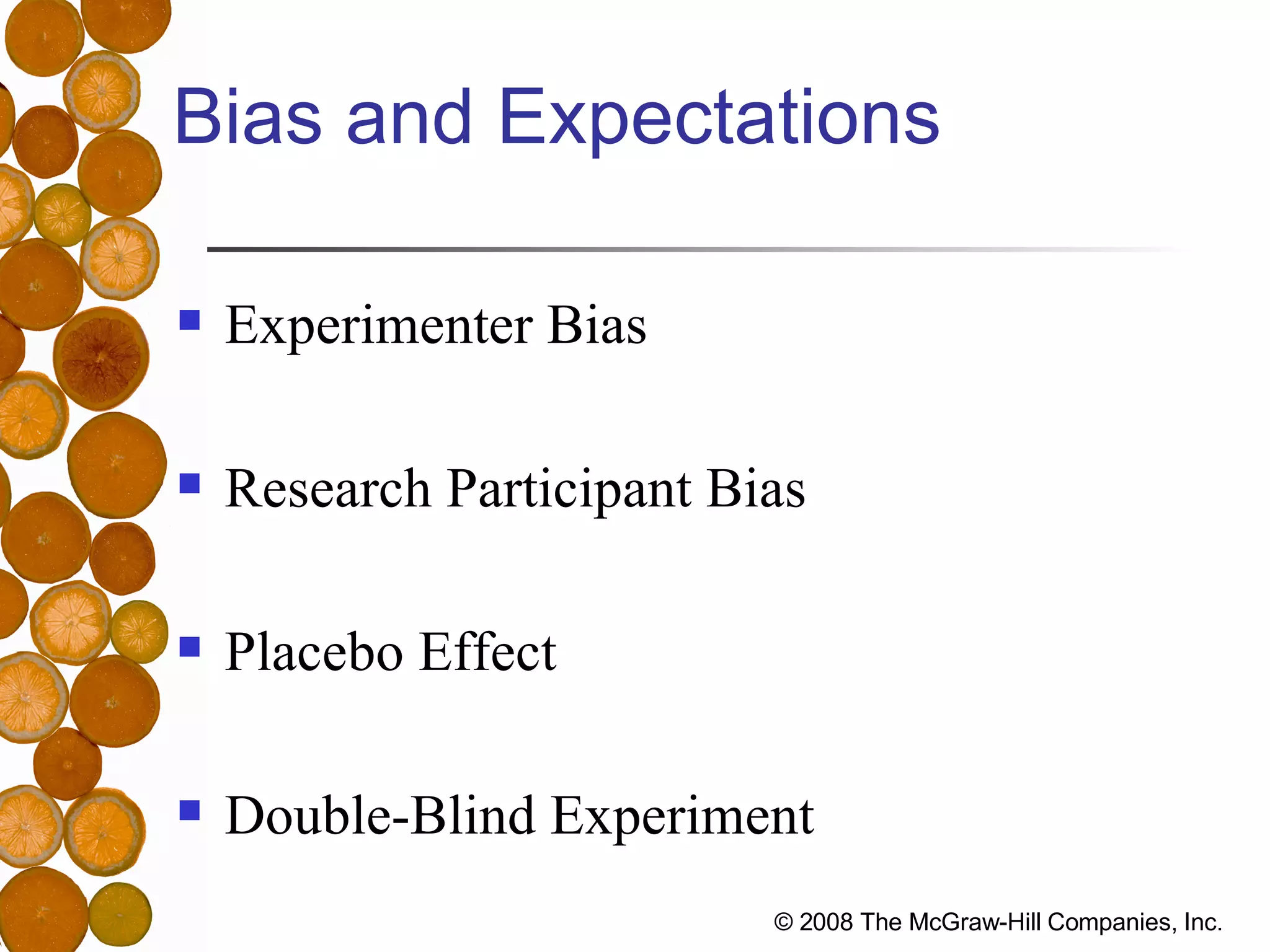
Bias and Expectations Experimenter Bias Research Participant Bias Placebo Effect Double-Blind Experiment
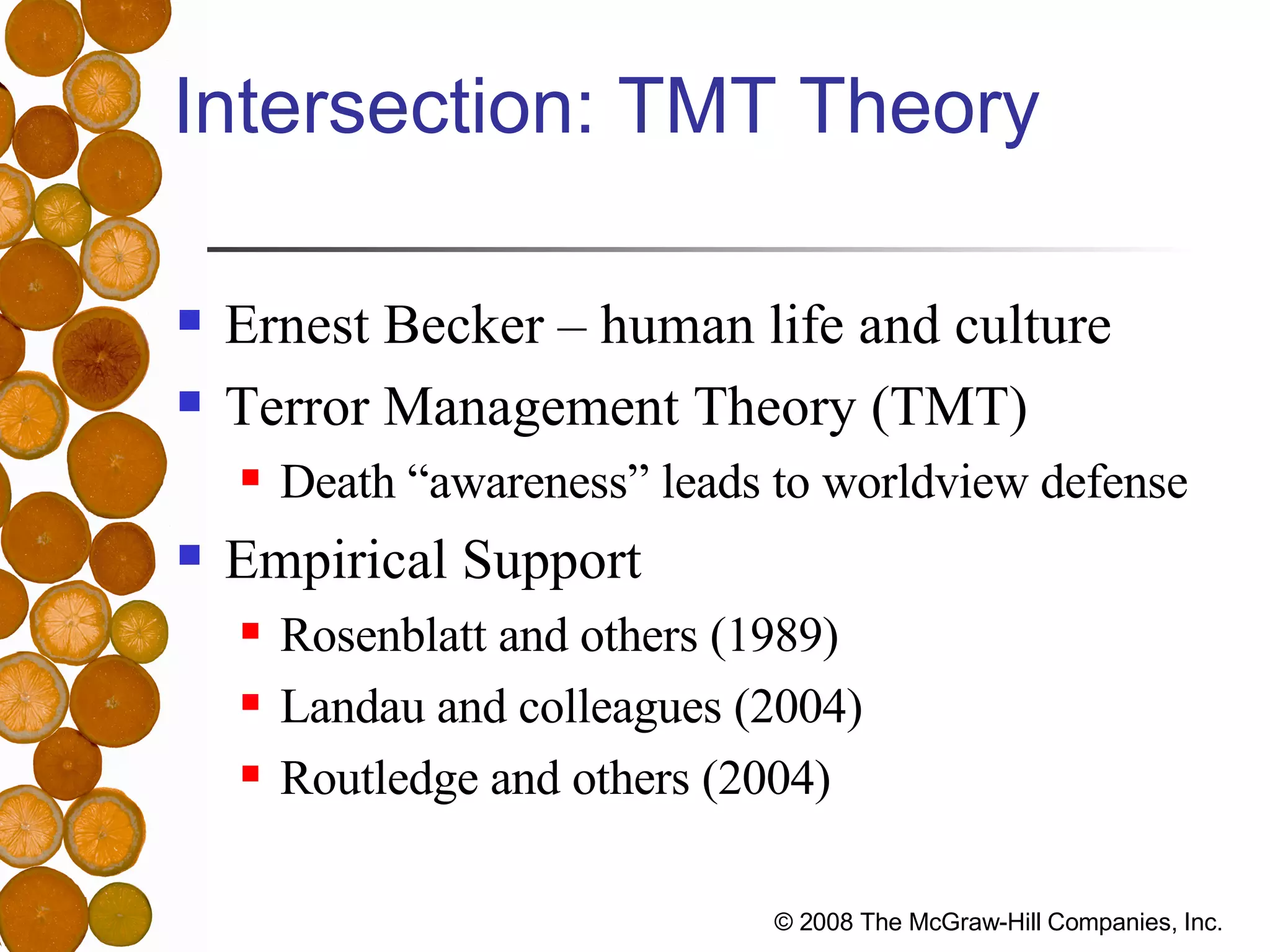
Intersection: TMT Theory Ernest Becker – human life and culture Terror Management Theory (TMT) Death “awareness” leads to worldview defense Empirical Support Rosenblatt and others (1989) Landau and colleagues (2004) Routledge and others (2004)
Analyzing and Interpreting Data Statistics Mathematical methods used to report data Descriptive Statistics Describe and summarize data Inferential Statistics Draw conclusions about data
Descriptive Statistics Measures of Central Tendency Mean Median Mode Measures of Dispersion Range Standard deviation
Inferential Statistics Does data confirm the hypothesis? Statistical significance α  = 0.05 (confidence level) Significance vs. meaningfulness
Research Ethics Research participants have rights! Institutional Review Board (IRB) APA Guidelines Informed consent Confidentiality Debriefing Deception
Animal Research in Psychology Animal Research and Human Problems Prevalence of Animal Research Animals Rights and Welfare Institutional Animal Care and Use Committees (IACUC)
Minimizing Bias in Research Gender Bias Research historically focused on males Cultural and Ethnic Bias Research historically focused on middle-socioeconomic-status European Americans Overgeneralizations about ethnic groups Currently research emphasizes diversity: gender, ethnicity, socioeconomic status
A Wise Consumer… …   is skeptical yet open-minded! Cautions Distinguish between group results and individual needs Avoid overgeneralizing results Look for converging evidence Question causal inferences Consider the source
Application: Happiness The Science of Happiness Subjective Well-Being Happiness ↔ Life Success Challenges to Becoming Happier The hedonic treadmill The pursuit of happiness
Chapter Summary Explain what makes psychology a science. Discuss common research settings and the three main types of research that are used in psychology. Distinguish between descriptive statistics and inferential statistics. Discuss some challenges that involve ethics, bias, and information. Discuss scientific studies on human happiness and the nature of their findings.
Chapter Summary The scientific method is marked by Curiosity, skepticism, objectiveness, and critical thinking Research settings and methods Descriptive, correlational, and experimental studies conducted in natural settings or the lab
Chapter Summary Data analysis and interpretation Descriptive and inferential statistics Challenges: Research Ethics and Bias APA guidelines and the IRB Application: Health and Wellness The scientific study of happiness
Chapter 3 Biological Foundations of Behavior
3-1 The Neuron Neurons are specialized cells in the nervous system that send and receive information.
1) The Neuron Researchers have identified three different types: Sensory Neurons : Detect stimuli inside the body or in the world Motor Neurons : Send commands from the brain to other parts of the body, telling them what to do Interneurons :  Connect other neurons to one another.
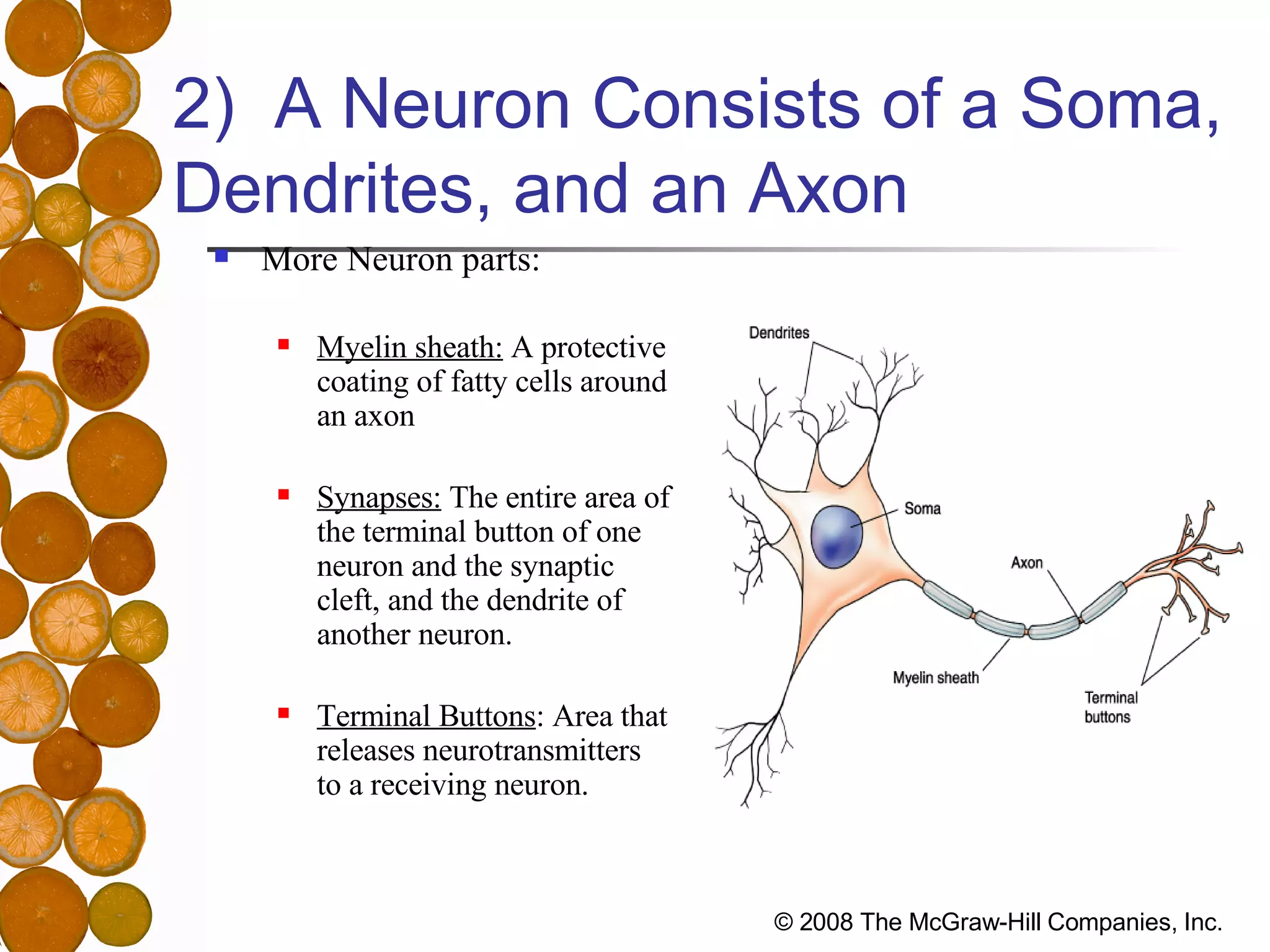
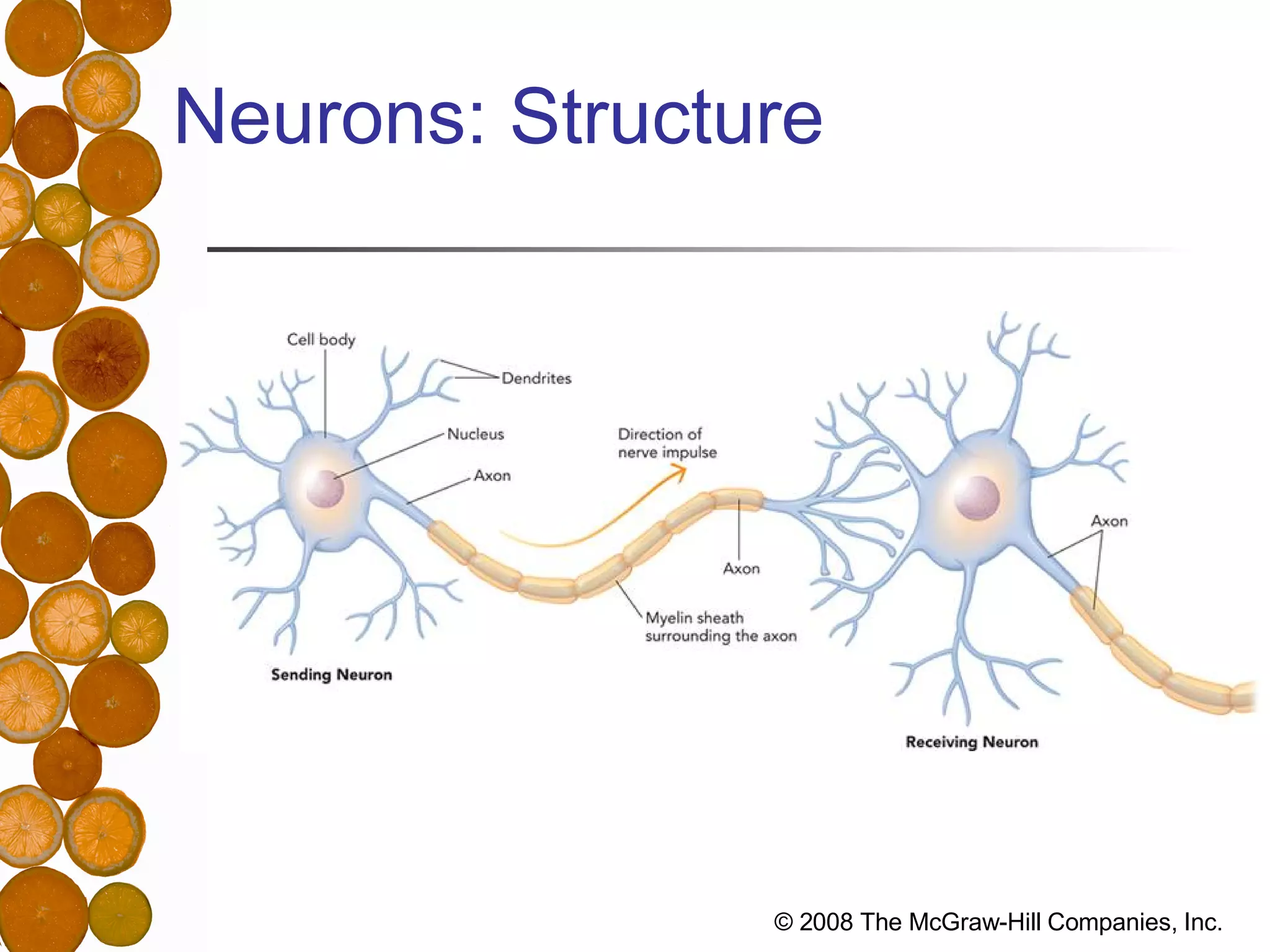
2)  A Neuron Consists of a Soma, Dendrites, and an Axon The basic components of the neuron are the: Soma : The cell body of the neuron  Dendrites : Branch-like extensions of the soma that receive information from other neurons. Axon : Tail of the soma that sends electrochemical messages
2)  A Neuron Consists of a Soma, Dendrites, and an Axon More Neuron parts: Myelin sheath:  A protective coating of fatty cells around an axon  Synapses:  The entire area of the terminal button of one neuron and the synaptic cleft, and the dendrite of another neuron. Terminal Buttons : Area that releases neurotransmitters to a receiving neuron.
Neurons: Structure
3-3c  Brain Parts Amygdala:  Fear & Agression (Approach or Avoid) Cerebral Cortex:  Higher order mental processes Cerebellum:  Body movement and coordination  Hipocampus:  Acquisition & consolidation of new info Hypothalamus:  Homeostasis (balance: eat, drink, sex) Limbic System:  Emotional Center Medulla:  Breathing, heart rate, swallowing Pons: Sleeping and arousal Thalamus:  Sensory Relay station
The Neural Impulse Resting Potential Stable, negative charge of an inactive neuron Action Potential Ion gates cause depolarization Brief, positive electrical charge: firing All-or-None Principle Once initiated, it cannot be stopped
Synapses and Neurotransmitters Synaptic Transmission Neurochemical communication Action potential (electrical impulse) is converted into a chemical signal Synapses Space between terminal buttons and the receiving neuron’s cell body or dendrites
Synapses and Neurotransmitters
Neurotransmitters Neurotransmitters either excite or inhibit Acetylcholine Muscle actions, learning, memory Alzheimer’s disease: ↓ Ach levels Nicotine: ↑ Ach levels GABA – inhibitory functions Anxiety: ↓ GABA levels
Neurotransmitters Norepinephrine Stress and mania: ↑ Norepinephrine levels Depression: ↓ Norepinephrine levels Regulates sleep states in conjunction with ACh Dopamine Stimulant drugs: ↑ Dopamine levels Parkinson’s disease: ↓ Dopamine levels
Neurotransmitters Serotonin Regulation of sleep, mood, attention, learning Depression: ↓ Serotonin levels Prozac    ↑ Serotonin levels Endorphins Endogenous (natural) opiates Mediate feelings of pleasure and pain
Neurotransmitters Oxytocin Both a hormone and a neurotransmitter Related to onset of lactation in new mothers Related to attachment / emotional bonds Drugs and Neurotransmitters Agonist – mimics or enhances NT effects Antagonist – blocks effects of NT
The Nervous System:  Divisions
The Nervous System:  Divisions Central nervous system (CNS) Brain and spinal cord Peripheral nervous system (PNS) Somatic nervous system Sensory nerves and muscular activity Autonomic nervous system – internal organs Sympathetic nervous system – arouses Parasympathetic nervous system – calms
The Endocrine System Communicates by Secreting Hormones Endocrine system:  Network of glands that manufacture and secrete hormones directly into the bloodstream Hormones: Chemical signals manufactured and secreted into the blood in one part of the body and that affect other parts of the body. The Pituitary gland  body’s “master” gland located at the base of the brain stimulates and regulates the endocrine system.
Modern Technology Measures Five techniques that may be used for  for measuring the brain’s electrical activity, structure, blood flow, and chemistry are: Electroencephalograph (EEG):  Records “waves” of electrical activity in the brain  Computerized Axial Tomograph (CAT):  Combines thousands of X-ray photographs to construct a cross-sectional image of the brain. Positron Emission Tomography (PET) scan : Measures average amount of metabolic activity in brain regions
Modern Technology Measures Magnetic Resonance Imaging (MRI): Produces 3-D images of the brain’s soft tissue by detecting magnetic activity Functional Magnetic Resonance Imaging (fMRI): Measures the average neural activity in different brain regions
3-3c  Brain Parts Amygdala:  Fear & Agression (Approach or Avoid) Cerebral Cortex:  Higher order mental processes Cerebellum:  Body movement and coordination  Hipocampus:  Acquisition & consolidation of new info Hypothalamus:  Homeostasis (balance: eat, drink, sex) Limbic System:  Emotional Center Medulla:  Breathing, heart rate, swallowing Pons: Sleeping and arousal Thalamus:  Sensory Relay station
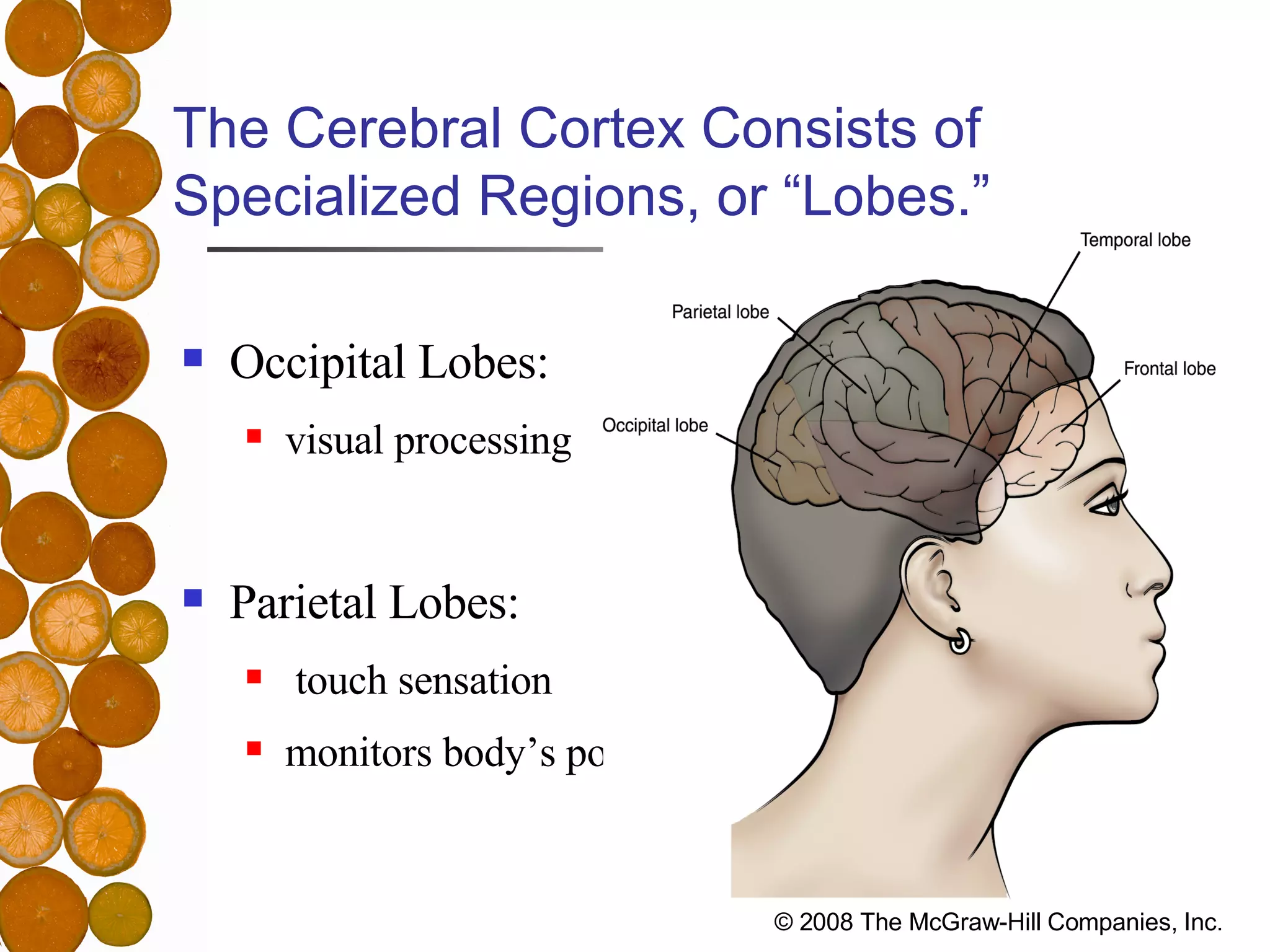
The Cerebral Cortex Consists of Specialized Regions, or “Lobes.” Occipital Lobes:  visual processing Parietal Lobes:  touch sensation monitors body’s position
11)  The Cerebral Cortex Consists of Specialized Regions, or “Lobes.” Temporal Lobes: audition and language. Frontal Lobes: coordination;  higher mental processes.
13)  The Right and Left Cerebral Hemispheres Function Differently Research shows these cautious generalizations : Right hemisphere:  visual and spatial tasks recognizing nonlinguistic sounds  identifying faces perceiving and expressing emotions  Left hemisphere:  Excels at language, logic providing explanations for events
14)  The Sexes May Differ in Their Hemispheric Organization Hemisphere Organization Left hemisphere damage due to stroke Men are more likely to develop aphasia  Women’s brains are bilateralized for language  Women’s left hemispheres may be organized differently than men’s.
15)  The Brain Can Alter Its Neural Connections Plasticity:  ability to alter its neural connections  Peak age of plasticity is 4-10 years of age
Genes and the Environment The “Nature versus Nurture” Debate Nature describes one’s genetic potential Genotype – genetic heritage Nurture    the expression of that potential Phenotype – observable characteristics Both physical and psychological characteristics

King1 Ppt Ch01 3

  • 1.
    Chapter 1 Whatis Psychology?
  • 2.
    Chapter Preview DefiningPsychology Historical Foundations of Psychology Contemporary Approaches to Psychology Specializations and Careers in Psychology Application: Health and Wellness
  • 3.
    Psychology: Defined Thescientific study of behavior and mental processes Key components of this definition: Science Behavior Mental Processes
  • 4.
    Psychology and Common Sense Is psychology simply common sense? Sometimes yes, but sometimes no… Hindsight Bias Unexpected Findings
  • 5.
    Positive Psychology Traditionalfocus on the negative aspects of human experience More than disordered Positive Psychology Movement Experiences people value Traits associated with optimal functioning Positive group and civic values
  • 6.
    Historical Approaches WesternPhilosophy Biology and Physiology Wilhelm Wundt (1832-1920) First Psychology Laboratory (1879) established at the University of Leipzig
  • 7.
    Structuralism Wundt: Identifystructures of the mind Research described dimensions of feeling: Pleasure / Displeasure Tension / Relaxation Excitement / Depression Methodology: Introspection
  • 8.
    Functionalism William Jamesand Pragmatism Identify the functions of the mind Focused on interactions with environment Adaptive significance: “Why?” Flow of thought: Stream of consciousness
  • 9.
    Psychology and EvolutionCharles Darwin (1859) Natural Selection There exists a constant struggle for resources Nature will favor those traits that promote reproduction and survival Environmental changes alter evolution’s course
  • 10.
    Contemporary Approaches SevenCurrent Psychological Perspectives Biological Behavioral Psychodynamic Humanistic Cognitive Evolutionary Sociocultural
  • 11.
    The Biological ApproachFocuses on the brain and nervous system Central to understanding behavior, thought, and emotion Neuroscience Structure, function, development, genetics, biochemistry of the nervous system Chapter 3: Biological Foundations of Behavior
  • 12.
    The Behavioral ApproachFocuses on the environmental determinants of observable behavior Notable Behaviorists: John Watson, B.F. Skinner Early conflicts with cognitive psychologists Chapter 7: Learning
  • 13.
    The Psychodynamic ApproachEmphasizes unconscious thought, conflict between internal drives and society, and early family experiences All influence behavior, thought, and emotion Notable Psychodynamic Theorists Sigmund Freud, Erik Erikson, Alfred Adler Chapter 11: Personality
  • 14.
    The Humanistic ApproachFocuses on positive human qualities, capacity for self-actualization, free will Developed in response to the behaviorist and psychodynamic approaches Notable Humanistic Theorists Carl Rogers, Abraham Maslow Chapter 11: Personality
  • 15.
    The Cognitive ApproachEmphasizes the importance of mental processes to problem solving, learning and memory Mental processes control behavior through memories, perceptions, and thinking Chapter 9: Thinking, Language, and Intelligence
  • 16.
    The Evolutionary ApproachEmphasizes the relevance of evolutionary theory to all behavior and mental processes Current function reflects changes that occurred in response to ancestral environments Notable Evolutionary Psychologists David Buss, Leda Cosmides, John Tooby Chapter 3: Biological Foundations of Behavior
  • 17.
    The Sociocultural ApproachExamines how social and cultural environments influence behavior and mental processes In contrast to the evolutionary approach Studies differences between ethnic and cultural groups within a country Chapter 12: Social Psychology
  • 18.
    Contemporary Approaches SevenCurrent Psychological Perspectives Biological Behavioral Psychodynamic Humanistic Cognitive Evolutionary Sociocultural
  • 19.
    Critical Controversy: AltruismAltruism Defined Voluntary behavior intended to help others Not motivated by expectation of personal gain Altruism: The Evolutionary Approach Kin selection and inclusive fitness Altruism: The Sociocultural Approach Social relationships unfold over time
  • 20.
    Areas of SpecializationSpecializations are not mutually exclusive Highlighted by “Intersections” in the text American Psychological Association Abbreviated: APA Currently 56 divisions / specializations
  • 21.
    Areas of SpecializationPhysiological Psychology Behavioral Neuroscience Developmental Psychology Sensation and Perception
  • 22.
    Areas of SpecializationCognitive Psychology Learning Motivation and Emotion Personality Psychology
  • 23.
    Areas of SpecializationSocial Psychology Industrial and Organizational Psychology Clinical and Counseling Psychology Health Psychology
  • 24.
    Areas of SpecializationCommunity Psychology School and Educational Psychology Environmental Psychology Psychology of Women
  • 25.
    Areas of SpecializationForensic Psychology Sport Psychology Cross-Cultural Psychology
  • 26.
    Intersection: Cultureand Emotion Complete the “Happiness” scale in the text Sum your ratings and divide the total by 5 Higher scores = higher perceived happiness Despite numerous cultural differences, most people report being happy But culture can impact perceived happiness
  • 27.
    Intersection: Cultureand Emotion Individualistic Cultures Individuals viewed as unique and distinct from their social group Value independence Collectivistic Cultures Emphasize social group and the individual’s role within that group Value interdependence
  • 28.
    Careers in PsychologyWhat do psychologists do? And where? Business Social and Human Services Research Education Research Laboratories Clinical and Private Practice Settings
  • 29.
  • 30.
  • 31.
    Psychology: Healthand Wellness Psychology is concerned with Mind-Body Connections The mind impacts the body Examples? The body impacts the mind Examples?
  • 32.
    Chapter Summary Explainwhat psychology is and describe the positive psychology movement. Discuss the roots and early scientific foundations of psychology. Summarize the main themes of seven approaches to psychology. Evaluate areas of specialization and careers in psychology. Describe the connections between the mind and the body.
  • 33.
    Chapter Summary DefiningPsychology The scientific study of behavior and mental processes Historical Foundations of Psychology Origins in philosophy and physiology Structuralism – Wilhelm Wundt Functionalism – William James Evolutionary Theory – Charles Darwin
  • 34.
    Chapter Summary ContemporaryApproaches to Psychology Seven current approaches – complementary Specializations and Careers in Psychology Business, social and human services, research Education, research, clinics and private practice Application: Health and Wellness The mind-body connection is a “two-way street”
  • 35.
    Chapter 2 Psychology’sScientific Method
  • 36.
    Chapter Preview Psychologyand the Scientific Method Research Settings and Methods Data Analysis and Interpretation Challenges: Research Ethics and Bias Application: Health and Wellness
  • 37.
    What Makes Psychology a Science? Scientific Approach Curiosity Skepticism Objectiveness Thinking critically Collaboration Peer-reviewed research Meta-analyses
  • 38.
    The Scientific AttitudeCuriosity Skepticism Objectivity Thinking Critically
  • 39.
    Collaboration Peer ReviewPublication Research/Scholarly Journals Meta-Analysis
  • 40.
    The Scientific TheoryWhat is a Theory? What is a Scientific Theory? Broad idea or set of closely related ideas Attempts to explain observations Makes predictions about future events Connects observations and research
  • 41.
    Scientific Method: ObservationOperational Definitions Objective description of variables How will variables be measured?
  • 42.
    Scientific Method: HypothesisFormulate Hypothesis Testable prediction Derived from theory
  • 43.
    Scientific Method: ResearchCollect Data Select participants Population – entire group of interest Sample – subset of population Random sampling Design Study / Select Research Method Analyze Data Data – all information collected in a study Use statistical procedures to understand data
  • 44.
    Scientific Method: ConclusionsWhat do the results mean? Statistical data analysis Replication of results (reliability) Revise theory?
  • 45.
    Research: Terms &Settings What? Variable – anything that varies Where? “Artificial” world – laboratory setting Advantages and disadvantages? Real world - natural setting Advantages and disadvantages?
  • 46.
    Descriptive Research Goal:Observe and Record Behavior Naturalistic observation Surveys and interviews Standardized tests Case studies
  • 47.
    Observation The goalof observational research is to accurately describe behavior. Naturalistic Observation: Investigates behavior in its natural environment. Participant Observation: Studies a group as a participant in the natural environment.
  • 48.
    Descriptive Methods StrengthsStudy behavior in context May see behavior that would not occur in a lab Systematically record events Record events too risky or unethical to create in a lab Weaknesses Absence of control Researcher’ presence may alter behaviors Possible invasion of privacy
  • 49.
    Campus Bash FunUsing the principles of naturalistic observations, you will observe behavior as it occurs in its natural environment. You may utilize either of the following methods for observation Naturalistic Observation: Investigates behavior in its natural environment. Participant Observation: Studies a group as a participant in the natural environment. Describe the context of the behavior, making note of the social roles and norms of the situation and people within.
  • 50.
    Campus Bash Fun,con’t Describe any incidence of conformity that you may have observed Here are some ideas for your observation: details about the setting and costumes (e.g., location, number of people present, lighting, background noise, dirty clothes) physical and demographic features of the main "actors” non-verbal behaviors (e.g., personal space, territoriality, gestures, eye contact, tone of voice) verbal exchanges Compose your observations in a 1 page paper that you will turn in on Friday.
  • 51.
    How Does theSocial Situation Affect Our Behavior? Social Standards of Behavior Social Roles Social Norms Conformity change in behavior, belief, or both to fit the group Norms: influence our behavior to do what is expected or “normal” Mode of responding (written vs. spoken) Status lesser or higher
  • 52.
    How Does theSocial Situation Affect Our Behavior? Compliance Compliance gaining strategies: FITD: start small, keep getting buy in, then assume compliance DITF: ask big, want small Low-Ball: get compliance with an attractive less costly investment then renigging on it. Car sales Social loafing: evil of the group project, diffusion of responsibility Bystander effect
  • 53.
    Descriptive Research Goal:Observe and Record Behavior Naturalistic observation Surveys and interviews Standardized tests Case studies
  • 54.
    Correlational Research Goal:Identify Relationships Correlation coefficient: r -1.00 ≤ r ≤ 1.00 Strength of relationship: # Direction of relationship: + / -
  • 55.
  • 56.
  • 57.
    Correlational Research Positive Correlations Factors vary in same direction ↑ and ↑ … or … ↓ and ↓ Negative Correlations Factors vary in opposite direction ↑ and ↓ … or … ↑ and ↓
  • 58.
    Correlation and CausationCorrelation does not equal causation Third Variable Problem Multivariate approach Longitudinal design Advantages and Disadvantages of Correlational Research
  • 59.
    Experimental Research Goal:Determine Causation Random Sampling and Assignment Independent Variable(s) – Manipulation Dependent Variable(s) – Measurement
  • 60.
    Experimental Research ExperimentalGroup Receives IV manipulation Control Group Treated equally, but no IV manipulation
  • 61.
    Psychology’s ResearchMethods Insert figure 2.4 here
  • 62.
    Validity Ecological validityRepresentative of real world issues? Do results generalize to the real world? Internal validity Are DV changes the result of IV manipulation? Bias? Logical errors?
  • 63.
    Bias and ExpectationsExperimenter Bias Research Participant Bias Placebo Effect Double-Blind Experiment
  • 64.
    Intersection: TMT TheoryErnest Becker – human life and culture Terror Management Theory (TMT) Death “awareness” leads to worldview defense Empirical Support Rosenblatt and others (1989) Landau and colleagues (2004) Routledge and others (2004)
  • 65.
    Analyzing and InterpretingData Statistics Mathematical methods used to report data Descriptive Statistics Describe and summarize data Inferential Statistics Draw conclusions about data
  • 66.
    Descriptive Statistics Measuresof Central Tendency Mean Median Mode Measures of Dispersion Range Standard deviation
  • 67.
    Inferential Statistics Doesdata confirm the hypothesis? Statistical significance α = 0.05 (confidence level) Significance vs. meaningfulness
  • 68.
    Research Ethics Researchparticipants have rights! Institutional Review Board (IRB) APA Guidelines Informed consent Confidentiality Debriefing Deception
  • 69.
    Animal Research inPsychology Animal Research and Human Problems Prevalence of Animal Research Animals Rights and Welfare Institutional Animal Care and Use Committees (IACUC)
  • 70.
    Minimizing Bias inResearch Gender Bias Research historically focused on males Cultural and Ethnic Bias Research historically focused on middle-socioeconomic-status European Americans Overgeneralizations about ethnic groups Currently research emphasizes diversity: gender, ethnicity, socioeconomic status
  • 71.
    A Wise Consumer…… is skeptical yet open-minded! Cautions Distinguish between group results and individual needs Avoid overgeneralizing results Look for converging evidence Question causal inferences Consider the source
  • 72.
    Application: Happiness TheScience of Happiness Subjective Well-Being Happiness ↔ Life Success Challenges to Becoming Happier The hedonic treadmill The pursuit of happiness
  • 73.
    Chapter Summary Explainwhat makes psychology a science. Discuss common research settings and the three main types of research that are used in psychology. Distinguish between descriptive statistics and inferential statistics. Discuss some challenges that involve ethics, bias, and information. Discuss scientific studies on human happiness and the nature of their findings.
  • 74.
    Chapter Summary Thescientific method is marked by Curiosity, skepticism, objectiveness, and critical thinking Research settings and methods Descriptive, correlational, and experimental studies conducted in natural settings or the lab
  • 75.
    Chapter Summary Dataanalysis and interpretation Descriptive and inferential statistics Challenges: Research Ethics and Bias APA guidelines and the IRB Application: Health and Wellness The scientific study of happiness
  • 76.
    Chapter 3 BiologicalFoundations of Behavior
  • 77.
    3-1 The NeuronNeurons are specialized cells in the nervous system that send and receive information.
  • 78.
    1) The NeuronResearchers have identified three different types: Sensory Neurons : Detect stimuli inside the body or in the world Motor Neurons : Send commands from the brain to other parts of the body, telling them what to do Interneurons : Connect other neurons to one another.
  • 79.
    2) ANeuron Consists of a Soma, Dendrites, and an Axon The basic components of the neuron are the: Soma : The cell body of the neuron Dendrites : Branch-like extensions of the soma that receive information from other neurons. Axon : Tail of the soma that sends electrochemical messages
  • 80.
    2) ANeuron Consists of a Soma, Dendrites, and an Axon More Neuron parts: Myelin sheath: A protective coating of fatty cells around an axon Synapses: The entire area of the terminal button of one neuron and the synaptic cleft, and the dendrite of another neuron. Terminal Buttons : Area that releases neurotransmitters to a receiving neuron.
  • 81.
  • 82.
    3-3c BrainParts Amygdala: Fear & Agression (Approach or Avoid) Cerebral Cortex: Higher order mental processes Cerebellum: Body movement and coordination Hipocampus: Acquisition & consolidation of new info Hypothalamus: Homeostasis (balance: eat, drink, sex) Limbic System: Emotional Center Medulla: Breathing, heart rate, swallowing Pons: Sleeping and arousal Thalamus: Sensory Relay station
  • 83.
    The Neural ImpulseResting Potential Stable, negative charge of an inactive neuron Action Potential Ion gates cause depolarization Brief, positive electrical charge: firing All-or-None Principle Once initiated, it cannot be stopped
  • 84.
    Synapses and NeurotransmittersSynaptic Transmission Neurochemical communication Action potential (electrical impulse) is converted into a chemical signal Synapses Space between terminal buttons and the receiving neuron’s cell body or dendrites
  • 85.
  • 86.
    Neurotransmitters Neurotransmitters eitherexcite or inhibit Acetylcholine Muscle actions, learning, memory Alzheimer’s disease: ↓ Ach levels Nicotine: ↑ Ach levels GABA – inhibitory functions Anxiety: ↓ GABA levels
  • 87.
    Neurotransmitters Norepinephrine Stressand mania: ↑ Norepinephrine levels Depression: ↓ Norepinephrine levels Regulates sleep states in conjunction with ACh Dopamine Stimulant drugs: ↑ Dopamine levels Parkinson’s disease: ↓ Dopamine levels
  • 88.
    Neurotransmitters Serotonin Regulationof sleep, mood, attention, learning Depression: ↓ Serotonin levels Prozac  ↑ Serotonin levels Endorphins Endogenous (natural) opiates Mediate feelings of pleasure and pain
  • 89.
    Neurotransmitters Oxytocin Botha hormone and a neurotransmitter Related to onset of lactation in new mothers Related to attachment / emotional bonds Drugs and Neurotransmitters Agonist – mimics or enhances NT effects Antagonist – blocks effects of NT
  • 90.
  • 91.
    The Nervous System: Divisions Central nervous system (CNS) Brain and spinal cord Peripheral nervous system (PNS) Somatic nervous system Sensory nerves and muscular activity Autonomic nervous system – internal organs Sympathetic nervous system – arouses Parasympathetic nervous system – calms
  • 92.
    The Endocrine SystemCommunicates by Secreting Hormones Endocrine system: Network of glands that manufacture and secrete hormones directly into the bloodstream Hormones: Chemical signals manufactured and secreted into the blood in one part of the body and that affect other parts of the body. The Pituitary gland body’s “master” gland located at the base of the brain stimulates and regulates the endocrine system.
  • 93.
    Modern Technology MeasuresFive techniques that may be used for for measuring the brain’s electrical activity, structure, blood flow, and chemistry are: Electroencephalograph (EEG): Records “waves” of electrical activity in the brain Computerized Axial Tomograph (CAT): Combines thousands of X-ray photographs to construct a cross-sectional image of the brain. Positron Emission Tomography (PET) scan : Measures average amount of metabolic activity in brain regions
  • 94.
    Modern Technology MeasuresMagnetic Resonance Imaging (MRI): Produces 3-D images of the brain’s soft tissue by detecting magnetic activity Functional Magnetic Resonance Imaging (fMRI): Measures the average neural activity in different brain regions
  • 95.
    3-3c BrainParts Amygdala: Fear & Agression (Approach or Avoid) Cerebral Cortex: Higher order mental processes Cerebellum: Body movement and coordination Hipocampus: Acquisition & consolidation of new info Hypothalamus: Homeostasis (balance: eat, drink, sex) Limbic System: Emotional Center Medulla: Breathing, heart rate, swallowing Pons: Sleeping and arousal Thalamus: Sensory Relay station
  • 96.
    The Cerebral CortexConsists of Specialized Regions, or “Lobes.” Occipital Lobes: visual processing Parietal Lobes: touch sensation monitors body’s position
  • 97.
    11) TheCerebral Cortex Consists of Specialized Regions, or “Lobes.” Temporal Lobes: audition and language. Frontal Lobes: coordination; higher mental processes.
  • 98.
    13) TheRight and Left Cerebral Hemispheres Function Differently Research shows these cautious generalizations : Right hemisphere: visual and spatial tasks recognizing nonlinguistic sounds identifying faces perceiving and expressing emotions Left hemisphere: Excels at language, logic providing explanations for events
  • 99.
    14) TheSexes May Differ in Their Hemispheric Organization Hemisphere Organization Left hemisphere damage due to stroke Men are more likely to develop aphasia Women’s brains are bilateralized for language Women’s left hemispheres may be organized differently than men’s.
  • 100.
    15) TheBrain Can Alter Its Neural Connections Plasticity: ability to alter its neural connections Peak age of plasticity is 4-10 years of age
  • 101.
    Genes and theEnvironment The “Nature versus Nurture” Debate Nature describes one’s genetic potential Genotype – genetic heritage Nurture  the expression of that potential Phenotype – observable characteristics Both physical and psychological characteristics