Chapter 15 Physical and Cognitive Development in Middle Adulthood
Noticeable Visible Changes See first outwardly visible signs of aging (40s or 50s) Fine lines and wrinkles (loss of collagen and fat under skin) Age spots Hair becomes thinner and grayer. Fingernails and toenails
Height, Weight and Strength:  The Benchmarks of Change Height  Max during the 20’s Remains stable till about 55 Height decrease and many gain weight Body fat increases: 10% of body weight in adolescence, about 20% or more in middle age. Individuals 30% or more overweight, increase probability of dying by about 40%.
Strength, Joints, and Bones Muscle strength  Noticeable decrease by mid 40s (back & legs) Bone Density Reduces with age Men loose about 1 inch in height Women loose about 2 inches in height OSTEOPOROSIS Bones become brittle, fragile, and thin.  Caused by lack of calcium in the body, and lack of exercise.  After the late 30s there is progressive bone loss. Women experience about twice the rate of bone loss as men. Bones break more easily and heal more slowly.
Vision Vision (starting at age 40) Visual acuity - the ability to discern fine spatial detail in both close and distant objects - begins to decline.  Lenses  change shape and elasticity.  become less transparent, which reduces the amount of light entering.  PRESBYOPIA Nearly universal; loss of “near vision”
Hearing Hearing  Begins gradual decline in middle adulthood PRESBYCUSIS   primary loss is for sounds of high frequency About 12 % between 45 and 65  Men are more prone to hearing loss than women Other aging is caused by  Loss of  hair cells  in the inner ear Ear drum becomes less elastic with age
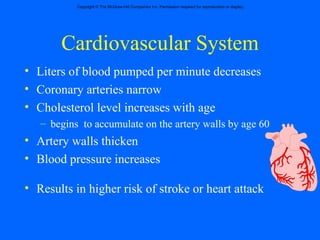
Cardiovascular System Liters of blood pumped per minute decreases Coronary arteries narrow Cholesterol level increases with age begins  to accumulate on the artery walls by age 60 Artery walls thicken Blood pressure increases Results in higher risk of stroke or heart attack
Health and Disease Number of accidents decline Less susceptible to colds and allergies Chronic disorders increase in middle adulthood. Gender differences in chronic disorders  Men have a higher incidence of fatal chronic conditions Women have a higher incidence of nonfatal ones.
The Climateric Changes in Sexuality  Men  typically need more time to get an erection volume of fluid in ejaculation declines production of  Testosterone (Male sex hormone)  also declines Women Walls of the vagina become less elastic and thinner Vagina shrinks potentially making intercourse painful for some women.
Menopause Begins late 40’s or early 50s Cessation of menstruation Dramatic decline in estrogen produced Causes symptoms such as “hot flashes,” nausea, fatigue, and rapid heartbeat Some report depression and irritability
Hormonal Changes in  Middle-Aged Men Hormonal changes, but nothing like the dramatic drop in estrogen that women experience. Testosterone production declines 1% a year  Sperm count has slow decline Men do not lose their fertility  Drop in testosterone levels results in: Sexual drive often lessens Erections are less full, less frequent, and require more stimulation to achieve them.
Sexual Attitudes and Behavior Sexuality Does not fade away for most middle age adults Frequency of sexual intercourse may decrease  For most, sexual activities remain a vital part of lives  Contributions to sexual freedom: No kids at home Menopause eliminates need for birth control
Intelligence Fluid intelligence:  ability to deal with new problems and situations Ex) inductive reasoning, spatial orientation, perceptual speed, and verbal memory   begins to decline  Crystallized intelligence:  information, skills, and strategies that people have acquired through education   continues to increase
Speed of Information Processing Perceptual speed Decline begins in early adulthood, continues in middle adulthood Assessment through reaction-time tasks Ex)  Push button at the sight of a light Middle-aged adults are slower than young adults  Not dramatic decline More of a decline for women than for men.
Memory Verbal memory peaks in 50s. Some studies show a decline (cross-sectional) Effective memory strategies, such as organization and imagery decrease the decline Actually, using such strategies may improve memory
Job Satisfaction Increases steadily throughout the work life, from age 20 to 60. For college-educated and non-college-educated adults For women and men Greater commitment to and involvement in our work as we get older. If you can work when how much you want as opposed to what they have to, they are happiest
Leisure More ime when you are free to pursue activities and interests of  their own choosing—hobbies, sports, reading. Link between type A behavior and heart disease/longevity
Chapter 16 Socioemotional Development in Middle Adulthood
Generativity vs. Stagnation Generativity  adults’ desire to leave a legacy to the next generation. Immortality through a legacy Achieved through parenting, teaching, leading, doing things to benefit the community Stagnation or self-absorption  develops when individuals sense that they have done nothing for the next generation
Affectionate Love Affectionate or companionate love increases during middle adulthood. Security, loyalty, and mutual emotional interest become key. A relationship is believed to mature when partners: share knowledge with one another assume responsibility for each other’s satisfaction share private information that governs their relationship
Marriage and Divorce For married individuals in midlife, most voiced considerable satisfaction with being married. 72% of married midlife individuals reported that their marriage was either “excellent” or “very good.” Getting married in midlife: lowered men’s anxiety, depression, and feelings of vulnerability. Women felt more positive emotions than they had previously. Couples who divorce in midlife tend to be cool, distant, and have suppressed emotions.
Consequences of Divorce  in Midlife Many perceive divorce in midlife as failing in the best years of their lives. Divorce in Midlife: Men became more depressed and had lower achievement goals. Women who divorced in middle age showed a surge in positive emotions. The perils of divorce in midlife may be fewer and less intense than for younger individuals.
The Empty Nest and Its Refilling Empty Nest Syndrome characterized by decrease in marital satisfaction due to the children’s departure which leaves parents with an empty feeling True for parents who live vicariously through their children Most parents do not experience less marital satisfaction, in fact for many it increases after their children have left home.
Coming Home More adult children are returning to live at home after an unsuccessful career or divorce. 42% of middle-aged parents had serious conflicts with their resident adult children. Most common complaints is a loss of privacy (both parents and children) Creates a disequilibrium, requiring considerable adaptation on both parties’ parts.
Parenting Conceptions Middle-aged parents notice as children became adults  they gained a new sense of appreciation for their commitment and influence as parents. Many parents of adult children regret not having had more involvement and better relationships with their children. Children in middle adulthood restructure perceptions of parents viewing them more as unique individuals.
Siblings and Friends The majority tend to be close to siblings This pattern has continued from childhood It is rare for sibling closeness to develop for the first time in adulthood. Friendships continue to be as important in midlife as they were in early adulthood.

Chap15 16

  • 1.
    Chapter 15 Physicaland Cognitive Development in Middle Adulthood
  • 2.
    Noticeable Visible ChangesSee first outwardly visible signs of aging (40s or 50s) Fine lines and wrinkles (loss of collagen and fat under skin) Age spots Hair becomes thinner and grayer. Fingernails and toenails
  • 3.
    Height, Weight andStrength: The Benchmarks of Change Height Max during the 20’s Remains stable till about 55 Height decrease and many gain weight Body fat increases: 10% of body weight in adolescence, about 20% or more in middle age. Individuals 30% or more overweight, increase probability of dying by about 40%.
  • 4.
    Strength, Joints, andBones Muscle strength Noticeable decrease by mid 40s (back & legs) Bone Density Reduces with age Men loose about 1 inch in height Women loose about 2 inches in height OSTEOPOROSIS Bones become brittle, fragile, and thin. Caused by lack of calcium in the body, and lack of exercise. After the late 30s there is progressive bone loss. Women experience about twice the rate of bone loss as men. Bones break more easily and heal more slowly.
  • 5.
    Vision Vision (startingat age 40) Visual acuity - the ability to discern fine spatial detail in both close and distant objects - begins to decline. Lenses change shape and elasticity. become less transparent, which reduces the amount of light entering. PRESBYOPIA Nearly universal; loss of “near vision”
  • 6.
    Hearing Hearing Begins gradual decline in middle adulthood PRESBYCUSIS primary loss is for sounds of high frequency About 12 % between 45 and 65 Men are more prone to hearing loss than women Other aging is caused by Loss of hair cells in the inner ear Ear drum becomes less elastic with age
  • 7.
    Cardiovascular System Litersof blood pumped per minute decreases Coronary arteries narrow Cholesterol level increases with age begins to accumulate on the artery walls by age 60 Artery walls thicken Blood pressure increases Results in higher risk of stroke or heart attack
  • 8.
    Health and DiseaseNumber of accidents decline Less susceptible to colds and allergies Chronic disorders increase in middle adulthood. Gender differences in chronic disorders Men have a higher incidence of fatal chronic conditions Women have a higher incidence of nonfatal ones.
  • 9.
    The Climateric Changesin Sexuality Men typically need more time to get an erection volume of fluid in ejaculation declines production of Testosterone (Male sex hormone) also declines Women Walls of the vagina become less elastic and thinner Vagina shrinks potentially making intercourse painful for some women.
  • 10.
    Menopause Begins late40’s or early 50s Cessation of menstruation Dramatic decline in estrogen produced Causes symptoms such as “hot flashes,” nausea, fatigue, and rapid heartbeat Some report depression and irritability
  • 11.
    Hormonal Changes in Middle-Aged Men Hormonal changes, but nothing like the dramatic drop in estrogen that women experience. Testosterone production declines 1% a year Sperm count has slow decline Men do not lose their fertility Drop in testosterone levels results in: Sexual drive often lessens Erections are less full, less frequent, and require more stimulation to achieve them.
  • 12.
    Sexual Attitudes andBehavior Sexuality Does not fade away for most middle age adults Frequency of sexual intercourse may decrease For most, sexual activities remain a vital part of lives Contributions to sexual freedom: No kids at home Menopause eliminates need for birth control
  • 13.
    Intelligence Fluid intelligence: ability to deal with new problems and situations Ex) inductive reasoning, spatial orientation, perceptual speed, and verbal memory begins to decline Crystallized intelligence: information, skills, and strategies that people have acquired through education continues to increase
  • 14.
    Speed of InformationProcessing Perceptual speed Decline begins in early adulthood, continues in middle adulthood Assessment through reaction-time tasks Ex) Push button at the sight of a light Middle-aged adults are slower than young adults Not dramatic decline More of a decline for women than for men.
  • 15.
    Memory Verbal memorypeaks in 50s. Some studies show a decline (cross-sectional) Effective memory strategies, such as organization and imagery decrease the decline Actually, using such strategies may improve memory
  • 16.
    Job Satisfaction Increasessteadily throughout the work life, from age 20 to 60. For college-educated and non-college-educated adults For women and men Greater commitment to and involvement in our work as we get older. If you can work when how much you want as opposed to what they have to, they are happiest
  • 17.
    Leisure More imewhen you are free to pursue activities and interests of their own choosing—hobbies, sports, reading. Link between type A behavior and heart disease/longevity
  • 18.
    Chapter 16 SocioemotionalDevelopment in Middle Adulthood
  • 19.
    Generativity vs. StagnationGenerativity adults’ desire to leave a legacy to the next generation. Immortality through a legacy Achieved through parenting, teaching, leading, doing things to benefit the community Stagnation or self-absorption develops when individuals sense that they have done nothing for the next generation
  • 20.
    Affectionate Love Affectionateor companionate love increases during middle adulthood. Security, loyalty, and mutual emotional interest become key. A relationship is believed to mature when partners: share knowledge with one another assume responsibility for each other’s satisfaction share private information that governs their relationship
  • 21.
    Marriage and DivorceFor married individuals in midlife, most voiced considerable satisfaction with being married. 72% of married midlife individuals reported that their marriage was either “excellent” or “very good.” Getting married in midlife: lowered men’s anxiety, depression, and feelings of vulnerability. Women felt more positive emotions than they had previously. Couples who divorce in midlife tend to be cool, distant, and have suppressed emotions.
  • 22.
    Consequences of Divorce in Midlife Many perceive divorce in midlife as failing in the best years of their lives. Divorce in Midlife: Men became more depressed and had lower achievement goals. Women who divorced in middle age showed a surge in positive emotions. The perils of divorce in midlife may be fewer and less intense than for younger individuals.
  • 23.
    The Empty Nestand Its Refilling Empty Nest Syndrome characterized by decrease in marital satisfaction due to the children’s departure which leaves parents with an empty feeling True for parents who live vicariously through their children Most parents do not experience less marital satisfaction, in fact for many it increases after their children have left home.
  • 24.
    Coming Home Moreadult children are returning to live at home after an unsuccessful career or divorce. 42% of middle-aged parents had serious conflicts with their resident adult children. Most common complaints is a loss of privacy (both parents and children) Creates a disequilibrium, requiring considerable adaptation on both parties’ parts.
  • 25.
    Parenting Conceptions Middle-agedparents notice as children became adults they gained a new sense of appreciation for their commitment and influence as parents. Many parents of adult children regret not having had more involvement and better relationships with their children. Children in middle adulthood restructure perceptions of parents viewing them more as unique individuals.
  • 26.
    Siblings and FriendsThe majority tend to be close to siblings This pattern has continued from childhood It is rare for sibling closeness to develop for the first time in adulthood. Friendships continue to be as important in midlife as they were in early adulthood.