THE GIFTED CHILD
Who ? What? When? Where? Why? How?
THE GIFTED CHILD
Hoagies’ Gifted Education Page” writes the following for parents…
No individual
can be more exhilarating
or more frustrating.
The parents and teachers who deal with these
wonderful children
can often be described in a this single word -
Exhausted!
…
 The gifted child can speak as an adult one
minute, comparing the emotional relationships in
Les Mis with relationships in her own life, or
discussing potential conflicts between evolution and
the bible, and in the next minute throw an
impressive tantrum because she didn't get what
she wanted... right now!
 She can have you in awe of her theories on
accelerated space travel, or pulling your hair out
in frustration over her argumentative refusal to do
her part in everyday chores.
http://www.hoagiesgifted.org/parents.htm
AND THE FOLLOWING FOR EDUCATORS…
Teachers of the gifted are faced with many issues.
 Is the gifted child identified appropriately?
 How can I best serve him?
 What are her greatest needs?
 What teaching techniques have been shown to work, or to fail, for
gifted children?
 What techniques are best for the individual gifted children I have before
me this day, this week, this year?
 How can I teach these gifted children and still give my best to the rest
of my classroom, especially my low-testing kids?
http://www.hoagiesgifted.org/educators.htm
BUT THE BIG QUESTION IS…
 What to teachers, parents, students and the
communities know about “Giftedness” anyway?
 So, let’s do a KWL!
WHAT DO WE KNOW?
The National Association of Gifted Children
GIFTED SURVEY QUESTION BANK DEVELOPED FROM HTTP://WWW.NAGC.ORG
AWZETTLER 07.12.2013
 visited the National
Association for Gifted
Children,
 developed a bank of
questions based on the
QA sections for parents
and teachers, the gifted
myths, and national
standards for the
gifted, then
 organized my questions
into categories.
 Identification Process
 Gifted Defined
 Curriculum and
Instruction
 Specific Teacher
Knowledge
 General Public
Knowledge
In order to find out what is known
about “giftedness,” I…
Question Categories
IDENTIFICATION PROCESS
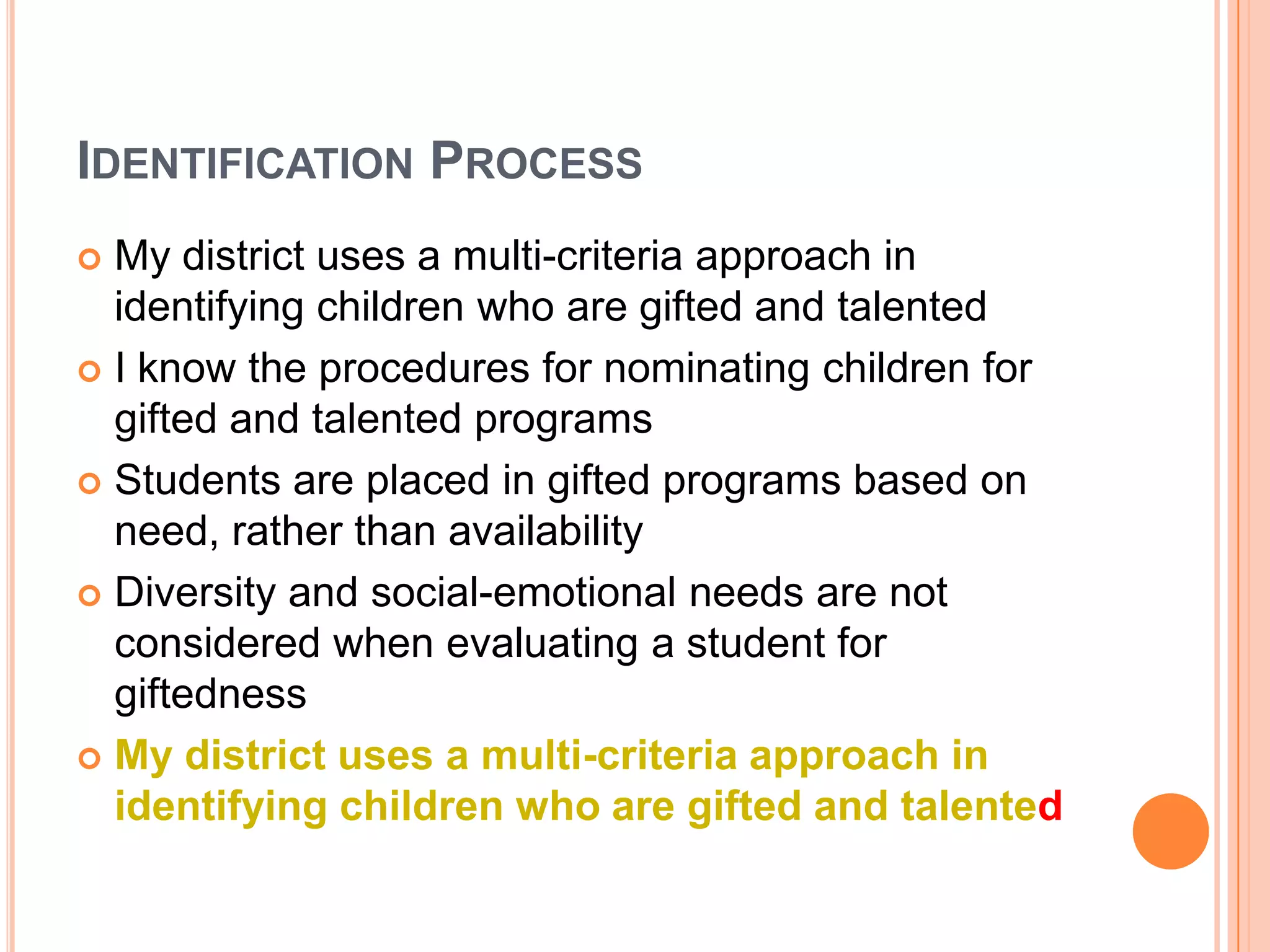
 My district uses a multi-criteria approach in
identifying children who are gifted and talented
 I know the procedures for nominating children for
gifted and talented programs
 Students are placed in gifted programs based on
need, rather than availability
 Diversity and social-emotional needs are not
considered when evaluating a student for
giftedness
 My district uses a multi-criteria approach in
identifying children who are gifted and talented
GIFTED DEFINED
 I know the definition of “gifted” according to
my district and state guidelines
 Students who earn poor grades are not
gifted
 Gifted students are happy, popular, and well
adjusted in school
 Gifted and talented students may come from
low-socioeconomic backgrounds
 Gifted and talented students learn differently
than other students
 All Children are gifted
 Children with learning disabilities cannot be
gifted
CURRICULUM AND INSTRUCTION
 My child’s teachers calibrate curriculum and instruction to his/her abilities and interests
rather than his/her age
 My child’s teachers adjust instruction based on what s/he already know to ensure that
s/he may learn something new every day
 My child’s teachers provide a challenging curriculum
 My child’s teachers understand gifted learner differences
 My child’s teachers provide opportunities for my child to work with other advanced
students
 My child demonstrates continuous progress
 My child demonstrated confidence
 My child demonstrates achievement at the level at which s/he is capable
 Teachers at my school differentiate instruction, so gifted children do not need
special services.
 Acceleration means: “students who finish their work early are given opportunities
to go on to the next lesson”
 Acceleration, curriculum compacting, grouping, pullout, and differentiation are all
strategies used when working with gifted children
 AP classes can take the place of a gifted program
 My school offers a variety of services, programs, and options for gifted services
TEACHER KNOWLEDGE
 I know –
 1) the procedures for how to determine children’s
present level ability,
 2) how to nominate children for gifted/talented
programs, and
 3) which support services are available for gifted and
talented children
 I know the district policies for acceleration
strategies k-12
 Gifted students can be accelerated by subject
grade level and/or entire grade level in my district
 Free professional development courses for working
with gifted children are available in my district for
district employees
GENERAL PUBLIC KNOWLEDGE
 Creativity cannot be taught
 There are National Stands for Gifted programming
 Gifted students are able to do fine on their own and do not need extra help
 Gifted students make everyone else in the class smarter by providing a role model or a challenge
 Decisions about gifted children and gifted education are made primarily at the local and state levels
because the federal government does not fund or require gifted education service
 Gifted education requires an abundance of resources.
 AP courses are for gifted and talented students
 Acceleration placement options are socially harmful for gifted students
 Gifted education programs are elitist
 It is important for all teachers to understand the issues in definitions, theories, and identification of gifted
and talented students, including those from diverse backgrounds
 Only teachers trained in gifted education need to understand, plan, and implement a range of
evidence-based strategies for working with “gifted” children
 Only teachers trained in gifted education need to recognize the learning differences, developmental
milestones, and cognitive/affective characteristics of gifted and talented students
WHAT DO I WANT TO KNOW?
SurveyMonkey
SURVEY DEVELOPED ON
SURVEYMONKEY.COM
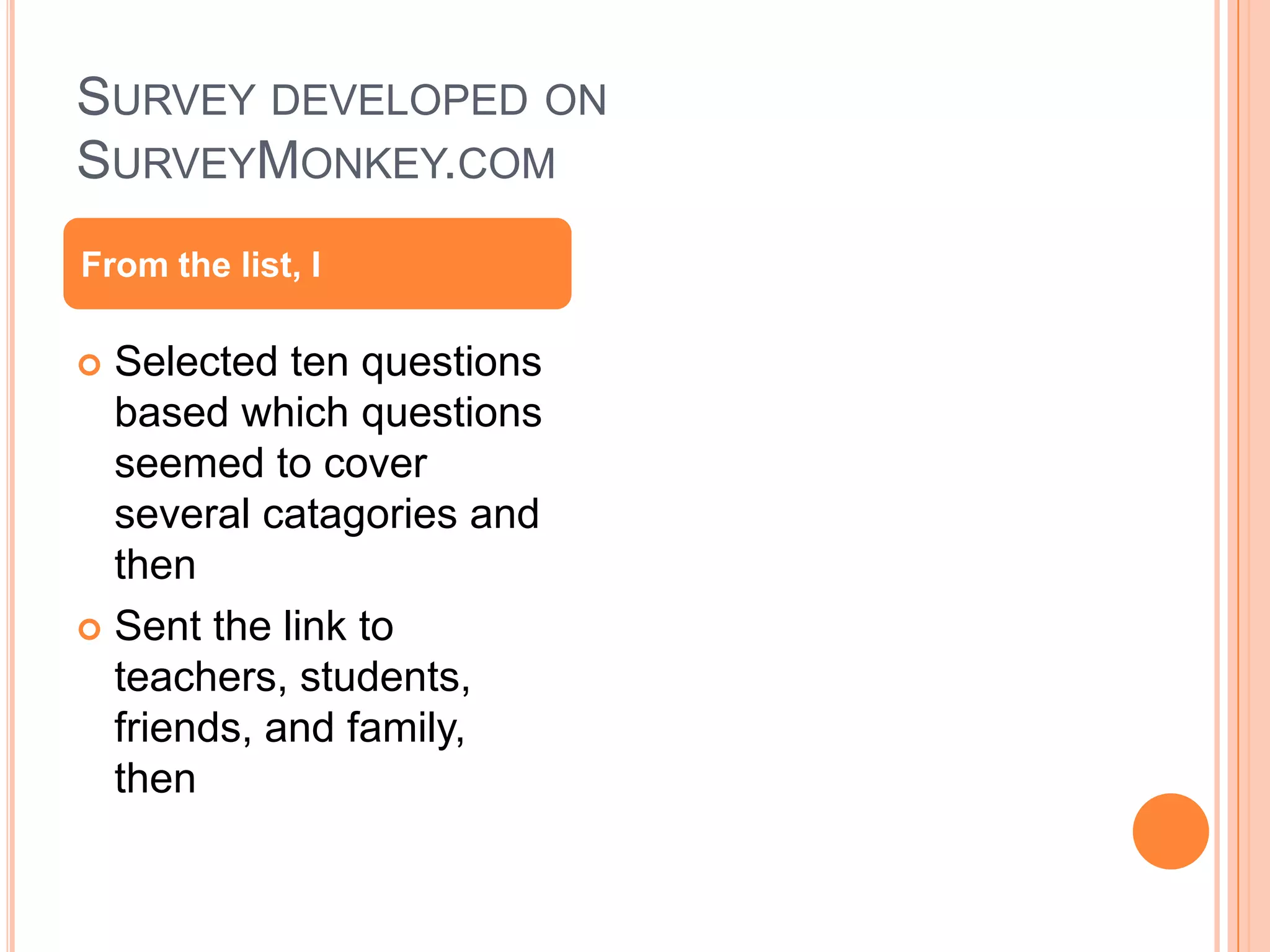
 Selected ten questions
based which questions
seemed to cover
several catagories and
then
 Sent the link to
teachers, students,
friends, and family,
then
From the list, I
RESULTS OF THE SURVEY
P = 23
IDENTIFICATION
My district uses a
multi-criteria
approach in
identifying children
who are gifted and
talented.
TRUE or FALSE
The rules for
identifying Giftedness
are state mandated.
However, “Plan B” is
in effect for most
states, offering
options for children
from low-
socioeconomic
backgrounds or
English Language
Learnings.
74%
26%
Percentage
TRUE
FALSE
CURRICULUMANDINSTRUCTION
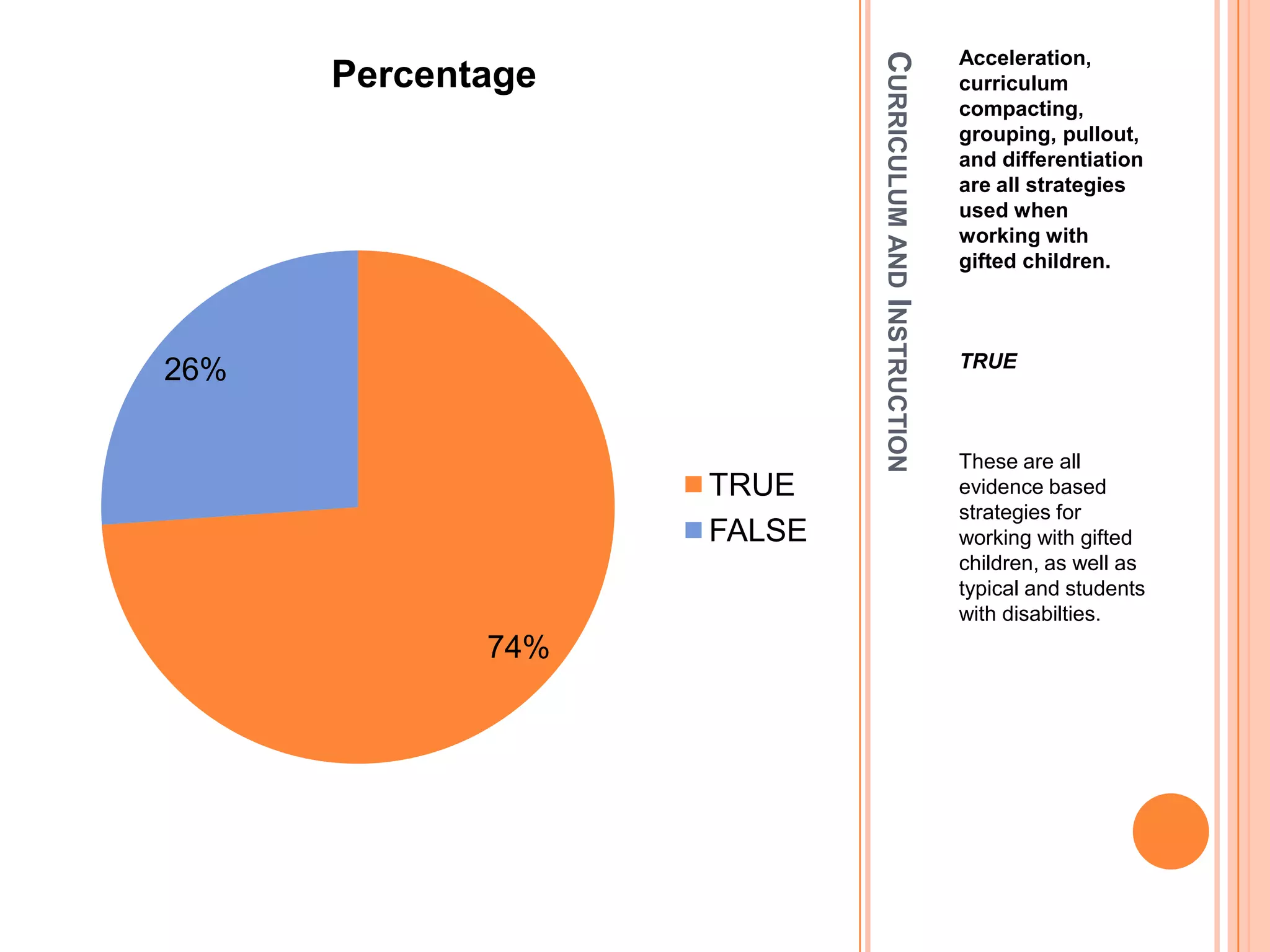
Acceleration,
curriculum
compacting,
grouping, pullout,
and differentiation
are all strategies
used when
working with
gifted children.
TRUE
These are all
evidence based
strategies for
working with gifted
children, as well as
typical and students
with disabilties.
74%
26%
Percentage
TRUE
FALSE
CURRICULUMANDINSTRUCTION
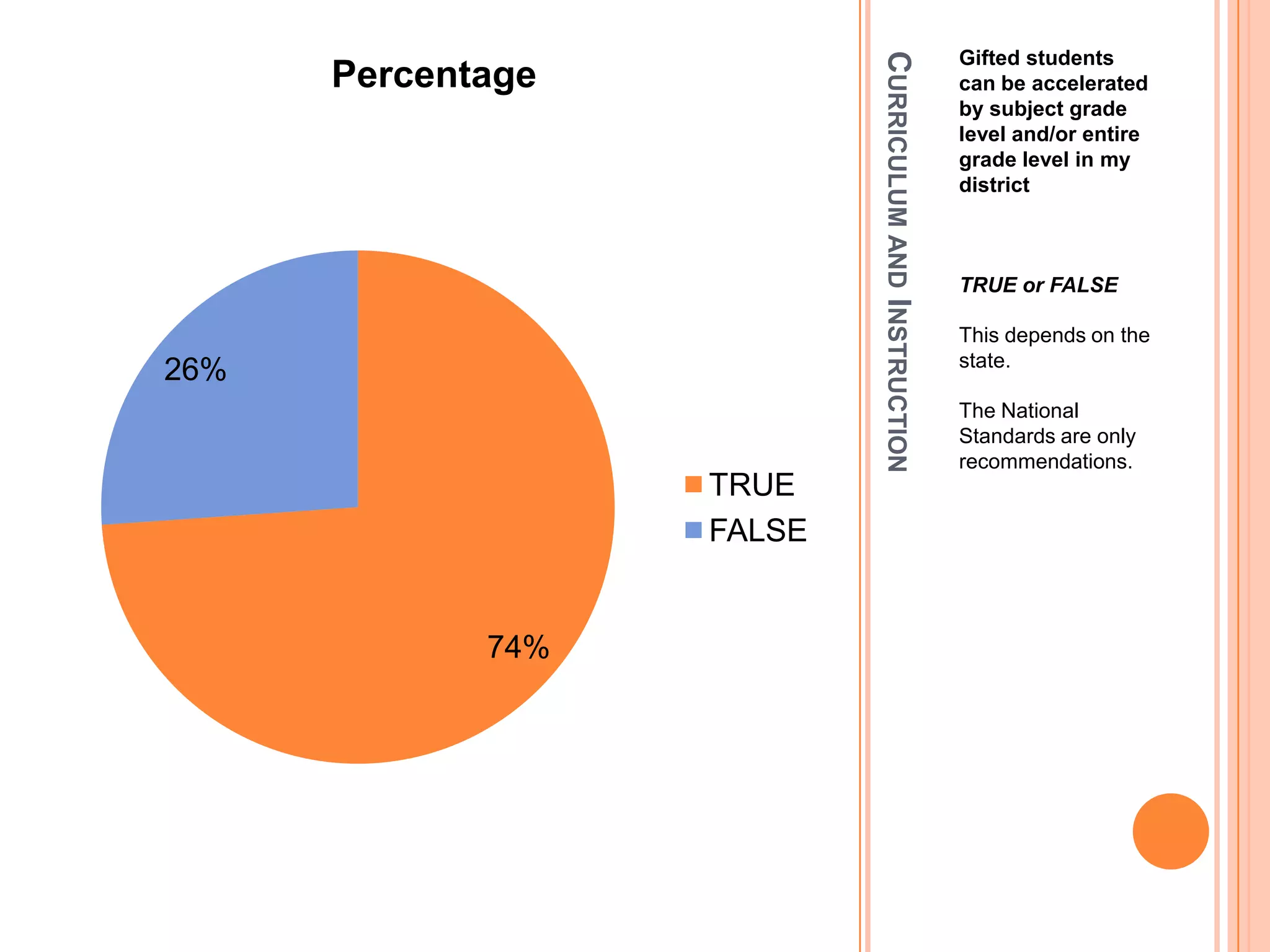
Gifted students
can be accelerated
by subject grade
level and/or entire
grade level in my
district
TRUE or FALSE
This depends on the
state.
The National
Standards are only
recommendations.
74%
26%
Percentage
TRUE
FALSE
CURRICULUMANDINSTRUCTION
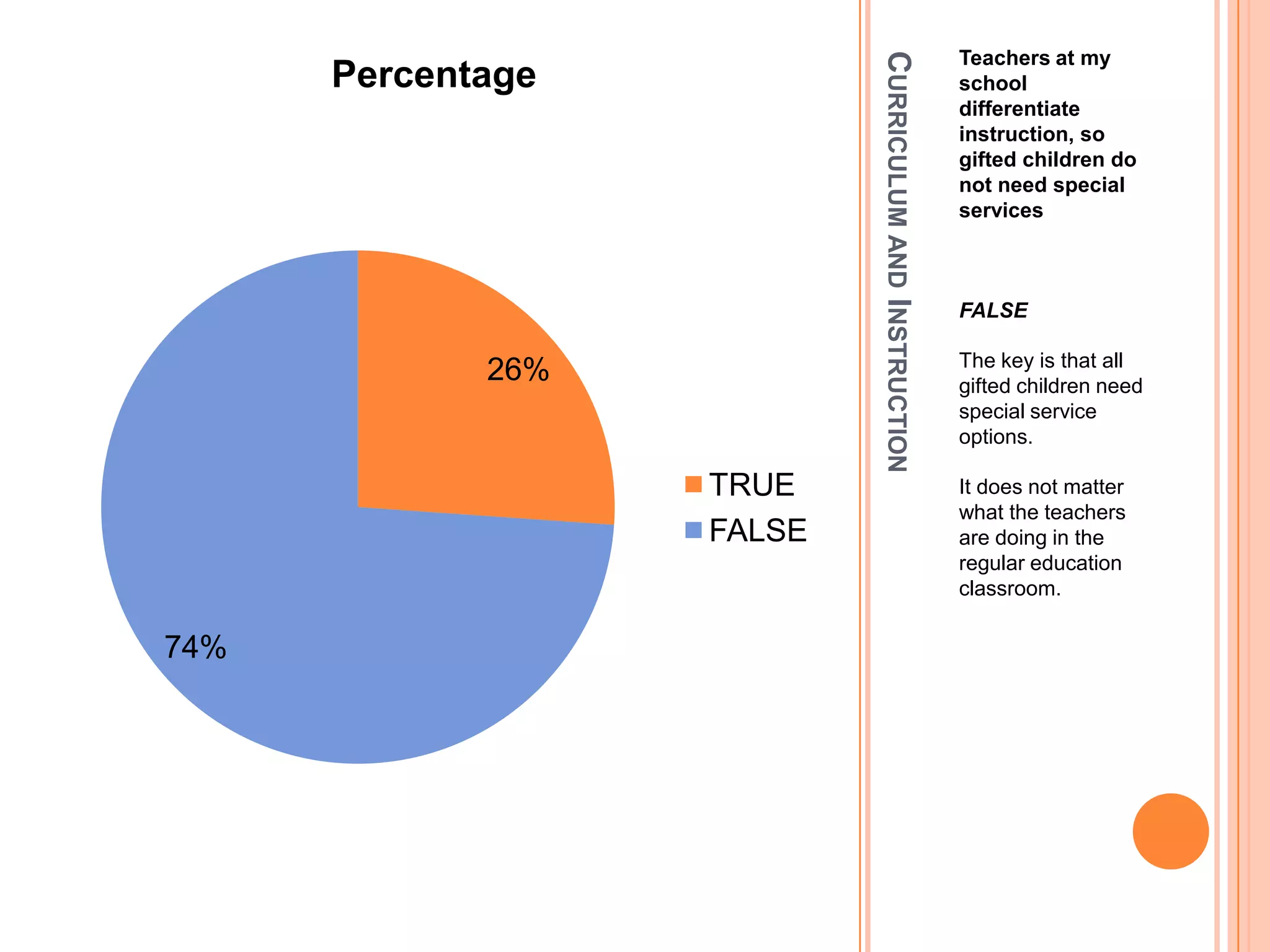
Teachers at my
school
differentiate
instruction, so
gifted children do
not need special
services
FALSE
The key is that all
gifted children need
special service
options.
It does not matter
what the teachers
are doing in the
regular education
classroom.
26%
74%
Percentage
TRUE
FALSE
CURRICULUMANDINSTRUCTION
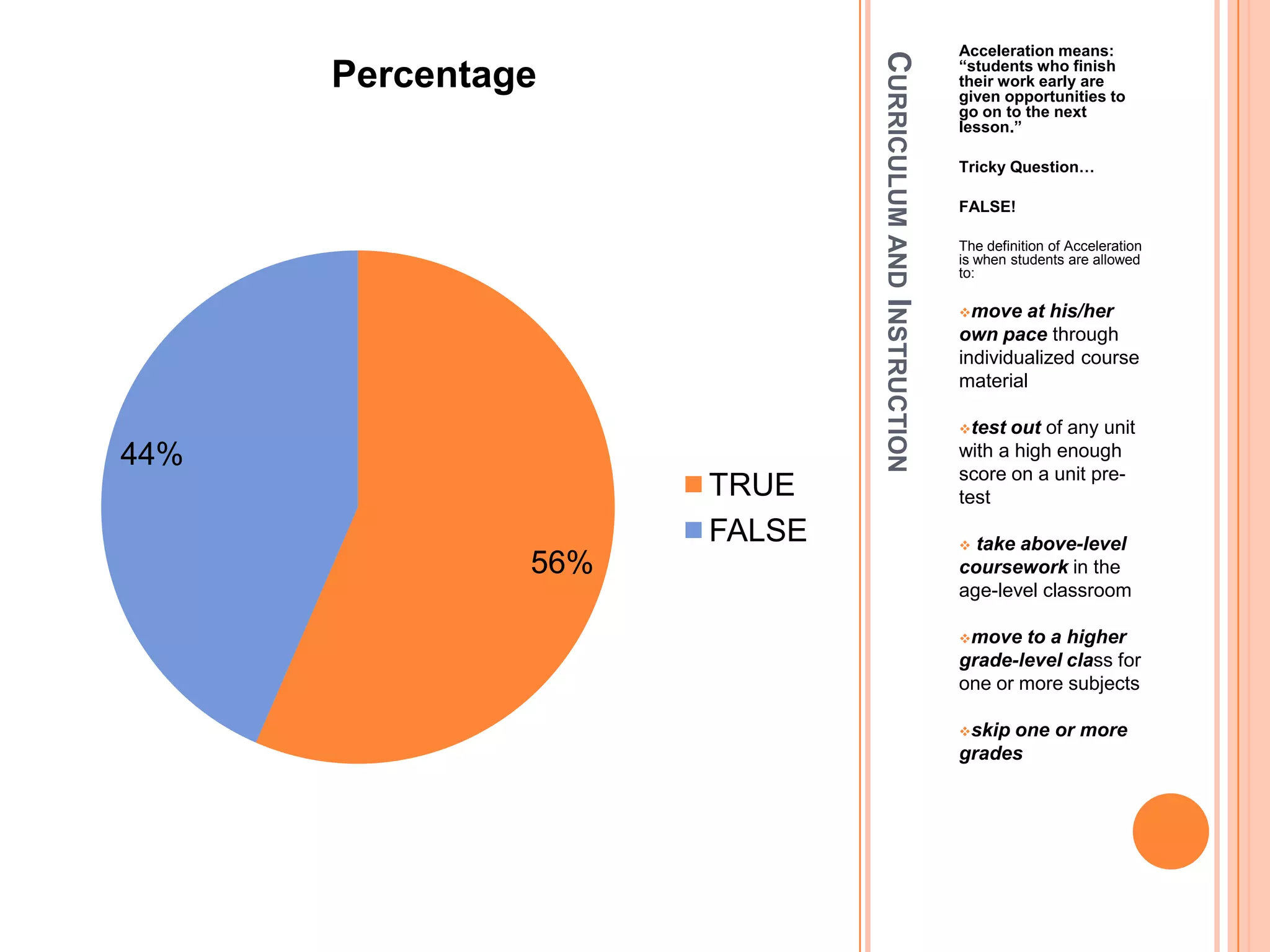
Acceleration means:
“students who finish
their work early are
given opportunities to
go on to the next
lesson.”
Tricky Question…
FALSE!
The definition of Acceleration
is when students are allowed
to:
move at his/her
own pace through
individualized course
material
test out of any unit
with a high enough
score on a unit pre-
test
 take above-level
coursework in the
age-level classroom
move to a higher
grade-level class for
one or more subjects
skip one or more
grades
56%
44%
Percentage
TRUE
FALSE
GIFTEDDEFINED
I know the
definition of
“gifted” according
to my district and
state guidelines.
TRUE OR FALSE
All teachers should
know this
information.
48%
52%
Percentage
TRUE
FALSE
GIFTEDDEFINED
Students who
earn poor grades
are not gifted
FALSE
Many students who
are gifted do not do
well in school for a
variety of reasons.
4%
96%
Percentage
TRUE
FALSE
GIFTEDDEFINED
Gifted and
Talented students
may come from
low socio
economic
backgrounds.
TRUE
Gifted comes in
every size, shape,
color, and son on.
91%
9%
Percentage
TRUE
FALSE
TEACHERKNOWLEDGE
I know –
1) the
procedures
for how to
determine
children’s
present level
ability,
2) how to
nominate
children for
gifted/talente
d programs,
and
3) which
support
services are
available for
gifted and
talented
children.
TRUE OR FALSE
All educators
should know
this
information.
43%
57%
Percentage
TRUE
FALSE
GENERALPUBLICKNOWLEDGE
Only teachers
trained in gifted
education need to
understand, plan,
and implement a
range of
evidence-based
strategies for
working with
“gifted” children.
FALSE!
All teachers are
responsible for
knowing strategies
for working with all
children. Regular
education teachers
are required by law
to implement the
Gifted Education
Plan as written.
17%
83%
Percentage
TRUE
FALSE
WHAT DID I LEARN?
THE LEVEL OF KNOWLEDGE DEPENDS ON…
 My students were completely
misinformed about all aspects of
giftedness.
 My Peers (teachers) were sadly
lacking in knowledge about our
district, but othewise answered
questions knowledgably
 The parents of my gifted
students answered every
question with knowledge and
accuracy
 My friends and family answered
general knowledge questions
correctly, but did not know much
about teaching strategies
 TEACH KIDS about “giftedness”
 Inservice on District Policies on
Gifted Programming and Education
and Identification Process
 Continue to have great report with
my students’ parents
 Continue to publish general
information about giftedness on my
social networking and blogging
sites.
Who Answered the
Question…
ACTION PLAN

The gifted child

  • 1.
    THE GIFTED CHILD Who? What? When? Where? Why? How?
  • 2.
    THE GIFTED CHILD Hoagies’Gifted Education Page” writes the following for parents… No individual can be more exhilarating or more frustrating. The parents and teachers who deal with these wonderful children can often be described in a this single word - Exhausted!
  • 3.
    …  The giftedchild can speak as an adult one minute, comparing the emotional relationships in Les Mis with relationships in her own life, or discussing potential conflicts between evolution and the bible, and in the next minute throw an impressive tantrum because she didn't get what she wanted... right now!  She can have you in awe of her theories on accelerated space travel, or pulling your hair out in frustration over her argumentative refusal to do her part in everyday chores. http://www.hoagiesgifted.org/parents.htm
  • 4.
    AND THE FOLLOWINGFOR EDUCATORS… Teachers of the gifted are faced with many issues.  Is the gifted child identified appropriately?  How can I best serve him?  What are her greatest needs?  What teaching techniques have been shown to work, or to fail, for gifted children?  What techniques are best for the individual gifted children I have before me this day, this week, this year?  How can I teach these gifted children and still give my best to the rest of my classroom, especially my low-testing kids? http://www.hoagiesgifted.org/educators.htm
  • 5.
    BUT THE BIGQUESTION IS…  What to teachers, parents, students and the communities know about “Giftedness” anyway?  So, let’s do a KWL!
  • 6.
    WHAT DO WEKNOW? The National Association of Gifted Children
  • 7.
    GIFTED SURVEY QUESTIONBANK DEVELOPED FROM HTTP://WWW.NAGC.ORG AWZETTLER 07.12.2013  visited the National Association for Gifted Children,  developed a bank of questions based on the QA sections for parents and teachers, the gifted myths, and national standards for the gifted, then  organized my questions into categories.  Identification Process  Gifted Defined  Curriculum and Instruction  Specific Teacher Knowledge  General Public Knowledge In order to find out what is known about “giftedness,” I… Question Categories
  • 8.
    IDENTIFICATION PROCESS  Mydistrict uses a multi-criteria approach in identifying children who are gifted and talented  I know the procedures for nominating children for gifted and talented programs  Students are placed in gifted programs based on need, rather than availability  Diversity and social-emotional needs are not considered when evaluating a student for giftedness  My district uses a multi-criteria approach in identifying children who are gifted and talented
  • 9.
    GIFTED DEFINED  Iknow the definition of “gifted” according to my district and state guidelines  Students who earn poor grades are not gifted  Gifted students are happy, popular, and well adjusted in school  Gifted and talented students may come from low-socioeconomic backgrounds  Gifted and talented students learn differently than other students  All Children are gifted  Children with learning disabilities cannot be gifted
  • 10.
    CURRICULUM AND INSTRUCTION My child’s teachers calibrate curriculum and instruction to his/her abilities and interests rather than his/her age  My child’s teachers adjust instruction based on what s/he already know to ensure that s/he may learn something new every day  My child’s teachers provide a challenging curriculum  My child’s teachers understand gifted learner differences  My child’s teachers provide opportunities for my child to work with other advanced students  My child demonstrates continuous progress  My child demonstrated confidence  My child demonstrates achievement at the level at which s/he is capable  Teachers at my school differentiate instruction, so gifted children do not need special services.  Acceleration means: “students who finish their work early are given opportunities to go on to the next lesson”  Acceleration, curriculum compacting, grouping, pullout, and differentiation are all strategies used when working with gifted children  AP classes can take the place of a gifted program  My school offers a variety of services, programs, and options for gifted services
  • 11.
    TEACHER KNOWLEDGE  Iknow –  1) the procedures for how to determine children’s present level ability,  2) how to nominate children for gifted/talented programs, and  3) which support services are available for gifted and talented children  I know the district policies for acceleration strategies k-12  Gifted students can be accelerated by subject grade level and/or entire grade level in my district  Free professional development courses for working with gifted children are available in my district for district employees
  • 12.
    GENERAL PUBLIC KNOWLEDGE Creativity cannot be taught  There are National Stands for Gifted programming  Gifted students are able to do fine on their own and do not need extra help  Gifted students make everyone else in the class smarter by providing a role model or a challenge  Decisions about gifted children and gifted education are made primarily at the local and state levels because the federal government does not fund or require gifted education service  Gifted education requires an abundance of resources.  AP courses are for gifted and talented students  Acceleration placement options are socially harmful for gifted students  Gifted education programs are elitist  It is important for all teachers to understand the issues in definitions, theories, and identification of gifted and talented students, including those from diverse backgrounds  Only teachers trained in gifted education need to understand, plan, and implement a range of evidence-based strategies for working with “gifted” children  Only teachers trained in gifted education need to recognize the learning differences, developmental milestones, and cognitive/affective characteristics of gifted and talented students
  • 13.
    WHAT DO IWANT TO KNOW? SurveyMonkey
  • 14.
    SURVEY DEVELOPED ON SURVEYMONKEY.COM Selected ten questions based which questions seemed to cover several catagories and then  Sent the link to teachers, students, friends, and family, then From the list, I
  • 15.
    RESULTS OF THESURVEY P = 23
  • 16.
    IDENTIFICATION My district usesa multi-criteria approach in identifying children who are gifted and talented. TRUE or FALSE The rules for identifying Giftedness are state mandated. However, “Plan B” is in effect for most states, offering options for children from low- socioeconomic backgrounds or English Language Learnings. 74% 26% Percentage TRUE FALSE
  • 17.
    CURRICULUMANDINSTRUCTION Acceleration, curriculum compacting, grouping, pullout, and differentiation areall strategies used when working with gifted children. TRUE These are all evidence based strategies for working with gifted children, as well as typical and students with disabilties. 74% 26% Percentage TRUE FALSE
  • 18.
    CURRICULUMANDINSTRUCTION Gifted students can beaccelerated by subject grade level and/or entire grade level in my district TRUE or FALSE This depends on the state. The National Standards are only recommendations. 74% 26% Percentage TRUE FALSE
  • 19.
    CURRICULUMANDINSTRUCTION Teachers at my school differentiate instruction,so gifted children do not need special services FALSE The key is that all gifted children need special service options. It does not matter what the teachers are doing in the regular education classroom. 26% 74% Percentage TRUE FALSE
  • 20.
    CURRICULUMANDINSTRUCTION Acceleration means: “students whofinish their work early are given opportunities to go on to the next lesson.” Tricky Question… FALSE! The definition of Acceleration is when students are allowed to: move at his/her own pace through individualized course material test out of any unit with a high enough score on a unit pre- test  take above-level coursework in the age-level classroom move to a higher grade-level class for one or more subjects skip one or more grades 56% 44% Percentage TRUE FALSE
  • 21.
    GIFTEDDEFINED I know the definitionof “gifted” according to my district and state guidelines. TRUE OR FALSE All teachers should know this information. 48% 52% Percentage TRUE FALSE
  • 22.
    GIFTEDDEFINED Students who earn poorgrades are not gifted FALSE Many students who are gifted do not do well in school for a variety of reasons. 4% 96% Percentage TRUE FALSE
  • 23.
    GIFTEDDEFINED Gifted and Talented students maycome from low socio economic backgrounds. TRUE Gifted comes in every size, shape, color, and son on. 91% 9% Percentage TRUE FALSE
  • 24.
    TEACHERKNOWLEDGE I know – 1)the procedures for how to determine children’s present level ability, 2) how to nominate children for gifted/talente d programs, and 3) which support services are available for gifted and talented children. TRUE OR FALSE All educators should know this information. 43% 57% Percentage TRUE FALSE
  • 25.
    GENERALPUBLICKNOWLEDGE Only teachers trained ingifted education need to understand, plan, and implement a range of evidence-based strategies for working with “gifted” children. FALSE! All teachers are responsible for knowing strategies for working with all children. Regular education teachers are required by law to implement the Gifted Education Plan as written. 17% 83% Percentage TRUE FALSE
  • 26.
    WHAT DID ILEARN?
  • 27.
    THE LEVEL OFKNOWLEDGE DEPENDS ON…  My students were completely misinformed about all aspects of giftedness.  My Peers (teachers) were sadly lacking in knowledge about our district, but othewise answered questions knowledgably  The parents of my gifted students answered every question with knowledge and accuracy  My friends and family answered general knowledge questions correctly, but did not know much about teaching strategies  TEACH KIDS about “giftedness”  Inservice on District Policies on Gifted Programming and Education and Identification Process  Continue to have great report with my students’ parents  Continue to publish general information about giftedness on my social networking and blogging sites. Who Answered the Question… ACTION PLAN