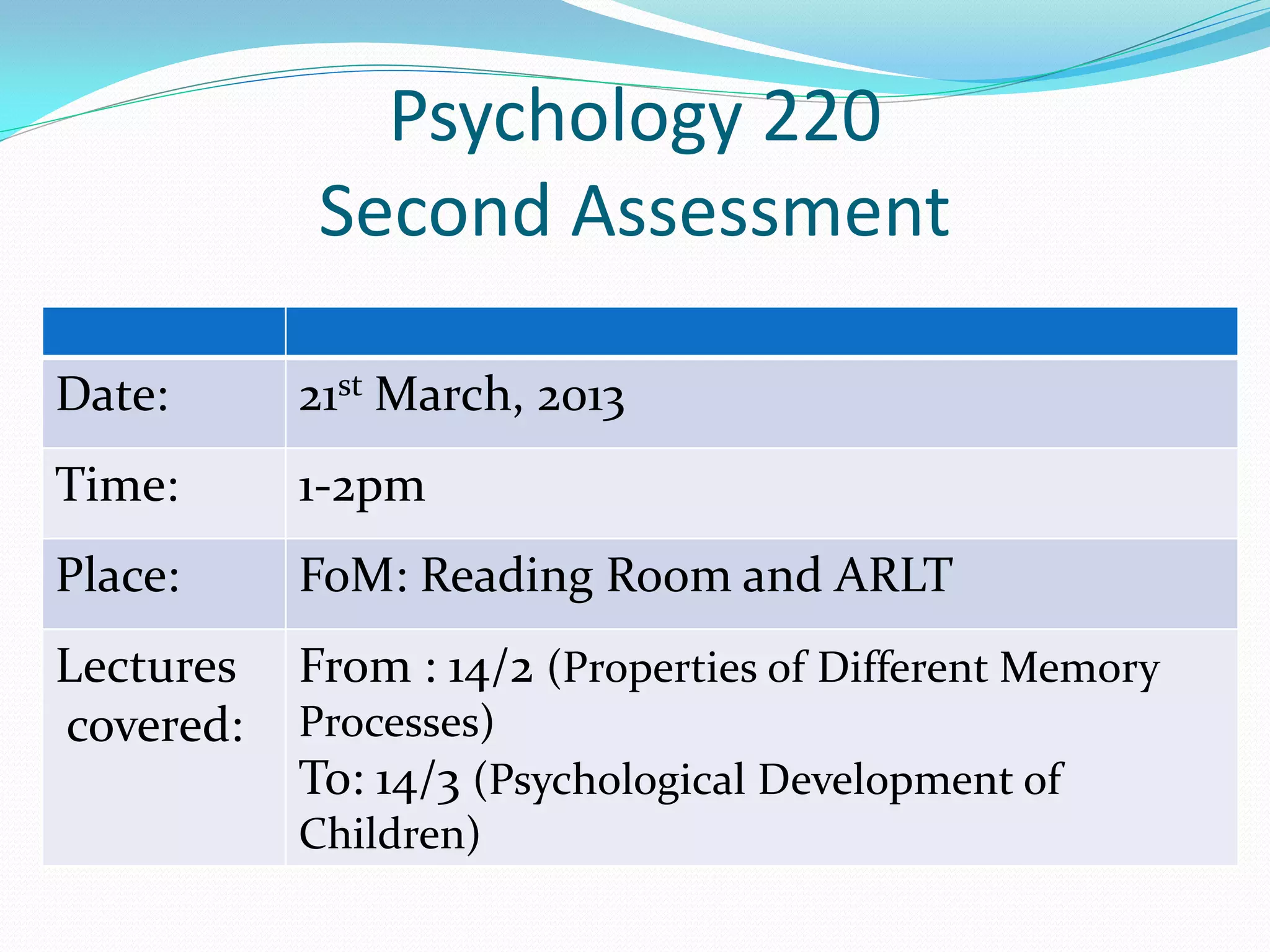
Psychology 220
            Second Assessment

Date:      21st March, 2013
Time:      1-2pm
Place:     FoM: Reading Room and ARLT
Lectures   From : 14/2 (Properties of Different Memory
covered:   Processes)
           To: 14/3 (Psychological Development of
           Children)
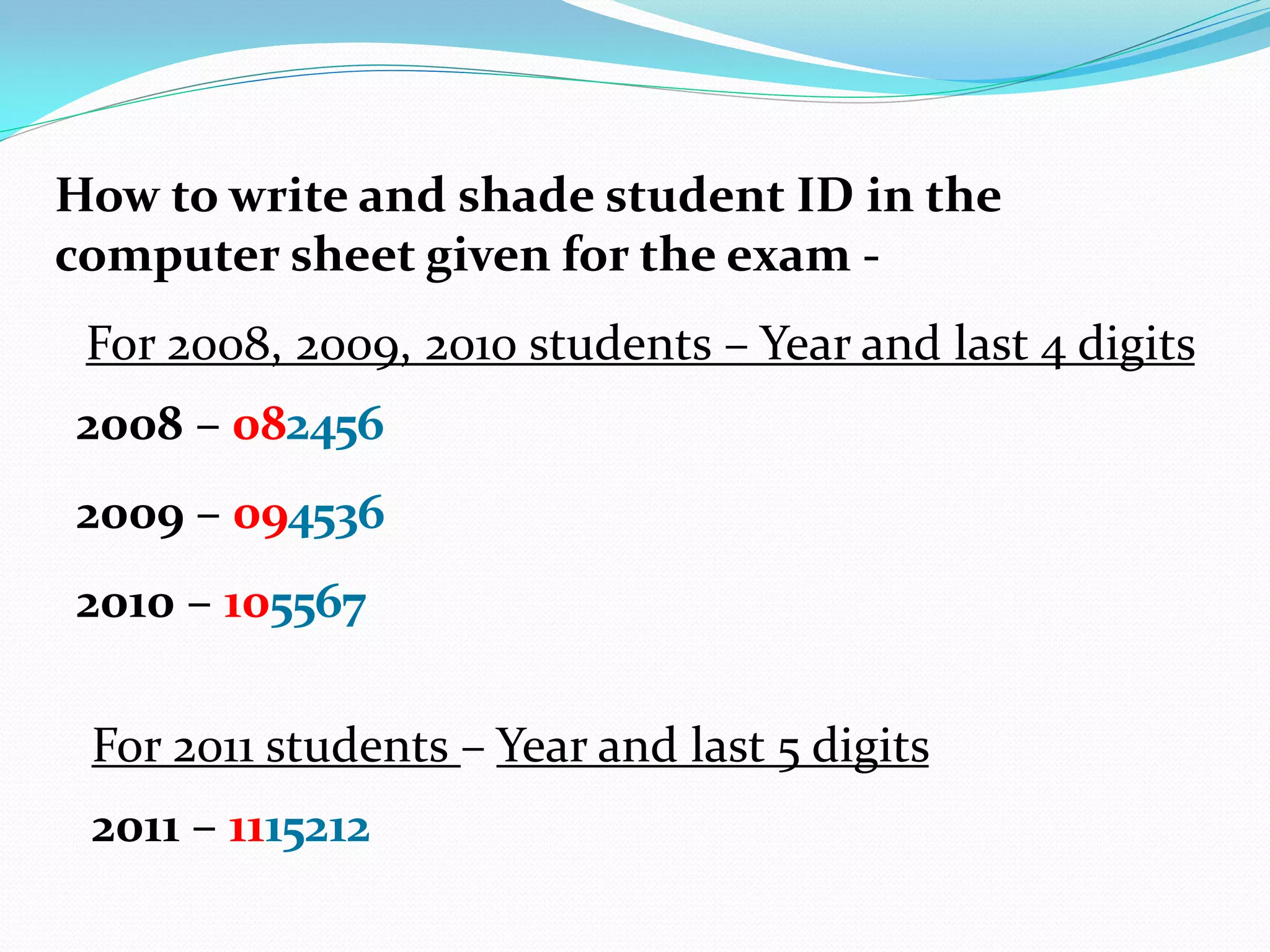
How to write and shade student ID in the
computer sheet given for the exam -
 For 2008, 2009, 2010 students – Year and last 4 digits
2008 – 082456
2009 – 094536
2010 – 105567

 For 2011 students – Year and last 5 digits
 2011 – 1115212
What is “cognition”?
 Cognition refers to thinking, including language,
 learning, memory, and intelligence.

 Jean Piaget (born 1896) was a pioneer in studying
 cognitive development in humans.

 More recent research has both validated and extended
 Piaget’s ideas about infant’s cognitive abilities.
Cognitive Theory
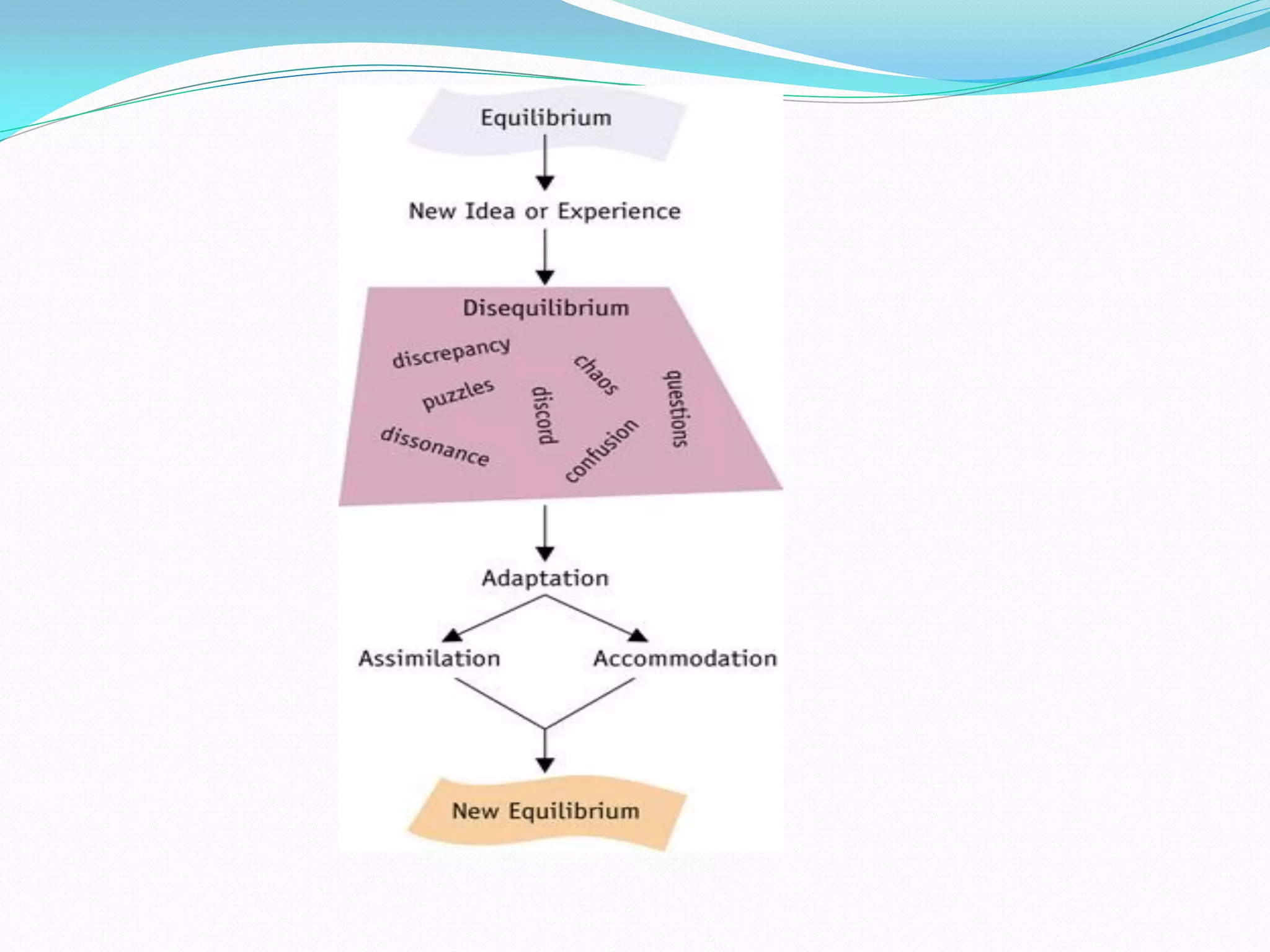
• Cognitive equilibrium—state of mental balance.

• If threatened, how do we achieve equilibrium
 again?

• Assimilation: taking new information in by
 incorporating it into previous “schemas”
 ▫ Schemas: theories about how the physical and
   social worlds operate (categories)

• Accommodation: requires an adjustment of
  previous schemas upon new information
Cognitive Theory (cont.)

 Example: A 10 month old learns that a red ball
 bounces. If given a blue ball, he will bounce it too
 (assimilation). If given a red tomato (which looks like a
 red ball), he may try to bounce it. He needs to
 accommodate his schema of round, red things.
Cognitive Theory
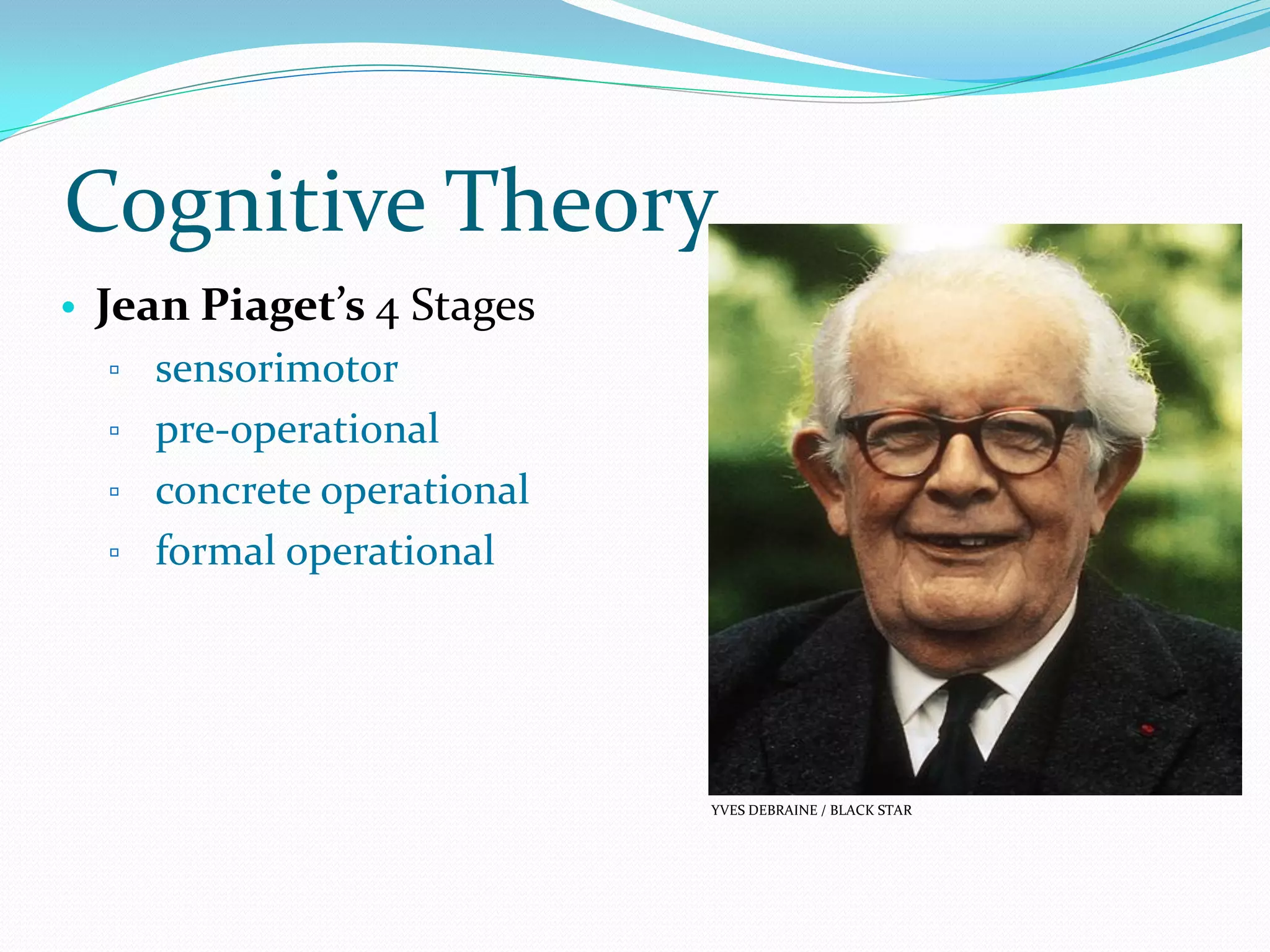
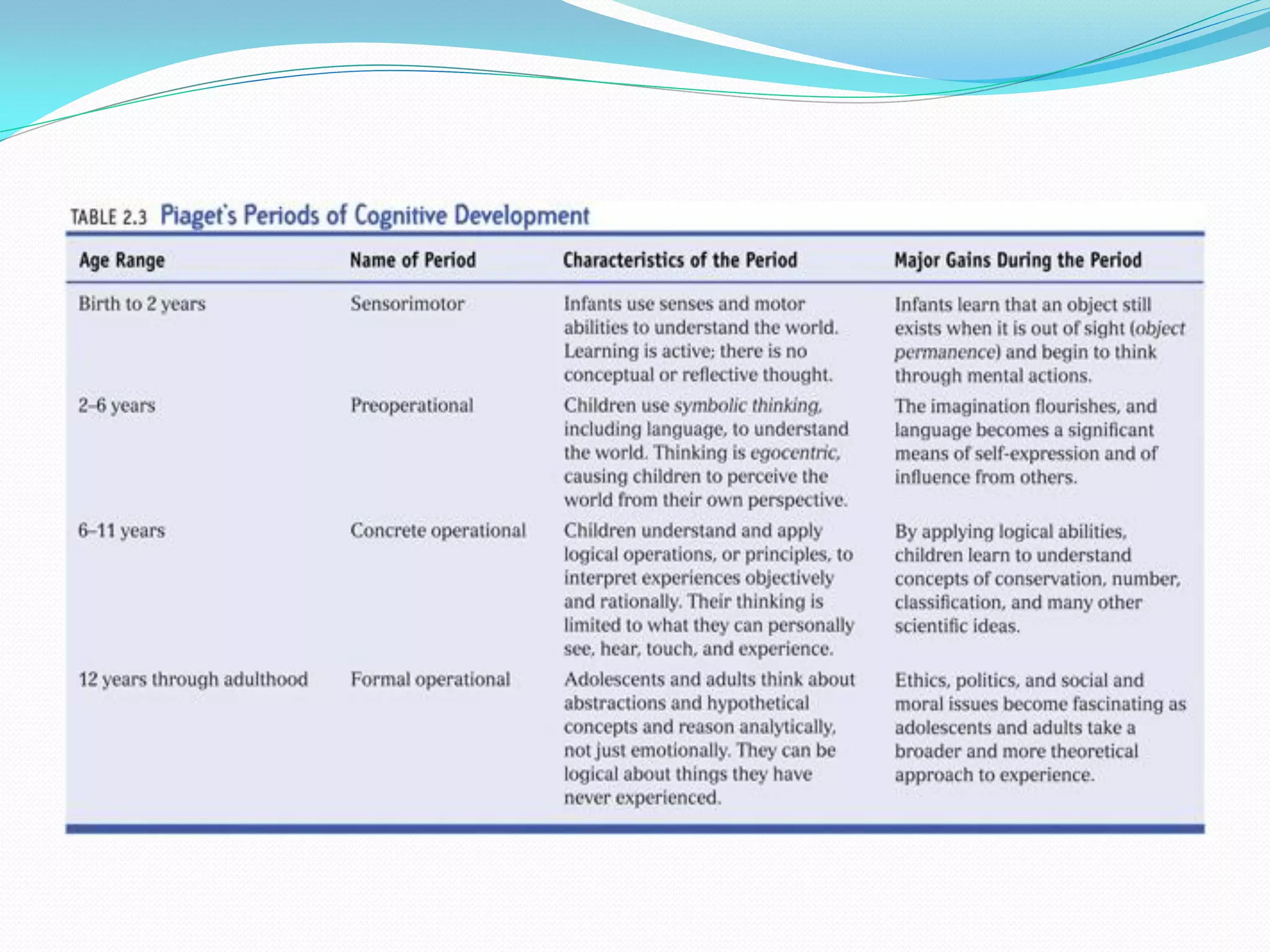
• Jean Piaget’s 4 Stages
   ▫ sensorimotor
   ▫ pre-operational
   ▫ concrete operational
   ▫ formal operational


                            YVES DEBRAINE / BLACK STAR
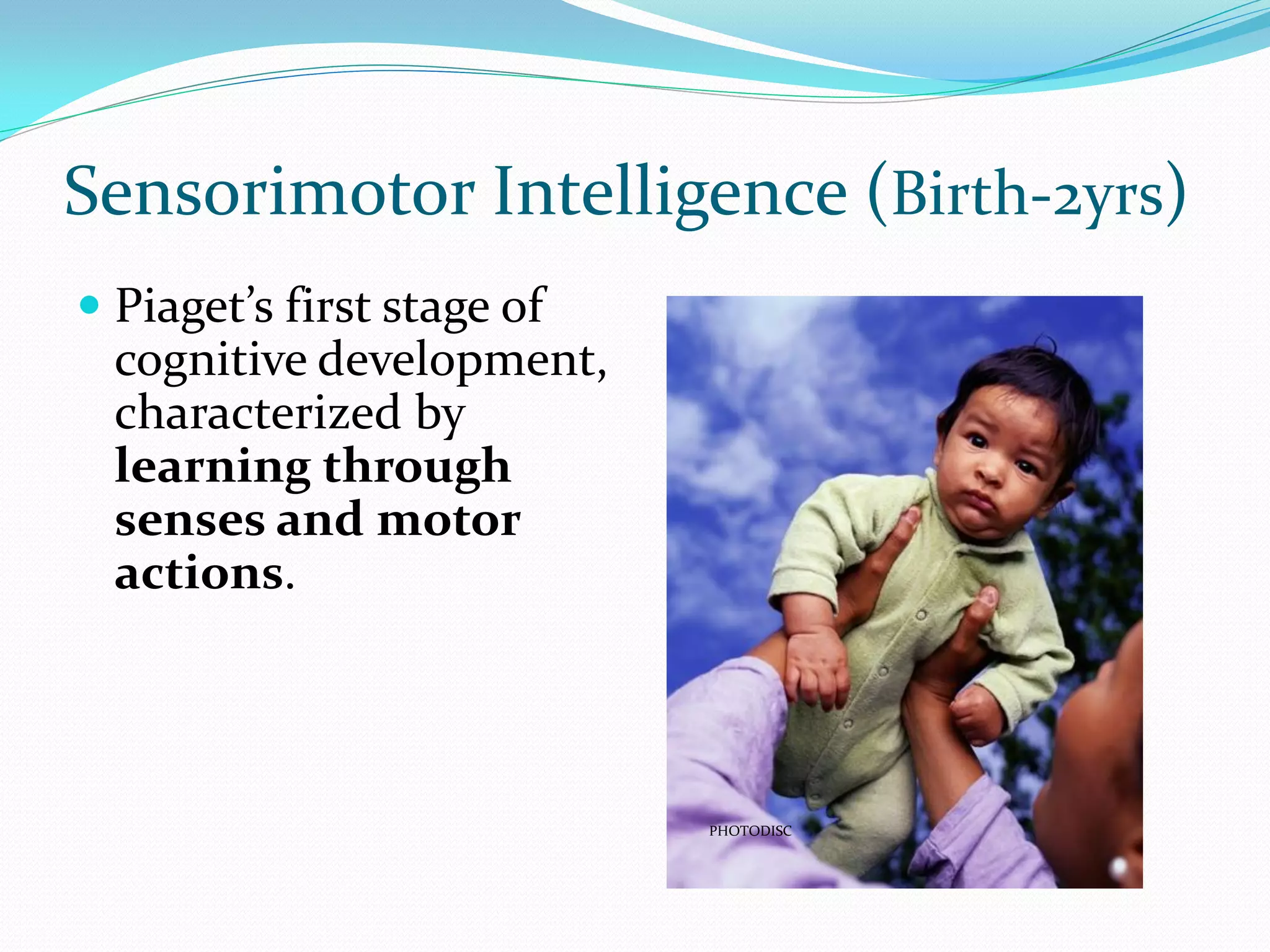
Sensorimotor Intelligence (Birth-2yrs)
 Piaget’s first stage of
  cognitive development,
 characterized by
 learning through
 senses and motor
 actions.


                            PHOTODISC
Sensorimotor Intelligence (Cont.)
 Infants are busy discovering the relationship between
  their actions and the consequences of those actions.

 Reflexes- sucking, grasping, staring, listening birth to 1
  month.
 Assimilation and coordination of reflexes (1-4
  months).

 Example: An infant sucks a bottle differently than
 the mother’s nipple.

 Awareness of things-responding to people and
  objects (4-8 months).
   Example: clapping hands when mother says
    “patty cake”
 Object Permanence (~8 months): the understanding
 that an object continues to exists even if it is not
 present.

 Active experimentation (12-18 months).
  Example: putting a teddy bear in the toilet and then
   flushing it.

 Mental combinations (18-24 months)
   Infants can think before taking action, for example,
    wondering before flushing remembering that the
    toilet overflowed the last time.
Preoperational Thought (2-6 yrs)
• Preoperational thought is characterized by:

  ▫ Egocentrism
  ▫ Centration
  ▫ Focus on appearance
  ▫ Static reasoning
  ▫ Irreversibility
  ▫ Lack of conservation
Egocentrism
 Egocentrism is the tendency to think about the
  world entirely from their own personal
 perspective.

   Example: A child tries to comfort his upset
    father by giving him a teddy bear.
Centration
 Centration is the tendency to focus on one aspect of a
  situation to the exclusion of others.

   Example: A child insists that lions and tigers are not
    “cats”!
   Example: Insist that “daddy” is a father, not a brother.


 This is a type of egocentrism.
Focus on Appearance
 When looking at something, young children tend
  to focus only on what is apparent, ignoring other
 relevant attributes.

   Example: A girl with a short haircut “must” be a
    boy. Or the “taller” child must be “older.”
Static Reasoning
 Young children assume the world is unchanging.


   Example: A boy is surprised to learn that “his”
    teacher is also someone’s mother!

 If things DO change, they occur totally and
  suddenly (e.g., a child “wakes up” tall).
Irreversibility
 Irreversibility is the idea that nothing can be
  undone. It is the failure to recognize that reversal
 of a process can sometimes restore something to
 its original state.

   Example: A child refuses to eat a hamburger
    that is “contaminated” by lettuce, even after the
    lettuce is removed.
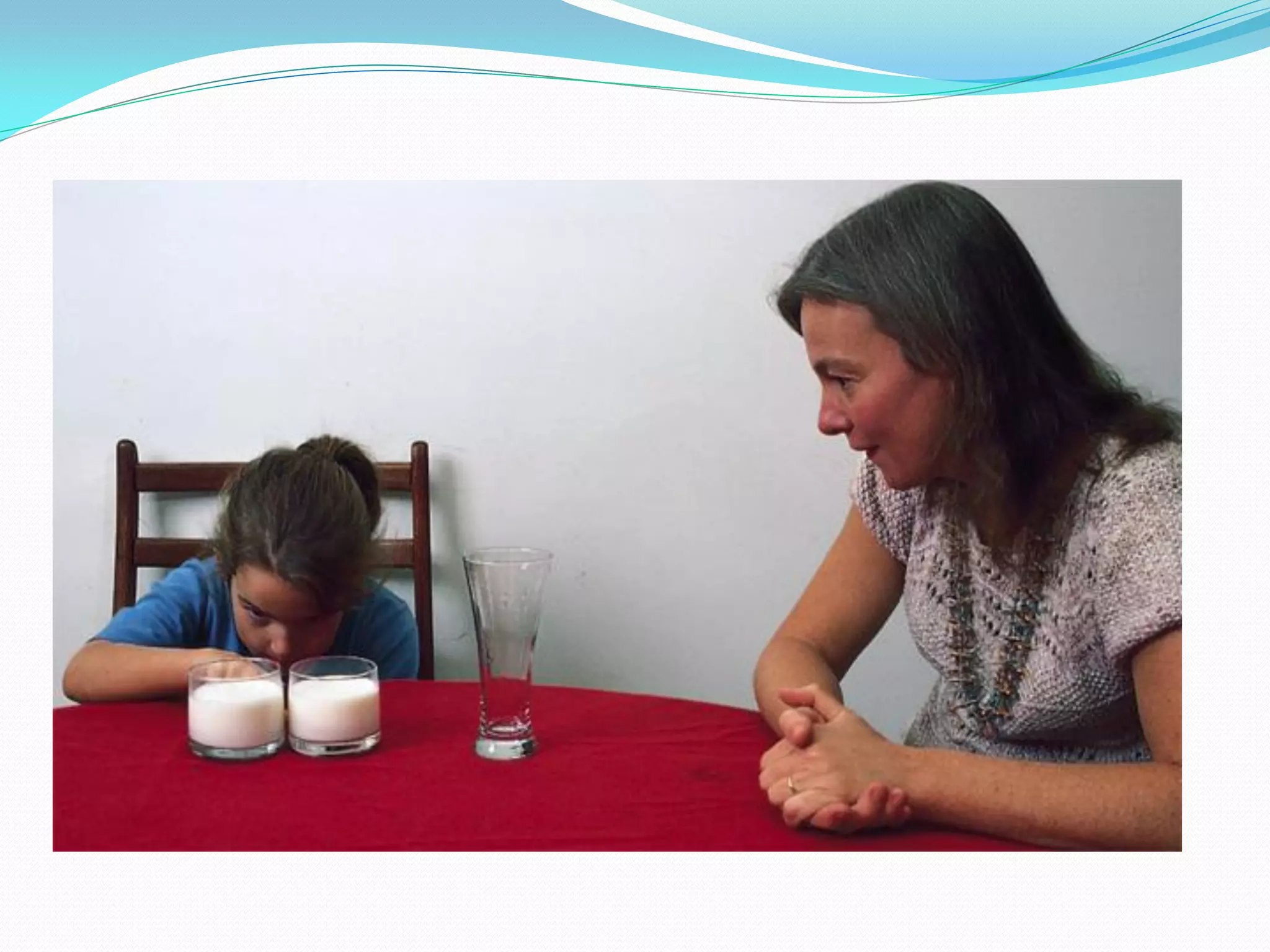
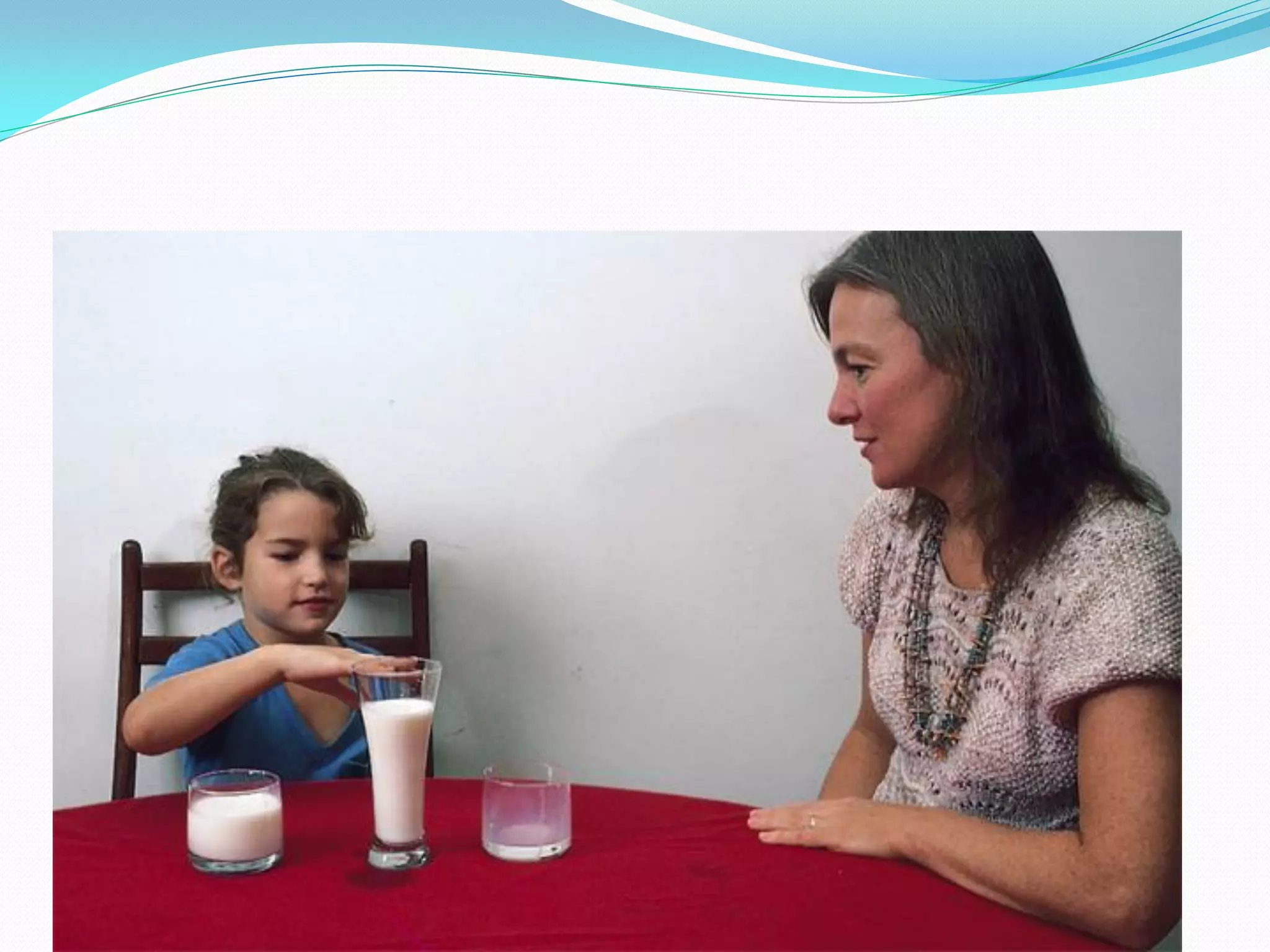
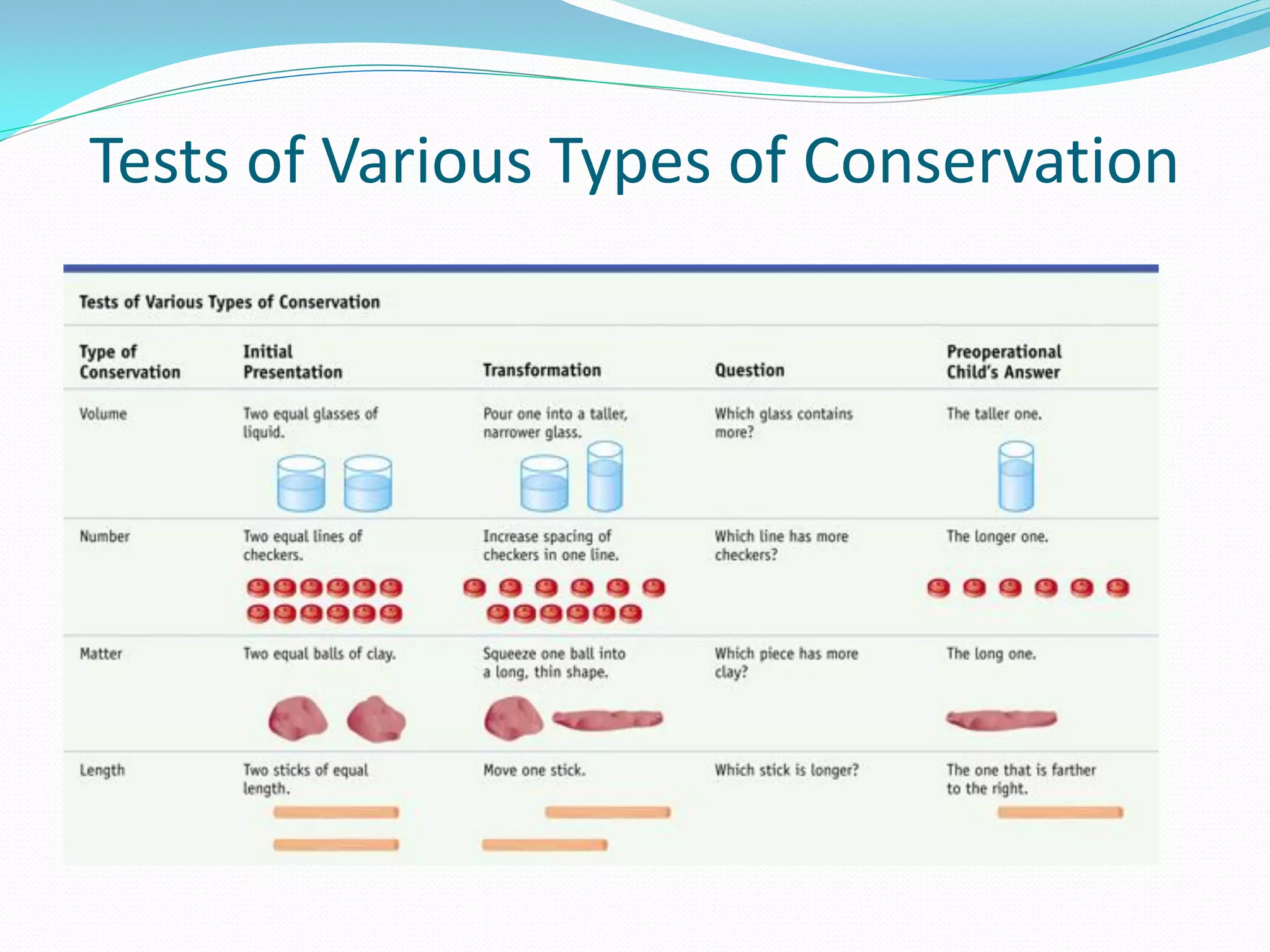
(Lack of) Conservation
 Conservation is the idea that the amount of a
  substance remains the same, despite changes in its
  appearance.

 Piaget found that most preoperational thinkers lack
  conservation.

   Example: Break a cookie in half, and a young child
    might think there are 2 cookies!
Tests of Various Types of Conservation
A Critique of Piaget’s Theory
 Many of the tasks designed to test stage theories
 requires several skills.

Example 1. Object permanence : the infant might know the
  object still exists but is unable to show this knowledge
  through searching behavior

Example 2. Conservation: When you ask children about
  the “aggregate” or collection rather than the individual
  items, they are less likely to be influenced by visual
  appearance.
Piaget’s Third Stage (6-11yrs)
 Concrete operational thought is the ability to
 reason logically about direct experiences and
 perceptions.

 Children in this stage become more systematic,
  objective, and scientific thinkers–but only about
  tangible, visible things.
Logical Principles
 Classification: organization into groups
  according to common property

   Example: Show 5 roses and 2 tulips. Ask, “Are
    there more roses or flowers?”

   Kids in middle childhood know that roses are a
    subcategory of “flowers.”
Essence and Change
 Identity: certain characteristics of an object
  remain the same even if other characteristics
 change

 Examples: frozen water is still water; a butterfly
 was once a caterpillar; liquid in smaller glass is the
 same liquid
Essence and Change (cont.)
 Reversibility: reversing the process by which
  something was changed brings the original
 conditions

 Example: if 5 + 9 = 14, then
 14 – 9 must equal 5! Also, imagine pouring water
 back in conservation task.
Essence and Change (cont.)
 Reciprocity is the principle that things may
  change in opposite ways, and thus balance each
 other out.

 Example: A child states that the decreased height
  in the shorter glass is balanced out by its increased
  width.
Piaget’s Highest Stage
                 (12yrs- adulthood)
 Adolescents are in Piaget’s 4th stage, formal
  operational thought, characterized by:


   logical thought

   hypothetical thought

   abstract thought

   deductive reasoning
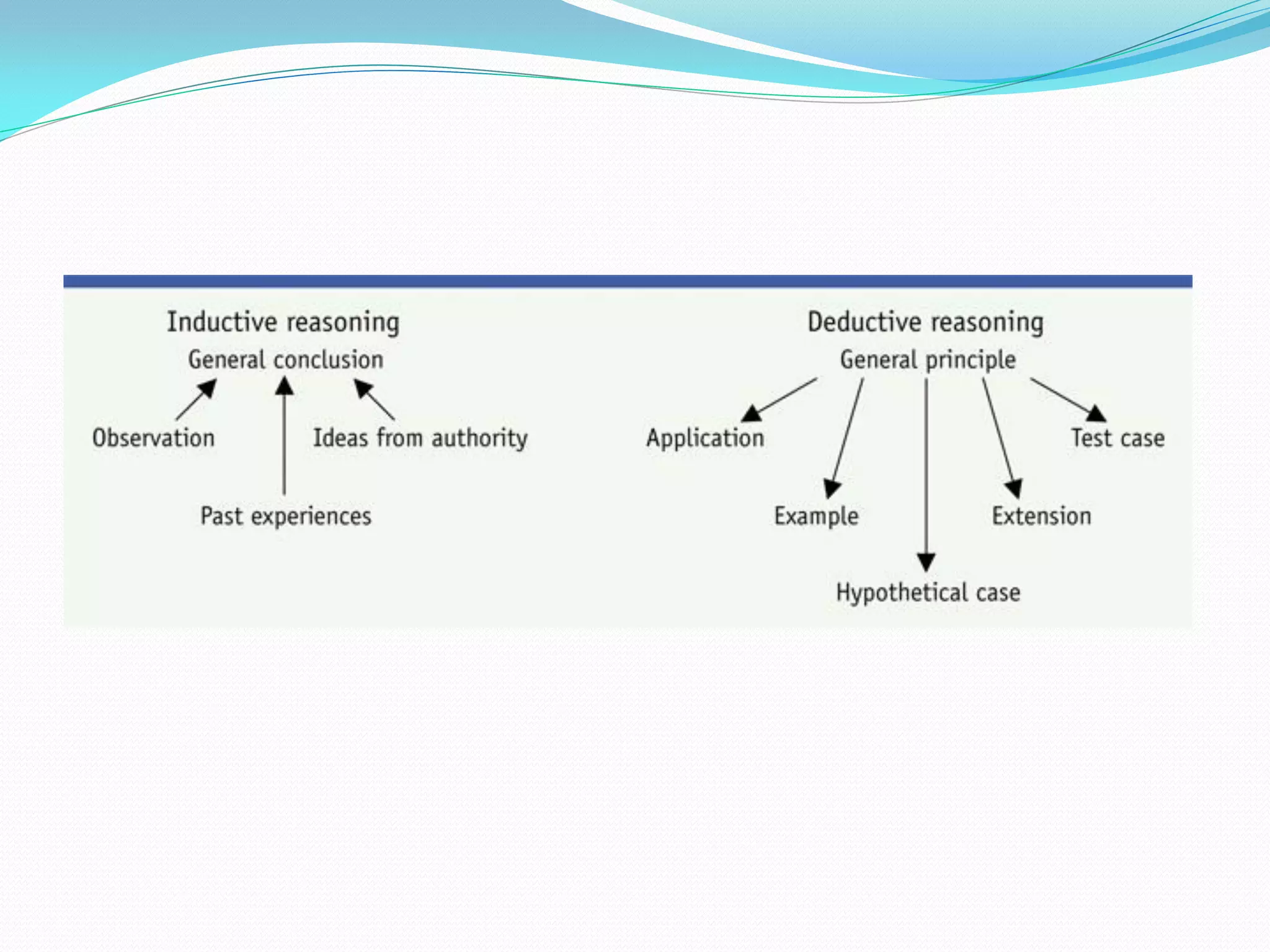
Inductive Reasoning
 Specific  General


 It consists of making observations and then
  drawing conclusions based on those observations
  (“bottom-up” thinking).


   Example: All of the swans I have seen in my life
    are white in color, therefore, all swans are white.
Deductive Reasoning
 General  specific


 You we start with the conclusion and then see if the
  evidence for that conclusion is valid. Generally, if
  the evidence is valid, the conclusion it supports is
 valid as well (“top-down” thinking).

 Example:        All oranges are fruits
                  All fruits grow on trees
                  Therefore, all oranges grow on trees
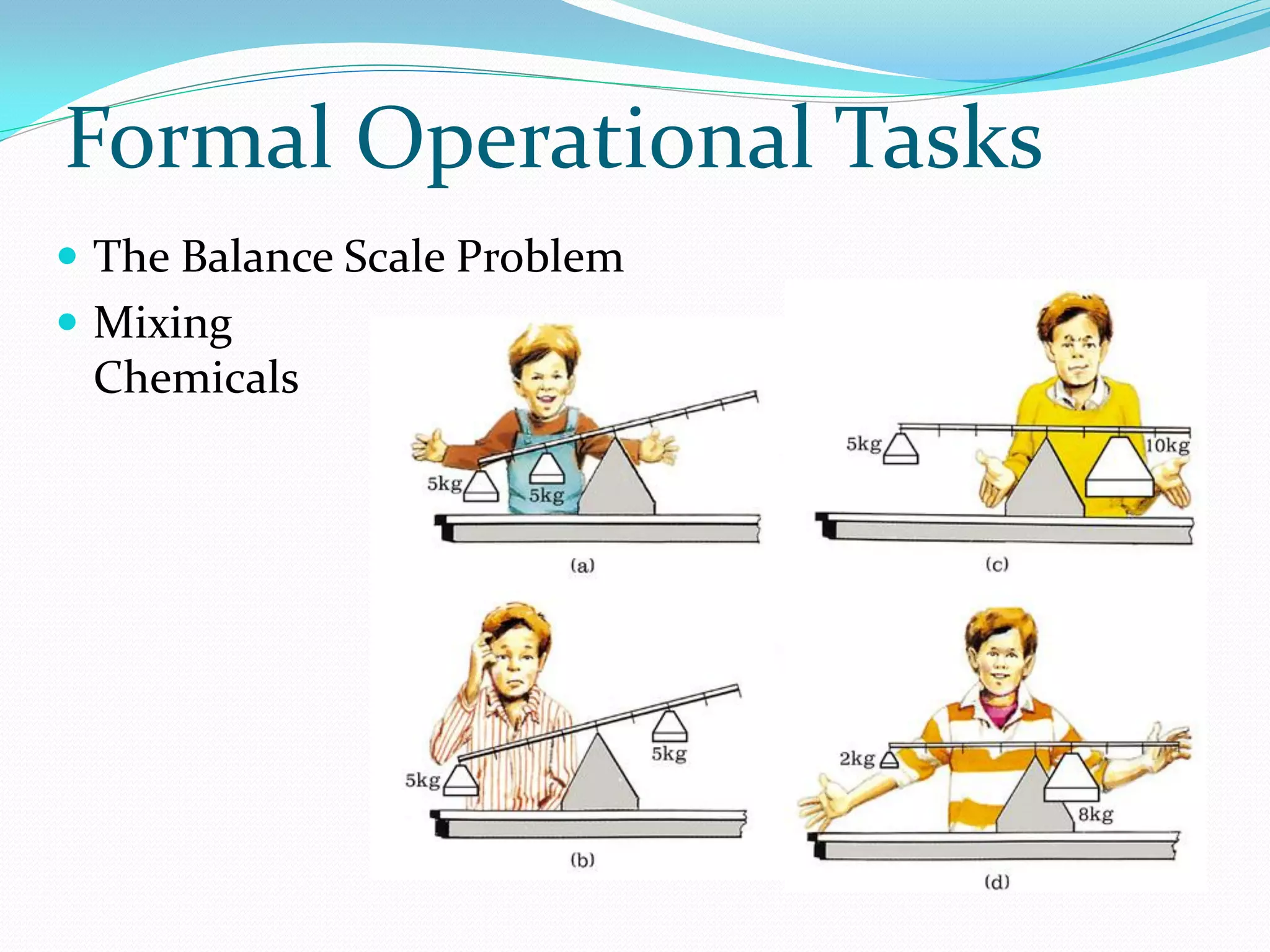
Formal Operational Tasks
 The Balance Scale Problem
 Mixing
 Chemicals
Formal Operational Thought
 Adolescents can think about possibilities and
  about the future.

 They often question adult values, practices.


 They love to think and discuss life, and are often
  idealists.

Lecture 11:Cognitive development of children- Dr.Reem AlSabah

  • 2.
    Psychology 220 Second Assessment Date: 21st March, 2013 Time: 1-2pm Place: FoM: Reading Room and ARLT Lectures From : 14/2 (Properties of Different Memory covered: Processes) To: 14/3 (Psychological Development of Children)
  • 3.
    How to writeand shade student ID in the computer sheet given for the exam - For 2008, 2009, 2010 students – Year and last 4 digits 2008 – 082456 2009 – 094536 2010 – 105567 For 2011 students – Year and last 5 digits 2011 – 1115212
  • 4.
    What is “cognition”? Cognition refers to thinking, including language, learning, memory, and intelligence.  Jean Piaget (born 1896) was a pioneer in studying cognitive development in humans.  More recent research has both validated and extended Piaget’s ideas about infant’s cognitive abilities.
  • 5.
    Cognitive Theory • Cognitiveequilibrium—state of mental balance. • If threatened, how do we achieve equilibrium again? • Assimilation: taking new information in by incorporating it into previous “schemas” ▫ Schemas: theories about how the physical and social worlds operate (categories) • Accommodation: requires an adjustment of previous schemas upon new information
  • 6.
    Cognitive Theory (cont.) Example: A 10 month old learns that a red ball bounces. If given a blue ball, he will bounce it too (assimilation). If given a red tomato (which looks like a red ball), he may try to bounce it. He needs to accommodate his schema of round, red things.
  • 8.
    Cognitive Theory • JeanPiaget’s 4 Stages ▫ sensorimotor ▫ pre-operational ▫ concrete operational ▫ formal operational YVES DEBRAINE / BLACK STAR
  • 10.
    Sensorimotor Intelligence (Birth-2yrs) Piaget’s first stage of cognitive development, characterized by learning through senses and motor actions. PHOTODISC
  • 11.
    Sensorimotor Intelligence (Cont.) Infants are busy discovering the relationship between their actions and the consequences of those actions.  Reflexes- sucking, grasping, staring, listening birth to 1 month.
  • 12.
     Assimilation andcoordination of reflexes (1-4 months). Example: An infant sucks a bottle differently than the mother’s nipple.  Awareness of things-responding to people and objects (4-8 months).  Example: clapping hands when mother says “patty cake”
  • 13.
     Object Permanence(~8 months): the understanding that an object continues to exists even if it is not present.  Active experimentation (12-18 months). Example: putting a teddy bear in the toilet and then flushing it.  Mental combinations (18-24 months)  Infants can think before taking action, for example, wondering before flushing remembering that the toilet overflowed the last time.
  • 14.
    Preoperational Thought (2-6yrs) • Preoperational thought is characterized by: ▫ Egocentrism ▫ Centration ▫ Focus on appearance ▫ Static reasoning ▫ Irreversibility ▫ Lack of conservation
  • 15.
    Egocentrism  Egocentrism isthe tendency to think about the world entirely from their own personal perspective.  Example: A child tries to comfort his upset father by giving him a teddy bear.
  • 16.
    Centration  Centration isthe tendency to focus on one aspect of a situation to the exclusion of others.  Example: A child insists that lions and tigers are not “cats”!  Example: Insist that “daddy” is a father, not a brother.  This is a type of egocentrism.
  • 17.
    Focus on Appearance When looking at something, young children tend to focus only on what is apparent, ignoring other relevant attributes.  Example: A girl with a short haircut “must” be a boy. Or the “taller” child must be “older.”
  • 18.
    Static Reasoning  Youngchildren assume the world is unchanging.  Example: A boy is surprised to learn that “his” teacher is also someone’s mother!  If things DO change, they occur totally and suddenly (e.g., a child “wakes up” tall).
  • 19.
    Irreversibility  Irreversibility isthe idea that nothing can be undone. It is the failure to recognize that reversal of a process can sometimes restore something to its original state.  Example: A child refuses to eat a hamburger that is “contaminated” by lettuce, even after the lettuce is removed.
  • 20.
    (Lack of) Conservation Conservation is the idea that the amount of a substance remains the same, despite changes in its appearance.  Piaget found that most preoperational thinkers lack conservation.  Example: Break a cookie in half, and a young child might think there are 2 cookies!
  • 23.
    Tests of VariousTypes of Conservation
  • 24.
    A Critique ofPiaget’s Theory  Many of the tasks designed to test stage theories requires several skills. Example 1. Object permanence : the infant might know the object still exists but is unable to show this knowledge through searching behavior Example 2. Conservation: When you ask children about the “aggregate” or collection rather than the individual items, they are less likely to be influenced by visual appearance.
  • 25.
    Piaget’s Third Stage(6-11yrs)  Concrete operational thought is the ability to reason logically about direct experiences and perceptions.  Children in this stage become more systematic, objective, and scientific thinkers–but only about tangible, visible things.
  • 26.
    Logical Principles  Classification:organization into groups according to common property  Example: Show 5 roses and 2 tulips. Ask, “Are there more roses or flowers?”  Kids in middle childhood know that roses are a subcategory of “flowers.”
  • 27.
    Essence and Change Identity: certain characteristics of an object remain the same even if other characteristics change  Examples: frozen water is still water; a butterfly was once a caterpillar; liquid in smaller glass is the same liquid
  • 28.
    Essence and Change(cont.)  Reversibility: reversing the process by which something was changed brings the original conditions  Example: if 5 + 9 = 14, then 14 – 9 must equal 5! Also, imagine pouring water back in conservation task.
  • 29.
    Essence and Change(cont.)  Reciprocity is the principle that things may change in opposite ways, and thus balance each other out.  Example: A child states that the decreased height in the shorter glass is balanced out by its increased width.
  • 30.
    Piaget’s Highest Stage (12yrs- adulthood)  Adolescents are in Piaget’s 4th stage, formal operational thought, characterized by:  logical thought  hypothetical thought  abstract thought  deductive reasoning
  • 31.
    Inductive Reasoning  Specific General  It consists of making observations and then drawing conclusions based on those observations (“bottom-up” thinking).  Example: All of the swans I have seen in my life are white in color, therefore, all swans are white.
  • 32.
    Deductive Reasoning  General specific  You we start with the conclusion and then see if the evidence for that conclusion is valid. Generally, if the evidence is valid, the conclusion it supports is valid as well (“top-down” thinking).  Example: All oranges are fruits All fruits grow on trees Therefore, all oranges grow on trees
  • 34.
    Formal Operational Tasks The Balance Scale Problem  Mixing Chemicals
  • 35.
    Formal Operational Thought Adolescents can think about possibilities and about the future.  They often question adult values, practices.  They love to think and discuss life, and are often idealists.