1 
CHAPTER 13 
Specifying Operations 
Software System 
Engineering (260CT)
In This Lecture You Will Learn: 
 About the role of operation specifications 
 What is meant by “Contracts” 
 About algorithmic and non-algorithmic 
techniques, and how they differ 
 How to use: 
• Decision Tables 
• Pre- and Post-condition Pairs 
• Structured English 
• Activity Diagrams 
• Object Constraint Language 
2
Why We Specify Operations 
From analysis perspective: 
• Ensure users’ needs are understood 
From design perspective: 
• Guide programmer to an appropriate 
3 
implementation (i.e. method) 
From test perspective: 
• Verify that the method does what was 
originally intended
Types of Operation and Their 
Effects 
 Operations with side-effects may: 
• Create or destroy object instances 
• Set attribute values 
• Form or break links with other objects 
• Carry out calculations 
• Send messages or events to other objects 
• Any combination of these 
 Operations without side-effects are pure 
queries 
• Request data but do not change anything 
4
5 
Services Among Objects 
When objects collaborate, one object 
typically provides a service to another 
Examples: 
• A Client object might ask a Campaign 
object for its details 
• The same Client object might then ask a 
boundary object to display its related 
Campaign details to the user
Contracts: an Approach to 
Defining Services 
A service can be defined as a contract 
between the participating objects 
Contracts focus on inputs and outputs 
Intervening process is seen as a black 
box 
Irrelevant details are hidden 
This emphasizes service delivery, and 
ignores implementation 
6
Contract-Style Operation 
Specification 
 Intent or purpose of the operation 
 Operation signature, including return type 
 Description of the logic 
 Other operations called 
 Events transmitted to other objects 
 Any attributes set 
 Response to exceptions (e.g. an invalid 
parameter) 
 Non-functional requirements 
(adapted from Larman, 1998 and Allen and Frost, 1998) 
7
Types of Logic Specification 
Logic description is probably the most 
important element 
Two main categories: 
Algorithmic types are white box—they 
focus on how the operation might work 
Non-algorithmic types are black box— 
they focus on what the operation should 
achieve 
8
Non-Algorithmic Techniques 
 Appropriate where correct result matters more 
than method to arrive at it 
 Decision tree: complex decisions, multiple 
criteria and steps (not described further here) 
 Decision table: similar applications to decision 
tree 
 Pre- and Post-condition pairs: suitable where 
precise logic is unimportant or uncertain 
9
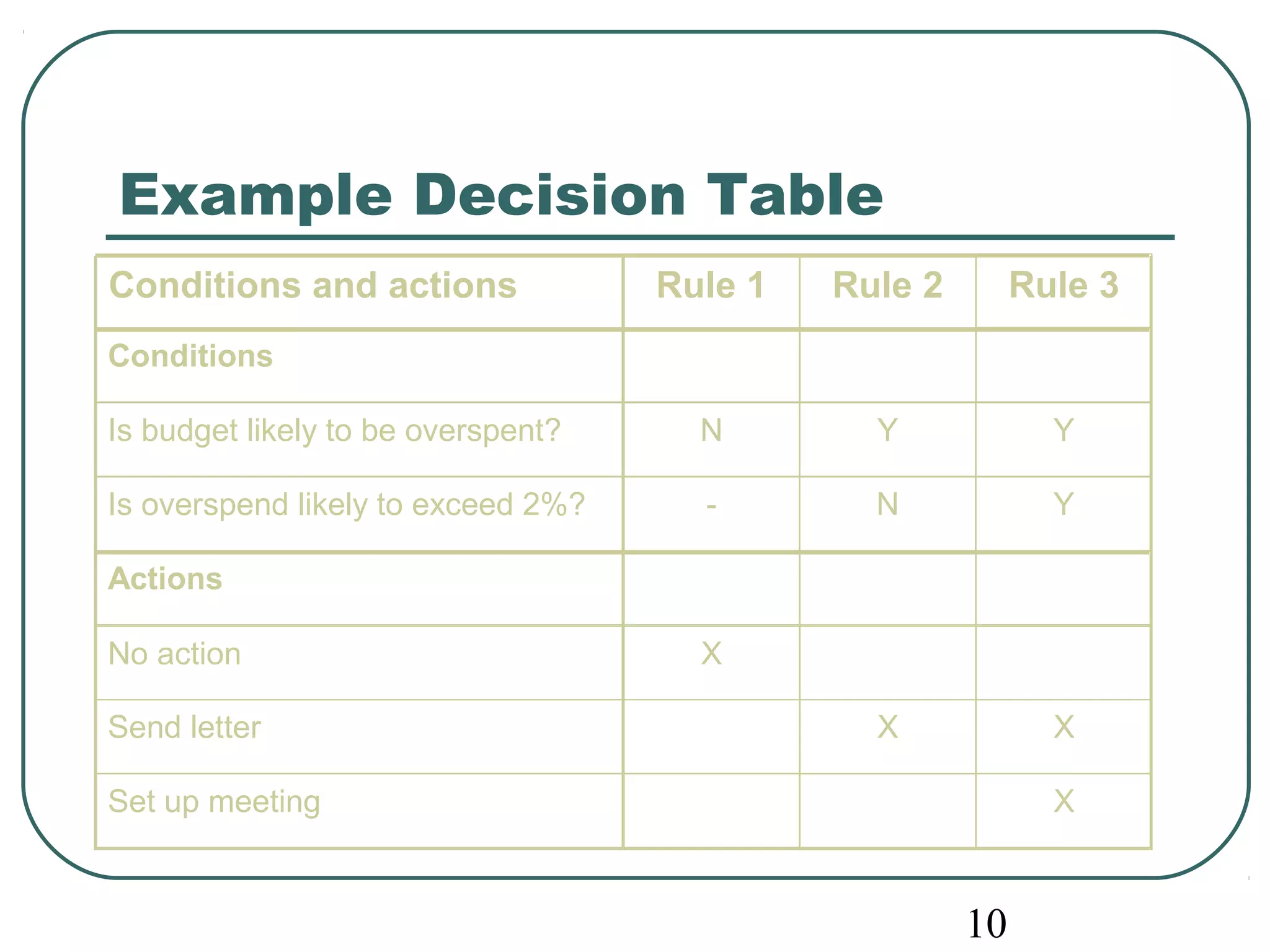
Conditions and actions Rule 1 Rule 2 Rule 3 
Conditions 
Is budget likely to be overspent? N Y Y 
Is overspend likely to exceed 2%? - N Y 
Actions 
No action X 
Send letter X X 
Set up meeting X 
10 
Example Decision Table
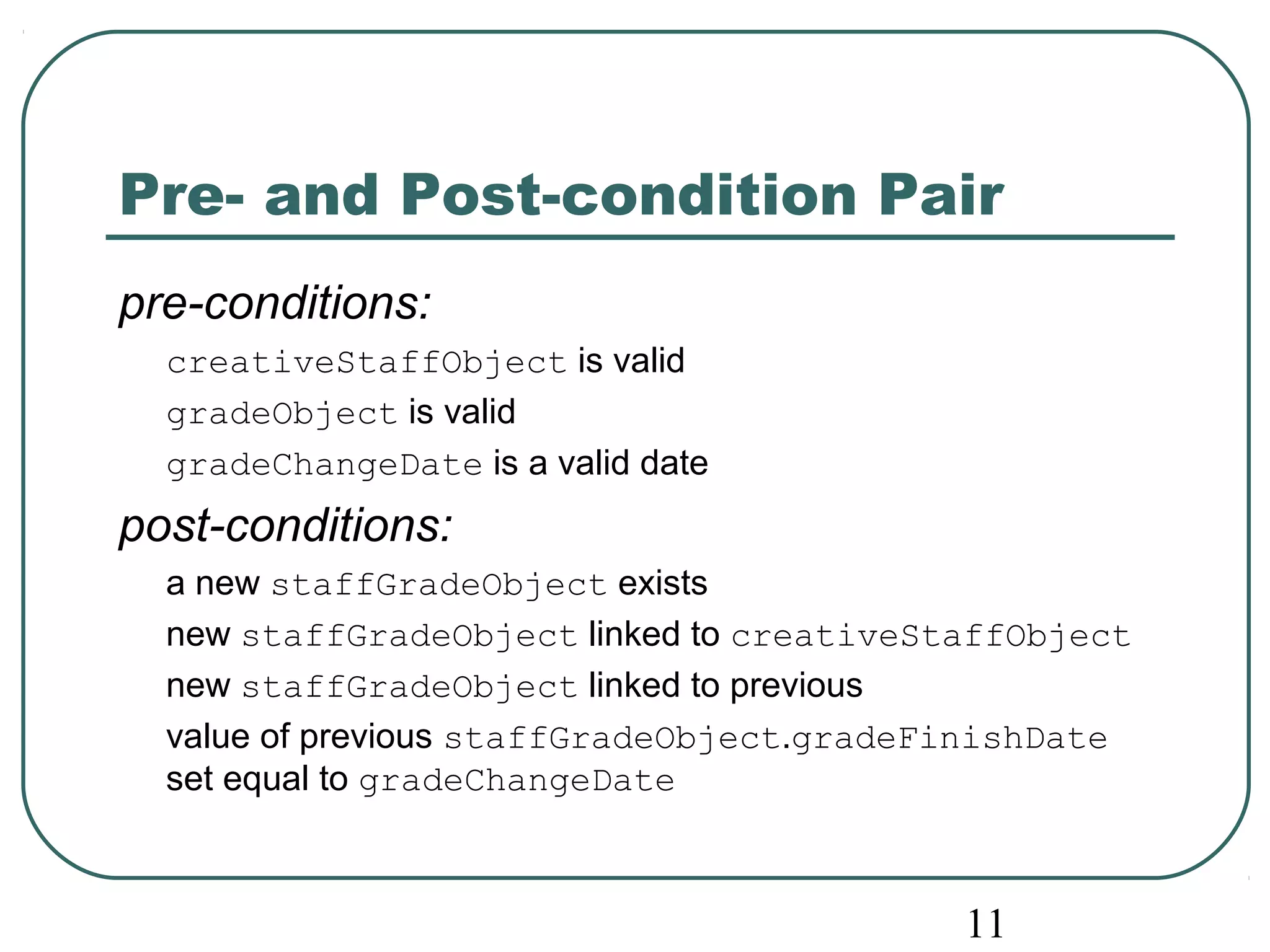
Pre- and Post-condition Pair 
pre-conditions: 
creativeStaffObject is valid 
gradeObject is valid 
gradeChangeDate is a valid date 
post-conditions: 
a new staffGradeObject exists 
new staffGradeObject linked to creativeStaffObject 
new staffGradeObject linked to previous 
value of previous staffGradeObject.gradeFinishDate 
set equal to gradeChangeDate 
11
12 
Algorithmic Techniques 
Suitable where users understand the 
procedure for arriving at a result 
Can be constructed top-down, to handle 
arbitrarily complex functionality 
Examples: 
• Structured English 
• Activity Diagrams
13 
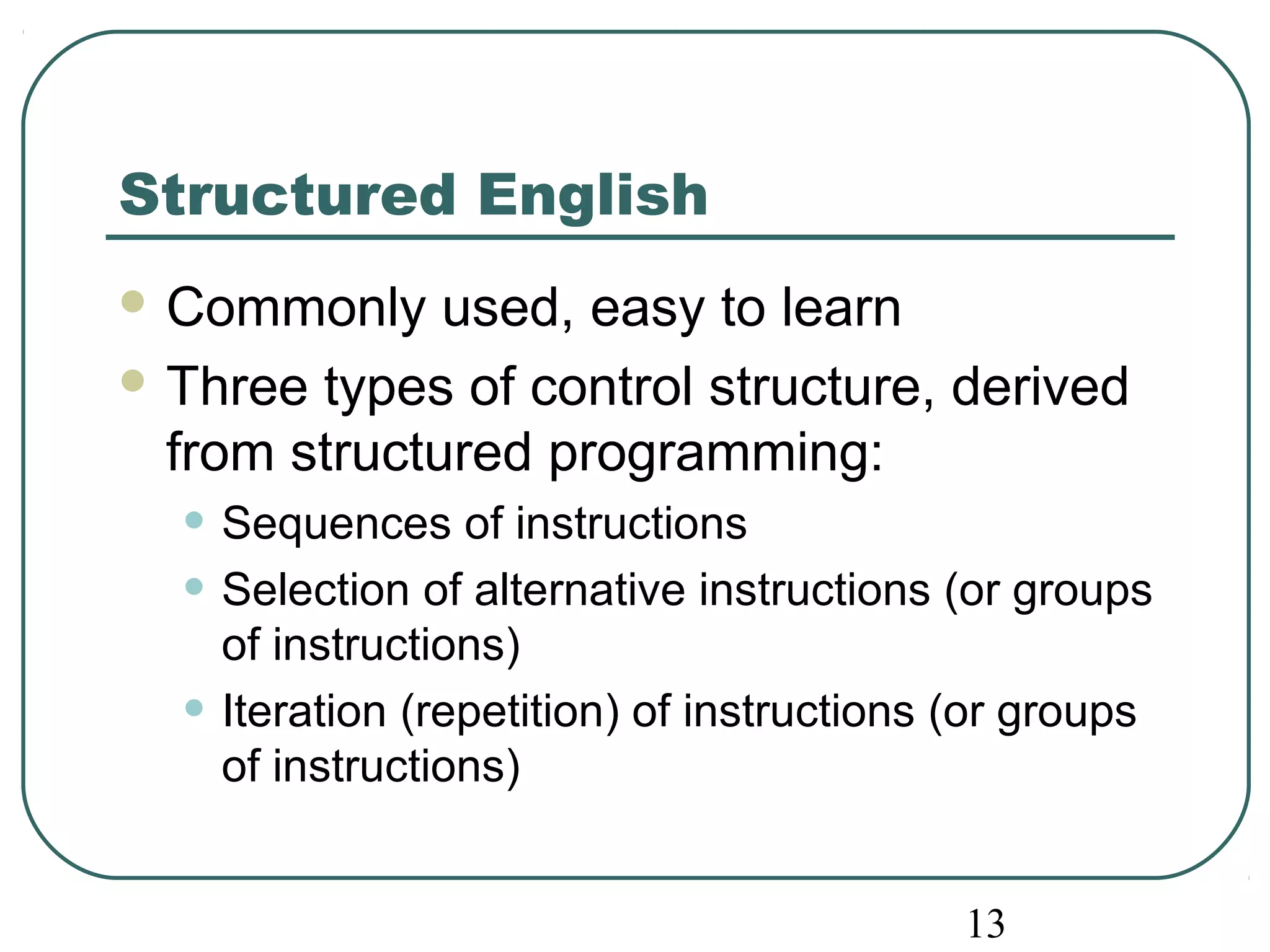
Structured English 
Commonly used, easy to learn 
Three types of control structure, derived 
from structured programming: 
• Sequences of instructions 
• Selection of alternative instructions (or groups 
of instructions) 
• Iteration (repetition) of instructions (or groups 
of instructions)
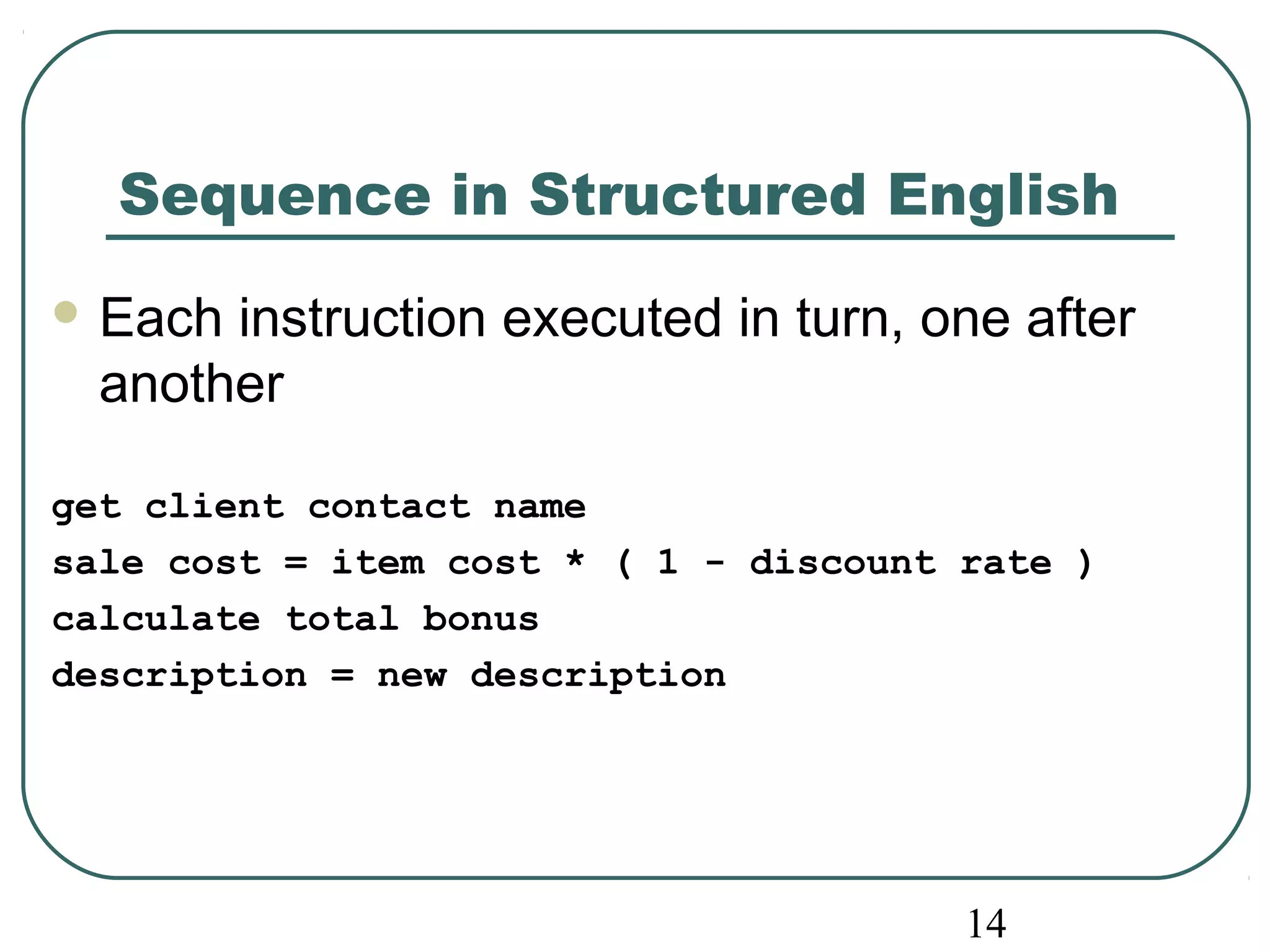
Sequence in Structured English 
Each instruction executed in turn, one after 
another 
get client contact name 
sale cost = item cost * ( 1 - discount rate ) 
calculate total bonus 
description = new description 
14
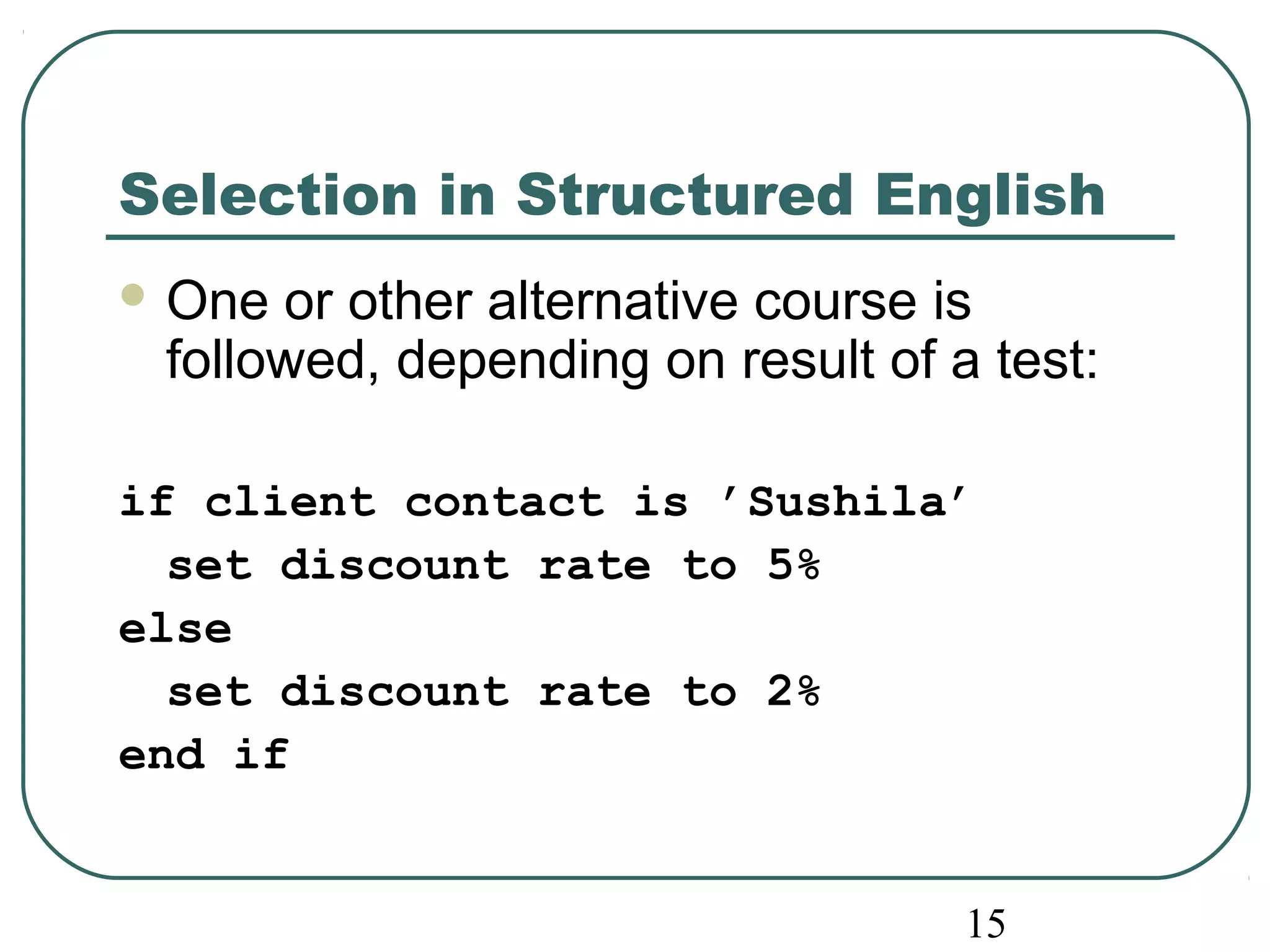
Selection in Structured English 
One or other alternative course is 
followed, depending on result of a test: 
if client contact is ’Sushila’ 
set discount rate to 5% 
else 
set discount rate to 2% 
end if 
15
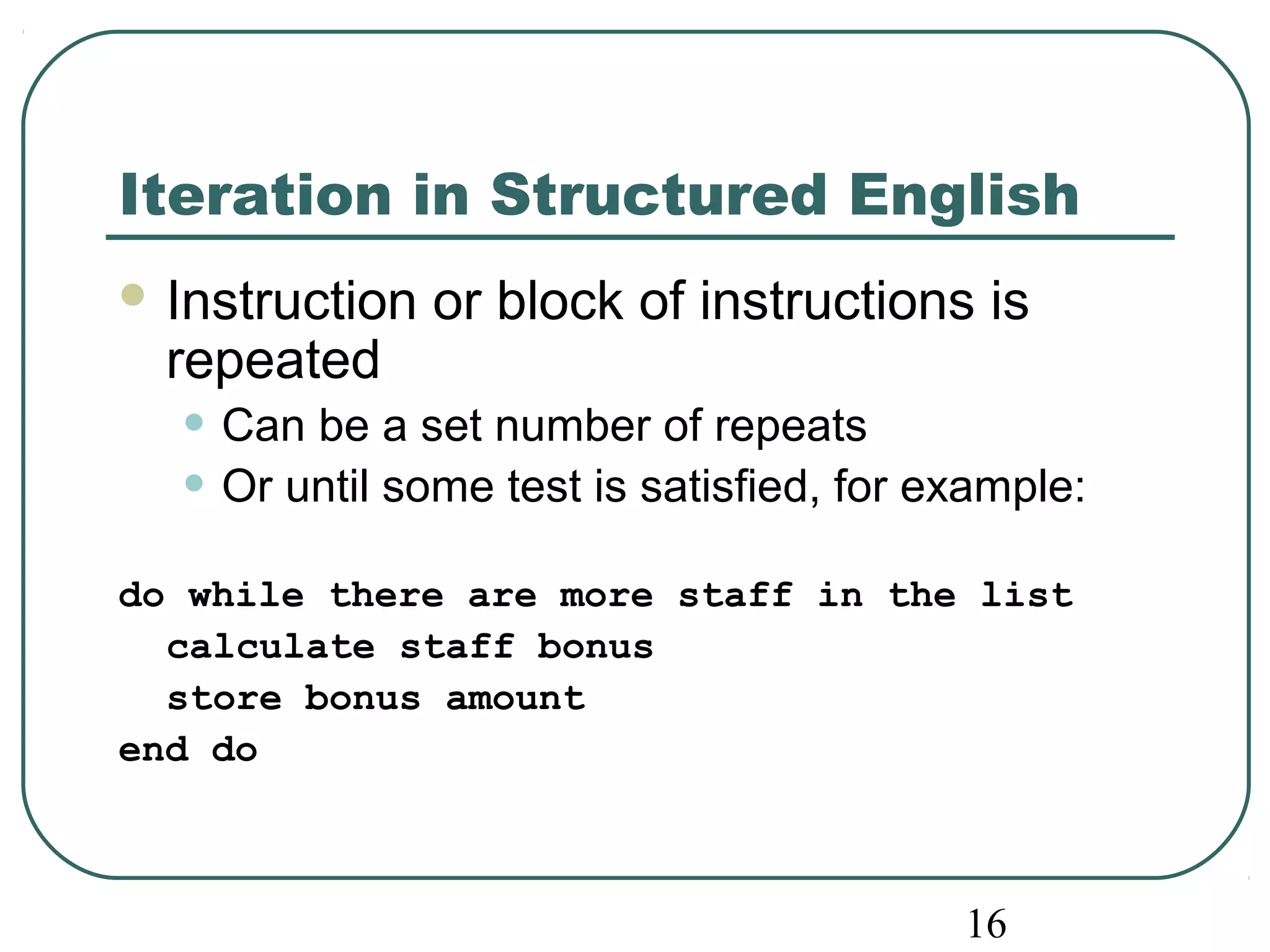
Iteration in Structured English 
Instruction or block of instructions is 
repeated 
• Can be a set number of repeats 
• Or until some test is satisfied, for example: 
do while there are more staff in the list 
16 
calculate staff bonus 
store bonus amount 
end do
Activity Diagrams 
Are part of UML notation set 
Can be used for operation logic 
specification, among many other uses 
Are easy to learn and understand 
Have the immediacy of graphical 
notation 
Bear some resemblance to old-fashioned 
flowchart technique 
17
18 
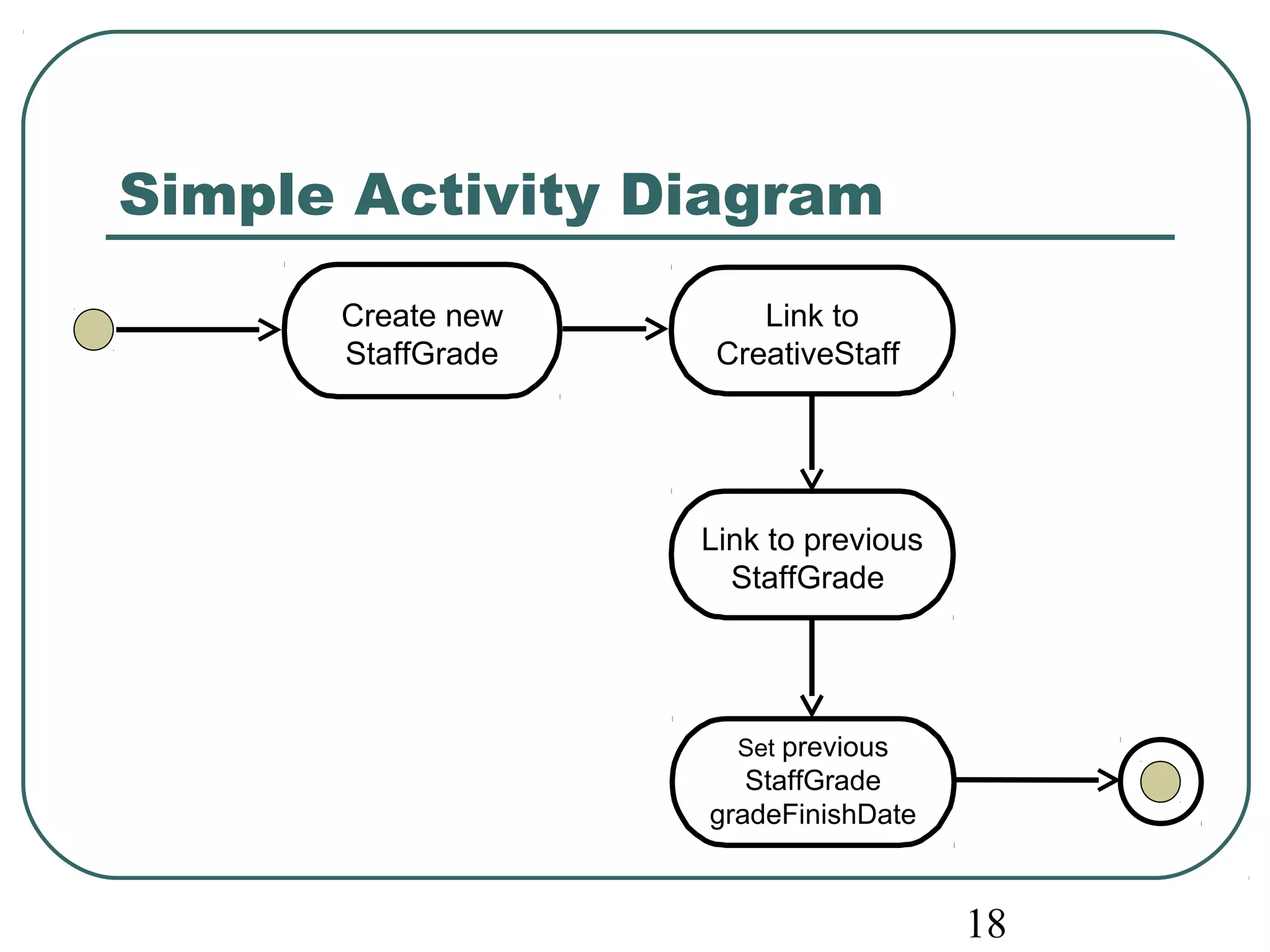
Simple Activity Diagram 
Link to 
CreativeStaff 
Create new 
StaffGrade 
Link to previous 
StaffGrade 
Set previous 
StaffGrade 
gradeFinishDate
Activity Diagram with Selection 
19 
Check approval 
for grade change 
[approved by 
Director] 
[not approved 
by Director] Print approval 
request 
Link to 
CreativeStaff 
Create new 
StaffGrade 
Link to previous 
StaffGrade 
Set previous 
StaffGrade 
gradeFinishDate
Activity Diagram with Selection 
and Iteration 
20 
Calculate bonus 
[bonus > £250] 
Add to list 
[more StaffMembers] 
[no more StaffMembers] 
Format list 
Add to ‘star’ list 
Create 
warning 
letter 
[bonus < £25] 
[bonus >= £25 AND 
bonus <= £250]
Object Constraint Language 
 Most OCL statements consist of: 
• Context, Property and Operation 
 Context 
• Defines domain within which expression is valid 
• Instance of a type, e.g. object in class diagram 
• Link (association instance) may be a context 
 A property of that instance 
• Often an attribute, association-end or query operation 
21
OCL operation is applied to the property 
Operations include 
• Arithmetical operators *, +, - and / 
• Set operators such as size, isEmpty and 
select 
• Type operators such as oclIsTypeOf 
22
23 
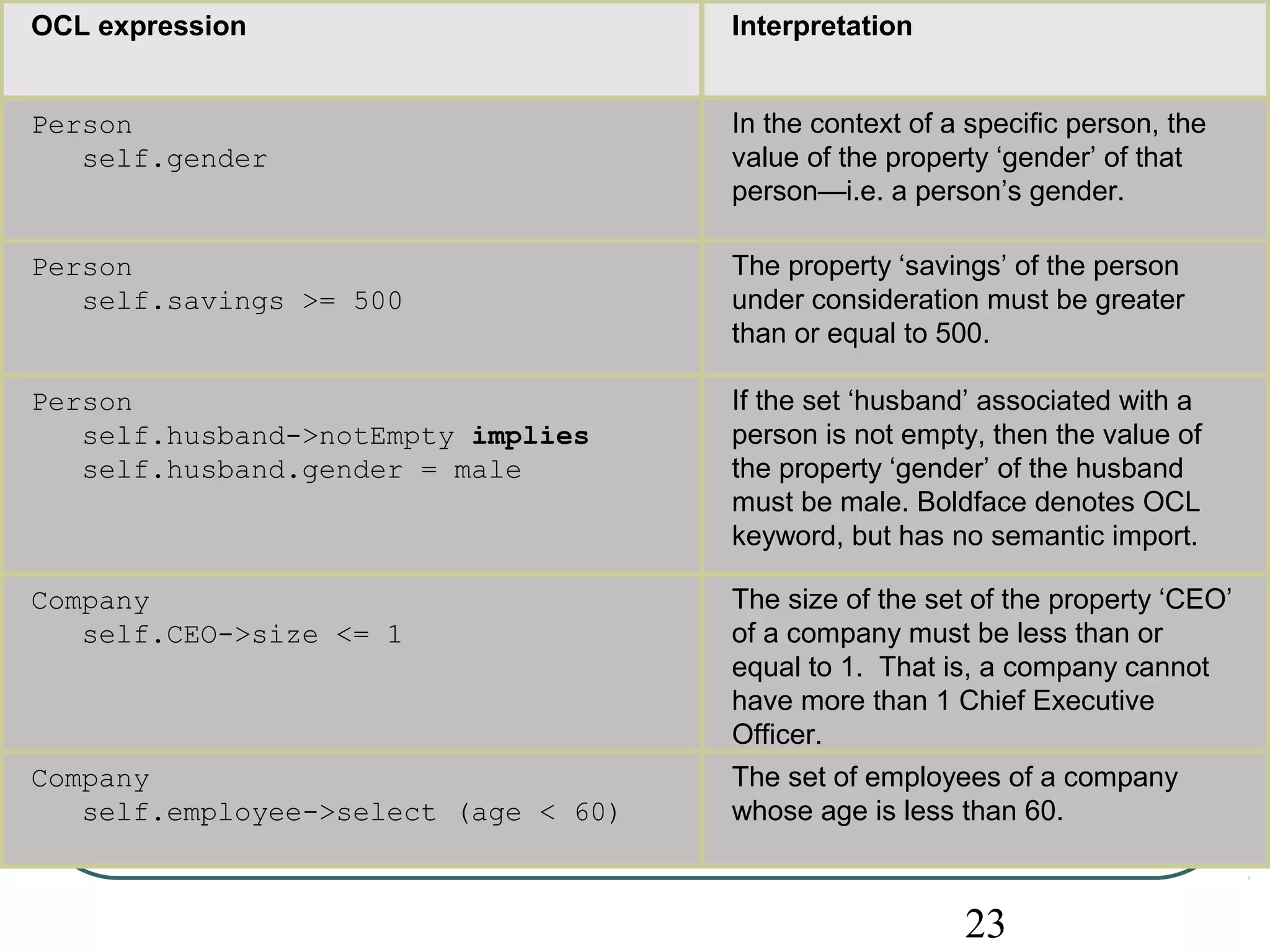
OCL expression Interpretation 
Person 
self.gender 
In the context of a specific person, the 
value of the property ‘gender’ of that 
person—i.e. a person’s gender. 
Person 
self.savings >= 500 
The property ‘savings’ of the person 
under consideration must be greater 
than or equal to 500. 
Person 
self.husband->notEmpty implies 
self.husband.gender = male 
If the set ‘husband’ associated with a 
person is not empty, then the value of 
the property ‘gender’ of the husband 
must be male. Boldface denotes OCL 
keyword, but has no semantic import. 
Company 
self.CEO->size <= 1 
The size of the set of the property ‘CEO’ 
of a company must be less than or 
equal to 1. That is, a company cannot 
have more than 1 Chief Executive 
Officer. 
Company 
self.employee->select (age < 60) 
The set of employees of a company 
whose age is less than 60.
24 
OCL Used for Pre-and 
Post-conditions 
context CreativeStaff::changeGrade 
(grade:Grade, gradeChangeDate:Date) 
pre: 
grade oclIsTypeOf(Grade) 
gradeChangeDate >= today 
post: 
self.staffGrade[grade]->exists 
self.staffGrade[previous]->notEmpty 
self.staffGrade.gradeStartDate = gradeChangeDate 
self.staffGrade.previous.gradeFinishDate = 
gradeChangeDate
Summary 
In this lecture you have learned about: 
 The role of operation specifications 
 What is meant by “Contracts” 
 Algorithmic and non-algorithmic techniques, 
and how they differ 
 How to use: 
• Decision Tables, Pre- and Post-condition Pairs, 
Structured English, Activity Diagrams and Object 
Constraint Language 
25

Software System Engineering - Chapter 13

  • 1.
    1 CHAPTER 13 Specifying Operations Software System Engineering (260CT)
  • 2.
    In This LectureYou Will Learn:  About the role of operation specifications  What is meant by “Contracts”  About algorithmic and non-algorithmic techniques, and how they differ  How to use: • Decision Tables • Pre- and Post-condition Pairs • Structured English • Activity Diagrams • Object Constraint Language 2
  • 3.
    Why We SpecifyOperations From analysis perspective: • Ensure users’ needs are understood From design perspective: • Guide programmer to an appropriate 3 implementation (i.e. method) From test perspective: • Verify that the method does what was originally intended
  • 4.
    Types of Operationand Their Effects  Operations with side-effects may: • Create or destroy object instances • Set attribute values • Form or break links with other objects • Carry out calculations • Send messages or events to other objects • Any combination of these  Operations without side-effects are pure queries • Request data but do not change anything 4
  • 5.
    5 Services AmongObjects When objects collaborate, one object typically provides a service to another Examples: • A Client object might ask a Campaign object for its details • The same Client object might then ask a boundary object to display its related Campaign details to the user
  • 6.
    Contracts: an Approachto Defining Services A service can be defined as a contract between the participating objects Contracts focus on inputs and outputs Intervening process is seen as a black box Irrelevant details are hidden This emphasizes service delivery, and ignores implementation 6
  • 7.
    Contract-Style Operation Specification  Intent or purpose of the operation  Operation signature, including return type  Description of the logic  Other operations called  Events transmitted to other objects  Any attributes set  Response to exceptions (e.g. an invalid parameter)  Non-functional requirements (adapted from Larman, 1998 and Allen and Frost, 1998) 7
  • 8.
    Types of LogicSpecification Logic description is probably the most important element Two main categories: Algorithmic types are white box—they focus on how the operation might work Non-algorithmic types are black box— they focus on what the operation should achieve 8
  • 9.
    Non-Algorithmic Techniques Appropriate where correct result matters more than method to arrive at it  Decision tree: complex decisions, multiple criteria and steps (not described further here)  Decision table: similar applications to decision tree  Pre- and Post-condition pairs: suitable where precise logic is unimportant or uncertain 9
  • 10.
    Conditions and actionsRule 1 Rule 2 Rule 3 Conditions Is budget likely to be overspent? N Y Y Is overspend likely to exceed 2%? - N Y Actions No action X Send letter X X Set up meeting X 10 Example Decision Table
  • 11.
    Pre- and Post-conditionPair pre-conditions: creativeStaffObject is valid gradeObject is valid gradeChangeDate is a valid date post-conditions: a new staffGradeObject exists new staffGradeObject linked to creativeStaffObject new staffGradeObject linked to previous value of previous staffGradeObject.gradeFinishDate set equal to gradeChangeDate 11
  • 12.
    12 Algorithmic Techniques Suitable where users understand the procedure for arriving at a result Can be constructed top-down, to handle arbitrarily complex functionality Examples: • Structured English • Activity Diagrams
  • 13.
    13 Structured English Commonly used, easy to learn Three types of control structure, derived from structured programming: • Sequences of instructions • Selection of alternative instructions (or groups of instructions) • Iteration (repetition) of instructions (or groups of instructions)
  • 14.
    Sequence in StructuredEnglish Each instruction executed in turn, one after another get client contact name sale cost = item cost * ( 1 - discount rate ) calculate total bonus description = new description 14
  • 15.
    Selection in StructuredEnglish One or other alternative course is followed, depending on result of a test: if client contact is ’Sushila’ set discount rate to 5% else set discount rate to 2% end if 15
  • 16.
    Iteration in StructuredEnglish Instruction or block of instructions is repeated • Can be a set number of repeats • Or until some test is satisfied, for example: do while there are more staff in the list 16 calculate staff bonus store bonus amount end do
  • 17.
    Activity Diagrams Arepart of UML notation set Can be used for operation logic specification, among many other uses Are easy to learn and understand Have the immediacy of graphical notation Bear some resemblance to old-fashioned flowchart technique 17
  • 18.
    18 Simple ActivityDiagram Link to CreativeStaff Create new StaffGrade Link to previous StaffGrade Set previous StaffGrade gradeFinishDate
  • 19.
    Activity Diagram withSelection 19 Check approval for grade change [approved by Director] [not approved by Director] Print approval request Link to CreativeStaff Create new StaffGrade Link to previous StaffGrade Set previous StaffGrade gradeFinishDate
  • 20.
    Activity Diagram withSelection and Iteration 20 Calculate bonus [bonus > £250] Add to list [more StaffMembers] [no more StaffMembers] Format list Add to ‘star’ list Create warning letter [bonus < £25] [bonus >= £25 AND bonus <= £250]
  • 21.
    Object Constraint Language  Most OCL statements consist of: • Context, Property and Operation  Context • Defines domain within which expression is valid • Instance of a type, e.g. object in class diagram • Link (association instance) may be a context  A property of that instance • Often an attribute, association-end or query operation 21
  • 22.
    OCL operation isapplied to the property Operations include • Arithmetical operators *, +, - and / • Set operators such as size, isEmpty and select • Type operators such as oclIsTypeOf 22
  • 23.
    23 OCL expressionInterpretation Person self.gender In the context of a specific person, the value of the property ‘gender’ of that person—i.e. a person’s gender. Person self.savings >= 500 The property ‘savings’ of the person under consideration must be greater than or equal to 500. Person self.husband->notEmpty implies self.husband.gender = male If the set ‘husband’ associated with a person is not empty, then the value of the property ‘gender’ of the husband must be male. Boldface denotes OCL keyword, but has no semantic import. Company self.CEO->size <= 1 The size of the set of the property ‘CEO’ of a company must be less than or equal to 1. That is, a company cannot have more than 1 Chief Executive Officer. Company self.employee->select (age < 60) The set of employees of a company whose age is less than 60.
  • 24.
    24 OCL Usedfor Pre-and Post-conditions context CreativeStaff::changeGrade (grade:Grade, gradeChangeDate:Date) pre: grade oclIsTypeOf(Grade) gradeChangeDate >= today post: self.staffGrade[grade]->exists self.staffGrade[previous]->notEmpty self.staffGrade.gradeStartDate = gradeChangeDate self.staffGrade.previous.gradeFinishDate = gradeChangeDate
  • 25.
    Summary In thislecture you have learned about:  The role of operation specifications  What is meant by “Contracts”  Algorithmic and non-algorithmic techniques, and how they differ  How to use: • Decision Tables, Pre- and Post-condition Pairs, Structured English, Activity Diagrams and Object Constraint Language 25

Editor's Notes

  • #11 Figure 10.1 A decision table with two conditions and three actions, yielding three distinct rules.
  • #19 Figure 10.2 An activity diagram showing the main steps for the operation CreativeStaff.changeGrade().
  • #20 Figure 10.3 A more complex activity diagram for CreativeStaff.changeGrade(), with an initial selection to check that approval has been given.
  • #21 Figure 10.4 Activity diagram for Prepare bonus list(), showing selection and iteration structures. Compare this with the Structured English example given earlier.