CHAPTER 1 
INTRODUCTION TO SOFTWARE 
ENGINEERING 
SOFTWARE SYSTEM 
ENGINEERING 
(260CT)
INTRODUCTION TO SOFTWARE ENGINEERING 
Introduction to Software Engineering 
(SE) 
Software Products 
Software Process 
Software Misconceptions 
What Causes the Needed of SE
Introduction to Software Engineering 
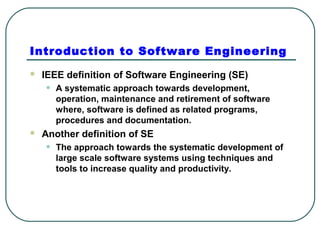
 IEEE definition of Software Engineering (SE) 
• A systematic approach towards development, 
operation, maintenance and retirement of software 
where, software is defined as related programs, 
procedures and documentation. 
 Another definition of SE 
• The approach towards the systematic development of 
large scale software systems using techniques and 
tools to increase quality and productivity.
Software-related Problems 
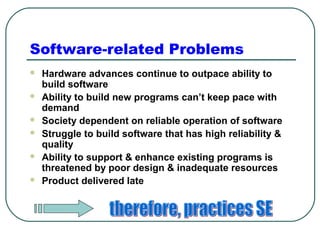
 Hardware advances continue to outpace ability to 
build software 
 Ability to build new programs can’t keep pace with 
demand 
 Society dependent on reliable operation of software 
 Struggle to build software that has high reliability & 
quality 
 Ability to support & enhance existing programs is 
threatened by poor design & inadequate resources 
 Product delivered late
Software Products 
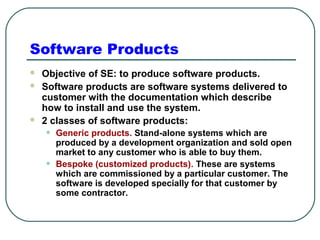
 Objective of SE: to produce software products. 
 Software products are software systems delivered to 
customer with the documentation which describe 
how to install and use the system. 
 2 classes of software products: 
• Generic products. Stand-alone systems which are 
produced by a development organization and sold open 
market to any customer who is able to buy them. 
• Bespoke (customized products). These are systems 
which are commissioned by a particular customer. The 
software is developed specially for that customer by 
some contractor.
Software Products 
-Software product attributes 
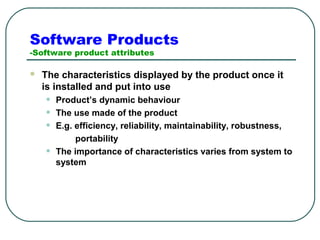
 The characteristics displayed by the product once it 
is installed and put into use 
• Product’s dynamic behaviour 
• The use made of the product 
• E.g. efficiency, reliability, maintainability, robustness, 
portability 
• The importance of characteristics varies from system to 
system
Software Products 
-Software product attributes 
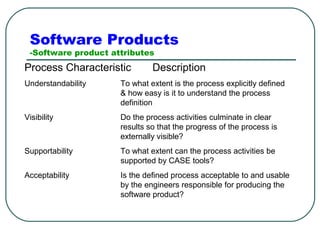
Process Characteristic Description 
Understandability To what extent is the process explicitly defined 
& how easy is it to understand the process 
definition 
Visibility Do the process activities culminate in clear 
results so that the progress of the process is 
externally visible? 
Supportability To what extent can the process activities be 
supported by CASE tools? 
Acceptability Is the defined process acceptable to and usable 
by the engineers responsible for producing the 
software product?
Software Products 
-Software product attributes 
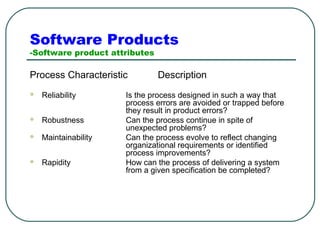
Process Characteristic Description 
 Reliability Is the process designed in such a way that 
process errors are avoided or trapped before 
they result in product errors? 
 Robustness Can the process continue in spite of 
unexpected problems? 
 Maintainability Can the process evolve to reflect changing 
organizational requirements or identified 
process improvements? 
 Rapidity How can the process of delivering a system 
from a given specification be completed?
The Software Process 
 The set of activities and associated results which 
produce a software product, which are carried by 
software engineers. 
 CASE (computer-aided software engineering) tools is 
used to help some process activities.
The Software Process 
 4 fundamental process activities common to all 
software processes: 
• Software specification. The functionality of the software 
& constraints on its operation must be defined. 
• Software development. The software to meet the 
specification must be produced. 
• Software validation. The software must be validated to 
ensure that it does what the customer wants. 
• Software evolution. The software must evolve to meet 
changing customer needs.
The Software Process 
-Process characteristics 
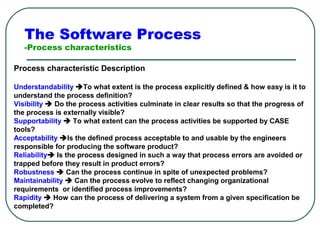
Process characteristic Description 
Understandability To what extent is the process explicitly defined & how easy is it to 
understand the process definition? 
Visibility  Do the process activities culminate in clear results so that the progress of 
the process is externally visible? 
Supportability  To what extent can the process activities be supported by CASE 
tools? 
Acceptability Is the defined process acceptable to and usable by the engineers 
responsible for producing the software product? 
Reliability Is the process designed in such a way that process errors are avoided or 
trapped before they result in product errors? 
Robustness  Can the process continue in spite of unexpected problems? 
Maintainability  Can the process evolve to reflect changing organizational 
requirements or identified process improvements? 
Rapidity  How can the process of delivering a system from a given specification be 
completed?
The Software Process 
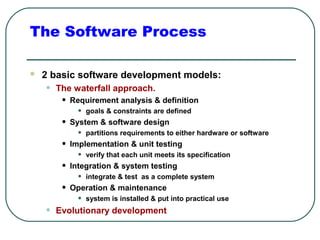
 2 basic software development models: 
• The waterfall approach. 
• Requirement analysis & definition 
• goals & constraints are defined 
• System & software design 
• partitions requirements to either hardware or software 
• Implementation & unit testing 
• verify that each unit meets its specification 
• Integration & system testing 
• integrate & test as a complete system 
• Operation & maintenance 
• system is installed & put into practical use 
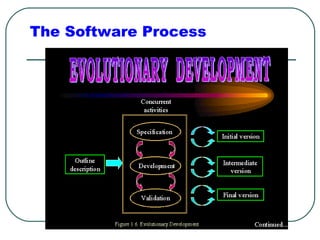
• Evolutionary development
The Software Process
The Software Process 
 2 types of evolutionary development 
• Exploratory programming 
• to work with the customer to explore their requirements & 
deliver a final system 
• Throw-away prototyping 
• to understand the customer's requirements & hence 
develop a better requirements definition of the system
Software Misconceptions 
 Management Misconceptions 
• There are standards and procedure existed for producing 
software. 
In reality: 
• Standards are rarely used & are often out-of-date and 
incomplete. 
• Developers rarely know about them. 
• State-of-art hardware is the essential ingredient for 
successful software production. 
In reality: 
• Software, not hardware, tools are usually more 
important for achieving quality and productivity.
Software Misconceptions 
 Management Misconceptions 
• If we get behind schedule, we can always add more 
programmers and thus catch up. 
In reality: 
• Software development is not a mechanistic 
process. 
• Adding people to a late software project makes 
it later. 
• Newcomers must be educated (usually by those 
working on the project) thereby reducing the 
amount time spent on productive effort.
Software Misconceptions 
 Customer Misconceptions 
• A general statement of objectives is sufficient to begin 
writing programs; details can be filled later. 
In reality: 
• Insufficient knowledge about requirements is 
the major cause of failed software efforts. 
• Formal & detailed descriptions of data, 
functionality, design constraints & and 
validation criteria are essential. 
• Communication between customer & developer 
is vital.
Software Misconceptions 
 Customer Misconceptions 
• Project requirements continually change, but change 
easily accommodated because software is flexible. 
In reality: 
• The impact of change varies with the time at 
which it is introduced. 
• Early request for change can be accommodated 
easily and cheaply. 
• Changes made during design, implementation & 
installation have a severe impact on cost.
Software Misconceptions 
 Practitioner’s Misconceptions 
• Once the program is written and works, the job is done. 
In reality: 
• Between 50%-70% of all effort expended on a 
program will be expended after it is delivered to 
the customer. 
• There is no way to access quality until the program is 
running. 
In reality: 
• Formal technical review is one of the most 
effective quality assurance tools & can be 
applied from the inception of the project.
Software Misconceptions 
 Practitioner’s Misconceptions 
• The only deliverable is the working program(s). 
In reality: 
• It is only one part of a software configuration 
that includes requirements & specification 
documents, testing information & other 
developmental & maintenance information.
What Causes the Need for SE 
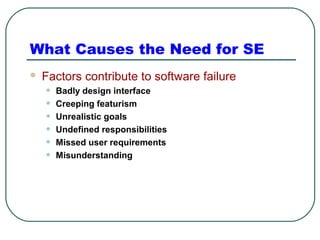
 Factors contribute to software failure 
• Badly design interface 
• Creeping featurism 
• Unrealistic goals 
• Undefined responsibilities 
• Missed user requirements 
• Misunderstanding
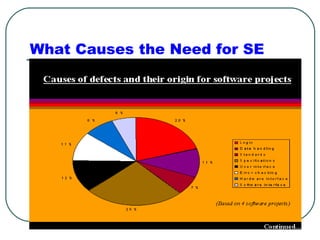
What Causes the Need for SE
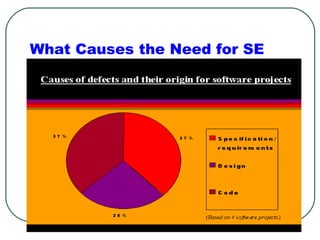
What Causes the Need for SE 
 Afflicting Problems 
• Data has not been collected on the software development process 
• thus there can’t be accurate evaluation of the efficiency of 
new tools, methods or standards 
• Customer dissatisfaction with the completed system is frequently 
encountered 
• software development is undertaken often with notation of 
the customer’s requirements 
• Software quality is not suspect 
• often there no systematic, complete software testing 
• Existing software can be difficult to maintain 
• software maintainability has not been emphasized as an 
important criteria

Software System Engineering - Chapter 1

  • 1.
    CHAPTER 1 INTRODUCTIONTO SOFTWARE ENGINEERING SOFTWARE SYSTEM ENGINEERING (260CT)
  • 2.
    INTRODUCTION TO SOFTWAREENGINEERING Introduction to Software Engineering (SE) Software Products Software Process Software Misconceptions What Causes the Needed of SE
  • 3.
    Introduction to SoftwareEngineering  IEEE definition of Software Engineering (SE) • A systematic approach towards development, operation, maintenance and retirement of software where, software is defined as related programs, procedures and documentation.  Another definition of SE • The approach towards the systematic development of large scale software systems using techniques and tools to increase quality and productivity.
  • 7.
    Software-related Problems Hardware advances continue to outpace ability to build software  Ability to build new programs can’t keep pace with demand  Society dependent on reliable operation of software  Struggle to build software that has high reliability & quality  Ability to support & enhance existing programs is threatened by poor design & inadequate resources  Product delivered late
  • 8.
    Software Products Objective of SE: to produce software products.  Software products are software systems delivered to customer with the documentation which describe how to install and use the system.  2 classes of software products: • Generic products. Stand-alone systems which are produced by a development organization and sold open market to any customer who is able to buy them. • Bespoke (customized products). These are systems which are commissioned by a particular customer. The software is developed specially for that customer by some contractor.
  • 9.
    Software Products -Softwareproduct attributes  The characteristics displayed by the product once it is installed and put into use • Product’s dynamic behaviour • The use made of the product • E.g. efficiency, reliability, maintainability, robustness, portability • The importance of characteristics varies from system to system
  • 10.
    Software Products -Softwareproduct attributes Process Characteristic Description Understandability To what extent is the process explicitly defined & how easy is it to understand the process definition Visibility Do the process activities culminate in clear results so that the progress of the process is externally visible? Supportability To what extent can the process activities be supported by CASE tools? Acceptability Is the defined process acceptable to and usable by the engineers responsible for producing the software product?
  • 11.
    Software Products -Softwareproduct attributes Process Characteristic Description  Reliability Is the process designed in such a way that process errors are avoided or trapped before they result in product errors?  Robustness Can the process continue in spite of unexpected problems?  Maintainability Can the process evolve to reflect changing organizational requirements or identified process improvements?  Rapidity How can the process of delivering a system from a given specification be completed?
  • 12.
    The Software Process  The set of activities and associated results which produce a software product, which are carried by software engineers.  CASE (computer-aided software engineering) tools is used to help some process activities.
  • 13.
    The Software Process  4 fundamental process activities common to all software processes: • Software specification. The functionality of the software & constraints on its operation must be defined. • Software development. The software to meet the specification must be produced. • Software validation. The software must be validated to ensure that it does what the customer wants. • Software evolution. The software must evolve to meet changing customer needs.
  • 14.
    The Software Process -Process characteristics Process characteristic Description Understandability To what extent is the process explicitly defined & how easy is it to understand the process definition? Visibility  Do the process activities culminate in clear results so that the progress of the process is externally visible? Supportability  To what extent can the process activities be supported by CASE tools? Acceptability Is the defined process acceptable to and usable by the engineers responsible for producing the software product? Reliability Is the process designed in such a way that process errors are avoided or trapped before they result in product errors? Robustness  Can the process continue in spite of unexpected problems? Maintainability  Can the process evolve to reflect changing organizational requirements or identified process improvements? Rapidity  How can the process of delivering a system from a given specification be completed?
  • 15.
    The Software Process  2 basic software development models: • The waterfall approach. • Requirement analysis & definition • goals & constraints are defined • System & software design • partitions requirements to either hardware or software • Implementation & unit testing • verify that each unit meets its specification • Integration & system testing • integrate & test as a complete system • Operation & maintenance • system is installed & put into practical use • Evolutionary development
  • 16.
  • 17.
    The Software Process  2 types of evolutionary development • Exploratory programming • to work with the customer to explore their requirements & deliver a final system • Throw-away prototyping • to understand the customer's requirements & hence develop a better requirements definition of the system
  • 18.
    Software Misconceptions Management Misconceptions • There are standards and procedure existed for producing software. In reality: • Standards are rarely used & are often out-of-date and incomplete. • Developers rarely know about them. • State-of-art hardware is the essential ingredient for successful software production. In reality: • Software, not hardware, tools are usually more important for achieving quality and productivity.
  • 19.
    Software Misconceptions Management Misconceptions • If we get behind schedule, we can always add more programmers and thus catch up. In reality: • Software development is not a mechanistic process. • Adding people to a late software project makes it later. • Newcomers must be educated (usually by those working on the project) thereby reducing the amount time spent on productive effort.
  • 20.
    Software Misconceptions Customer Misconceptions • A general statement of objectives is sufficient to begin writing programs; details can be filled later. In reality: • Insufficient knowledge about requirements is the major cause of failed software efforts. • Formal & detailed descriptions of data, functionality, design constraints & and validation criteria are essential. • Communication between customer & developer is vital.
  • 21.
    Software Misconceptions Customer Misconceptions • Project requirements continually change, but change easily accommodated because software is flexible. In reality: • The impact of change varies with the time at which it is introduced. • Early request for change can be accommodated easily and cheaply. • Changes made during design, implementation & installation have a severe impact on cost.
  • 22.
    Software Misconceptions Practitioner’s Misconceptions • Once the program is written and works, the job is done. In reality: • Between 50%-70% of all effort expended on a program will be expended after it is delivered to the customer. • There is no way to access quality until the program is running. In reality: • Formal technical review is one of the most effective quality assurance tools & can be applied from the inception of the project.
  • 23.
    Software Misconceptions Practitioner’s Misconceptions • The only deliverable is the working program(s). In reality: • It is only one part of a software configuration that includes requirements & specification documents, testing information & other developmental & maintenance information.
  • 24.
    What Causes theNeed for SE  Factors contribute to software failure • Badly design interface • Creeping featurism • Unrealistic goals • Undefined responsibilities • Missed user requirements • Misunderstanding
  • 25.
    What Causes theNeed for SE
  • 26.
    What Causes theNeed for SE
  • 27.
    What Causes theNeed for SE
  • 28.
    What Causes theNeed for SE  Afflicting Problems • Data has not been collected on the software development process • thus there can’t be accurate evaluation of the efficiency of new tools, methods or standards • Customer dissatisfaction with the completed system is frequently encountered • software development is undertaken often with notation of the customer’s requirements • Software quality is not suspect • often there no systematic, complete software testing • Existing software can be difficult to maintain • software maintainability has not been emphasized as an important criteria