Object Oriented Analysis and Design
V Semester CSE
© Vignesh Saravanan K, AP/CSE
Lecture-11
Elaboration, Domain Model
UNIT II – STATIC UML DIAGRAMS
© Vignesh Saravanan K, AP/CSE
Object Oriented Analysis and Design
RAMCO INSTITUTE OF TECHNOLOGY
2
The Essentials of Class Diagram
 A class diagram describes the types of objects in the system and the
various kinds of static relationship that exist among them.
 There are 2 kinds of static relationships.
 Associations
 Subtypes
 The class diagrams show the attributes and operations of a class and the
constraints that apply to the way objects are connected.
 Perspectives
 There are three different perspectives; we use in drawing class
diagrams. They are
 Conceptual
 Specification
 Implementation
© Vignesh Saravanan K, AP/CSE
Object Oriented Analysis and Design
RAMCO INSTITUTE OF TECHNOLOGY
3
ELABORATION
 Elaboration is an activity in which the requirements is expanded
and refined. Elaboration consists of several modeling and
refinement tasks.
 During Elaboration phase, each user scenario is parsed and various
classes are identified. Then we can define the following:
 Attributes and services (functions)
 Relationships on the classes.
 Then UML diagram (class diagrams) can be easily developed.
© Vignesh Saravanan K, AP/CSE
Object Oriented Analysis and Design
RAMCO INSTITUTE OF TECHNOLOGY
4
ELABORATION (cont.)
 Elaboration has the following series of iterations.
1. The core (risky) software architecture is programmed and built.
2. Almost all requirements are identified and refined.
3. High risks are resolved or removed and rough estimation done.
 Elaboration is conducted within two or more iterations.
 During these iterations the team
 Does serious investigations
 Implements programs and tests for core architecture
 Clarifies requirements tackles high risk issues.
© Vignesh Saravanan K, AP/CSE
Object Oriented Analysis and Design
RAMCO INSTITUTE OF TECHNOLOGY
5
ELABORATION (cont.)
 Each iteration goes for 2 or 3 weeks. Each iteration is time-boxed. .
i.e. its end date is fixed. It lasts for two to six weeks
 During elaboration the models are fully developed in preparation
for implementation.
 During elaboration, the code and design are in production. It is
called “Executable architecture” or “Architectural baseline”.
 Elaboration is neither a design step nor a phase in which fully
developed model for implementation is developed.
© Vignesh Saravanan K, AP/CSE
Object Oriented Analysis and Design
RAMCO INSTITUTE OF TECHNOLOGY
6
Key Ideas of Elaboration
 Elaboration is
 Building the core architecture
 Resolving the high risk elements
 Define more requirements and Estimate overall schedule and
resources
 Key Ideas of Elaboration
 Elaboration is not more than few months
 Core and risky parts done in step by step
 Has short time boxed iterations
 Has realistic tests.
 Adapt according to the feedback of users
 Most of the use cases and other requirements in detail
© Vignesh Saravanan K, AP/CSE
Object Oriented Analysis and Design
RAMCO INSTITUTE OF TECHNOLOGY
7
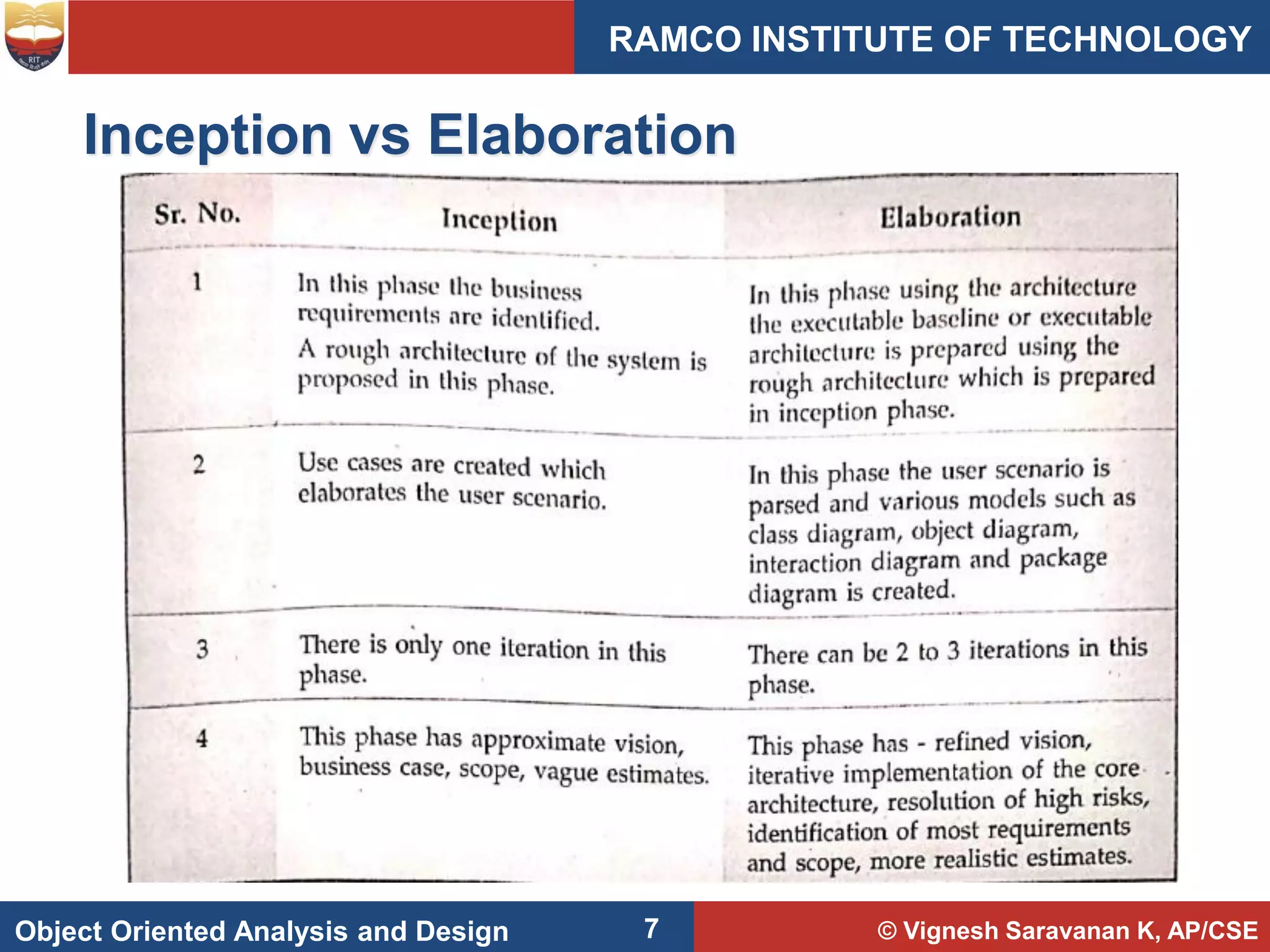
Inception vs Elaboration
© Vignesh Saravanan K, AP/CSE
Object Oriented Analysis and Design
RAMCO INSTITUTE OF TECHNOLOGY
8
DOMAIN MODELS
 A domain model is a visual representation of conceptual classes or
real situation objects in a domain.
 In object oriented analysis, domain model is the most important.
 It illustrates the concepts in a domain.
 It acts as a source of inspiration for designing some software
objects.
 Example
 A partial domain model for a visual dictionary is drawn with
UML class diagram. The conceptual classes of
– Payment and
– Sale are shown
 The payment is related to sale. Sale has date and time
information.
© Vignesh Saravanan K, AP/CSE
Object Oriented Analysis and Design
RAMCO INSTITUTE OF TECHNOLOGY
9
DOMAIN MODELS (cont.)
 Domain models are also called as conceptual models. Domain models are
illustrated with a set of class diagrams
 Domain objects or conceptual classes
 Association between conceptual classes
 Attributes of conceptual classes
 A domain model shows real-situation conceptual classes and not software
classes. [such as Java or C++ classes]
 So a domain model should probably avoid
 Software artifacts like window or database
 Methods and responsibilities.
Object Oriented Analysis and Design
V Semester CSE
© Vignesh Saravanan K, AP/CSE
End of Lecture
• The Essentials of Class Diagram
• ELABORATION
• Key Ideas of Elaboration
• Inception vs Elaboration
• Domain Model

Elaboration and domain model

  • 1.
    Object Oriented Analysisand Design V Semester CSE © Vignesh Saravanan K, AP/CSE Lecture-11 Elaboration, Domain Model UNIT II – STATIC UML DIAGRAMS
  • 2.
    © Vignesh SaravananK, AP/CSE Object Oriented Analysis and Design RAMCO INSTITUTE OF TECHNOLOGY 2 The Essentials of Class Diagram  A class diagram describes the types of objects in the system and the various kinds of static relationship that exist among them.  There are 2 kinds of static relationships.  Associations  Subtypes  The class diagrams show the attributes and operations of a class and the constraints that apply to the way objects are connected.  Perspectives  There are three different perspectives; we use in drawing class diagrams. They are  Conceptual  Specification  Implementation
  • 3.
    © Vignesh SaravananK, AP/CSE Object Oriented Analysis and Design RAMCO INSTITUTE OF TECHNOLOGY 3 ELABORATION  Elaboration is an activity in which the requirements is expanded and refined. Elaboration consists of several modeling and refinement tasks.  During Elaboration phase, each user scenario is parsed and various classes are identified. Then we can define the following:  Attributes and services (functions)  Relationships on the classes.  Then UML diagram (class diagrams) can be easily developed.
  • 4.
    © Vignesh SaravananK, AP/CSE Object Oriented Analysis and Design RAMCO INSTITUTE OF TECHNOLOGY 4 ELABORATION (cont.)  Elaboration has the following series of iterations. 1. The core (risky) software architecture is programmed and built. 2. Almost all requirements are identified and refined. 3. High risks are resolved or removed and rough estimation done.  Elaboration is conducted within two or more iterations.  During these iterations the team  Does serious investigations  Implements programs and tests for core architecture  Clarifies requirements tackles high risk issues.
  • 5.
    © Vignesh SaravananK, AP/CSE Object Oriented Analysis and Design RAMCO INSTITUTE OF TECHNOLOGY 5 ELABORATION (cont.)  Each iteration goes for 2 or 3 weeks. Each iteration is time-boxed. . i.e. its end date is fixed. It lasts for two to six weeks  During elaboration the models are fully developed in preparation for implementation.  During elaboration, the code and design are in production. It is called “Executable architecture” or “Architectural baseline”.  Elaboration is neither a design step nor a phase in which fully developed model for implementation is developed.
  • 6.
    © Vignesh SaravananK, AP/CSE Object Oriented Analysis and Design RAMCO INSTITUTE OF TECHNOLOGY 6 Key Ideas of Elaboration  Elaboration is  Building the core architecture  Resolving the high risk elements  Define more requirements and Estimate overall schedule and resources  Key Ideas of Elaboration  Elaboration is not more than few months  Core and risky parts done in step by step  Has short time boxed iterations  Has realistic tests.  Adapt according to the feedback of users  Most of the use cases and other requirements in detail
  • 7.
    © Vignesh SaravananK, AP/CSE Object Oriented Analysis and Design RAMCO INSTITUTE OF TECHNOLOGY 7 Inception vs Elaboration
  • 8.
    © Vignesh SaravananK, AP/CSE Object Oriented Analysis and Design RAMCO INSTITUTE OF TECHNOLOGY 8 DOMAIN MODELS  A domain model is a visual representation of conceptual classes or real situation objects in a domain.  In object oriented analysis, domain model is the most important.  It illustrates the concepts in a domain.  It acts as a source of inspiration for designing some software objects.  Example  A partial domain model for a visual dictionary is drawn with UML class diagram. The conceptual classes of – Payment and – Sale are shown  The payment is related to sale. Sale has date and time information.
  • 9.
    © Vignesh SaravananK, AP/CSE Object Oriented Analysis and Design RAMCO INSTITUTE OF TECHNOLOGY 9 DOMAIN MODELS (cont.)  Domain models are also called as conceptual models. Domain models are illustrated with a set of class diagrams  Domain objects or conceptual classes  Association between conceptual classes  Attributes of conceptual classes  A domain model shows real-situation conceptual classes and not software classes. [such as Java or C++ classes]  So a domain model should probably avoid  Software artifacts like window or database  Methods and responsibilities.
  • 10.
    Object Oriented Analysisand Design V Semester CSE © Vignesh Saravanan K, AP/CSE End of Lecture • The Essentials of Class Diagram • ELABORATION • Key Ideas of Elaboration • Inception vs Elaboration • Domain Model