REAL NUMBERS
REAL NUMBERS
PREPARED BY:
Dr. VIVEK NAITHANI (TGT MATHS)
K.V. JAGDALPUR
Copyright Information: CC By- SA
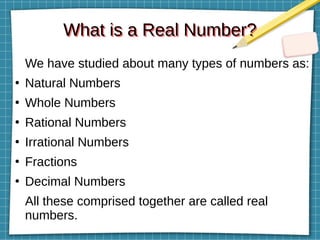
What is a Real Number?
We have studied about many types of numbers as:
●
Natural Numbers
●
Whole Numbers
●
Rational Numbers
●
Irrational Numbers
●
Fractions
●
Decimal Numbers
All these comprised together are called real
numbers.
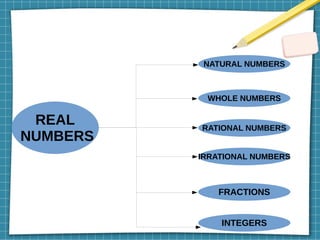
REAL
NUMBERS
NATURAL NUMBERS
WHOLE NUMBERS
RATIONAL NUMBERS
IRRATIONAL NUMBERS
FRACTIONS
INTEGERS
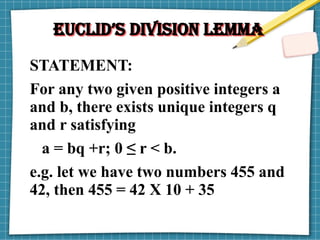
EUCLID’S DIVISION LEMMA
STATEMENT:
For any two given positive integers a
and b, there exists unique integers q
and r satisfying
a = bq +r; 0 ≤ r < b.
e.g. let we have two numbers 455 and
42, then 455 = 42 X 10 + 35
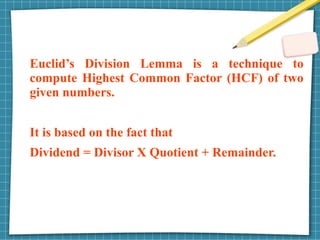
Euclid’s Division Lemma is a technique to
compute Highest Common Factor (HCF) of two
given numbers.
It is based on the fact that
Dividend = Divisor X Quotient + Remainder.
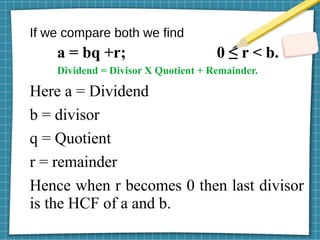
If we compare both we find
a = bq +r; 0 ≤ r < b.
Dividend = Divisor X Quotient + Remainder.
Here a = Dividend
b = divisor
q = Quotient
r = remainder
Hence when r becomes 0 then last divisor
is the HCF of a and b.
EXAMPLE
EXAMPLE
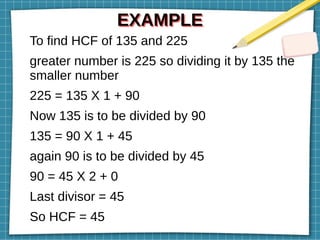
To find HCF of 135 and 225
greater number is 225 so dividing it by 135 the
smaller number
225 = 135 X 1 + 90
Now 135 is to be divided by 90
135 = 90 X 1 + 45
again 90 is to be divided by 45
90 = 45 X 2 + 0
Last divisor = 45
So HCF = 45
Comparison between Euclid’s
division lemma and long division
method
Comparison between Euclid’s
division lemma and long division
method
To understand the similarity between Euclid’s
Division Lemma and Long Division Method for
finding HCF let us take an example.
●
To find the HCF of 12576 and 4052
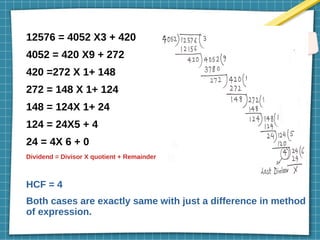
12576 = 4052 X3 + 420
4052 = 420 X9 + 272
420 =272 X 1+ 148
272 = 148 X 1+ 124
148 = 124X 1+ 24
124 = 24X5 + 4
24 = 4X 6 + 0
Dividend = Divisor X quotient + Remainder
HCF = 4
Both cases are exactly same with just a difference in method
of expression.
Similar Example
Similar Example
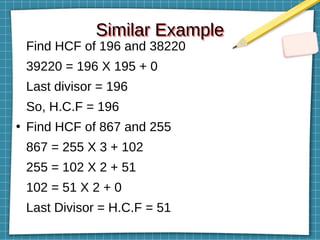
Find HCF of 196 and 38220
39220 = 196 X 195 + 0
Last divisor = 196
So, H.C.F = 196
●
Find HCF of 867 and 255
867 = 255 X 3 + 102
255 = 102 X 2 + 51
102 = 51 X 2 + 0
Last Divisor = H.C.F = 51
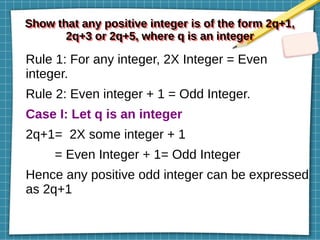
Show that any positive integer is of the form 2q+1,
2q+3 or 2q+5, where q is an integer
Show that any positive integer is of the form 2q+1,
2q+3 or 2q+5, where q is an integer
Rule 1: For any integer, 2X Integer = Even
integer.
Rule 2: Even integer + 1 = Odd Integer.
Case I: Let q is an integer
2q+1= 2X some integer + 1
= Even Integer + 1= Odd Integer
Hence any positive odd integer can be expressed
as 2q+1
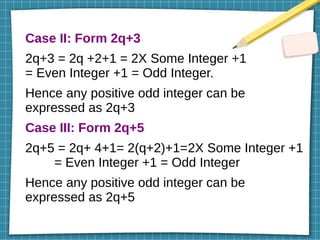
Case II: Form 2q+3
2q+3 = 2q +2+1 = 2X Some Integer +1
= Even Integer +1 = Odd Integer.
Hence any positive odd integer can be
expressed as 2q+3
Case III: Form 2q+5
2q+5 = 2q+ 4+1= 2(q+2)+1=2X Some Integer +1
= Even Integer +1 = Odd Integer
Hence any positive odd integer can be
expressed as 2q+5
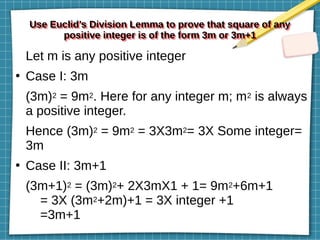
Use Euclid’s Division Lemma to prove that square of any
positive integer is of the form 3m or 3m+1
Use Euclid’s Division Lemma to prove that square of any
positive integer is of the form 3m or 3m+1
Let m is any positive integer
●
Case I: 3m
(3m)2 = 9m2. Here for any integer m; m2 is always
a positive integer.
Hence (3m)2 = 9m2 = 3X3m2= 3X Some integer=
3m
●
Case II: 3m+1
(3m+1)2 = (3m)2+ 2X3mX1 + 1= 9m2+6m+1
= 3X (3m2+2m)+1 = 3X integer +1
=3m+1
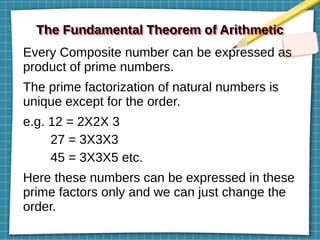
The Fundamental Theorem of Arithmetic
Every Composite number can be expressed as
product of prime numbers.
The prime factorization of natural numbers is
unique except for the order.
e.g. 12 = 2X2X 3
27 = 3X3X3
45 = 3X3X5 etc.
Here these numbers can be expressed in these
prime factors only and we can just change the
order.
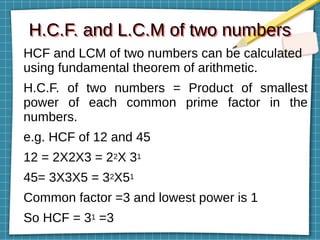
H.C.F. and L.C.M of two numbers
HCF and LCM of two numbers can be calculated
using fundamental theorem of arithmetic.
H.C.F. of two numbers = Product of smallest
power of each common prime factor in the
numbers.
e.g. HCF of 12 and 45
12 = 2X2X3 = 22X 31
45= 3X3X5 = 32X51
Common factor =3 and lowest power is 1
So HCF = 31 =3
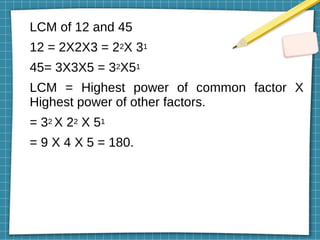
LCM of 12 and 45
12 = 2X2X3 = 22X 31
45= 3X3X5 = 32X51
LCM = Highest power of common factor X
Highest power of other factors.
= 32 X 22 X 51
= 9 X 4 X 5 = 180.
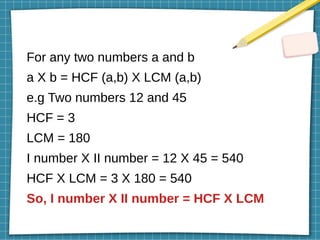
For any two numbers a and b
a X b = HCF (a,b) X LCM (a,b)
e.g Two numbers 12 and 45
HCF = 3
LCM = 180
I number X II number = 12 X 45 = 540
HCF X LCM = 3 X 180 = 540
So, I number X II number = HCF X LCM
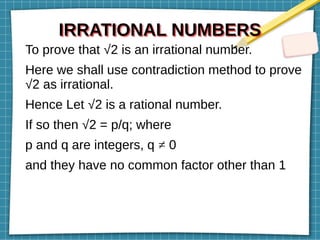
IRRATIONAL NUMBERS
IRRATIONAL NUMBERS
To prove that √2 is an irrational number.
Here we shall use contradiction method to prove
√2 as irrational.
Hence Let √2 is a rational number.
If so then √2 = p/q; where
p and q are integers, q ≠ 0
and they have no common factor other than 1
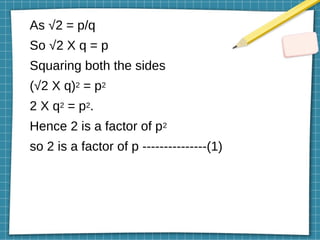
As √2 = p/q
So √2 X q = p
Squaring both the sides
(√2 X q)2 = p2
2 X q2 = p2.
Hence 2 is a factor of p2
so 2 is a factor of p ---------------(1)
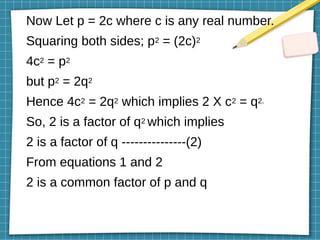
Now Let p = 2c where c is any real number.
Squaring both sides; p2 = (2c)2
4c2 = p2
but p2 = 2q2
Hence 4c2 = 2q2 which implies 2 X c2 = q2.
So, 2 is a factor of q2 which implies
2 is a factor of q ---------------(2)
From equations 1 and 2
2 is a common factor of p and q
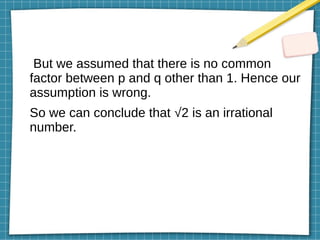
But we assumed that there is no common
factor between p and q other than 1. Hence our
assumption is wrong.
So we can conclude that √2 is an irrational
number.
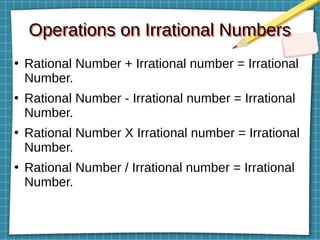
Operations on Irrational Numbers
●
Rational Number + Irrational number = Irrational
Number.
●
Rational Number - Irrational number = Irrational
Number.
●
Rational Number X Irrational number = Irrational
Number.
●
Rational Number / Irrational number = Irrational
Number.
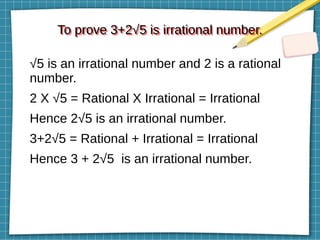
To prove 3+2√5 is irrational number.
√5 is an irrational number and 2 is a rational
number.
2 X √5 = Rational X Irrational = Irrational
Hence 2√5 is an irrational number.
3+2√5 = Rational + Irrational = Irrational
Hence 3 + 2√5 is an irrational number.
Terminating and Non- terminating decimals
Working Rule:
Step 1: Factorize the denominator of the fractions
into its prime factors.
Step 2: Check the factors of the denominators, if
the factors contain 2 or 5 or 2 & 5 only then it is
terminating decimal.
Step 3: If the factors of the denominator contain
any number other than 2 and 5 then it is non-
terminating decimal.
Example
Example
13/3125
Here denominator is 3125
3125 = 5X5X5X5X5
The prime factors contain only 5 so 13/ 3125 is a
terminating decimal.
●
64/455
Here denominator is 455
455 = 5 X 7 X 13
The prime factors contain numbers other than 5 &
2 so 64/455 is a non terminating decimal.
PRACTICE QUESTIONS
PRACTICE QUESTIONS
1. Using Euclid’s Division lemma find the HCF of (I)
510 and 92 (ii) 336 and 54.
2. Find HCF and LCM of 26 and 91 and hence verify
I No. X II No. = HCF X LCM.
3. Given that HCF (306, 657)= 9. Find the HCF.
4. Explain why 7X11X13+13 is a composite number.
5. Identify terminating and non terminating: (I)
15/1600. (ii) 23/40. (iii) 77/210.
Prepared By:
Dr. Vivek Naithani TGT Maths
k.v Jagdalpur
This work is licensed under a Creative Commons
Attribution-ShareAlike 3.0 Unported License.
It makes use of the works of Mateus Machado Luna.
Prepared By:
Dr. Vivek Naithani TGT Maths
k.v Jagdalpur
This work is licensed under a Creative Commons
Attribution-ShareAlike 3.0 Unported License.
It makes use of the works of Mateus Machado Luna.

1. real numbers

  • 1.
    REAL NUMBERS REAL NUMBERS PREPAREDBY: Dr. VIVEK NAITHANI (TGT MATHS) K.V. JAGDALPUR Copyright Information: CC By- SA
  • 2.
    What is aReal Number? What is a Real Number? We have studied about many types of numbers as: ● Natural Numbers ● Whole Numbers ● Rational Numbers ● Irrational Numbers ● Fractions ● Decimal Numbers All these comprised together are called real numbers.
  • 3.
    REAL NUMBERS NATURAL NUMBERS WHOLE NUMBERS RATIONALNUMBERS IRRATIONAL NUMBERS FRACTIONS INTEGERS
  • 4.
    EUCLID’S DIVISION LEMMA EUCLID’SDIVISION LEMMA STATEMENT: For any two given positive integers a and b, there exists unique integers q and r satisfying a = bq +r; 0 ≤ r < b. e.g. let we have two numbers 455 and 42, then 455 = 42 X 10 + 35
  • 5.
    Euclid’s Division Lemmais a technique to compute Highest Common Factor (HCF) of two given numbers. It is based on the fact that Dividend = Divisor X Quotient + Remainder.
  • 6.
    If we compareboth we find a = bq +r; 0 ≤ r < b. Dividend = Divisor X Quotient + Remainder. Here a = Dividend b = divisor q = Quotient r = remainder Hence when r becomes 0 then last divisor is the HCF of a and b.
  • 7.
    EXAMPLE EXAMPLE To find HCFof 135 and 225 greater number is 225 so dividing it by 135 the smaller number 225 = 135 X 1 + 90 Now 135 is to be divided by 90 135 = 90 X 1 + 45 again 90 is to be divided by 45 90 = 45 X 2 + 0 Last divisor = 45 So HCF = 45
  • 8.
    Comparison between Euclid’s divisionlemma and long division method Comparison between Euclid’s division lemma and long division method To understand the similarity between Euclid’s Division Lemma and Long Division Method for finding HCF let us take an example. ● To find the HCF of 12576 and 4052
  • 9.
    12576 = 4052X3 + 420 4052 = 420 X9 + 272 420 =272 X 1+ 148 272 = 148 X 1+ 124 148 = 124X 1+ 24 124 = 24X5 + 4 24 = 4X 6 + 0 Dividend = Divisor X quotient + Remainder HCF = 4 Both cases are exactly same with just a difference in method of expression.
  • 10.
    Similar Example Similar Example FindHCF of 196 and 38220 39220 = 196 X 195 + 0 Last divisor = 196 So, H.C.F = 196 ● Find HCF of 867 and 255 867 = 255 X 3 + 102 255 = 102 X 2 + 51 102 = 51 X 2 + 0 Last Divisor = H.C.F = 51
  • 11.
    Show that anypositive integer is of the form 2q+1, 2q+3 or 2q+5, where q is an integer Show that any positive integer is of the form 2q+1, 2q+3 or 2q+5, where q is an integer Rule 1: For any integer, 2X Integer = Even integer. Rule 2: Even integer + 1 = Odd Integer. Case I: Let q is an integer 2q+1= 2X some integer + 1 = Even Integer + 1= Odd Integer Hence any positive odd integer can be expressed as 2q+1
  • 12.
    Case II: Form2q+3 2q+3 = 2q +2+1 = 2X Some Integer +1 = Even Integer +1 = Odd Integer. Hence any positive odd integer can be expressed as 2q+3 Case III: Form 2q+5 2q+5 = 2q+ 4+1= 2(q+2)+1=2X Some Integer +1 = Even Integer +1 = Odd Integer Hence any positive odd integer can be expressed as 2q+5
  • 13.
    Use Euclid’s DivisionLemma to prove that square of any positive integer is of the form 3m or 3m+1 Use Euclid’s Division Lemma to prove that square of any positive integer is of the form 3m or 3m+1 Let m is any positive integer ● Case I: 3m (3m)2 = 9m2. Here for any integer m; m2 is always a positive integer. Hence (3m)2 = 9m2 = 3X3m2= 3X Some integer= 3m ● Case II: 3m+1 (3m+1)2 = (3m)2+ 2X3mX1 + 1= 9m2+6m+1 = 3X (3m2+2m)+1 = 3X integer +1 =3m+1
  • 14.
    The Fundamental Theoremof Arithmetic The Fundamental Theorem of Arithmetic Every Composite number can be expressed as product of prime numbers. The prime factorization of natural numbers is unique except for the order. e.g. 12 = 2X2X 3 27 = 3X3X3 45 = 3X3X5 etc. Here these numbers can be expressed in these prime factors only and we can just change the order.
  • 15.
    H.C.F. and L.C.Mof two numbers H.C.F. and L.C.M of two numbers HCF and LCM of two numbers can be calculated using fundamental theorem of arithmetic. H.C.F. of two numbers = Product of smallest power of each common prime factor in the numbers. e.g. HCF of 12 and 45 12 = 2X2X3 = 22X 31 45= 3X3X5 = 32X51 Common factor =3 and lowest power is 1 So HCF = 31 =3
  • 16.
    LCM of 12and 45 12 = 2X2X3 = 22X 31 45= 3X3X5 = 32X51 LCM = Highest power of common factor X Highest power of other factors. = 32 X 22 X 51 = 9 X 4 X 5 = 180.
  • 17.
    For any twonumbers a and b a X b = HCF (a,b) X LCM (a,b) e.g Two numbers 12 and 45 HCF = 3 LCM = 180 I number X II number = 12 X 45 = 540 HCF X LCM = 3 X 180 = 540 So, I number X II number = HCF X LCM
  • 18.
    IRRATIONAL NUMBERS IRRATIONAL NUMBERS Toprove that √2 is an irrational number. Here we shall use contradiction method to prove √2 as irrational. Hence Let √2 is a rational number. If so then √2 = p/q; where p and q are integers, q ≠ 0 and they have no common factor other than 1
  • 19.
    As √2 =p/q So √2 X q = p Squaring both the sides (√2 X q)2 = p2 2 X q2 = p2. Hence 2 is a factor of p2 so 2 is a factor of p ---------------(1)
  • 20.
    Now Let p= 2c where c is any real number. Squaring both sides; p2 = (2c)2 4c2 = p2 but p2 = 2q2 Hence 4c2 = 2q2 which implies 2 X c2 = q2. So, 2 is a factor of q2 which implies 2 is a factor of q ---------------(2) From equations 1 and 2 2 is a common factor of p and q
  • 21.
    But we assumedthat there is no common factor between p and q other than 1. Hence our assumption is wrong. So we can conclude that √2 is an irrational number.
  • 22.
    Operations on IrrationalNumbers Operations on Irrational Numbers ● Rational Number + Irrational number = Irrational Number. ● Rational Number - Irrational number = Irrational Number. ● Rational Number X Irrational number = Irrational Number. ● Rational Number / Irrational number = Irrational Number.
  • 23.
    To prove 3+2√5is irrational number. To prove 3+2√5 is irrational number. √5 is an irrational number and 2 is a rational number. 2 X √5 = Rational X Irrational = Irrational Hence 2√5 is an irrational number. 3+2√5 = Rational + Irrational = Irrational Hence 3 + 2√5 is an irrational number.
  • 24.
    Terminating and Non-terminating decimals Terminating and Non- terminating decimals Working Rule: Step 1: Factorize the denominator of the fractions into its prime factors. Step 2: Check the factors of the denominators, if the factors contain 2 or 5 or 2 & 5 only then it is terminating decimal. Step 3: If the factors of the denominator contain any number other than 2 and 5 then it is non- terminating decimal.
  • 25.
    Example Example 13/3125 Here denominator is3125 3125 = 5X5X5X5X5 The prime factors contain only 5 so 13/ 3125 is a terminating decimal. ● 64/455 Here denominator is 455 455 = 5 X 7 X 13 The prime factors contain numbers other than 5 & 2 so 64/455 is a non terminating decimal.
  • 26.
    PRACTICE QUESTIONS PRACTICE QUESTIONS 1.Using Euclid’s Division lemma find the HCF of (I) 510 and 92 (ii) 336 and 54. 2. Find HCF and LCM of 26 and 91 and hence verify I No. X II No. = HCF X LCM. 3. Given that HCF (306, 657)= 9. Find the HCF. 4. Explain why 7X11X13+13 is a composite number. 5. Identify terminating and non terminating: (I) 15/1600. (ii) 23/40. (iii) 77/210.
  • 27.
    Prepared By: Dr. VivekNaithani TGT Maths k.v Jagdalpur This work is licensed under a Creative Commons Attribution-ShareAlike 3.0 Unported License. It makes use of the works of Mateus Machado Luna. Prepared By: Dr. Vivek Naithani TGT Maths k.v Jagdalpur This work is licensed under a Creative Commons Attribution-ShareAlike 3.0 Unported License. It makes use of the works of Mateus Machado Luna.