General Routing Overview
and Channel Routing
Shantanu Dutt
ECE Dept.
UIC
References and Copyright
(cont.)
• Slides used: (Modified by Shantanu Dutt when necessary)
– [©Sarrafzadeh] © Majid Sarrafzadeh, 2001;
Department of Computer Science, UCLA
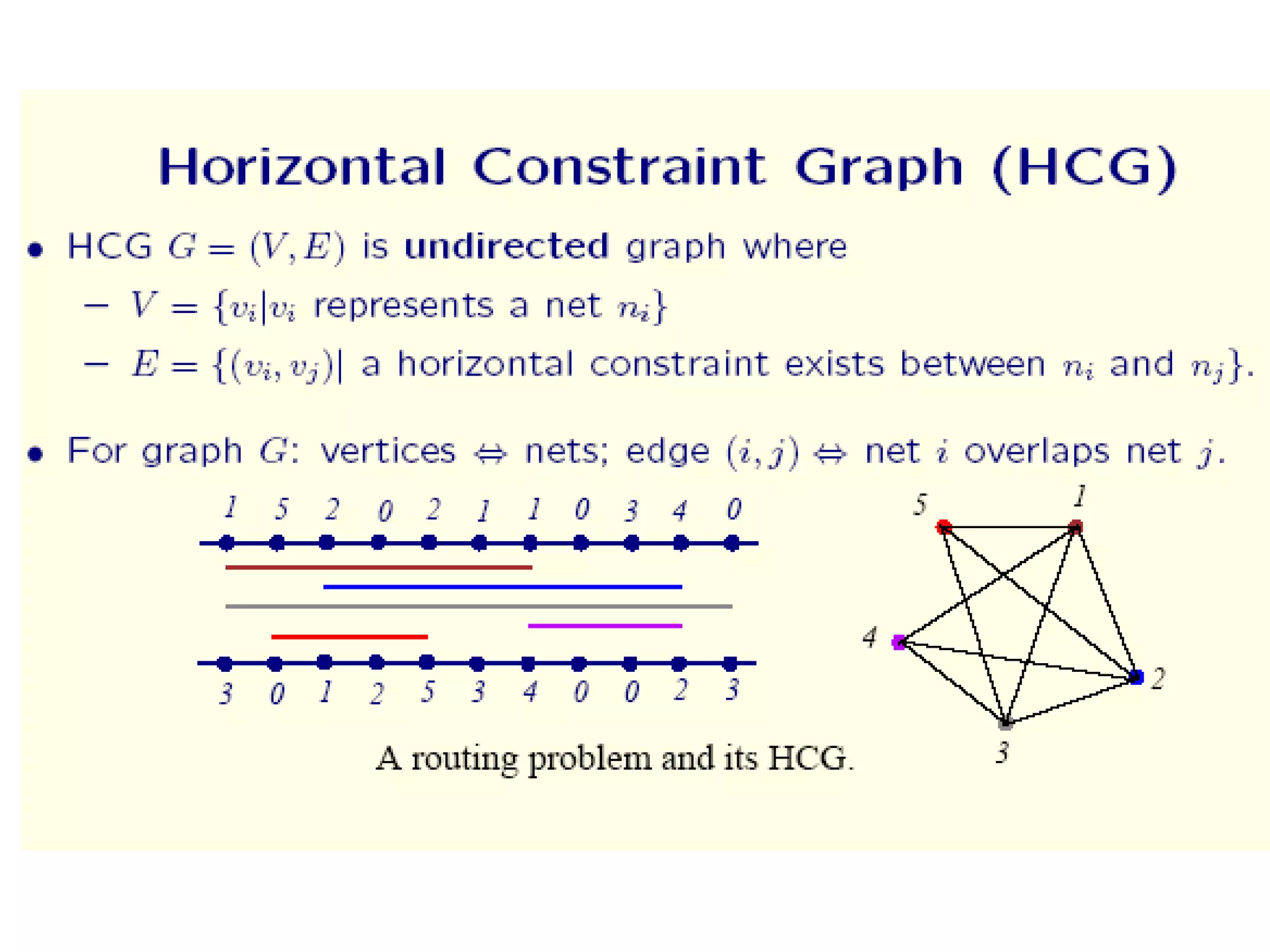
– [©Sherwani] © Naveed A. Sherwani, 1992
(companion slides to [She99])
– [©Keutzer] © Kurt Keutzer, Dept. of EECS,
UC-Berekeley
http://www-cad.eecs.berkeley.edu/~niraj/ee244/index.htm
– [©Gupta] © Rajesh Gupta
UC-Irvine
http://www.ics.uci.edu/~rgupta/ics280.html
– [©Kang] © Steve Kang, UIUC http://www.ece.uiuc.edu/ece482/
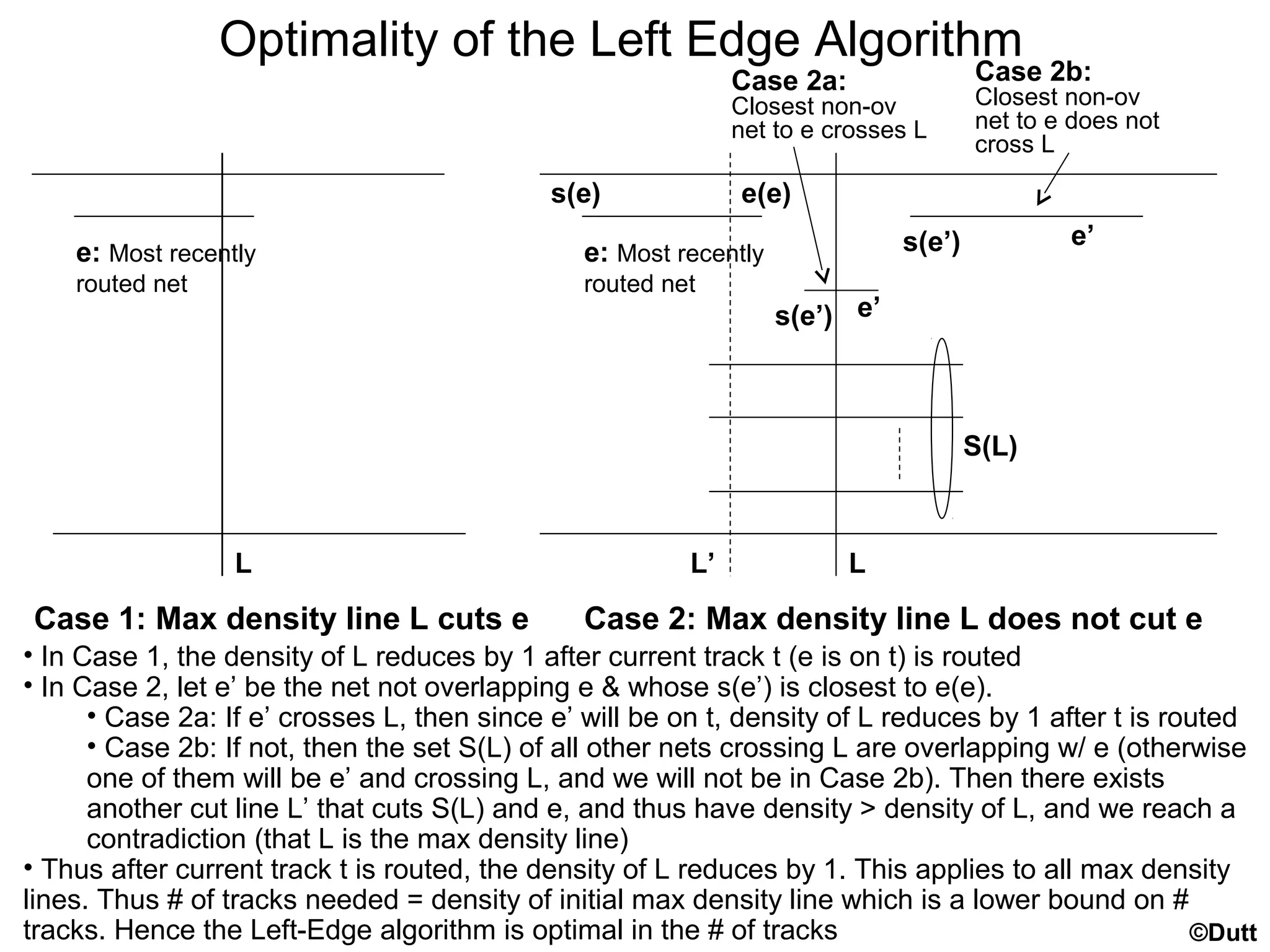
– [©Bazargan] © Kia Bazargan
Routing
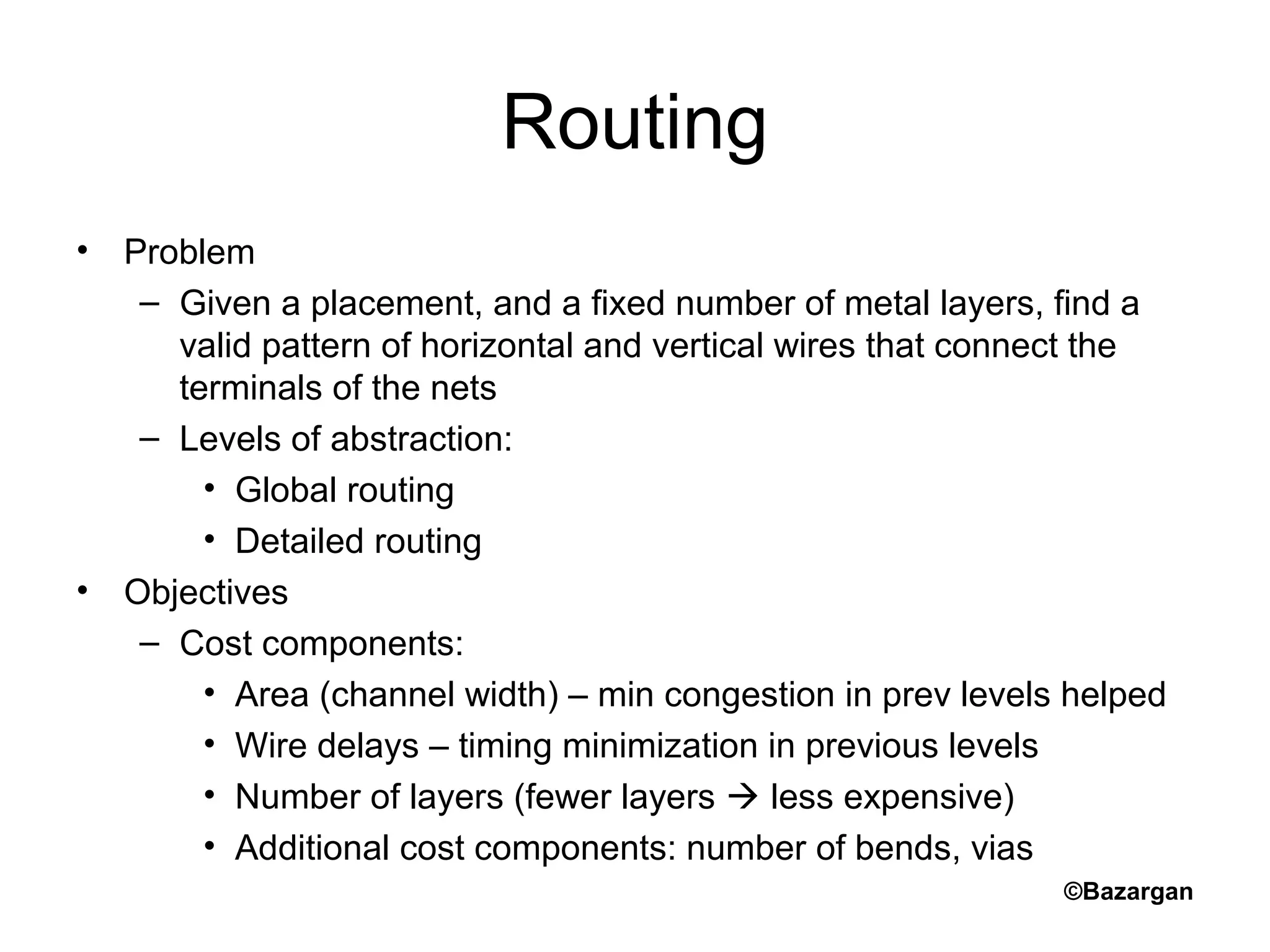
• Problem
– Given a placement, and a fixed number of metal layers, find a
valid pattern of horizontal and vertical wires that connect the
terminals of the nets
– Levels of abstraction:
• Global routing
• Detailed routing
• Objectives
– Cost components:
• Area (channel width) – min congestion in prev levels helped
• Wire delays – timing minimization in previous levels
• Number of layers (fewer layers  less expensive)
• Additional cost components: number of bends, vias
©Bazargan
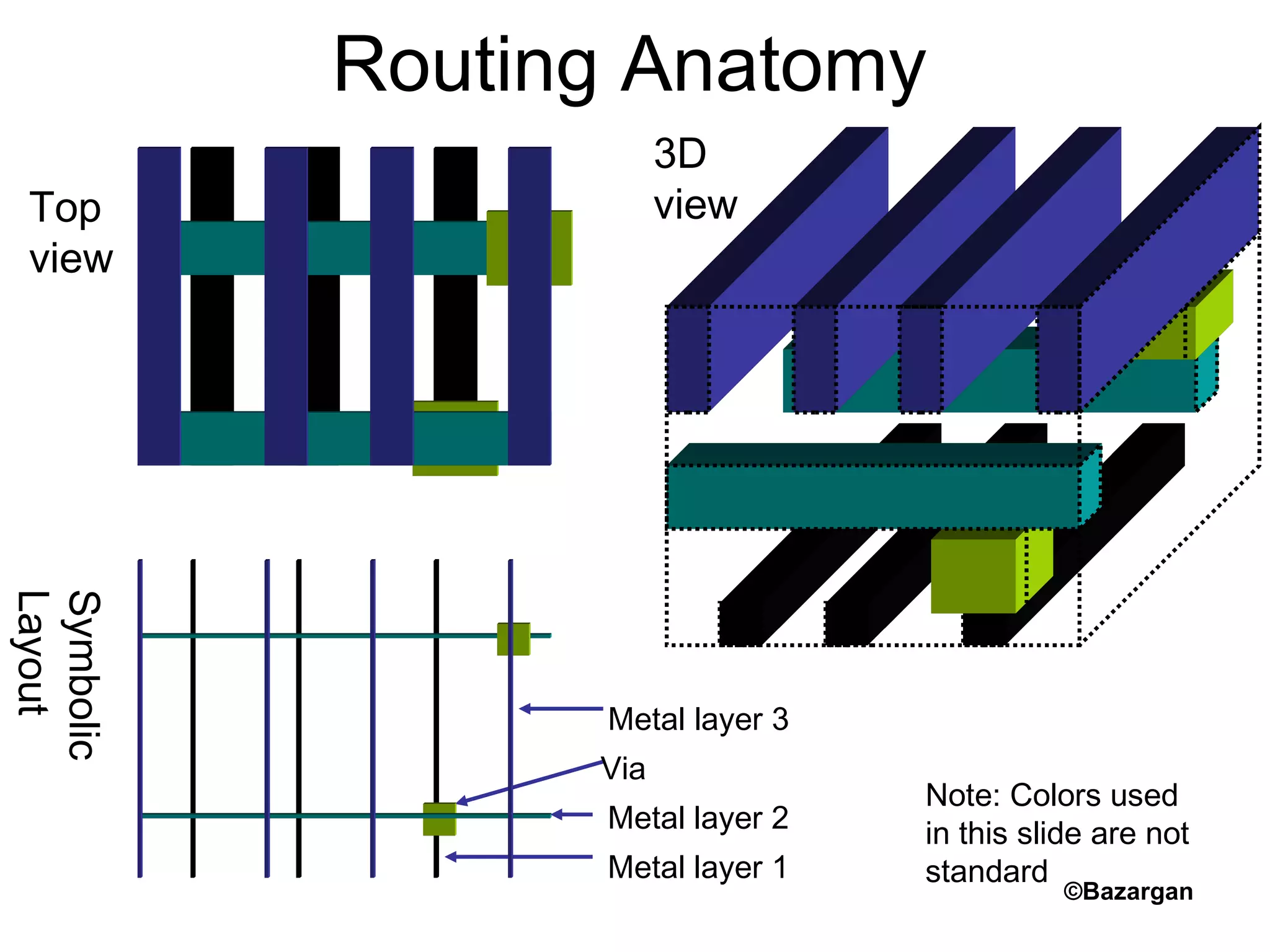
Metal layer 1
Via
Routing Anatomy
Top
view
3D
view
Metal layer 2
Metal layer 3
Symbolic
Layout
Note: Colors used
in this slide are not
standard
©Bazargan
Global vs. Detailed Routing
• Global routing
– Input: detailed placement, with exact terminal
locations
– Determine “channel” (routing region) for each
net
– Objective: minimize area (congestion), and
timing (approximate)
• Detailed routing
– Input: channels and approximate routing from
the global routing phase
– Determine the exact route and layers for each
net
– Objective: valid routing, minimize area
(congestion), meet timing constraints
– Additional objectives: min via, power
Figs. [©Sherwani]
Taxonomy of VLSI Routers
[©Keutzer]
Graph Search
Steiner
Iterative
Hierarchical Greedy Left-Edge
River
Switchbox
Channel
Maze
Line Probe
Line Expansion
Restricted
General
Purpose
Clock
Specialized
Power/Gnd
Routers
DetailedGlobal
Maze
Global Routing
• Stages
– Routing region definition
– Routing region ordering
– Steiner-tree / area routing
• Grid
– Tiles super-imposed on placement
– Regular or irregular
– Smaller problem to solve,
higher level of abstraction
– Terminals at center of grid tiles
• Edge capacity
– Number of nets that can pass a certain
grid edge (aka congestion)
– On edge Eij,
Capacity(Eij) ≥ Congestion(Eij)
• Steiner routing is generally performed on the
routing graph using edge lengths as cost and
considering edge capacities
M1
M2
M3
[©Sarrafzadeh]
Grid Graph
• Course or fine-grain
• Vertices: routing regions, edges: route exists?
• Weights on edges
– How costly is to use that edge
– Could vary during the routing (e.g., for congestion)
– Horizontal / vertical might have different weights
[©Sherwani]
t1 t2 t3
t4
t1 t2 t3
t4
1 1 1
1 1 1
2 2 1 1
t1 t3
t4
t2
Global Routing – Graph Search
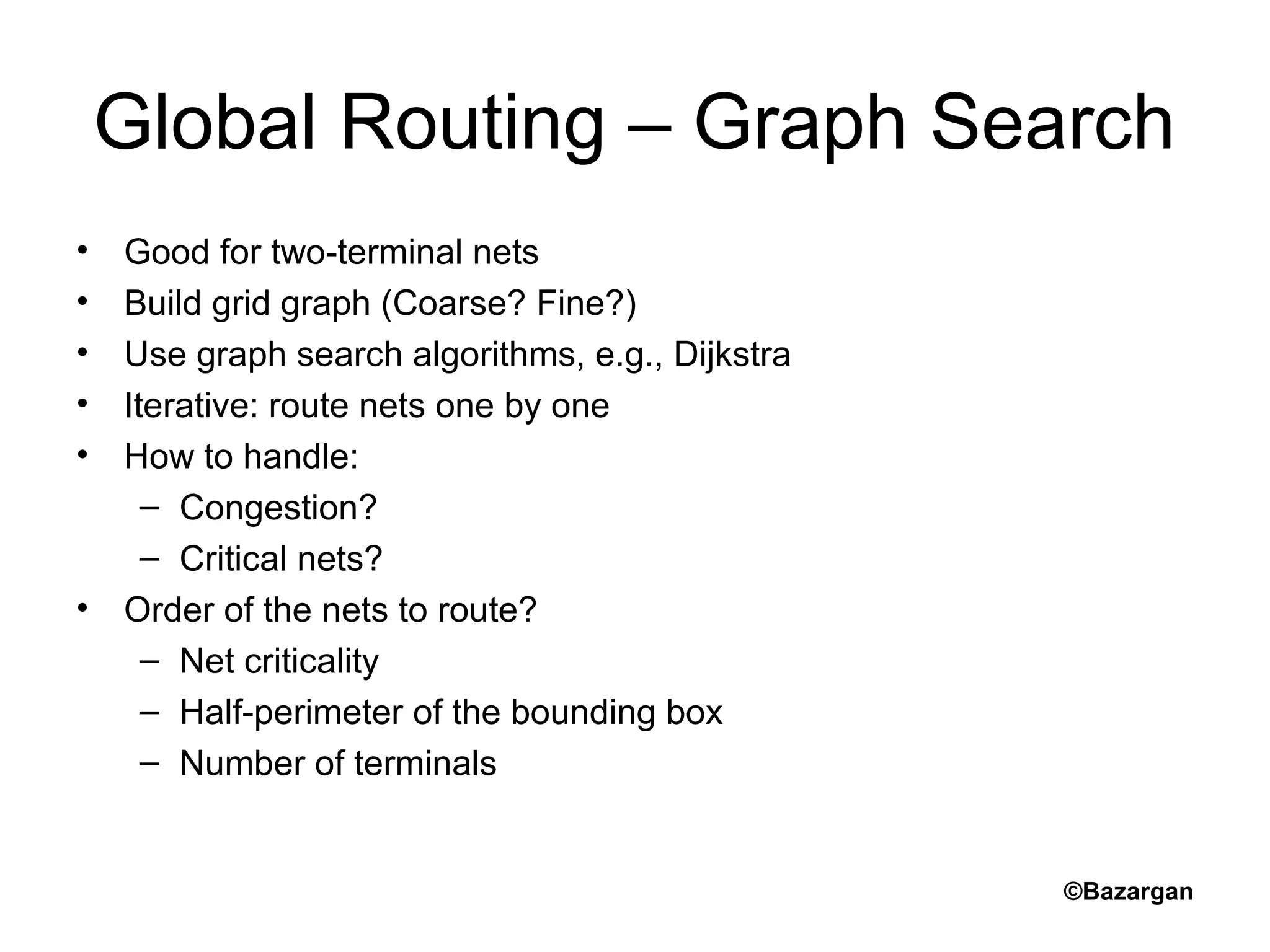
• Good for two-terminal nets
• Build grid graph (Coarse? Fine?)
• Use graph search algorithms, e.g., Dijkstra
• Iterative: route nets one by one
• How to handle:
– Congestion?
– Critical nets?
• Order of the nets to route?
– Net criticality
– Half-perimeter of the bounding box
– Number of terminals
©Bazargan
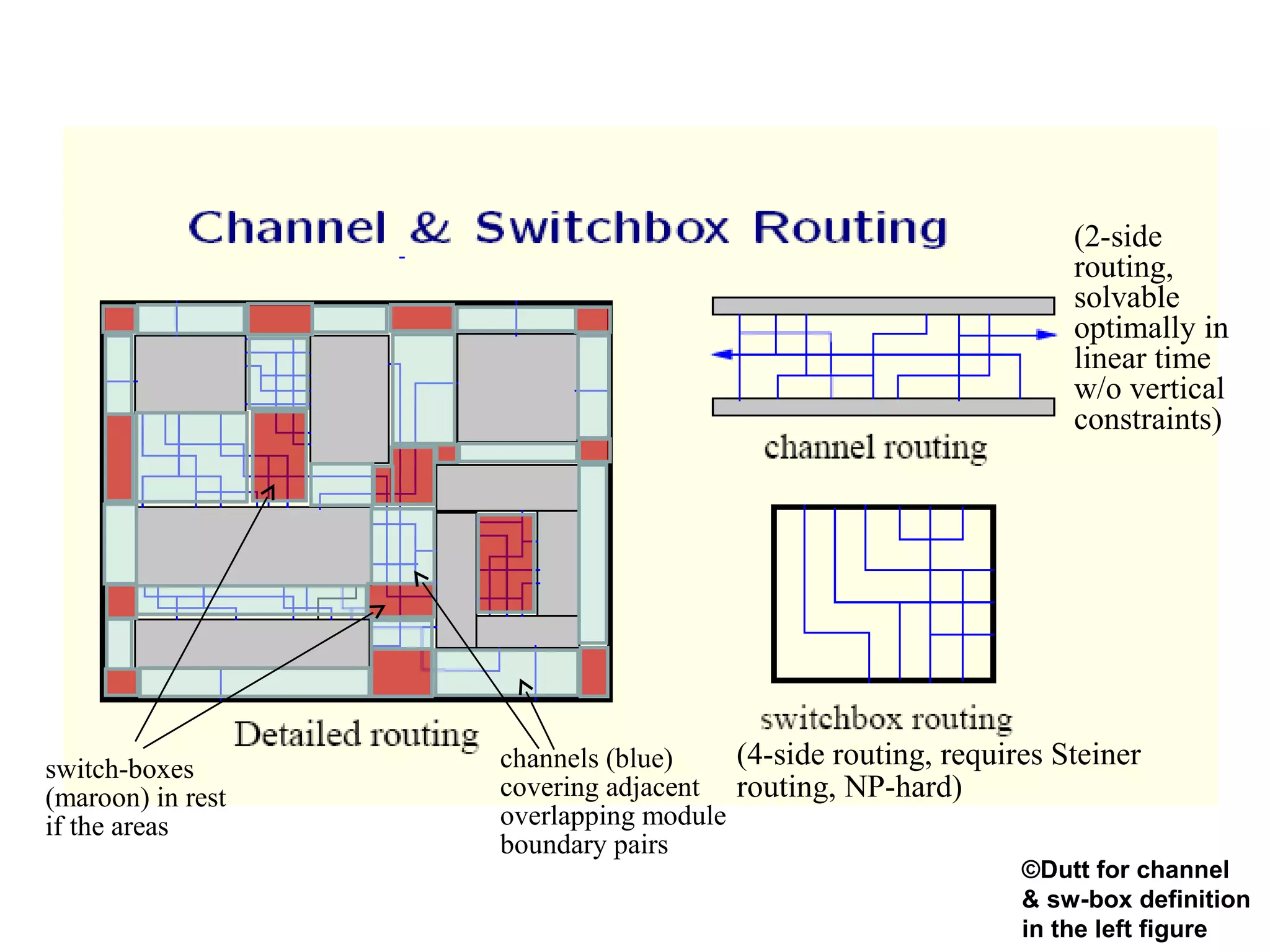
(4-side routing, requires Steiner
routing, NP-hard)
(2-side
routing,
solvable
optimally in
linear time
w/o vertical
constraints)
channels (blue)
covering adjacent
overlapping module
boundary pairs
switch-boxes
(maroon) in rest
if the areas
©Dutt for channel
& sw-box definition
in the left figure
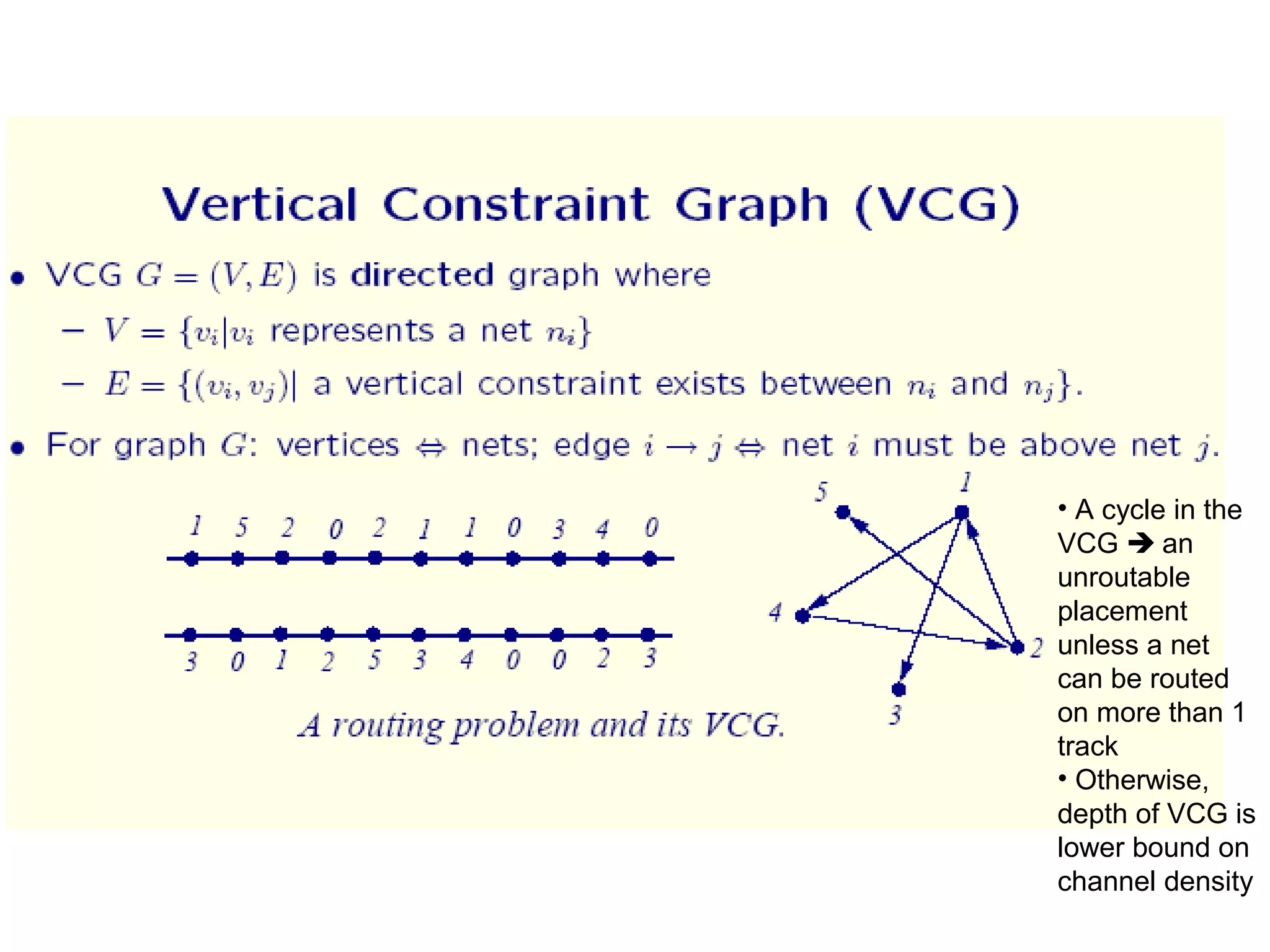
• A cycle in the
VCG  an
unroutable
placement
unless a net
can be routed
on more than 1
track
• Otherwise,
depth of VCG is
lower bound on
channel density
Case 2a:
Closest non-ov
net to e crosses L
Case 2b:
Closest non-ov
net to e does not
cross L
L
e: Most recently
routed net
L’
e: Most recently
routed net
L
Optimality of the Left Edge Algorithm
Case 1: Max density line L cuts e Case 2: Max density line L does not cut e
• In Case 1, the density of L reduces by 1 after current track t (e is on t) is routed
• In Case 2, let e’ be the net not overlapping e & whose s(e’) is closest to e(e).
• Case 2a: If e’ crosses L, then since e’ will be on t, density of L reduces by 1 after t is routed
• Case 2b: If not, then the set S(L) of all other nets crossing L are overlapping w/ e (otherwise
one of them will be e’ and crossing L, and we will not be in Case 2b). Then there exists
another cut line L’ that cuts S(L) and e, and thus have density > density of L, and we reach a
contradiction (that L is the max density line)
• Thus after current track t is routed, the density of L reduces by 1. This applies to all max density
lines. Thus # of tracks needed = density of initial max density line which is a lower bound on #
tracks. Hence the Left-Edge algorithm is optimal in the # of tracks
e’
e’
s(e) e(e)
s(e’)
s(e’)
S(L)
©Dutt
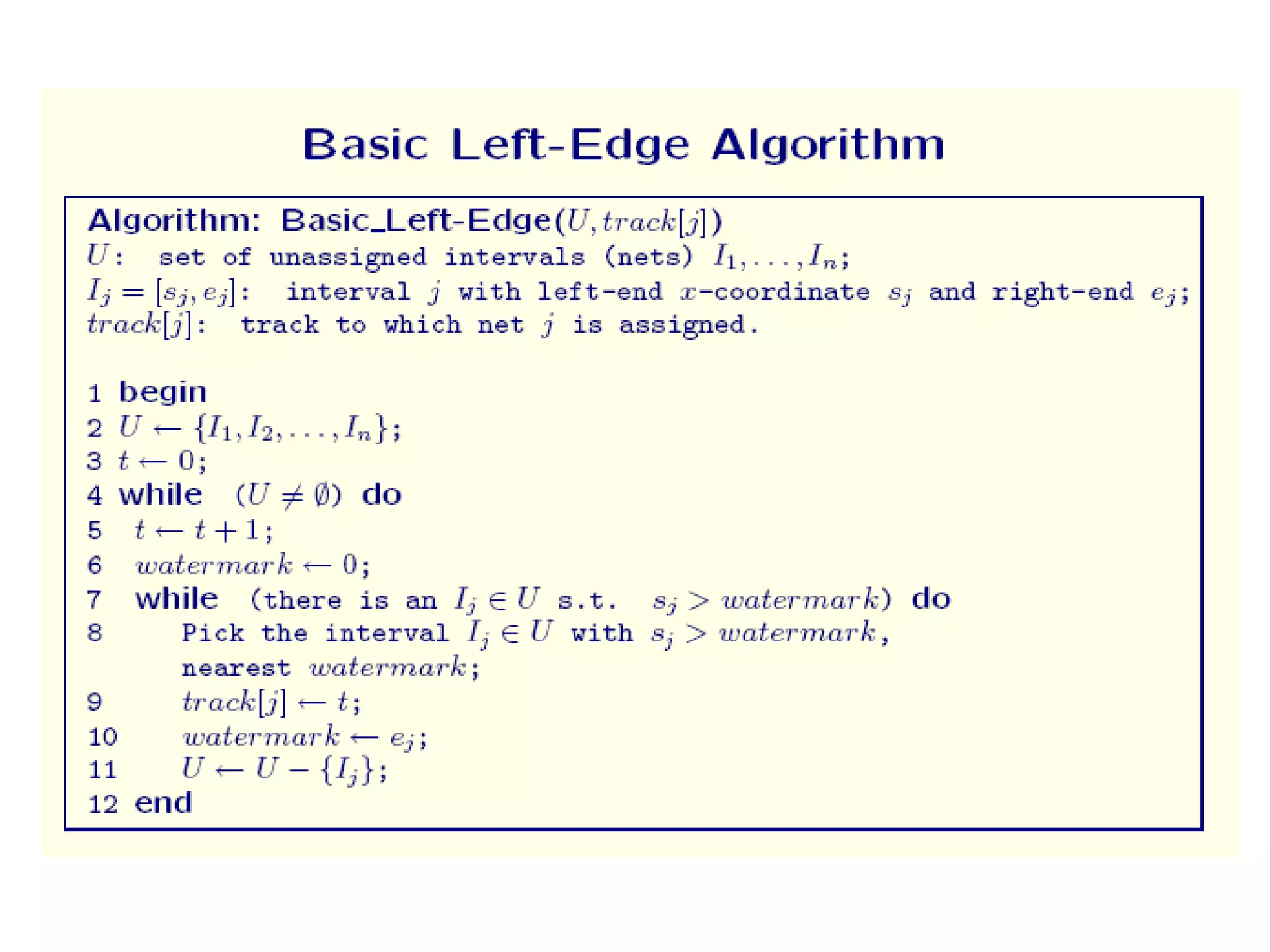
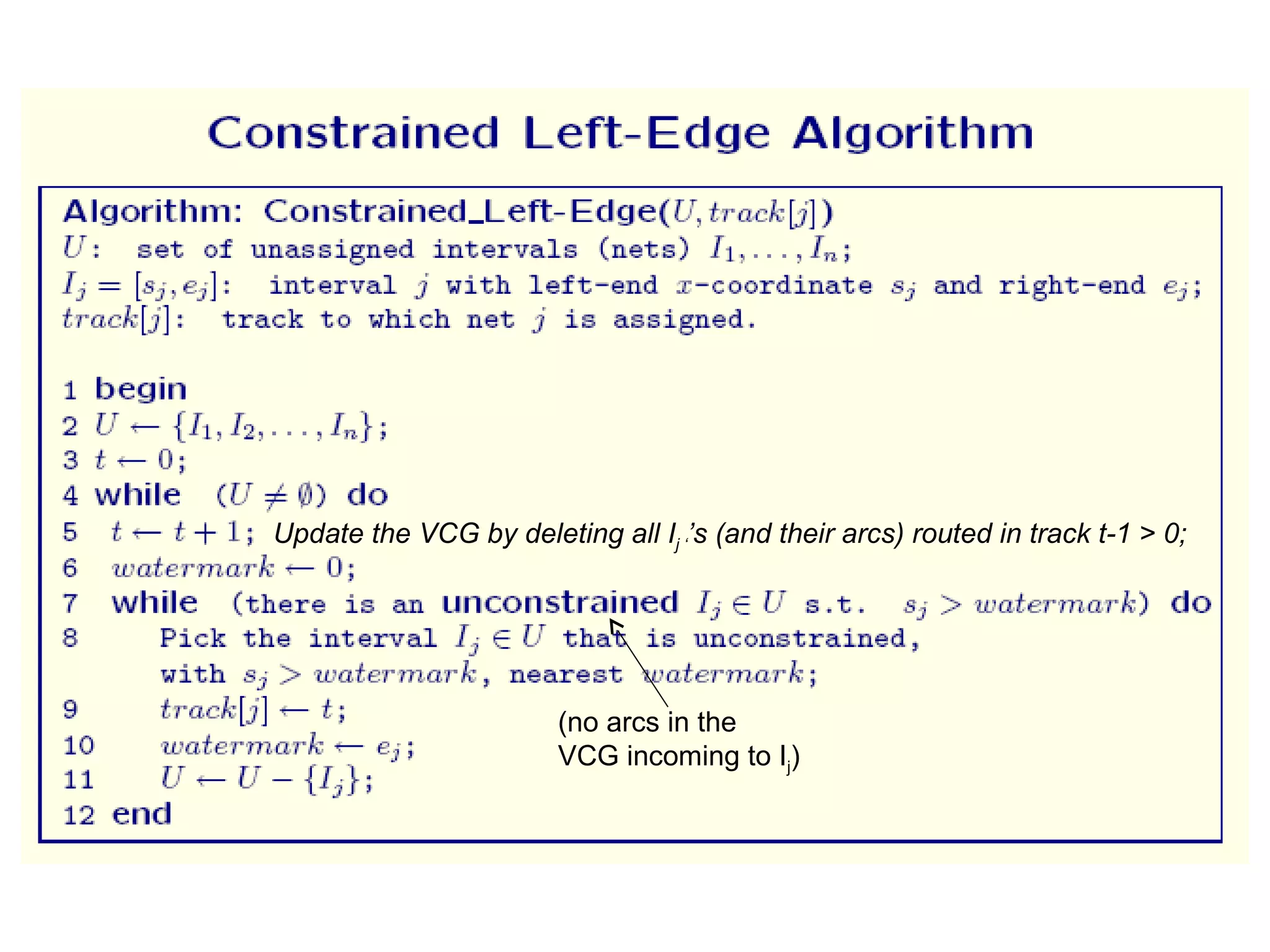
Update the VCG by deleting all Ij ‘’s (and their arcs) routed in track t-1 > 0;
(no arcs in the
VCG incoming to Ij)
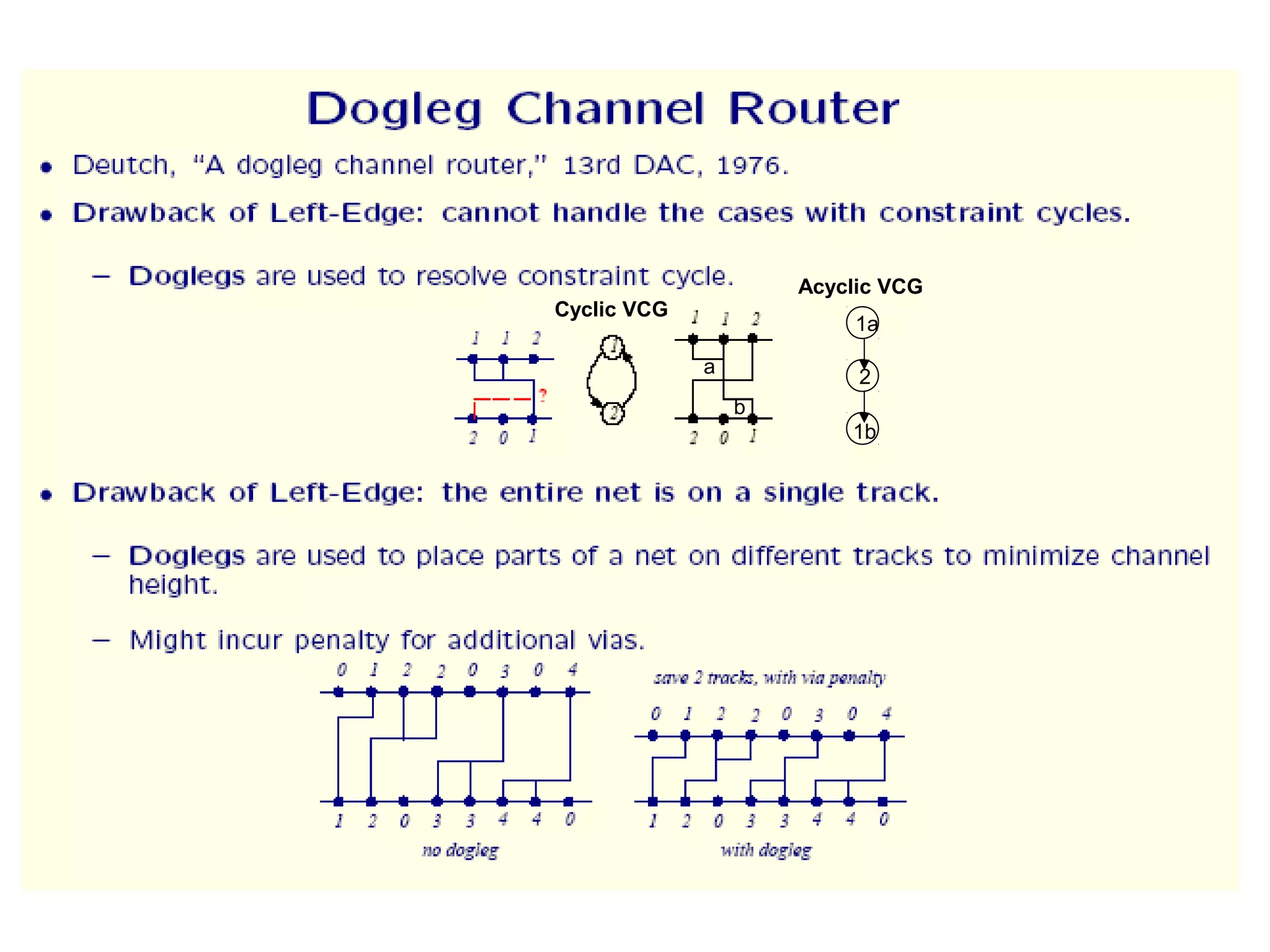
1a
2
1b
b
a
Acyclic VCG
Cyclic VCG
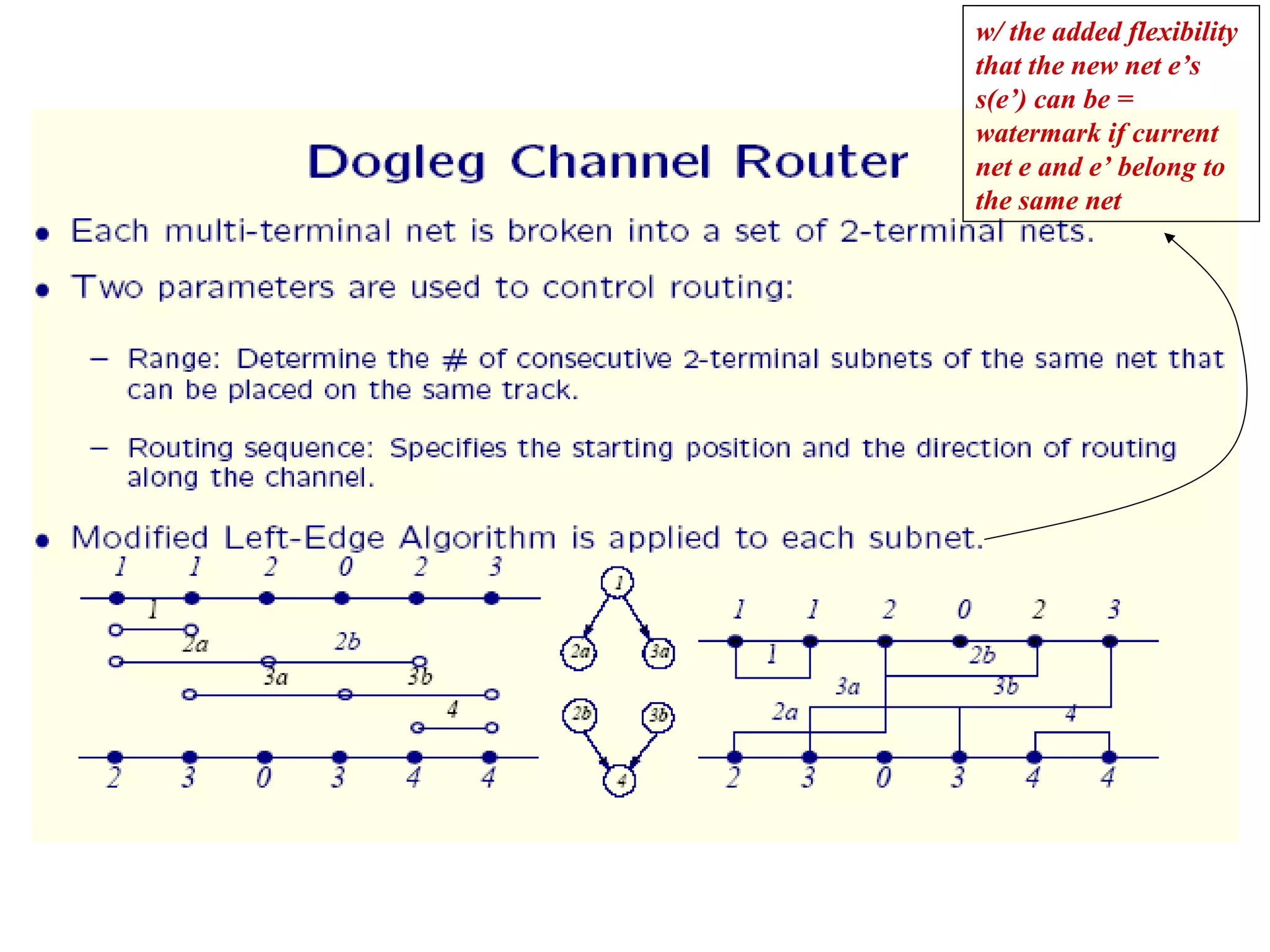
w/ the added flexibility
that the new net e’s
s(e’) can be =
watermark if current
net e and e’ belong to
the same net
Channel routing
Channel routing
Channel routing

Channel routing

  • 1.
    General Routing Overview andChannel Routing Shantanu Dutt ECE Dept. UIC
  • 2.
    References and Copyright (cont.) •Slides used: (Modified by Shantanu Dutt when necessary) – [©Sarrafzadeh] © Majid Sarrafzadeh, 2001; Department of Computer Science, UCLA – [©Sherwani] © Naveed A. Sherwani, 1992 (companion slides to [She99]) – [©Keutzer] © Kurt Keutzer, Dept. of EECS, UC-Berekeley http://www-cad.eecs.berkeley.edu/~niraj/ee244/index.htm – [©Gupta] © Rajesh Gupta UC-Irvine http://www.ics.uci.edu/~rgupta/ics280.html – [©Kang] © Steve Kang, UIUC http://www.ece.uiuc.edu/ece482/ – [©Bazargan] © Kia Bazargan
  • 3.
    Routing • Problem – Givena placement, and a fixed number of metal layers, find a valid pattern of horizontal and vertical wires that connect the terminals of the nets – Levels of abstraction: • Global routing • Detailed routing • Objectives – Cost components: • Area (channel width) – min congestion in prev levels helped • Wire delays – timing minimization in previous levels • Number of layers (fewer layers  less expensive) • Additional cost components: number of bends, vias ©Bazargan
  • 4.
    Metal layer 1 Via RoutingAnatomy Top view 3D view Metal layer 2 Metal layer 3 Symbolic Layout Note: Colors used in this slide are not standard ©Bazargan
  • 5.
    Global vs. DetailedRouting • Global routing – Input: detailed placement, with exact terminal locations – Determine “channel” (routing region) for each net – Objective: minimize area (congestion), and timing (approximate) • Detailed routing – Input: channels and approximate routing from the global routing phase – Determine the exact route and layers for each net – Objective: valid routing, minimize area (congestion), meet timing constraints – Additional objectives: min via, power Figs. [©Sherwani]
  • 6.
    Taxonomy of VLSIRouters [©Keutzer] Graph Search Steiner Iterative Hierarchical Greedy Left-Edge River Switchbox Channel Maze Line Probe Line Expansion Restricted General Purpose Clock Specialized Power/Gnd Routers DetailedGlobal Maze
  • 7.
    Global Routing • Stages –Routing region definition – Routing region ordering – Steiner-tree / area routing • Grid – Tiles super-imposed on placement – Regular or irregular – Smaller problem to solve, higher level of abstraction – Terminals at center of grid tiles • Edge capacity – Number of nets that can pass a certain grid edge (aka congestion) – On edge Eij, Capacity(Eij) ≥ Congestion(Eij) • Steiner routing is generally performed on the routing graph using edge lengths as cost and considering edge capacities M1 M2 M3 [©Sarrafzadeh]
  • 8.
    Grid Graph • Courseor fine-grain • Vertices: routing regions, edges: route exists? • Weights on edges – How costly is to use that edge – Could vary during the routing (e.g., for congestion) – Horizontal / vertical might have different weights [©Sherwani] t1 t2 t3 t4 t1 t2 t3 t4 1 1 1 1 1 1 2 2 1 1 t1 t3 t4 t2
  • 9.
    Global Routing –Graph Search • Good for two-terminal nets • Build grid graph (Coarse? Fine?) • Use graph search algorithms, e.g., Dijkstra • Iterative: route nets one by one • How to handle: – Congestion? – Critical nets? • Order of the nets to route? – Net criticality – Half-perimeter of the bounding box – Number of terminals ©Bazargan
  • 10.
    (4-side routing, requiresSteiner routing, NP-hard) (2-side routing, solvable optimally in linear time w/o vertical constraints) channels (blue) covering adjacent overlapping module boundary pairs switch-boxes (maroon) in rest if the areas ©Dutt for channel & sw-box definition in the left figure
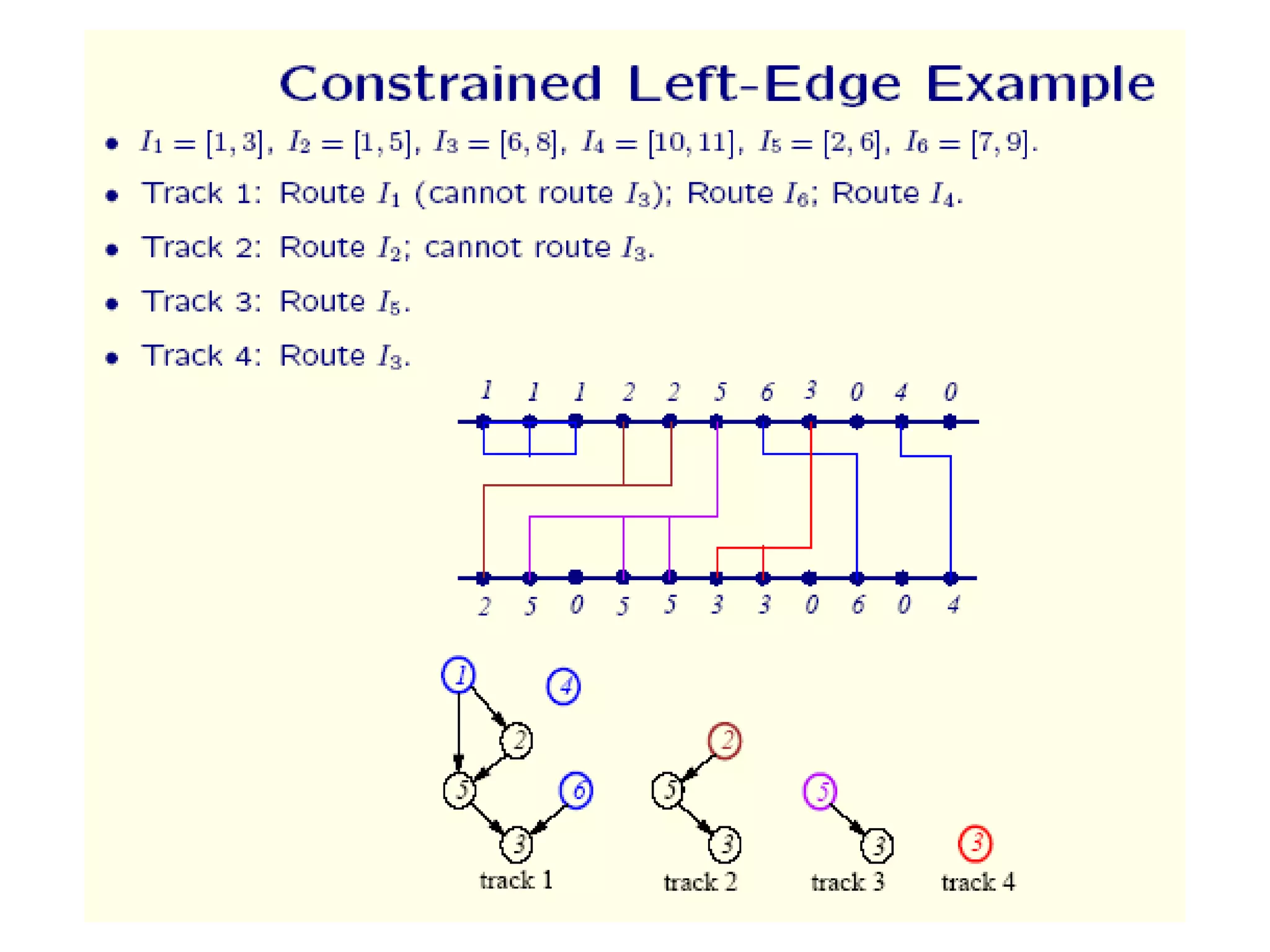
  • 15.
    • A cyclein the VCG  an unroutable placement unless a net can be routed on more than 1 track • Otherwise, depth of VCG is lower bound on channel density
  • 19.
    Case 2a: Closest non-ov netto e crosses L Case 2b: Closest non-ov net to e does not cross L L e: Most recently routed net L’ e: Most recently routed net L Optimality of the Left Edge Algorithm Case 1: Max density line L cuts e Case 2: Max density line L does not cut e • In Case 1, the density of L reduces by 1 after current track t (e is on t) is routed • In Case 2, let e’ be the net not overlapping e & whose s(e’) is closest to e(e). • Case 2a: If e’ crosses L, then since e’ will be on t, density of L reduces by 1 after t is routed • Case 2b: If not, then the set S(L) of all other nets crossing L are overlapping w/ e (otherwise one of them will be e’ and crossing L, and we will not be in Case 2b). Then there exists another cut line L’ that cuts S(L) and e, and thus have density > density of L, and we reach a contradiction (that L is the max density line) • Thus after current track t is routed, the density of L reduces by 1. This applies to all max density lines. Thus # of tracks needed = density of initial max density line which is a lower bound on # tracks. Hence the Left-Edge algorithm is optimal in the # of tracks e’ e’ s(e) e(e) s(e’) s(e’) S(L) ©Dutt
  • 20.
    Update the VCGby deleting all Ij ‘’s (and their arcs) routed in track t-1 > 0; (no arcs in the VCG incoming to Ij)
  • 22.
  • 23.
    w/ the addedflexibility that the new net e’s s(e’) can be = watermark if current net e and e’ belong to the same net

Editor's Notes

  • #5 Top layers have more spacing between wires Top layers higher aspect ratio (like walls)
  • #9 The weight on the edges in the middle graph indicate edge cost, not capacity. The right graph is called “channel intersection” graph. It is more popular than the other two.