Download to read offline
![IJRET: International Journal of Research in Engineering and Technology eISSN: 2319-1163 | pISSN: 2321-7308
_______________________________________________________________________________________
Volume: 03 Issue: 07 | Jul-2014, Available @ http://www.ijret.org 420
A NEW DYNAMIC SINGLE-ROW ROUTING FOR CHANNEL
ASSIGNMENTS
N Patra1, B N B Ray2, S P Mohanty3
1Research Scholar, PG Dept of Comp.Sc. & Application,Utkal University, Odisha,India
2Sr. Lecture, PG Dept of Comp.Sc. & Application,Utkal University, Odisha,India
3Professors, Dept. of Mathematics,College of Engg. & Technology,Odisha,India
Abstract
One of the graph theoretic approaches of channel assignment for cellular networks is routing a pair of nodes arranged in a
single-row axis called single-row routing problem. The network with nodes representing caller and receiver is to be transformed
into a single-row network efficiently is proposed. The connected graph derived from the base network is presented using incidence
matrix. The rows and columns of the matrix represent the ordered list of zones and ordered list of nets respectively for the Single-row
network. By successive row-interchange of the matrix, maximum number of nodes adjacent to each other can be placed with
minimum distance. The proposed method with the support of ESSR bySalleh in [2], only increases the speed of convergence to the
optimal ordering of nets but also find the minimum value of energy function, street congestion and the number of doglegs. The
comparative analysis between the traditional method and the proposed method is also discussed.
Keywords: Single-row routing; ESSR; street congestion; doglegs; incidence matrix.
-------------------------------------------------------------------***--------------------------------------------------------------------
1. INTRODUCTION
In recent years, there has been a tremendous growth in the
demand for wireless cellular networks. The cellular
principle partitions a geographical area into cells where each
cell has a base station and a number of mobile terminals
(e.g. mobile phones). A group of base stations are connected
to the Mobile Switching Center (MSC). The MSC monitors
all the mobile users inside or outside the cells of its own
network via the base stations. Users communicate each other
by obtaining conflict-free channels from MSC. The cells
denoted as ci for i = 1, 2...n, in a network are generally
regular hexagon in shape as proposed by R.Mathar in [10]
and by V. H. MacDonald in [11].
Most of the engineering and science problems are presented
based on graph.To solve channel assignment problem for
cellular networks, the graph which represents the problem is
transformed into single-row network (S). Due to the frequent
change in the shape of the graph, channel assignment is
performed in the network using a routing method known as
dynamic single-row routing.
In this model, a set of m evenly-spaced pins (terminals or
vias), pi for 1, 2...m, arranged horizontally from left to right
in a single horizontal row called single-row axis. Each path
joining the pair of pins is called a net. The problem is to
construct m/2 nets L= {Nk}, for k = 1,2,…m/2 , formed from
the horizontal intervals (bk,ek) on the node axis, where pins
bk and ek are the extremities of the intervals. Each of the net
is formed from a pair of pins through non-intersecting
vertical and horizontal line segments drawn only in the
direction from left to right. Physically, each net in the
single-row provides a conductor path for its pins to
communicate. The area above and below the node axis are
called the upper street and lower street respectively. Thus,
Q= max (Qu, Ql) (1)
where, Q, Qu, and Ql are overall, upper and lower street
congestions respectively. The net crossing on the node axis,
called a dogleg or inter-street crossing. The objective of
single-row routing is to minimize both street congestion (Q)
and number of doglegs (D). S.Salleh et al. in [2] proposed a
model called ESSR (Enhanced Simulated annealing
technique for Single-row Routing) where the energy
functions is directly proportional to the absolute sum of the
height of segments of the tracks:
Energy, E =
/ 2
1 1
,
m
k
m
j
k j
k
h (2)
In equation (2), hk,j is the height of segment j in the net k ,
while mk is the number of segments in the net k. ESSR finds
optimal results in terms of both street congestion and
number of doglegs. The energy for the given net list is
formulated as a function of the street congestion (Q) and
number of doglegs (D), or E= f(Q, D). The basics of
simulated annealing approach are to find the optimal result
in terms of both minimum street congestion and number of
doglegs through a series of iterative steps. In this approach a
list of nets L is formed according to their positions from top
to bottom. The list of nets generated initially is treated as L0
and start the process with initial high temperature. The
initial value of energy function E0 is also recorded. The
temperature is then lowered gradually, where at the same
time, the position of a set of nets in the list are swapped. The](https://image.slidesharecdn.com/anewdynamicsingle-rowroutingforchannel-140821043806-phpapp02/85/A-new-dynamic-single-row-routing-for-channel-1-320.jpg)
![IJRET: International Journal of Research in Engineering and Technology eISSN: 2319-1163 | pISSN: 2321-7308
_______________________________________________________________________________________
Volume: 03 Issue: 07 | Jul-2014, Available @ http://www.ijret.org 420
A NEW DYNAMIC SINGLE-ROW ROUTING FOR CHANNEL
ASSIGNMENTS
N Patra1, B N B Ray2, S P Mohanty3
1Research Scholar, PG Dept of Comp.Sc. & Application,Utkal University, Odisha,India
2Sr. Lecture, PG Dept of Comp.Sc. & Application,Utkal University, Odisha,India
3Professors, Dept. of Mathematics,College of Engg. & Technology,Odisha,India
Abstract
One of the graph theoretic approaches of channel assignment for cellular networks is routing a pair of nodes arranged in a
single-row axis called single-row routing problem. The network with nodes representing caller and receiver is to be transformed
into a single-row network efficiently is proposed. The connected graph derived from the base network is presented using incidence
matrix. The rows and columns of the matrix represent the ordered list of zones and ordered list of nets respectively for the Single-row
network. By successive row-interchange of the matrix, maximum number of nodes adjacent to each other can be placed with
minimum distance. The proposed method with the support of ESSR bySalleh in [2], only increases the speed of convergence to the
optimal ordering of nets but also find the minimum value of energy function, street congestion and the number of doglegs. The
comparative analysis between the traditional method and the proposed method is also discussed.
Keywords: Single-row routing; ESSR; street congestion; doglegs; incidence matrix.
-------------------------------------------------------------------***--------------------------------------------------------------------
1. INTRODUCTION
In recent years, there has been a tremendous growth in the
demand for wireless cellular networks. The cellular
principle partitions a geographical area into cells where each
cell has a base station and a number of mobile terminals
(e.g. mobile phones). A group of base stations are connected
to the Mobile Switching Center (MSC). The MSC monitors
all the mobile users inside or outside the cells of its own
network via the base stations. Users communicate each other
by obtaining conflict-free channels from MSC. The cells
denoted as ci for i = 1, 2...n, in a network are generally
regular hexagon in shape as proposed by R.Mathar in [10]
and by V. H. MacDonald in [11].
Most of the engineering and science problems are presented
based on graph.To solve channel assignment problem for
cellular networks, the graph which represents the problem is
transformed into single-row network (S). Due to the frequent
change in the shape of the graph, channel assignment is
performed in the network using a routing method known as
dynamic single-row routing.
In this model, a set of m evenly-spaced pins (terminals or
vias), pi for 1, 2...m, arranged horizontally from left to right
in a single horizontal row called single-row axis. Each path
joining the pair of pins is called a net. The problem is to
construct m/2 nets L= {Nk}, for k = 1,2,…m/2 , formed from
the horizontal intervals (bk,ek) on the node axis, where pins
bk and ek are the extremities of the intervals. Each of the net
is formed from a pair of pins through non-intersecting
vertical and horizontal line segments drawn only in the
direction from left to right. Physically, each net in the
single-row provides a conductor path for its pins to
communicate. The area above and below the node axis are
called the upper street and lower street respectively. Thus,
Q= max (Qu, Ql) (1)
where, Q, Qu, and Ql are overall, upper and lower street
congestions respectively. The net crossing on the node axis,
called a dogleg or inter-street crossing. The objective of
single-row routing is to minimize both street congestion (Q)
and number of doglegs (D). S.Salleh et al. in [2] proposed a
model called ESSR (Enhanced Simulated annealing
technique for Single-row Routing) where the energy
functions is directly proportional to the absolute sum of the
height of segments of the tracks:
Energy, E =
/ 2
1 1
,
m
k
m
j
k j
k
h (2)
In equation (2), hk,j is the height of segment j in the net k ,
while mk is the number of segments in the net k. ESSR finds
optimal results in terms of both street congestion and
number of doglegs. The energy for the given net list is
formulated as a function of the street congestion (Q) and
number of doglegs (D), or E= f(Q, D). The basics of
simulated annealing approach are to find the optimal result
in terms of both minimum street congestion and number of
doglegs through a series of iterative steps. In this approach a
list of nets L is formed according to their positions from top
to bottom. The list of nets generated initially is treated as L0
and start the process with initial high temperature. The
initial value of energy function E0 is also recorded. The
temperature is then lowered gradually, where at the same
time, the position of a set of nets in the list are swapped. The](https://image.slidesharecdn.com/anewdynamicsingle-rowroutingforchannel-140821043806-phpapp02/75/A-new-dynamic-single-row-routing-for-channel-1-2048.jpg)
![IJRET: International Journal of Research in Engineering and Technology eISSN: 2319-1163 | pISSN: 2321-7308
_______________________________________________________________________________________
Volume: 03 Issue: 07 | Jul-2014, Available @ http://www.ijret.org 421
new energy is recorded and its difference from the old
energy known as ∂E determines whether the new list is
accepted or rejected. The new list is accepted if ∂E ≤ 0. If
∂E > 0 then the new list is accepted only if its Boltzmann
probability given by
E T P E e / ( ) is greater than some
threshold value, Є. This annealing step is repeated until the
energy becomes minimum and that no further improvement
is observed after several iterations. The new list
corresponding to this minimum energy is then the solution
to the problem, and this list produces the desired least-congested
routing.
The rest of this paper is organized as follows. Section 2
presents preliminaries, in which related works and the
motivations for our method are discussed? The details of the
proposed method and algorithms are discussed in section 3.
Section 4 analyses the proposed method through experiment
using open software Scilab-5.4.1. And finally, the paper is
concluded in section 5 with future direction.
2. PRILIMINARIES
Considering all the callers and receivers belonging to the
same network, the problem is to assign n channels to the m
telephone calls at a discrete time t. Each call requires two
channels, one for the caller and another for the receiver. In
order to assign the channels on real-time basis to the caller
and the receiver, the network needs to be transformed into
single-row network. The methodology is that initially a
connected graph is to be formed from the given network.
Then the graph is transformed into a single-row network.
Many researchers have studied on the transformation of
single-row networks from various types graphs for the
purpose of the design of circuits in VLSI as proposed by
Johar et al in [9]. In [1], Salleh et al. proposed a model for
transforming the connected graph into its single-row, in
which, the graph is partitioned into several disjoint cliques
using the Hopfield neural network. Then the corresponding
interval graph is generated with matching nodes in the
single-row axis. Finally, they applied ESSR technique to
obtain its least congested single-row routing. Salleh et al. in
[2] proposed ESSR model, where local minimum converges
to the global minimum in faster. Norazia et al. in [3]
proposed a new technique based on graph clustering by
using k-means algorithm. The ESSR was used to obtain the
optimum single-row network and also could minimize the
inter-street crossing (doglegs). Loh et al. in [6] implemented
spanning tree model for this problem. Salleh et al. in [4]
proposed a technique for transforming complete graph into
its single-row representation and also applied the single-row
routing in the channel assignment problem for wireless
cellular network system. Salleh and Sarmin in [5] studied
the real-time simulation of channel assignment in wireless
cellular network using single-row routing techniques.
The model proposed by Salleh et al. in [5] motivates to
transform the given connected graph into single-row
network using incidence matrix in order to find local
optimal solution subject to minimizing the value of energy
function, street congestions and number of doglegs in the
problem of dynamic single-row routing. By arranging all the
adjacent vertices as near as possible, the energy value of the
nets for the single-row network could be diminished to zero.
However, most of the previous works in the single-row
routing problem have implemented the technique of
spanning tree or clique finding to transform the connected
graph into single-row network. By using incidence matrix
for the connected graph, it is easier to arrange the adjacent
vertices (zones) nearest to each other by interchanging the
appropriate rows. This continues till the number of two
consecutive 1’s in the columns of the matrix is at least (v-1),
where v is the number of vertices (zones) of the graph
(network S). So that the energy value produced by the nets
formed by the nearest adjacent zones could be zero. In this
way the ordering of the zones as well as the ordering of nets
for the single-row network can be obtained in polynomial
time. Since the proper ordering of zones directly affect the
speed of convergence to the optimal solution, therefore
instead of selecting the initial list of nets either in random or
sequential as proposed by Kuh et al. in [2] and by Loh et al.
in [9], the initial list is selected from the proposed model can
expedite the speed of convergence to the optimal solution
than the models proposed earlier. The intervals for the
single-row network obtained in this process are now mapped
to the nets by one-to-one correspond. The nets made up of
horizontal and vertical line segments in unidirectional i.e., is
from left to right without crossing each other.
3. SINGLE-ROW ROUTING NETWORK
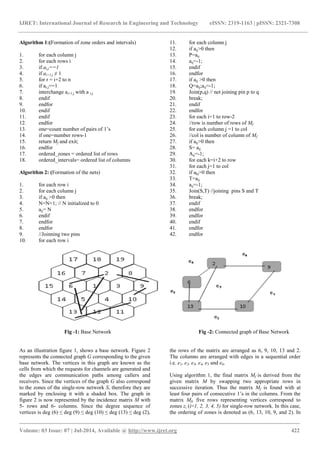
In the first step the base network showing the requests for
channels by the communicating users is considered. In the
second step the above network is converted into a connected
graph known as G. The given graph is now represented as
an incidence matrix with n-rows and m-columns in the third
step. The ordering of rows is based on the ordering of
degrees of the vertices of the graph G. That is, if deg (v1) ≤
deg (v2)….≤ deg (vn), then the first row will contain v1,
second row will contain v2 and so on. The elements of
incidence matrix M of graph G is defined as,
ai,j=
1 , 푖푓 푗 − 푡푕 푒푑푔푒 푖푛푐푖푑푒푛푐푒 푤푖푡푕 푖 − 푡푕 푣푒푟푡푒푥
0, 푂푡푕푒푟푤푖푠푒
(3)
In fourth step, interchange two appropriate rows in each
iteration until the number of two consecutive 1’s in the
columns of the matrix is at least (v-1). In fifth step, form the
intervals by correct mapping of 1’s from the final matrix
into the pins of the single-row axis. Then these intervals are
converted into nets in which each net contains two pins at
either ends. The ordering of zones for the single-row
network is now same as the ordering of rows of the final
incidence matrix Mf. From the matrix Mf, the initial net list is
found which is known as L0. By applying ESSR for the
routing in single-row network, it is found that the value of
energy function, street congestion and the number of
doglegs are minimum. Thus the list of nets generated in this
way is optimal.](https://image.slidesharecdn.com/anewdynamicsingle-rowroutingforchannel-140821043806-phpapp02/85/A-new-dynamic-single-row-routing-for-channel-2-320.jpg)
![IJRET: International Journal of Research in Engineering and Technology eISSN: 2319-1163 | pISSN: 2321-7308
_______________________________________________________________________________________
Volume: 03 Issue: 07 | Jul-2014, Available @ http://www.ijret.org 423
single-row network S, since 12
1
n
i
i d , where di is the
degree of the vertex vi , the number of pins to be used is 12.
The pins are also known as the terminals used by S. These
12 pins, generate 6 intervals that are denoted by I ( , ) k k c r
for 1 k 12 from the matrix Mf. Each of the intervals
made up of two pins is marked by two end points known as
caller (ck) and receiver (rk). After forming a single-row
network from the base network, a routing technique is
applied to create an unique path between a pair of pins. The
paths obtained in this way are known as nets. Each of ej’s of
the matrix Mf are called intervals represented by Ii ( , ), k k c r
for 1 i 6 and 1 k 12 is constructed only from left
to right direction. For example, in this case, I1(1,11), I2(2,3,),
I3(4,12), I4(5,6), I5(7,8) and I6(9,10) are the intervals as
presented in the figure 3.
In figure 3, the ordered zones are 6, 13, 10, 9 and 2, where
each of the zone controls two or more pins (terminals). Now
using algorithm 2, the initial order list of nets is found. In
this case, the initial list of the nets Ni, for 1 i 6, as
shown in the figure 4. Let the initial net list is given by, L0=
{N (2,3), N (5,6), N (7,8), N (9,10), N (1,11), N (4,12)}. 2 4 5 6 1 3
Using the equation 1 and 2, the energy function, minimum
street congestion and the number of doglegs are calculated
as E = 5, Q = 2 and D =2 respectively. To improve this
solution the method ESSR as proposed by Salleh et al. in [2]
is implemented. The optimal ordering of nets using ESSR is
presented in the figure 5. The corresponding minimum
energy function, minimum street congestion and number of
doglegs from the figure 4 for this illustration are given by E
=2, Q = 1 and D = 0, with the corresponding ordered zones
<6, 13, 10, 9, 2>. The final net list is denoted as Lf =
{ (2,3), (4,12), (5,6), (7,8), (9,10), (1,11)}, 2 3 4 5 6 1 N N N N N N
whose realization for single-row network is given in Fig.6.
Fig -3 Initial order zones of single-row network
Fig -4. Initial list of nets
Fig -5. Optimal Ordering of Nets
Fig -6. Realization of optimal paths
4. ANALYSIS AND EXPERIMENTAL RESULTS
Most of the traditional works for transformation of single-row
network are based on the implementation of maximal
cliques finding problem. In general maximal clique problem
is NP-complete as suggested by Panos M. Pardalos et al. in
[8]. The running time to find all the maximal cliques of
connected graph of n vertices is Ο(3 ) n/3
as derived by
Etsuji Tomita et al. in [7]. Where as representing the graph
in incidence matrix and applying finite number of swap
operations on its rows, transformation problem takes
polynomial time. However, incidence matrix, which is the
alternative to a connected graph, is highly used for the
design of electrical circuits. The method proposed by us is
more beter than the others based on their initial as well as
optimal values of energy function, street congestion and the
number of doglegs respectively. The Table 1 shows the
comparative results between traditional method and the
proposed method. The bar graph given in figure (7, 8, 9)
below showing the comparison between energy values,
number of doglegs and street congestions of the figure 1 in
this paper based on the traditional and proposed method. We](https://image.slidesharecdn.com/anewdynamicsingle-rowroutingforchannel-140821043806-phpapp02/85/A-new-dynamic-single-row-routing-for-channel-4-320.jpg)
![IJRET: International Journal of Research in Engineering and Technology eISSN: 2319-1163 | pISSN: 2321-7308
_______________________________________________________________________________________
Volume: 03 Issue: 07 | Jul-2014, Available @ http://www.ijret.org 424
have implemented proposed algorithms in Scilab 5.4.1 software for the formation of optimal ordering of zones and ordered list of nets. Table 1 : Comparative Analysis
Graph
Initial Solution
Optimal Solution
Traditional Method
Proposed Method
Traditional Method
Proposed Method
E
Q
D
E
Q
D
E
Q
D
E
Q
D
Fig.1
9
3
3
5
2
2
7
2
2
2
1
0
Fig 1[3]
3
2
0
1
1
0
2
1
0
1
1
0
Fig -7 Comparative analysis of energy value of Fig.1
Fig -8 Comparative Analysis of Number of Doglegs of Fig.1
Fig - 9 Comparative Analysis of Street Congestion of Fig -1 5. CONCLUSIONS The proposed method for optimal solution for the ordered list of nets and at the same time with minimum value of energy function, street congestion and number of doglegs are derived by the support of ESSR in [2]. From the graphs of comparative analysis between traditional and proposed methods, we concluded that the initial list of nets based on our method results a better optimal solution in comparison to the tradition method. We will consider the same problem when the communicating users belong to the same cell of the same network for future scope. We will also try to find the rate of convergence to find the optimal solution. REFERENCES [1]. S.Salleh, A.Zomaya, S.Olariu, K.L.Yieng and N.Aziz, “Single-row mapping and transformation of connected graphs”, Journal of Supercomputing (Springer Science), 39(1) 73-89, 2007. [2]. Salleh, B.Sanugi, H.Jamaluddin, S.Olariu and A.Zomaya,“Enhanced simulated annealing technique for the single-row routing problem", Journal of Supercomputing(Springer Science), 21(3) 285-302,2002. [3]. A. Noraziah1*, Noriyani Mohd Zin1, Ahmed N. Abdalla2 and Norazaliza Mohd. Jamil3,” Minimize network congestions in single-row networks”, Scientific Research and Essays Vol. 6(11), pp. 2372-2378, 4 June, 2011. [4]. S.Salleh,S. Olariu, B. Sanugi, MIA.Aziz, “Single-row transformation of complete graphs.”, Journal of Supercomputing 31(3):265-279, 2005. [5]. S. Salleh, N H Sarmin, “Dynamic Single-row Routing Technique for Channel Assignments”, Sixth International conference on Information Technology: New Generation- 2009.
[6]. S.L. Loh, S. Salleh, and N.H. Sarmin “Spanning Tree Transformation of Connected Graphs into Single- Row](https://image.slidesharecdn.com/anewdynamicsingle-rowroutingforchannel-140821043806-phpapp02/85/A-new-dynamic-single-row-routing-for-channel-5-320.jpg)
![IJRET: International Journal of Research in Engineering and Technology eISSN: 2319-1163 | pISSN: 2321-7308
_______________________________________________________________________________________
Volume: 03 Issue: 07 | Jul-2014, Available @ http://www.ijret.org 425
Networks”, World Academy of Science, Engineering and Technology, vol 38, 2010. [7]. Etsuji Tomitaa, Akira Tanakaa, Haruhisa Takahashia, “The worst-case time complexity for generating all maximal cliques and computational experiments”, ScienceDirect, Theoretical Computer Science 363 (2006) 28 – 42. [8]. Panos M. Pardalos, Jue Xue, “The maximum clique problem”, 1992. [9]. Johar F., Salleh S.,”Placement and Routing in VLSI design Problem Using Single Row Routing Technique”, MATEMATIKA, 2007, Volume 23, Number 2, 99-120. [10]. R.Mathar, J.Mattfeldt, “Channel assignment in cellular radio networks”, IEEE Trans. Vehicular Technology, 42(4) 647–656, 1993 [11]. V. H. MacDonald. The cellular concept. The Bell System Techn. J. 58: 15-41, 1979. BIOGRAPHIES:
Narayan Patra received his M.Sc degree in Mathematics from Utkal University, M.Tech degree in Computer Science from Utkal University. He has 15 years of teaching experience in the leading engineering colleges under BPUT in Odisha, India. His research interest is in channel allocation problem in wireless cellular networks. B N B Ray received his M.Sc degree in Mathematics from Utkal University, M.Tech degree in Computer Science from IIT Karaghpur and Ph. D degree from Utkal University. His research interests are in parallel algorithm, channel assignment in wireless network and VLSI. He is now working as Senior Lecturer in the PG Dept. of Computer Science and Application of Utkal University, Bhubaneswar, India. S P Mohanty received his M.Sc degree in Mathematics from Utkal University and Ph.D degree from Utkal University. He is currently working as a Professor in the dept of Mathematics in the College of Engg. & Technology, Bhubaneswar, India. His research interest is in parallel computing , operation research and graph theory.](https://image.slidesharecdn.com/anewdynamicsingle-rowroutingforchannel-140821043806-phpapp02/85/A-new-dynamic-single-row-routing-for-channel-6-320.jpg)

The paper presents a novel dynamic single-row routing method for channel assignments in cellular networks, utilizing a graph-theoretic approach. An incidence matrix is employed to efficiently transform a connected graph into a single-row network, minimizing street congestion and the number of doglegs. The proposed enhanced simulated annealing technique (ESSR) optimizes the routing by converging to an optimal configuration of networks through iterative improvements.


