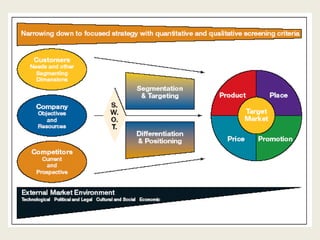
Market Segmentation A fundamental principle of marketing • In the past, segmentation has been largely used as a guiding conceptual principle for developing marketing plans and strategies rather than a call for empirical data analysis. • Today, some form of quantitative measurement is typically required if you want to segment.  • Segmentation is facilitated by the computer and other information technology. • However, raw data are not segments, only the building blocks of segmentation.
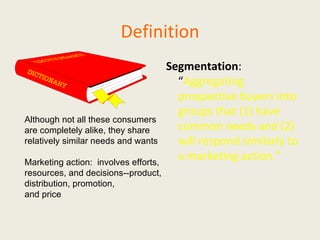
Definition Segmentation :  “ Aggregating prospective buyers into groups that (1) have common needs and (2) will respond similarly to a marketing action.” Although not all these consumers are completely alike, they share relatively similar needs and wants Marketing action:  involves efforts, resources, and decisions--product, distribution, promotion,  and price
 
The Principle of Segmentation “ It is more important to reach the people who count than to count the people you reach.” • Based on the believe that individuals and businesses have differences. • Defining and targeting segments is a way to leverage knowledge about individuals’ or companies’ differential responses.
MARKET SEGMENTATION LOGIC Markets consist of buyers, and buyers differ in one or more respects, including... Wants Resources Buying attitudes Buying practices Geographical locations
Segmentation Variables There is no single way to segment a market.  A marketer has to try different segmentation variables, singly and in combination. Geographics  Demographics Psychographics Purchase Behavior Category Networking
•  •  •  • •  • •  • •  • •  •  •  •  •  •  •  • • • • •  • • •  • • •  • •  •  •  • No market Segmentation Complete Segmentation Market Segmentation by Income Classes 1, 2, and  3 Market Segmentation by age classes A & B Multi-dimensional  Market Segmentation By income-age class 2 2 1 1 1 3 a a a b b b 1b 1a 2b 3a 3b Different Segmentations of a Market
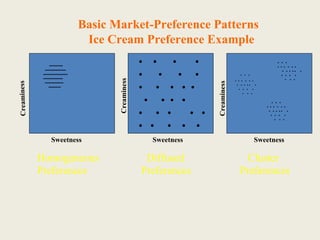
Creaminess Creaminess Creaminess Sweetness Sweetness Sweetness ••••••••••• ••••••••••••••••• •••••••••••••••••••• •••••••••••••••• ••••••••••••••• •••••••••• •  •  •  • •  •  •  • •  •  •  •  • •  •  •  • •  •  •  •  • •  •  •  •  • •  •  • •  •  •  •  •  • •  •  •  • •  • •  •  •  • •  •  • •  •  • •  •  •  •  •  • •  •  •  • •  • •  •  •  • •  •  • •  •  • •  •  •  •  •  • •  •  •  • •  • •  •  •  • •  •  • Homogeneous   Diffused   Cluster Preferences   Preferences   Preferences Basic Market-Preference Patterns Ice Cream Preference Example
Bases for Segmenting Consumer Markets
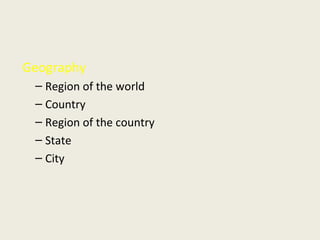
Geography  Region of the world Country Region of the country State City
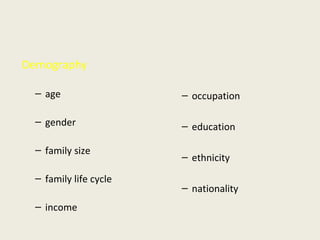
Demography age gender family size family life cycle income occupation education ethnicity nationality
Psychographics social class lifestyle personality
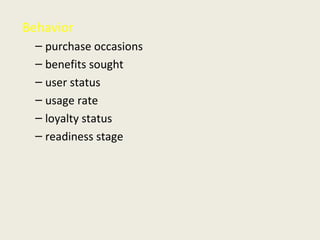
Behavior purchase occasions benefits sought user status usage rate loyalty status readiness stage
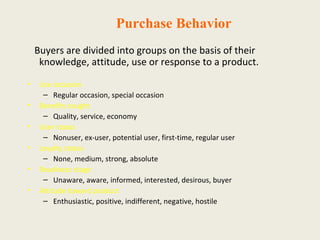
  Purchase Behavior   Buyers are divided into groups on the basis of their knowledge, attitude, use or response to a product. Use occasion Regular occasion, special occasion Benefits sought Quality, service, economy User status Nonuser, ex-user, potential user, first-time, regular user Loyalty status None, medium, strong, absolute Readiness stage Unaware, aware, informed, interested, desirous, buyer Attitude toward product Enthusiastic, positive, indifferent, negative, hostile
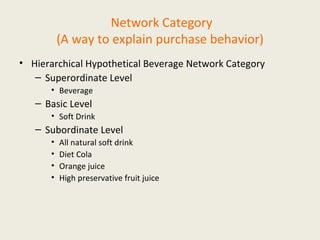
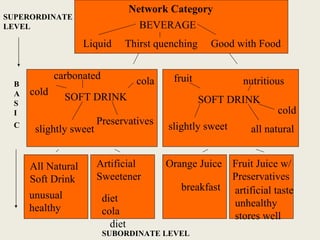
Network Category (A way to explain purchase behavior) Hierarchical Hypothetical Beverage Network Category Superordinate Level Beverage Basic Level Soft Drink Subordinate Level All natural soft drink Diet Cola Orange juice High preservative fruit juice
BEVERAGE Liquid  Thirst quenching  Good with Food SUPERORDINATE LEVEL carbonated cola cold slightly sweet Preservatives SOFT DRINK SOFT DRINK fruit slightly sweet nutritious cold all natural B  A  S  I  C   Artificial Sweetener All Natural Soft Drink diet cola diet unusual healthy Orange Juice breakfast Fruit Juice w/ Preservatives artificial taste unhealthy stores well SUBORDINATE LEVEL Network Category
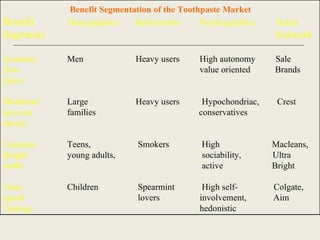
  Benefit Segmentation of the Toothpaste Market Benefit Demographics  Behaviorists  Psychographics  Brand Segments   Network Economy Men   Heavy users   High autonomy  Sale (low    value oriented  Brands price) Medicinal Large   Heavy users   Hypochondriac,  Crest (prevent   families   conservatives decay) Cosmetic Teens,   Smokers   High    Macleans, (bright   young adults,     sociability,   Ultra teeth)     active   Bright Taste Children     Spearmint   High self-  Colgate, (good   lovers     involvement,  Aim Tasting)     hedonistic
SEGMENTING BUSINESS MARKETS Basis…..
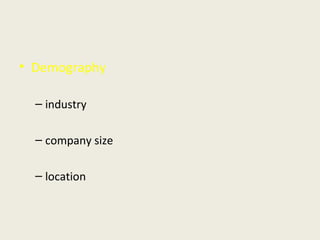
Demography industry company size location
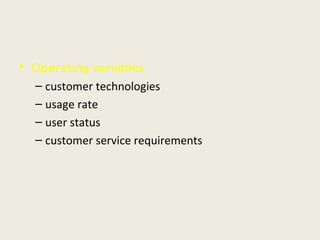
Operating variables customer technologies usage rate user status  customer service requirements
Purchasing approaches centralized vs. decentralized purchasing current vs. potential customers purchasing criteria
Situational factors urgency of need application of product size of order
Requirements for Effective Segmentation
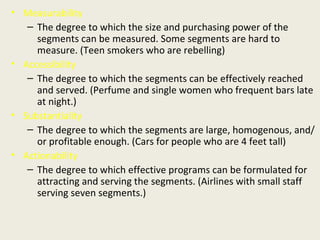
Measurability The degree to which the size and purchasing power of the segments can be measured. Some segments are hard to measure. (Teen smokers who are rebelling) Accessibility The degree to which the segments can be effectively reached and served. (Perfume and single women who frequent bars late at night.) Substantiality The degree to which the segments are large, homogenous, and/or profitable enough. (Cars for people who are 4 feet tall) Actionability The degree to which effective programs can be formulated for attracting and serving the segments. (Airlines with small staff serving seven segments.)
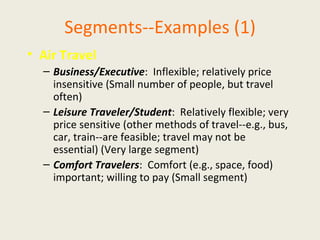
Segments--Examples (1) Air Travel Business/Executive :  Inflexible; relatively price insensitive (Small number of people, but travel often) Leisure Traveler/Student :  Relatively flexible; very price sensitive (other methods of travel--e.g., bus, car, train--are feasible; travel may not be essential) (Very large segment) Comfort Travelers :  Comfort (e.g., space, food) important; willing to pay (Small segment)
Examples (2)   SEGMENTATION FOR COSMETICS Over the last decade, women have become more confident and the negatives attached to a well-dressed woman are on the wane. People have accepted color cosmetics as an essential part of daily grooming.
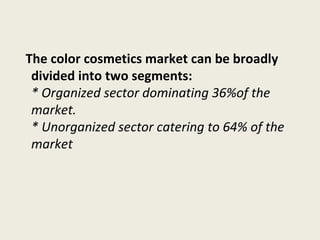
The color cosmetics market can be broadly divided into two segments:   * Organized sector dominating 36%of the market.   * Unorganized sector catering to 64% of the market
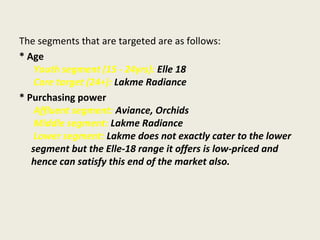
The segments that are targeted are as follows:  * Age     Youth segment (15 - 24yrs):  Elle 18     Core target (24+):  Lakme Radiance   * Purchasing power     Affluent segment:  Aviance, Orchids     Middle segment:  Lakme Radiance     Lower segment:  Lakme does not exactly cater to the lower segment but the Elle-18 range it offers is low-priced and hence can satisfy this end of the market also.
 

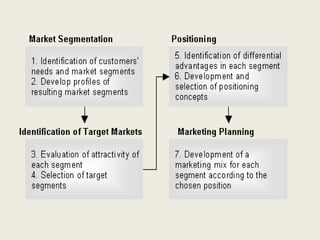
Segmentation & Targeting

  • 1.
    Market Segmentation Afundamental principle of marketing • In the past, segmentation has been largely used as a guiding conceptual principle for developing marketing plans and strategies rather than a call for empirical data analysis. • Today, some form of quantitative measurement is typically required if you want to segment. • Segmentation is facilitated by the computer and other information technology. • However, raw data are not segments, only the building blocks of segmentation.
  • 2.
    Definition Segmentation : “ Aggregating prospective buyers into groups that (1) have common needs and (2) will respond similarly to a marketing action.” Although not all these consumers are completely alike, they share relatively similar needs and wants Marketing action: involves efforts, resources, and decisions--product, distribution, promotion, and price
  • 3.
  • 4.
    The Principle ofSegmentation “ It is more important to reach the people who count than to count the people you reach.” • Based on the believe that individuals and businesses have differences. • Defining and targeting segments is a way to leverage knowledge about individuals’ or companies’ differential responses.
  • 5.
    MARKET SEGMENTATION LOGICMarkets consist of buyers, and buyers differ in one or more respects, including... Wants Resources Buying attitudes Buying practices Geographical locations
  • 6.
    Segmentation Variables Thereis no single way to segment a market. A marketer has to try different segmentation variables, singly and in combination. Geographics Demographics Psychographics Purchase Behavior Category Networking
  • 7.
    • • • • • • • • • • • • • • • • • • • • • • • • • • • • • • • • • No market Segmentation Complete Segmentation Market Segmentation by Income Classes 1, 2, and 3 Market Segmentation by age classes A & B Multi-dimensional Market Segmentation By income-age class 2 2 1 1 1 3 a a a b b b 1b 1a 2b 3a 3b Different Segmentations of a Market
  • 8.
    Creaminess Creaminess CreaminessSweetness Sweetness Sweetness ••••••••••• ••••••••••••••••• •••••••••••••••••••• •••••••••••••••• ••••••••••••••• •••••••••• • • • • • • • • • • • • • • • • • • • • • • • • • • • • • • • • • • • • • • • • • • • • • • • • • • • • • • • • • • • • • • • • • • • • • • • • • • • • • • • • • • • • • • • • • • • • • Homogeneous Diffused Cluster Preferences Preferences Preferences Basic Market-Preference Patterns Ice Cream Preference Example
  • 9.
    Bases for SegmentingConsumer Markets
  • 10.
    Geography Regionof the world Country Region of the country State City
  • 11.
    Demography age genderfamily size family life cycle income occupation education ethnicity nationality
  • 12.
    Psychographics social classlifestyle personality
  • 13.
    Behavior purchase occasionsbenefits sought user status usage rate loyalty status readiness stage
  • 14.
    PurchaseBehavior Buyers are divided into groups on the basis of their knowledge, attitude, use or response to a product. Use occasion Regular occasion, special occasion Benefits sought Quality, service, economy User status Nonuser, ex-user, potential user, first-time, regular user Loyalty status None, medium, strong, absolute Readiness stage Unaware, aware, informed, interested, desirous, buyer Attitude toward product Enthusiastic, positive, indifferent, negative, hostile
  • 15.
    Network Category (Away to explain purchase behavior) Hierarchical Hypothetical Beverage Network Category Superordinate Level Beverage Basic Level Soft Drink Subordinate Level All natural soft drink Diet Cola Orange juice High preservative fruit juice
  • 16.
    BEVERAGE Liquid Thirst quenching Good with Food SUPERORDINATE LEVEL carbonated cola cold slightly sweet Preservatives SOFT DRINK SOFT DRINK fruit slightly sweet nutritious cold all natural B A S I C Artificial Sweetener All Natural Soft Drink diet cola diet unusual healthy Orange Juice breakfast Fruit Juice w/ Preservatives artificial taste unhealthy stores well SUBORDINATE LEVEL Network Category
  • 17.
    BenefitSegmentation of the Toothpaste Market Benefit Demographics Behaviorists Psychographics Brand Segments Network Economy Men Heavy users High autonomy Sale (low value oriented Brands price) Medicinal Large Heavy users Hypochondriac, Crest (prevent families conservatives decay) Cosmetic Teens, Smokers High Macleans, (bright young adults, sociability, Ultra teeth) active Bright Taste Children Spearmint High self- Colgate, (good lovers involvement, Aim Tasting) hedonistic
  • 18.
  • 19.
  • 20.
    Operating variables customertechnologies usage rate user status customer service requirements
  • 21.
    Purchasing approaches centralizedvs. decentralized purchasing current vs. potential customers purchasing criteria
  • 22.
    Situational factors urgencyof need application of product size of order
  • 23.
  • 24.
    Measurability The degreeto which the size and purchasing power of the segments can be measured. Some segments are hard to measure. (Teen smokers who are rebelling) Accessibility The degree to which the segments can be effectively reached and served. (Perfume and single women who frequent bars late at night.) Substantiality The degree to which the segments are large, homogenous, and/or profitable enough. (Cars for people who are 4 feet tall) Actionability The degree to which effective programs can be formulated for attracting and serving the segments. (Airlines with small staff serving seven segments.)
  • 25.
    Segments--Examples (1) AirTravel Business/Executive : Inflexible; relatively price insensitive (Small number of people, but travel often) Leisure Traveler/Student : Relatively flexible; very price sensitive (other methods of travel--e.g., bus, car, train--are feasible; travel may not be essential) (Very large segment) Comfort Travelers : Comfort (e.g., space, food) important; willing to pay (Small segment)
  • 26.
    Examples (2) SEGMENTATION FOR COSMETICS Over the last decade, women have become more confident and the negatives attached to a well-dressed woman are on the wane. People have accepted color cosmetics as an essential part of daily grooming.
  • 27.
    The color cosmeticsmarket can be broadly divided into two segments: * Organized sector dominating 36%of the market. * Unorganized sector catering to 64% of the market
  • 28.
    The segments thatare targeted are as follows: * Age Youth segment (15 - 24yrs): Elle 18 Core target (24+): Lakme Radiance * Purchasing power Affluent segment: Aviance, Orchids Middle segment: Lakme Radiance Lower segment: Lakme does not exactly cater to the lower segment but the Elle-18 range it offers is low-priced and hence can satisfy this end of the market also.
  • 29.

Editor's Notes

  • #13 Personality -- gregarious, introverted, authoritarian, etc.
  • #14 Occasions -- regular occasion, special occasion benefits sought -- quality, service, economy, speed user status -- nonuser, ex-user, potential user, first-time user, regular user usage rate -- light user, medium user, heavy user loyalty status -- none, medium, absolute readiness stage -- unaware, aware, informed, interested, desirous, intend to buy
  • #15 Occasions -Travel agency: air travel related to business, vacation or family VACATION= why charter airlines exist - Oranage Juice= extension of occasional use = Not just for B anymore _Mother’s Day and Farther’s Day = promoted to increase sale of candy, flowers and cards. -Curtis Candy company= promoted “trick or treat” at Halloween to get every home ready to dispense candy. Benefits sought -Requires a determination of what major benefits people want In a product class -Yankelovich: Watches= low price, durability, quality Timex= did not focus on only quality segment; Toothpaste User status -Light, medium and heavy users= volume segmentation; Beer study: found that 68% didn’t drink beer; 12% were light users, 16% accounted for 88% of the beer consumption = get one heavy user over several light users.; Loyalty Status: Hard core loyals; Shifting loyals, Swittchers P. 262 Kotler