Amity Business School MBA Class of 2010, Semester II Distribution & Logistics Management Ms.Vandana Gupta
Designing customer-oriented  marketing channels
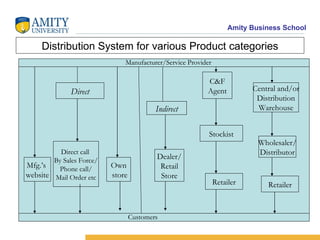
Distribution System for various Product categories Direct Mfg.’s  website Direct call  By Sales Force/ Phone call/ Mail Order etc Own store Indirect Dealer/ Retail Store C&F Agent Stockist Retailer Central and/or Distribution Warehouse Wholesaler/ Distributor Retailer Manufacturer/Service Provider Customers
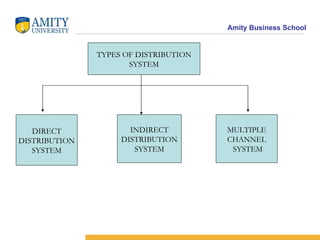
TYPES OF DISTRIBUTION SYSTEM DIRECT DISTRIBUTION SYSTEM INDIRECT DISTRIBUTION SYSTEM MULTIPLE CHANNEL SYSTEM
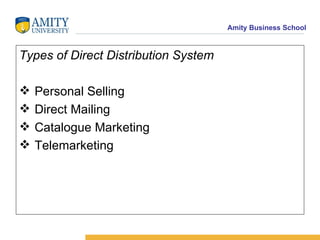
Types of Direct Distribution System Personal Selling Direct Mailing Catalogue Marketing Telemarketing
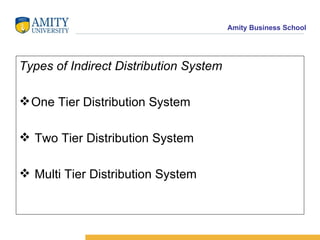
Types of Indirect Distribution System One Tier Distribution System Two Tier Distribution System Multi Tier Distribution System
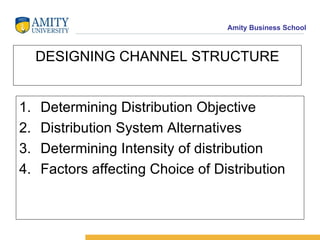
DESIGNING CHANNEL STRUCTURE Determining Distribution Objective Distribution System Alternatives Determining Intensity of distribution Factors affecting Choice of Distribution
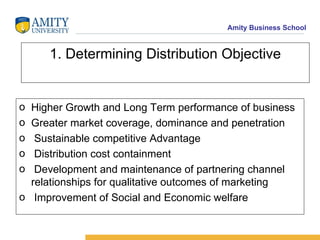
1. Determining Distribution Objective Higher Growth and Long Term performance of business Greater market coverage, dominance and penetration Sustainable competitive Advantage Distribution cost containment Development and maintenance of partnering channel relationships for qualitative outcomes of marketing Improvement of Social and Economic welfare
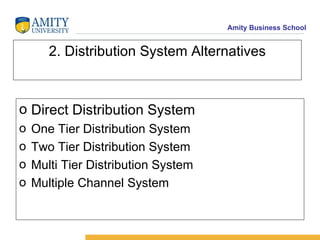
2. Distribution System Alternatives Direct Distribution System One Tier Distribution System Two Tier Distribution System Multi Tier Distribution System Multiple Channel System
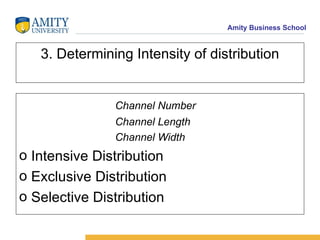
3. Determining Intensity of distribution Channel Number Channel Length Channel Width Intensive Distribution Exclusive Distribution Selective Distribution
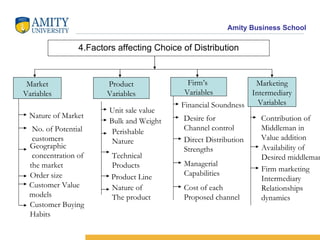
4.Factors affecting Choice of Distribution Market Variables Product Variables Firm’s  Variables Marketing Intermediary Variables Nature of Market No. of Potential customers Geographic concentration of the market Order size Customer Value  models Customer Buying  Habits Unit sale value Bulk and Weight Perishable  Nature Technical  Products Product Line Nature of The product Financial Soundness Desire for Channel control Direct Distribution  Strengths Managerial Capabilities Cost of each Proposed channel Contribution of  Middleman in Value addition Availability of Desired middleman Firm marketing Intermediary Relationships dynamics
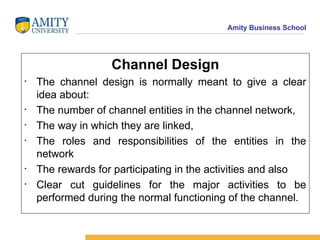
Channel Design The channel design is normally meant to give a clear idea about: The number of channel entities in the channel network,  The way in which they are linked, The roles and responsibilities of the entities in the network The rewards for participating in the activities and also  Clear cut guidelines for the major activities to be performed during the normal functioning of the channel.
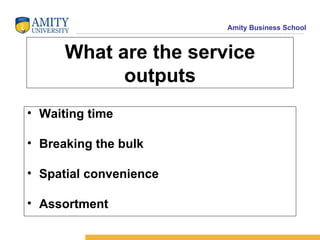
What are the service outputs Waiting time Breaking the bulk Spatial convenience Assortment
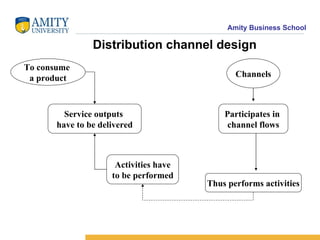
Distribution channel design To consume  a product Service outputs  have to be delivered Channels Participates in  channel flows Activities have to be performed   Thus performs activities
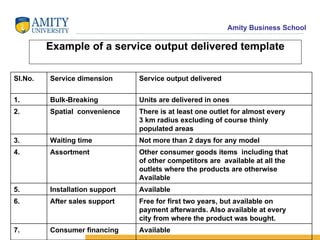
Example of a service output delivered template Available Consumer financing 7. Free for first two years, but available on  payment afterwards. Also available at every  city from where the product was bought. After sales support 6. Available Installation support 5. Other consumer goods items  including that  of other competitors are  available at all the outlets where the products are otherwise Available Assortment 4. Not more than 2 days for any model Waiting time 3. There is at least one outlet for almost every  3 km radius excluding of course thinly  populated areas  Spatial  convenience 2. Units are delivered in ones  Bulk-Breaking 1. Service output delivered Service dimension Sl.No.
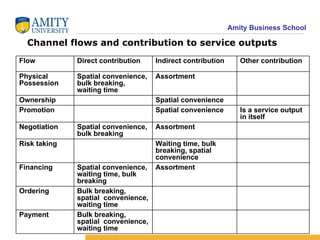
Channel flows and contribution to service outputs Bulk breaking, spatial  convenience, waiting time Payment Bulk breaking, spatial  convenience, waiting time Ordering Assortment Spatial convenience, waiting time, bulk breaking Financing Waiting time, bulk breaking, spatial convenience Risk taking Assortment Spatial convenience,  bulk breaking Negotiation Is a service output in itself Spatial convenience Promotion Spatial convenience  Ownership Assortment Spatial convenience,  bulk breaking, waiting time Physical Possession Other contribution Indirect contribution Direct contribution Flow
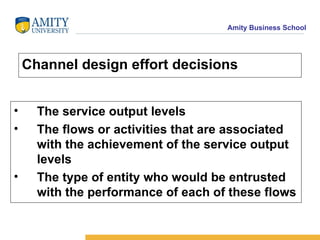
Channel design effort decisions The service output levels The flows or activities that are associated with the achievement of the service output levels The type of entity who would be entrusted with the performance of each of these flows
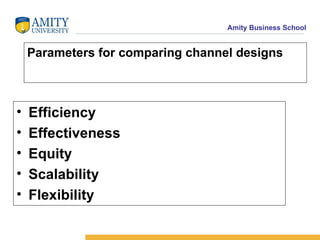
Parameters for comparing channel designs Efficiency Effectiveness Equity Scalability Flexibility
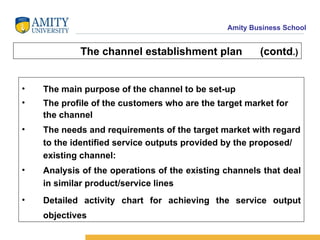
The channel establishment plan  (contd .) The main purpose of the channel to be set-up The profile of the customers who are the target market for the channel  The needs and requirements of the target market with regard to the identified service outputs provided by the proposed/ existing channel:  Analysis of the operations of the existing channels that deal in similar product/service lines Detailed activity chart for achieving the service output objectives
Plan….. Contd. Details about the various channel constituents who will be performing these tasks The cost of performing the activities The designated roles and responsibilities of the channel constituents The proposed remuneration for performing these roles and responsibilities Standards  for measuring the performance Procedures for reporting and information sharing Monitoring mechanisms Criteria for appointing the channel members

53601dlm Mod 2

  • 1.
    Amity Business SchoolMBA Class of 2010, Semester II Distribution & Logistics Management Ms.Vandana Gupta
  • 2.
    Designing customer-oriented marketing channels
  • 3.
    Distribution System forvarious Product categories Direct Mfg.’s website Direct call By Sales Force/ Phone call/ Mail Order etc Own store Indirect Dealer/ Retail Store C&F Agent Stockist Retailer Central and/or Distribution Warehouse Wholesaler/ Distributor Retailer Manufacturer/Service Provider Customers
  • 4.
    TYPES OF DISTRIBUTIONSYSTEM DIRECT DISTRIBUTION SYSTEM INDIRECT DISTRIBUTION SYSTEM MULTIPLE CHANNEL SYSTEM
  • 5.
    Types of DirectDistribution System Personal Selling Direct Mailing Catalogue Marketing Telemarketing
  • 6.
    Types of IndirectDistribution System One Tier Distribution System Two Tier Distribution System Multi Tier Distribution System
  • 7.
    DESIGNING CHANNEL STRUCTUREDetermining Distribution Objective Distribution System Alternatives Determining Intensity of distribution Factors affecting Choice of Distribution
  • 8.
    1. Determining DistributionObjective Higher Growth and Long Term performance of business Greater market coverage, dominance and penetration Sustainable competitive Advantage Distribution cost containment Development and maintenance of partnering channel relationships for qualitative outcomes of marketing Improvement of Social and Economic welfare
  • 9.
    2. Distribution SystemAlternatives Direct Distribution System One Tier Distribution System Two Tier Distribution System Multi Tier Distribution System Multiple Channel System
  • 10.
    3. Determining Intensityof distribution Channel Number Channel Length Channel Width Intensive Distribution Exclusive Distribution Selective Distribution
  • 11.
    4.Factors affecting Choiceof Distribution Market Variables Product Variables Firm’s Variables Marketing Intermediary Variables Nature of Market No. of Potential customers Geographic concentration of the market Order size Customer Value models Customer Buying Habits Unit sale value Bulk and Weight Perishable Nature Technical Products Product Line Nature of The product Financial Soundness Desire for Channel control Direct Distribution Strengths Managerial Capabilities Cost of each Proposed channel Contribution of Middleman in Value addition Availability of Desired middleman Firm marketing Intermediary Relationships dynamics
  • 12.
    Channel Design Thechannel design is normally meant to give a clear idea about: The number of channel entities in the channel network, The way in which they are linked, The roles and responsibilities of the entities in the network The rewards for participating in the activities and also Clear cut guidelines for the major activities to be performed during the normal functioning of the channel.
  • 13.
    What are theservice outputs Waiting time Breaking the bulk Spatial convenience Assortment
  • 14.
    Distribution channel designTo consume a product Service outputs have to be delivered Channels Participates in channel flows Activities have to be performed Thus performs activities
  • 15.
    Example of aservice output delivered template Available Consumer financing 7. Free for first two years, but available on payment afterwards. Also available at every city from where the product was bought. After sales support 6. Available Installation support 5. Other consumer goods items including that of other competitors are available at all the outlets where the products are otherwise Available Assortment 4. Not more than 2 days for any model Waiting time 3. There is at least one outlet for almost every 3 km radius excluding of course thinly populated areas Spatial convenience 2. Units are delivered in ones Bulk-Breaking 1. Service output delivered Service dimension Sl.No.
  • 16.
    Channel flows andcontribution to service outputs Bulk breaking, spatial convenience, waiting time Payment Bulk breaking, spatial convenience, waiting time Ordering Assortment Spatial convenience, waiting time, bulk breaking Financing Waiting time, bulk breaking, spatial convenience Risk taking Assortment Spatial convenience, bulk breaking Negotiation Is a service output in itself Spatial convenience Promotion Spatial convenience Ownership Assortment Spatial convenience, bulk breaking, waiting time Physical Possession Other contribution Indirect contribution Direct contribution Flow
  • 17.
    Channel design effortdecisions The service output levels The flows or activities that are associated with the achievement of the service output levels The type of entity who would be entrusted with the performance of each of these flows
  • 18.
    Parameters for comparingchannel designs Efficiency Effectiveness Equity Scalability Flexibility
  • 19.
    The channel establishmentplan (contd .) The main purpose of the channel to be set-up The profile of the customers who are the target market for the channel The needs and requirements of the target market with regard to the identified service outputs provided by the proposed/ existing channel: Analysis of the operations of the existing channels that deal in similar product/service lines Detailed activity chart for achieving the service output objectives
  • 20.
    Plan….. Contd. Detailsabout the various channel constituents who will be performing these tasks The cost of performing the activities The designated roles and responsibilities of the channel constituents The proposed remuneration for performing these roles and responsibilities Standards for measuring the performance Procedures for reporting and information sharing Monitoring mechanisms Criteria for appointing the channel members

Editor's Notes

  • #2 Amity Business School