Will have a Short Quiz on Unit No. 5
A
https://forms.microsoft.com/Pages/ResponsePage.aspx?id=KiAMX
0CkqkCnnzogdtqLIk23NdGtRYBHlxwT-
SNqwKNUQlJSMlhES01LMjlRWVZaNlBaS1pVTDlNVy4u
B
https://forms.microsoft.com/Pages/ResponsePage.aspx?id=KiAMX
0CkqkCnnzogdtqLIk23NdGtRYBHlxwT-
SNqwKNUNkxZTDhYRDMySUFZWTZQVlNFN0swTDdWNS4u
Unit 6
Developing Marketing Channel
Marketing Channel Strategy
A Marketing channel strategy is a vendor's plan for moving a
product or a service through the chain of commerce to the end
customer.
Marketing channel strategy: The broad principles by which the firm
expects to achieve its distribution objectives for its target markets.
To achieve its objectives a firm will have to address six basic
distribution decisions:
1. What role should distribution play in the firm’s overall objectives
and strategies?
2. What role should distribution play in the marketing mix?
3. How should the firm’s marketing channels be designed to achieve
its distribution objectives?
4. What kinds of channel members should be selected to meet the
firm’s distribution objectives?
5. How can the marketing channel be managed to implement the
firm’s channel design effectively and efficiently on a continuing
basis?
6. How can channel member performance be evaluated?
Marketing Channel Strategy and the Marketing Mix
The role of distribution must be considered in the marketing mix
along with price, promotion, and product. How much emphasis to be
placed on place has no general answer. Each firm or marketing
manager must make that determination for his or her self.
What we do know is that a general case of stressing distribution
strategy can be made if any one of certain conditions prevails:
1) Distribution is the most relevant variable for satisfying target
market demands.
2) Equality exists among competitors in the other three/seven
variables of the marketing mix.
3) A high degree of Differentiation exists because of competitors’
neglect of distribution.
4) Distribution can enhance the firm by creating cooperation from
marketing channels.
1) Distribution Relevance to Target Market Demand
As firms have become more orientated to target markets over the
past two decades by listening more closely to their customers, the
relevance of distribution has become apparent to an increasing
number of companies because it plays such a key role in providing
customer service.
Why are marketing channels so closely linked to customer need
satisfaction? Because it is through distribution that the firm can
provide the kinds of levels of service that make for satisfied
customers.
2) Competitive Parity in Other Marketing Mix Variables
It is increasingly more difficult for a company to differentiate its marketing
mix from that of the competition. Price, product, and promotional strategies
can easily and quickly be copied.
Distribution (place), the fourth variable of the marketing mix, can offer a
more favorable basis for developing a competitive edge because the
advantages achieved in distribution are not as easily copied by competitors
as the other three. Why is this the case? Distribution advantages, if
manifest in a superior marketing channel (rather than just the logistical
aspects of distribution), are based on a combination of superior strategy,
organization, and human capabilities. This is a combination not easily or
quickly imitated by competitors.
3) Distribution Neglect and Competitive Vulnerability
Neglect of distribution strategy by competitors provides an excellent
opportunity for those companies who are willing to make the effort to
develop distribution as a key strategic variable in the marketing mix.
But to pursue this approach, the channel manager has to make a conscious
effort to analyze target markets to determine if distribution has been
neglected by competitors and whether vulnerabilities exist that can be
exploited.
4) Distribution can enhance the firm by creating cooperation from
marketing channels
Distribution and Synergy for the Channel By “hooking up” with the
right kind of channel members, the marketing mix can be
substantially strengthened to a degree not easily duplicated with
other variables. The most obvious example of this is when a
channel member’s reputation or prestige is stronger than the
manufacturer’s.
Designing the Marketing Channel
Channel design is presented as a decision faced by the marketer,
and it includes either setting up channels from scratch or
modifying existing channels. This is sometimes referred to as
reengineering the channel and in practice is more common than
setting up channels from scratch.
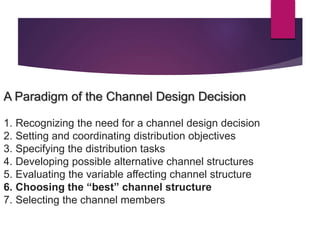
A Paradigm of the Channel Design Decision
1. Recognizing the need for a channel design decision
2. Setting and coordinating distribution objectives
3. Specifying the distribution tasks
4. Developing possible alternative channel structures
5. Evaluating the variable affecting channel structure
6. Choosing the “best” channel structure
7. Selecting the channel members
SELECTING THE CHANNEL MEMBERS
The Selection Process Three steps are involved:
1. Finding prospective channel members
2. Applying selection criteria to determine the suitability of
prospective channel members
3. Securing the prospective channel members as actual channel
members
Finding Prospective Channel Members
The most important sources for finding channel members are
listed below in their order of importance.
1. Field sales organizations
2. Trade sources
3. Reseller inquiries
4. Customers
5. Advertising
6. Trade shows
Applying Selection Criteria
Generalized Lists of Criteria
1. Credit and Financial Condition
2. Sale Strength
3. Product Lines
4. Reputation
5. Market Coverage
6. Sales Performance
7. Management Succession
8. Management Ability
9. Attitude
10.Size
Securing the Channel Members
The channel manager in producing and manufacturing firms can use
a number of specific inducements in attempting to secure channel
members. Manufacturers and producers should convey to the
prospective intermediary that the partnership will be mutually
beneficial.
Specific Inducements for Securing Channel Members
Generally, the more specific the manufacturer can be in spelling
out what kinds of support and assistance will be offered to
channel members, the better.
Most of the inducements fit within one of four areas:
A)Product Line
B)Advertising and Promotion
C)Management Assistance
D)Fair Dealing and Friendly Relationship
Evaluating the variable affecting channel structure
These six basic categories are most important:
1. Market variables
2. Product variables
3. Company variables
4. Intermediary variables
5. Environmental variables
6. Behavioral variables
Choosing the “best” channel structure
A. “Characteristics of Goods and Parallel Systems” Approach
First laid out in the 1950s by Aspinwall, the main emphasis for
choosing a channel structure should be based upon product
variables. Each product characteristic is identified with a particular
color on the spectrum. These variables are:
1. Replacement rate
2. Gross margin
3. Adjustment
4. Time of consumption
5. Searching time
B) Financial Approach
Financial Approach decision involves comparing estimated
earnings on capital resulting from alternative channel structures in
light of the cost of capital to determine the most profitable
channel.
C) Transaction Cost Analysis (TCA) Approach
TCA addresses the choice of marketing channel structure only in
the most general case situation of choosing between the
manufacturer performing all of the distribution tasks itself through
vertical integration versus using independent intermediaries to
perform some or most of the distribution tasks. It is based upon
opportunistic behaviors of channel members.
The main focus of TCA is on the cost of conducting the
transactions necessary for a firm to accomplish its distribution
tasks.
D) Management Science Approaches
It would certainly be desirable if the channel manager could take
all possible channel structures, along with all the relevant
variables, and “plug” these into a set of equations, which would
then yield the optimal channel structure.
E) Judgmental-Heuristic Approaches
These approaches rely heavily on managerial judgment and
heuristics for decisions. Some attempt to formalize the decision-
making process whereas others attempt to incorporate cost and
revenue data.
Channel Strategy and Designing Marketing Channels
Differential Advantage and Channel Design
A differential advantage based on the design of a superior
marketing channel can yield a formidable and long-term
advantage because it cannot be copied easily by competitors.
Positioning the Channel to Gain Differential Advantage
Channel positioning: “What the firm does with its channel planning
and decision making to attain the channel position.”
By thinking in terms of channel positioning, the channel manager
takes a longer-term strategic view of channel design and is more
likely to ask the question: How can I design the channel so that
channel members will view my firm as having done a better job
than the competitive manufacturers they represent?
Channel Strategy and Managing the Marketing Channel
The channel manager attempting to plan and implement a
program to gain the cooperation of channel members is faced with
three strategic questions:
1) How close a relationship should be developed with the channel
members?
2) How should the channel members be motivated to cooperate in
achieving the manufacturer’s distribution objectives?
3) How should the marketing mix be used to enhance channel
member cooperation?
E-MARKETING CHANNELS
E-marketing, an abbreviation of electronic marketing, is one part
of the e-business. Those strategies and activities of e-marketing
such as market research, product development, advertising, and
selling, etc. are transferred to a digital environment. Moreover, the
activities like introducing a company and its products,
communicating with customers, promoting, and pricing goods or
services are also conducted over the Internet or through the digital
tools to achieve its marketing objectives.
Benefits of doing e-marketing
1. Cost effectiveness
2. Worldwide reach and access
3. Time
4. Space
5. Interactivity
6. Value added and competition
Unit VI Developing Marketing Channel.pptx

Unit VI Developing Marketing Channel.pptx

  • 1.
    Will have aShort Quiz on Unit No. 5 A https://forms.microsoft.com/Pages/ResponsePage.aspx?id=KiAMX 0CkqkCnnzogdtqLIk23NdGtRYBHlxwT- SNqwKNUQlJSMlhES01LMjlRWVZaNlBaS1pVTDlNVy4u B https://forms.microsoft.com/Pages/ResponsePage.aspx?id=KiAMX 0CkqkCnnzogdtqLIk23NdGtRYBHlxwT- SNqwKNUNkxZTDhYRDMySUFZWTZQVlNFN0swTDdWNS4u
  • 2.
  • 3.
    Marketing Channel Strategy AMarketing channel strategy is a vendor's plan for moving a product or a service through the chain of commerce to the end customer. Marketing channel strategy: The broad principles by which the firm expects to achieve its distribution objectives for its target markets.
  • 4.
    To achieve itsobjectives a firm will have to address six basic distribution decisions: 1. What role should distribution play in the firm’s overall objectives and strategies? 2. What role should distribution play in the marketing mix? 3. How should the firm’s marketing channels be designed to achieve its distribution objectives? 4. What kinds of channel members should be selected to meet the firm’s distribution objectives? 5. How can the marketing channel be managed to implement the firm’s channel design effectively and efficiently on a continuing basis? 6. How can channel member performance be evaluated?
  • 5.
    Marketing Channel Strategyand the Marketing Mix The role of distribution must be considered in the marketing mix along with price, promotion, and product. How much emphasis to be placed on place has no general answer. Each firm or marketing manager must make that determination for his or her self.
  • 6.
    What we doknow is that a general case of stressing distribution strategy can be made if any one of certain conditions prevails: 1) Distribution is the most relevant variable for satisfying target market demands. 2) Equality exists among competitors in the other three/seven variables of the marketing mix. 3) A high degree of Differentiation exists because of competitors’ neglect of distribution. 4) Distribution can enhance the firm by creating cooperation from marketing channels.
  • 7.
    1) Distribution Relevanceto Target Market Demand As firms have become more orientated to target markets over the past two decades by listening more closely to their customers, the relevance of distribution has become apparent to an increasing number of companies because it plays such a key role in providing customer service. Why are marketing channels so closely linked to customer need satisfaction? Because it is through distribution that the firm can provide the kinds of levels of service that make for satisfied customers.
  • 8.
    2) Competitive Parityin Other Marketing Mix Variables It is increasingly more difficult for a company to differentiate its marketing mix from that of the competition. Price, product, and promotional strategies can easily and quickly be copied. Distribution (place), the fourth variable of the marketing mix, can offer a more favorable basis for developing a competitive edge because the advantages achieved in distribution are not as easily copied by competitors as the other three. Why is this the case? Distribution advantages, if manifest in a superior marketing channel (rather than just the logistical aspects of distribution), are based on a combination of superior strategy, organization, and human capabilities. This is a combination not easily or quickly imitated by competitors.
  • 9.
    3) Distribution Neglectand Competitive Vulnerability Neglect of distribution strategy by competitors provides an excellent opportunity for those companies who are willing to make the effort to develop distribution as a key strategic variable in the marketing mix. But to pursue this approach, the channel manager has to make a conscious effort to analyze target markets to determine if distribution has been neglected by competitors and whether vulnerabilities exist that can be exploited.
  • 10.
    4) Distribution canenhance the firm by creating cooperation from marketing channels Distribution and Synergy for the Channel By “hooking up” with the right kind of channel members, the marketing mix can be substantially strengthened to a degree not easily duplicated with other variables. The most obvious example of this is when a channel member’s reputation or prestige is stronger than the manufacturer’s.
  • 11.
    Designing the MarketingChannel Channel design is presented as a decision faced by the marketer, and it includes either setting up channels from scratch or modifying existing channels. This is sometimes referred to as reengineering the channel and in practice is more common than setting up channels from scratch.
  • 12.
    A Paradigm ofthe Channel Design Decision 1. Recognizing the need for a channel design decision 2. Setting and coordinating distribution objectives 3. Specifying the distribution tasks 4. Developing possible alternative channel structures 5. Evaluating the variable affecting channel structure 6. Choosing the “best” channel structure 7. Selecting the channel members
  • 13.
    SELECTING THE CHANNELMEMBERS The Selection Process Three steps are involved: 1. Finding prospective channel members 2. Applying selection criteria to determine the suitability of prospective channel members 3. Securing the prospective channel members as actual channel members
  • 14.
    Finding Prospective ChannelMembers The most important sources for finding channel members are listed below in their order of importance. 1. Field sales organizations 2. Trade sources 3. Reseller inquiries 4. Customers 5. Advertising 6. Trade shows
  • 15.
    Applying Selection Criteria GeneralizedLists of Criteria 1. Credit and Financial Condition 2. Sale Strength 3. Product Lines 4. Reputation 5. Market Coverage 6. Sales Performance 7. Management Succession 8. Management Ability 9. Attitude 10.Size
  • 16.
    Securing the ChannelMembers The channel manager in producing and manufacturing firms can use a number of specific inducements in attempting to secure channel members. Manufacturers and producers should convey to the prospective intermediary that the partnership will be mutually beneficial.
  • 17.
    Specific Inducements forSecuring Channel Members Generally, the more specific the manufacturer can be in spelling out what kinds of support and assistance will be offered to channel members, the better. Most of the inducements fit within one of four areas: A)Product Line B)Advertising and Promotion C)Management Assistance D)Fair Dealing and Friendly Relationship
  • 18.
    Evaluating the variableaffecting channel structure These six basic categories are most important: 1. Market variables 2. Product variables 3. Company variables 4. Intermediary variables 5. Environmental variables 6. Behavioral variables
  • 19.
    Choosing the “best”channel structure
  • 20.
    A. “Characteristics ofGoods and Parallel Systems” Approach First laid out in the 1950s by Aspinwall, the main emphasis for choosing a channel structure should be based upon product variables. Each product characteristic is identified with a particular color on the spectrum. These variables are: 1. Replacement rate 2. Gross margin 3. Adjustment 4. Time of consumption 5. Searching time
  • 21.
    B) Financial Approach FinancialApproach decision involves comparing estimated earnings on capital resulting from alternative channel structures in light of the cost of capital to determine the most profitable channel.
  • 22.
    C) Transaction CostAnalysis (TCA) Approach TCA addresses the choice of marketing channel structure only in the most general case situation of choosing between the manufacturer performing all of the distribution tasks itself through vertical integration versus using independent intermediaries to perform some or most of the distribution tasks. It is based upon opportunistic behaviors of channel members. The main focus of TCA is on the cost of conducting the transactions necessary for a firm to accomplish its distribution tasks.
  • 23.
    D) Management ScienceApproaches It would certainly be desirable if the channel manager could take all possible channel structures, along with all the relevant variables, and “plug” these into a set of equations, which would then yield the optimal channel structure.
  • 24.
    E) Judgmental-Heuristic Approaches Theseapproaches rely heavily on managerial judgment and heuristics for decisions. Some attempt to formalize the decision- making process whereas others attempt to incorporate cost and revenue data.
  • 25.
    Channel Strategy andDesigning Marketing Channels
  • 26.
    Differential Advantage andChannel Design A differential advantage based on the design of a superior marketing channel can yield a formidable and long-term advantage because it cannot be copied easily by competitors.
  • 27.
    Positioning the Channelto Gain Differential Advantage Channel positioning: “What the firm does with its channel planning and decision making to attain the channel position.” By thinking in terms of channel positioning, the channel manager takes a longer-term strategic view of channel design and is more likely to ask the question: How can I design the channel so that channel members will view my firm as having done a better job than the competitive manufacturers they represent?
  • 28.
    Channel Strategy andManaging the Marketing Channel The channel manager attempting to plan and implement a program to gain the cooperation of channel members is faced with three strategic questions: 1) How close a relationship should be developed with the channel members? 2) How should the channel members be motivated to cooperate in achieving the manufacturer’s distribution objectives? 3) How should the marketing mix be used to enhance channel member cooperation?
  • 29.
  • 30.
    E-marketing, an abbreviationof electronic marketing, is one part of the e-business. Those strategies and activities of e-marketing such as market research, product development, advertising, and selling, etc. are transferred to a digital environment. Moreover, the activities like introducing a company and its products, communicating with customers, promoting, and pricing goods or services are also conducted over the Internet or through the digital tools to achieve its marketing objectives.
  • 31.
    Benefits of doinge-marketing
  • 32.
    1. Cost effectiveness 2.Worldwide reach and access 3. Time 4. Space 5. Interactivity 6. Value added and competition