Changing Matter Page 144
Objectives To state the 2 different types of changes To compare between physical and chemical change
Animation Changes
Types of Changes Physical change Chemical change
Physical change Change in which no new substance is formed Can be reversed Examples: Salt dissolves in water to form salt solution Evaporation of sweat in the skin Evaporation of water from the roads Melting ice cream or chocolate Boiling water Expansion and contraction of metal
Chemical change Change in which new substance is formed Difficult to reverse, permanent change Examples: Iron rust Apple turning brown Cooking food Respiration Photosynthesis Baking bread/cake Rotting of food
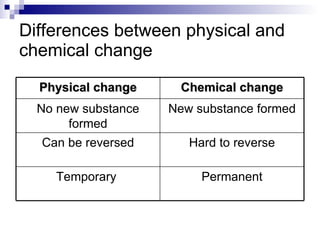
Differences between physical and chemical change Permanent Temporary  Hard to reverse Can be reversed New substance formed No new substance formed Chemical change Physical change
Do checkpoint & Inquiry Time Page 145
What happens when matter changes? Sometimes heat energy is given out to bring about change Burning of charcoal Sometimes heat energy is needed to bring about change Toasting bread
Changes involving… Heat Light Electricity Mixing
Chemical reaction At least  two reactants Chemical changes occur at a molecular level where bonds are broken and formed again Molecular structure is changed Two or more reactants combine to form  one or more products Left hand side shows the reactants and the right hand side shows the products Reactant A + Reactant B  -> Product C + Product D
Changes involving heat Heat causes Expansion and contraction Changes of state such as melting and boiling Heat involved in chemical reaction Chemical reaction that gives out heat energy – EXOTHERMIC Chemical reaction that takes in heat energy - ENDOTHERMIC
Changes involving heat Exothermic Reactions occur spontaneously and energy can be released in the form of heat, light or sound Examples, sodium reacts with chlorine to form common salt Heat and light are given out
Changes involving heat Endothermic Cannot occur spontaneously Require energy in order to get these reactions to occur Example: Photosynthesis: require light energy to break the bonds of carbon dioxide and water
Changes involving heat Different types of chemical reactions Combination Thermal decomposition Combustion or burning
Combination Heat causes 2 substances to combine to form new substances Example: combination of iron and sulphur to form iron sulphide Iron + sulphur    iron sulphide heat
Thermal decomposition Breaking down of substances into 2 or more simpler substances Example: decomposition of sugar Sugar    carbon + water vapour heat
Combustion or burning Substances that combine with oxygen when heated to form new substances Example: charcoal burning When charcoal is burnt oxygen is needed, the addition of oxygen to a substance is called OXIDATION Carbon + oxygen    carbon dioxide heat
Changes involving light Photosynthesis Light energy is absorbed by green plants to make food (glucose) Carbon dioxide + water    glucose + oxygen light
Changes involving light Photography Black and white photographic film contains silver bromide Exposure to light decomposes the silver bromide into silver Produces dark areas on the film Greater the exposure to light, the darker the area on the film
Changes involving electricity Electricity involved in many physical and chemical changes Electric current passes through the filament of an electric light bulb, the filament heats up and glows. When current is passed through a liquid that conduct electricity, chemical reaction called ELECTROLYSIS
Changes involving Electricity Electrolysis It is the chemical decomposition of an electrolyte by an electric current Application of electrolysis: Extract metals such as sodium, magnesium and aluminium from their molten compounds Prepare gases such as chlorine Refine metals such as copper and zinc
Changes involving mixing Two or more substances are mixed together, they may react chemically Example of physical change: sugar mix with water Examples of chemical changes:  Magnesium added to hydrochloric acid Acids and carbonates Acid and alkali
Do checkpoint pg 150 Exothermic: reaction in which heat energy is given out Endothermic: reaction in which heat energy is take in/absorbed Combination, thermal decomposition and combustion
Short animation Air pollution
Effects of Burning Fuels Causes air pollution, acid rain and leads to global warming Air pollution can cause respiratory diseases, skin and eye irritations Main source of air pollutants is burning of fuels in power stations and vehicle engines
Common air pollutants Gases Carbon monoxide Sulphur dioxide Nitrogen dioxide Solid Ash Dust Soot
What are the effects of air pollution? Breathe smoke, the smoke stick onto our lungs. Cause cough and lung cancer Sulphur dioxide and nitrogen dioxide hurt the eyes, make breathing difficult and can cause lung diseases. Plants cannot grow well too
What are the effects of air pollution? Sulphur dioxide and nitrogen dioxide dissolved in rain to become acid rain Corrodes metal and concrete building Harms plant life and affects aquatic organisms
What are the effects of air pollution? Incomplete combustion due to insufficient supply of oxygen produce carbon monoxide Brain damage and death Prevents red blood cells from combining with oxygen Can pass on to an unborn child in a pregnant woman. Born prematurely, underweight or dead
Do checkpoint pg 152 Sulphur dioxide, nitrogen dioxide, carbon dioxide and solid (soot) particles The burning of fuels in power stations and vehicle engines Sulphur dioxide and nitrogen dioxide Kill plants, fish and damage buildings and statues
Short animation Global warming
Global warming Burning fuels also produce carbon dioxide Carbon dioxide trap heat from the sun This is important to keep the Earth warm Carbon dioxide and other gases (sulphur dioxide and nitrogen dioxide) that trap heat are called greenhouse gases Global warming causes drastic changes in the climate and ice to melt faster in the polar region
Global warming Melting ice raises the sea level and some coastal areas will become flooded
Short animation Greenhouse effects
Short animation Human and the environment
Saving the environment Use public transport instead of cars Use solar powered devices Conserve energy

Changing Matter

  • 1.
  • 2.
    Objectives To statethe 2 different types of changes To compare between physical and chemical change
  • 3.
  • 4.
    Types of ChangesPhysical change Chemical change
  • 5.
    Physical change Changein which no new substance is formed Can be reversed Examples: Salt dissolves in water to form salt solution Evaporation of sweat in the skin Evaporation of water from the roads Melting ice cream or chocolate Boiling water Expansion and contraction of metal
  • 6.
    Chemical change Changein which new substance is formed Difficult to reverse, permanent change Examples: Iron rust Apple turning brown Cooking food Respiration Photosynthesis Baking bread/cake Rotting of food
  • 7.
    Chemical change Changein which new substance is formed Difficult to reverse, permanent change Examples: Iron rust Apple turning brown Cooking food Respiration Photosynthesis Baking bread/cake Rotting of food
  • 8.
    Differences between physicaland chemical change Permanent Temporary Hard to reverse Can be reversed New substance formed No new substance formed Chemical change Physical change
  • 9.
    Do checkpoint &Inquiry Time Page 145
  • 10.
    What happens whenmatter changes? Sometimes heat energy is given out to bring about change Burning of charcoal Sometimes heat energy is needed to bring about change Toasting bread
  • 11.
    Changes involving… HeatLight Electricity Mixing
  • 12.
    Chemical reaction Atleast two reactants Chemical changes occur at a molecular level where bonds are broken and formed again Molecular structure is changed Two or more reactants combine to form one or more products Left hand side shows the reactants and the right hand side shows the products Reactant A + Reactant B -> Product C + Product D
  • 13.
    Changes involving heatHeat causes Expansion and contraction Changes of state such as melting and boiling Heat involved in chemical reaction Chemical reaction that gives out heat energy – EXOTHERMIC Chemical reaction that takes in heat energy - ENDOTHERMIC
  • 14.
    Changes involving heatExothermic Reactions occur spontaneously and energy can be released in the form of heat, light or sound Examples, sodium reacts with chlorine to form common salt Heat and light are given out
  • 15.
    Changes involving heatEndothermic Cannot occur spontaneously Require energy in order to get these reactions to occur Example: Photosynthesis: require light energy to break the bonds of carbon dioxide and water
  • 16.
    Changes involving heatDifferent types of chemical reactions Combination Thermal decomposition Combustion or burning
  • 17.
    Combination Heat causes2 substances to combine to form new substances Example: combination of iron and sulphur to form iron sulphide Iron + sulphur  iron sulphide heat
  • 18.
    Thermal decomposition Breakingdown of substances into 2 or more simpler substances Example: decomposition of sugar Sugar  carbon + water vapour heat
  • 19.
    Combustion or burningSubstances that combine with oxygen when heated to form new substances Example: charcoal burning When charcoal is burnt oxygen is needed, the addition of oxygen to a substance is called OXIDATION Carbon + oxygen  carbon dioxide heat
  • 20.
    Changes involving lightPhotosynthesis Light energy is absorbed by green plants to make food (glucose) Carbon dioxide + water  glucose + oxygen light
  • 21.
    Changes involving lightPhotography Black and white photographic film contains silver bromide Exposure to light decomposes the silver bromide into silver Produces dark areas on the film Greater the exposure to light, the darker the area on the film
  • 22.
    Changes involving electricityElectricity involved in many physical and chemical changes Electric current passes through the filament of an electric light bulb, the filament heats up and glows. When current is passed through a liquid that conduct electricity, chemical reaction called ELECTROLYSIS
  • 23.
    Changes involving ElectricityElectrolysis It is the chemical decomposition of an electrolyte by an electric current Application of electrolysis: Extract metals such as sodium, magnesium and aluminium from their molten compounds Prepare gases such as chlorine Refine metals such as copper and zinc
  • 24.
    Changes involving mixingTwo or more substances are mixed together, they may react chemically Example of physical change: sugar mix with water Examples of chemical changes: Magnesium added to hydrochloric acid Acids and carbonates Acid and alkali
  • 25.
    Do checkpoint pg150 Exothermic: reaction in which heat energy is given out Endothermic: reaction in which heat energy is take in/absorbed Combination, thermal decomposition and combustion
  • 26.
  • 27.
    Effects of BurningFuels Causes air pollution, acid rain and leads to global warming Air pollution can cause respiratory diseases, skin and eye irritations Main source of air pollutants is burning of fuels in power stations and vehicle engines
  • 28.
    Common air pollutantsGases Carbon monoxide Sulphur dioxide Nitrogen dioxide Solid Ash Dust Soot
  • 29.
    What are theeffects of air pollution? Breathe smoke, the smoke stick onto our lungs. Cause cough and lung cancer Sulphur dioxide and nitrogen dioxide hurt the eyes, make breathing difficult and can cause lung diseases. Plants cannot grow well too
  • 30.
    What are theeffects of air pollution? Sulphur dioxide and nitrogen dioxide dissolved in rain to become acid rain Corrodes metal and concrete building Harms plant life and affects aquatic organisms
  • 31.
    What are theeffects of air pollution? Incomplete combustion due to insufficient supply of oxygen produce carbon monoxide Brain damage and death Prevents red blood cells from combining with oxygen Can pass on to an unborn child in a pregnant woman. Born prematurely, underweight or dead
  • 32.
    Do checkpoint pg152 Sulphur dioxide, nitrogen dioxide, carbon dioxide and solid (soot) particles The burning of fuels in power stations and vehicle engines Sulphur dioxide and nitrogen dioxide Kill plants, fish and damage buildings and statues
  • 33.
  • 34.
    Global warming Burningfuels also produce carbon dioxide Carbon dioxide trap heat from the sun This is important to keep the Earth warm Carbon dioxide and other gases (sulphur dioxide and nitrogen dioxide) that trap heat are called greenhouse gases Global warming causes drastic changes in the climate and ice to melt faster in the polar region
  • 35.
    Global warming Meltingice raises the sea level and some coastal areas will become flooded
  • 36.
  • 37.
    Short animation Humanand the environment
  • 38.
    Saving the environmentUse public transport instead of cars Use solar powered devices Conserve energy