Changes Around Us:
Physical and Chemical
Transformations
Have you ever wondered why ice melts, fruits ripen, or iron rusts? Our world is
constantly changing around us. Some changes are obvious, like a flower
blooming, while others happen so slowly we barely notice them, like rocks
weathering into soil over centuries.
In this presentation, we'll explore the fascinating world of physical and
chemical changes. We'll discover how to identify different types of changes,
understand what causes them, and learn which changes can be reversed and
which cannot. From the kitchen to the mountains, changes are happening
everywhere - let's understand the science behind them!
by sandeep swamy
Understanding Changes
Around Us
Melting Ice Cubes
A cube of ice placed on a table
melts into water over time. The
cold water in a bottle
eventually warms up to room
temperature.
Blooming Flowers
A bud on a rose plant
transforms into a beautiful
flower overnight, changing its
appearance completely.
Ripening Fruits
A banana with a few brown spots develops more spots and a strong
smell as it ripens further.
We observe these changes with our senses - sight, smell, touch, hearing, and
taste. Changes can occur in size, shape, smell, or other properties of
substances or objects. But how can we categorize these different types of
changes?
Physical Changes: Same Substance, New
Appearance
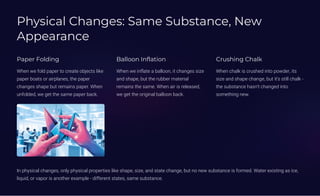
Paper Folding
When we fold paper to create objects like
paper boats or airplanes, the paper
changes shape but remains paper. When
unfolded, we get the same paper back.
Balloon Inflation
When we inflate a balloon, it changes size
and shape, but the rubber material
remains the same. When air is released,
we get the original balloon back.
Crushing Chalk
When chalk is crushed into powder, its
size and shape change, but it's still chalk -
the substance hasn't changed into
something new.
In physical changes, only physical properties like shape, size, and state change, but no new substance is formed. Water existing as ice,
liquid, or vapor is another example - different states, same substance.
Chemical Changes: New Substances Form
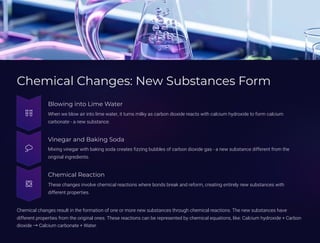
Blowing into Lime Water
When we blow air into lime water, it turns milky as carbon dioxide reacts with calcium hydroxide to form calcium
carbonate - a new substance.
Vinegar and Baking Soda
Mixing vinegar with baking soda creates fizzing bubbles of carbon dioxide gas - a new substance different from the
original ingredients.
Chemical Reaction
These changes involve chemical reactions where bonds break and reform, creating entirely new substances with
different properties.
Chemical changes result in the formation of one or more new substances through chemical reactions. The new substances have
different properties from the original ones. These reactions can be represented by chemical equations, like: Calcium hydroxide + Carbon
dioxide ³ Calcium carbonate + Water.
Testing for Carbon Dioxide
Mix Vinegar and Baking Soda
Take a teaspoonful of vinegar or lemon
juice in a test tube and add a pinch of
baking soda. Observe the fizzing bubbles
forming as carbon dioxide gas is
produced.
Capture the Gas
Direct the gas produced into another test
tube containing freshly prepared lime
water using a delivery tube or straw
arrangement.
Observe the Reaction
Watch as the lime water turns milky,
confirming the presence of carbon dioxide
gas - this is a reliable test for CO¢.
This experiment demonstrates a chemical change where vinegar and baking soda react to form carbon dioxide. The reaction can be
represented as: Vinegar + Baking soda ³ Carbon dioxide + Other substances. The milky appearance of lime water is due to the
formation of calcium carbonate, an insoluble white substance.
Rusting: A Chemical Change
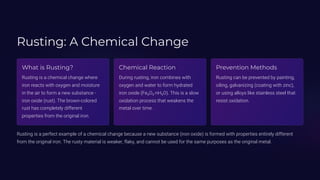
What is Rusting?
Rusting is a chemical change where
iron reacts with oxygen and moisture
in the air to form a new substance -
iron oxide (rust). The brown-colored
rust has completely different
properties from the original iron.
Chemical Reaction
During rusting, iron combines with
oxygen and water to form hydrated
iron oxide (Fe¢O£·nH¢O). This is a slow
oxidation process that weakens the
metal over time.
Prevention Methods
Rusting can be prevented by painting,
oiling, galvanizing (coating with zinc),
or using alloys like stainless steel that
resist oxidation.
Rusting is a perfect example of a chemical change because a new substance (iron oxide) is formed with properties entirely different
from the original iron. The rusty material is weaker, flaky, and cannot be used for the same purposes as the original metal.
Combustion: Burning with Oxygen
Combustion is a chemical reaction where a substance reacts with oxygen to produce heat and/or light, along with new substances.
When magnesium ribbon burns, it combines with oxygen to form magnesium oxide (a white powder): Magnesium + Oxygen ³
Magnesium oxide + Heat + Light.
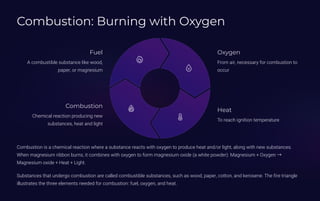
Substances that undergo combustion are called combustible substances, such as wood, paper, cotton, and kerosene. The fire triangle
illustrates the three elements needed for combustion: fuel, oxygen, and heat.
Fuel
A combustible substance like wood,
paper, or magnesium
Oxygen
From air, necessary for combustion to
occur
Heat
To reach ignition temperature
Combustion
Chemical reaction producing new
substances, heat and light
The Role of Oxygen in Combustion
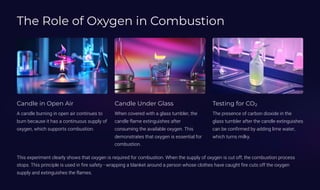
Candle in Open Air
A candle burning in open air continues to
burn because it has a continuous supply of
oxygen, which supports combustion.
Candle Under Glass
When covered with a glass tumbler, the
candle flame extinguishes after
consuming the available oxygen. This
demonstrates that oxygen is essential for
combustion.
Testing for CO¢
The presence of carbon dioxide in the
glass tumbler after the candle extinguishes
can be confirmed by adding lime water,
which turns milky.
This experiment clearly shows that oxygen is required for combustion. When the supply of oxygen is cut off, the combustion process
stops. This principle is used in fire safety - wrapping a blanket around a person whose clothes have caught fire cuts off the oxygen
supply and extinguishes the flames.
Ignition Temperature: The Starting Point
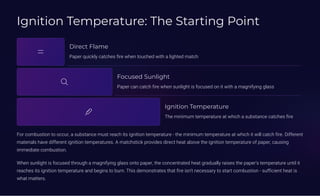
Direct Flame
Paper quickly catches fire when touched with a lighted match
Focused Sunlight
Paper can catch fire when sunlight is focused on it with a magnifying glass
Ignition Temperature
The minimum temperature at which a substance catches fire
For combustion to occur, a substance must reach its ignition temperature - the minimum temperature at which it will catch fire. Different
materials have different ignition temperatures. A matchstick provides direct heat above the ignition temperature of paper, causing
immediate combustion.
When sunlight is focused through a magnifying glass onto paper, the concentrated heat gradually raises the paper's temperature until it
reaches its ignition temperature and begins to burn. This demonstrates that fire isn't necessary to start combustion - sufficient heat is
what matters.
The Burning Candle: Physical and Chemical
Changes Together
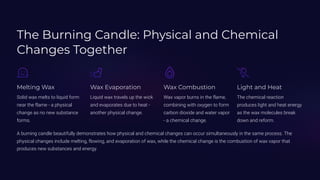
Melting Wax
Solid wax melts to liquid form
near the flame - a physical
change as no new substance
forms.
Wax Evaporation
Liquid wax travels up the wick
and evaporates due to heat -
another physical change.
Wax Combustion
Wax vapor burns in the flame,
combining with oxygen to form
carbon dioxide and water vapor
- a chemical change.
Light and Heat
The chemical reaction
produces light and heat energy
as the wax molecules break
down and reform.
A burning candle beautifully demonstrates how physical and chemical changes can occur simultaneously in the same process. The
physical changes include melting, flowing, and evaporation of wax, while the chemical change is the combustion of wax vapor that
produces new substances and energy.
Reversible vs. Irreversible Changes
Change Reversible? Type of Change Explanation
Melting ice cubes Yes Physical Water can be refrozen into
ice
Boiling water Yes Physical Steam can condense back to
water
Chopping vegetables No Physical Cannot restore original
shape
Making popcorn No Chemical New substances formed
Rusting of iron No Chemical New substance (iron oxide)
formed
Changes can be classified as reversible or irreversible based on whether we can get back the original substance. Most physical changes
are reversible - like melting ice or dissolving salt in water. Most chemical changes are irreversible - like burning paper or cooking an egg.
However, not all physical changes are reversible (like cutting paper), and some chemical changes can be reversed through other
chemical processes (like electrolysis of water).
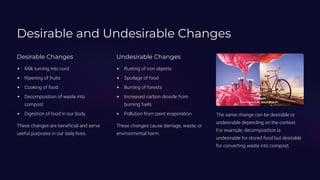
Desirable and Undesirable Changes
Desirable Changes
Milk turning into curd
Ripening of fruits
Cooking of food
Decomposition of waste into
compost
Digestion of food in our body
These changes are beneficial and serve
useful purposes in our daily lives.
Undesirable Changes
Rusting of iron objects
Spoilage of food
Burning of forests
Increased carbon dioxide from
burning fuels
Pollution from paint evaporation
These changes cause damage, waste, or
environmental harm.
The same change can be desirable or
undesirable depending on the context.
For example, decomposition is
undesirable for stored food but desirable
for converting waste into compost.
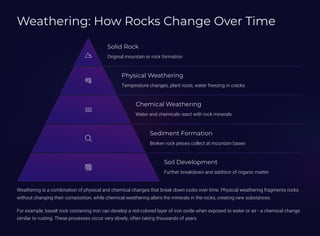
Weathering: How Rocks Change Over Time
Solid Rock
Original mountain or rock formation
Physical Weathering
Temperature changes, plant roots, water freezing in cracks
Chemical Weathering
Water and chemicals react with rock minerals
Sediment Formation
Broken rock pieces collect at mountain bases
Soil Development
Further breakdown and addition of organic matter
Weathering is a combination of physical and chemical changes that break down rocks over time. Physical weathering fragments rocks
without changing their composition, while chemical weathering alters the minerals in the rocks, creating new substances.
For example, basalt rock containing iron can develop a red-colored layer of iron oxide when exposed to water or air - a chemical change
similar to rusting. These processes occur very slowly, often taking thousands of years.
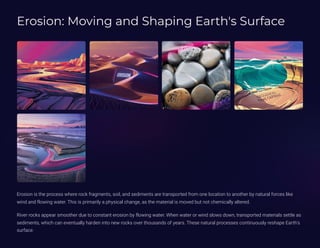
Erosion: Moving and Shaping Earth's Surface
Erosion is the process where rock fragments, soil, and sediments are transported from one location to another by natural forces like
wind and flowing water. This is primarily a physical change, as the material is moved but not chemically altered.
River rocks appear smoother due to constant erosion by flowing water. When water or wind slows down, transported materials settle as
sediments, which can eventually harden into new rocks over thousands of years. These natural processes continuously reshape Earth's
surface.
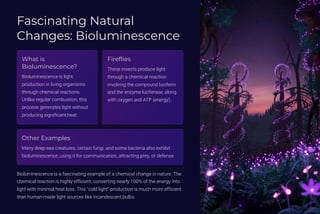
Fascinating Natural
Changes: Bioluminescence
What is
Bioluminescence?
Bioluminescence is light
production in living organisms
through chemical reactions.
Unlike regular combustion, this
process generates light without
producing significant heat.
Fireflies
These insects produce light
through a chemical reaction
involving the compound luciferin
and the enzyme luciferase, along
with oxygen and ATP (energy).
Other Examples
Many deep-sea creatures, certain fungi, and some bacteria also exhibit
bioluminescence, using it for communication, attracting prey, or defense.
Bioluminescence is a fascinating example of a chemical change in nature. The
chemical reaction is highly efficient, converting nearly 100% of the energy into
light with minimal heat loss. This "cold light" production is much more efficient
than human-made light sources like incandescent bulbs.
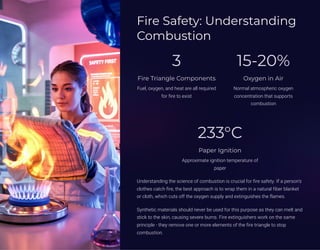
Fire Safety: Understanding
Combustion
3
Fire Triangle Components
Fuel, oxygen, and heat are all required
for fire to exist
15-20%
Oxygen in Air
Normal atmospheric oxygen
concentration that supports
combustion
233°C
Paper Ignition
Approximate ignition temperature of
paper
Understanding the science of combustion is crucial for fire safety. If a person's
clothes catch fire, the best approach is to wrap them in a natural fiber blanket
or cloth, which cuts off the oxygen supply and extinguishes the flames.
Synthetic materials should never be used for this purpose as they can melt and
stick to the skin, causing severe burns. Fire extinguishers work on the same
principle - they remove one or more elements of the fire triangle to stop
combustion.
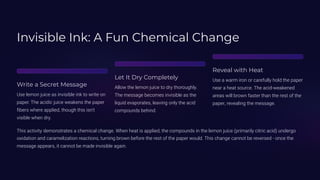
Invisible Ink: A Fun Chemical Change
Write a Secret Message
Use lemon juice as invisible ink to write on
paper. The acidic juice weakens the paper
fibers where applied, though this isn't
visible when dry.
Let It Dry Completely
Allow the lemon juice to dry thoroughly.
The message becomes invisible as the
liquid evaporates, leaving only the acid
compounds behind.
Reveal with Heat
Use a warm iron or carefully hold the paper
near a heat source. The acid-weakened
areas will brown faster than the rest of the
paper, revealing the message.
This activity demonstrates a chemical change. When heat is applied, the compounds in the lemon juice (primarily citric acid) undergo
oxidation and caramelization reactions, turning brown before the rest of the paper would. This change cannot be reversed - once the
message appears, it cannot be made invisible again.
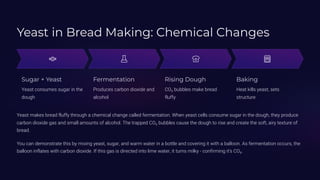
Yeast in Bread Making: Chemical Changes
Sugar + Yeast
Yeast consumes sugar in the
dough
Fermentation
Produces carbon dioxide and
alcohol
Rising Dough
CO¢ bubbles make bread
fluffy
Baking
Heat kills yeast, sets
structure
Yeast makes bread fluffy through a chemical change called fermentation. When yeast cells consume sugar in the dough, they produce
carbon dioxide gas and small amounts of alcohol. The trapped CO¢ bubbles cause the dough to rise and create the soft, airy texture of
bread.
You can demonstrate this by mixing yeast, sugar, and warm water in a bottle and covering it with a balloon. As fermentation occurs, the
balloon inflates with carbon dioxide. If this gas is directed into lime water, it turns milky - confirming it's CO¢.
Chameleons: Color Changes in Nature
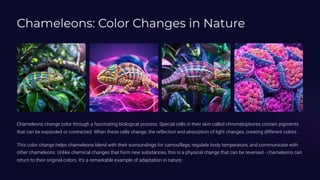
Chameleons change color through a fascinating biological process. Special cells in their skin called chromatophores contain pigments
that can be expanded or contracted. When these cells change, the reflection and absorption of light changes, creating different colors.
This color change helps chameleons blend with their surroundings for camouflage, regulate body temperature, and communicate with
other chameleons. Unlike chemical changes that form new substances, this is a physical change that can be reversed - chameleons can
return to their original colors. It's a remarkable example of adaptation in nature.
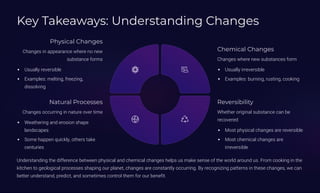
Key Takeaways: Understanding Changes
Understanding the difference between physical and chemical changes helps us make sense of the world around us. From cooking in the
kitchen to geological processes shaping our planet, changes are constantly occurring. By recognizing patterns in these changes, we can
better understand, predict, and sometimes control them for our benefit.
Physical Changes
Changes in appearance where no new
substance forms
Usually reversible
Examples: melting, freezing,
dissolving
Chemical Changes
Changes where new substances form
Usually irreversible
Examples: burning, rusting, cooking
Reversibility
Whether original substance can be
recovered
Most physical changes are reversible
Most chemical changes are
irreversible
Natural Processes
Changes occurring in nature over time
Weathering and erosion shape
landscapes
Some happen quickly, others take
centuries