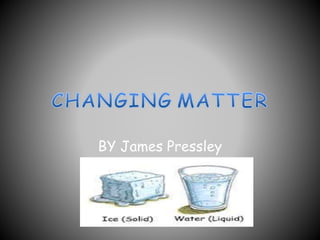
BY James Pressley
Changing Matter 
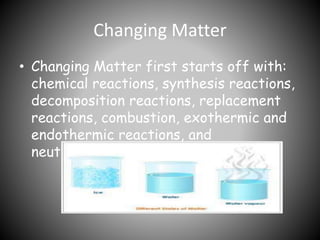
• Changing Matter first starts off with: 
chemical reactions, synthesis reactions, 
decomposition reactions, replacement 
reactions, combustion, exothermic and 
endothermic reactions, and 
neutralization.
Chemical Reactions 
• Chemical reactions changes matter 
come when different types of matter 
interact with each other or with 
sources of energy. In any chemical 
reaction there are two parts. Reactants 
are the substances that go into the 
reaction: products are the new 
substances that are produced.
Synthesis Reactions 
• In synthesis reactions, two or more 
substances chemically join to form a 
new compound. Rust is formed when the 
iron in a bike rim, for example, and the 
oxygen in air react chemically. This is an 
oxidation reaction.
Decomposition Reactions 
• Some compounds will break down into 
two or more simpler substances. An 
example of a decomposition reaction is 
souring milk. Lactose is a sugar in milk. 
It breaks down into lactic acid , 
producing a sugar taste.
Replacement Reactions 
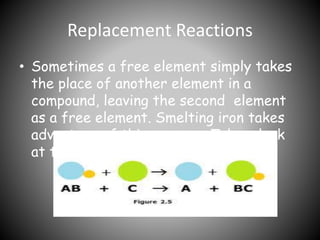
• Sometimes a free element simply takes 
the place of another element in a 
compound, leaving the second element 
as a free element. Smelting iron takes 
advantage of this process. Take a look 
at the following equation.
Combustion 
A combustion reaction is when oxygen 
combines with another compound to 
form water and carbon dioxide. 
Combustion is really the chemical 
process of burning.
Exothermic & Endothermic Reactions 
• One result of chemical reactions is 
temperature change. Some chemical 
reactions, called exothermic reactions, 
release heat, producing an increase in 
temperature. 
• Endothermic reactions absorb heat 
energy and produce a rise in 
temperature.
Neutralization 
In the last issue you learned that 
compounds can be categorized as acids 
and bases. Strong acids and strong bases 
can have corrosive and dangerous effects. 
Here is an example of neutralization 
reactions:

Science Indicators (changing matter)

  • 1.
  • 2.
    Changing Matter •Changing Matter first starts off with: chemical reactions, synthesis reactions, decomposition reactions, replacement reactions, combustion, exothermic and endothermic reactions, and neutralization.
  • 3.
    Chemical Reactions •Chemical reactions changes matter come when different types of matter interact with each other or with sources of energy. In any chemical reaction there are two parts. Reactants are the substances that go into the reaction: products are the new substances that are produced.
  • 4.
    Synthesis Reactions •In synthesis reactions, two or more substances chemically join to form a new compound. Rust is formed when the iron in a bike rim, for example, and the oxygen in air react chemically. This is an oxidation reaction.
  • 5.
    Decomposition Reactions •Some compounds will break down into two or more simpler substances. An example of a decomposition reaction is souring milk. Lactose is a sugar in milk. It breaks down into lactic acid , producing a sugar taste.
  • 6.
    Replacement Reactions •Sometimes a free element simply takes the place of another element in a compound, leaving the second element as a free element. Smelting iron takes advantage of this process. Take a look at the following equation.
  • 7.
    Combustion A combustionreaction is when oxygen combines with another compound to form water and carbon dioxide. Combustion is really the chemical process of burning.
  • 8.
    Exothermic & EndothermicReactions • One result of chemical reactions is temperature change. Some chemical reactions, called exothermic reactions, release heat, producing an increase in temperature. • Endothermic reactions absorb heat energy and produce a rise in temperature.
  • 9.
    Neutralization In thelast issue you learned that compounds can be categorized as acids and bases. Strong acids and strong bases can have corrosive and dangerous effects. Here is an example of neutralization reactions: