Unit 1 Review
Science 24
Chapter 1- Useful Chemistry
Chemistry Then and Now
- Farmers used to do their jobs which involved
a lot of labour. Thanks to modern chemistry,
farmers have a more efficient way to get jobs
done.
Farmers use synthetic (non-natural) chemicals
to control pests. Pesticides come in 2 types:
Herbicides kill unwanted plants, like weeds.
Insecticides kill bugs like grasshoppers, which
can devastate a crop.
People of the past also used to make their own soap
using ashes from fires and animal fat.
Modern chemists substitute plant oils for animal fat.
Soaps can either contain perfumes to make you smell
better, exfoliants to scrub off dead skin, or other
additives.
Soaps contain strong bases. The bases produce soap
when they react with the fatty acids in grease. One
molecule in soap dissolves in grease and another
molecule dissolves in water. This reaction enables us
to wash away grease.
Chemistry and Synthetics
Fabric for clothes was often taken from nature.
Examples are cotton from the cotton plant, linen from
the flax plant, wools from the coats of sheep, and
fibres from the cocoons of silk worms were made into
silk.
Chemists have produced man-made fibres to make
clothing. The first was nylon, which is made from coal,
water and air.
Examples are polyester, Gore-Tex
TM
and Kevlar.
Plastics, Polymers, and Alloys
Polymers are compounds that occur in nature. A
spider web and sap from rubber trees are
examples. Synthetic polymers have been created
to suit particular needs such as plastics.
Alloys are mixtures of metals that have properties
of the original metal but also have other
properties. For example, gold is a very soft metal
that would never keep its shape as jewelry. 14k
gold is an alloy made of gold, silver, and copper.
Chemistry at Home
We have chemicals in our houses that each has
a purpose for. We have cleaners for ovens,
floors, and etc. We have chemicals that help
clean and protect cuts like hydrogen peroxide.
We also have chemicals that, when mixed
together, can be a food source. For example,
we can add together yeast, flour, and other
things to make bread.
Chemistry at Work
Think of all the types of jobs out there and the
chemicals they use. Some examples are:
Automotive repair shops
Hair salons
Office work
Construction sites
WHMIS or Workplace Hazardous Material
Information System is useful information on the
store, handle and dispose of dangerous
materials that may be used at work.
Chapter 2- Useful Reactions
In chemical reactions, substances react to
produce new substances.
The active component in bleach reacts with
stains to make the stain colourless.
The yeast in bread reacts to create carbon
dioxide, a gas that gives the bread its airy
texture. The chlorine in swimming pools mixes
with water to create an acid to kill micro-
organisms in the pool.
The Changes that Occur
In a chemical reaction, the
substances that you start with are
not the same as the substances
that you end with.
This type of change cannot be
reversed.
Combustion is the burning of a
substance that occurs in the presence
of oxygen.
Energy is given off.
Neutralization is another chemical
reaction where an acid and a base are
combined to create a compound and
water.
Evidence that a Reaction has
Occurred
-a different colour is produced
-an odour, or smell, can be detected
-Bubbles appear as gas forms
-a solid, or precipitate, forms
-energy is given off in forms of light,
heat, or sound--- or absorbed
Energy and Chemical Reactions
Chemical changes always involve energy changes.
Some, like fireworks, are obvious
Others, like rust forming, are slow. Heat is actually
released as rust forms!!!
Exothermic- energy is released in the environment.
Endothermic- energy is absorbed and can feel cool to
the touch.
Chapter 3- Types of Chemical Reactions
Word equations uses words (no!) to indicate
what changed during the reaction and what is
produced.
Writing word equations has a format that never
changes.
-The left side lists all the reactants
-The right side lists all the products
-An arrow is used to show that a reaction takes
place
Types of Reactions
1.Simple composition- two or more elements
form a compound.
2.Simple decomposition- a compound that
breaks into its component elements.
3.Combustion- oxygen, ignition, and a fuel
source burns to produce carbon dioxide,
water vapour and energy.
4.Neutralization- an acid reacts with a base to
produce a form of salt and water.
Formulas for Common Compounds
Example: sulfur + zinc  zinc sulfide
The metal is named first and the non-metal
follows with an “ide” attached to the name.
Common names of compounds are often used
simply because its easier to remember.
We use the name of salt instead of sodium
chloride. Water instead of dihydrogen oxide.
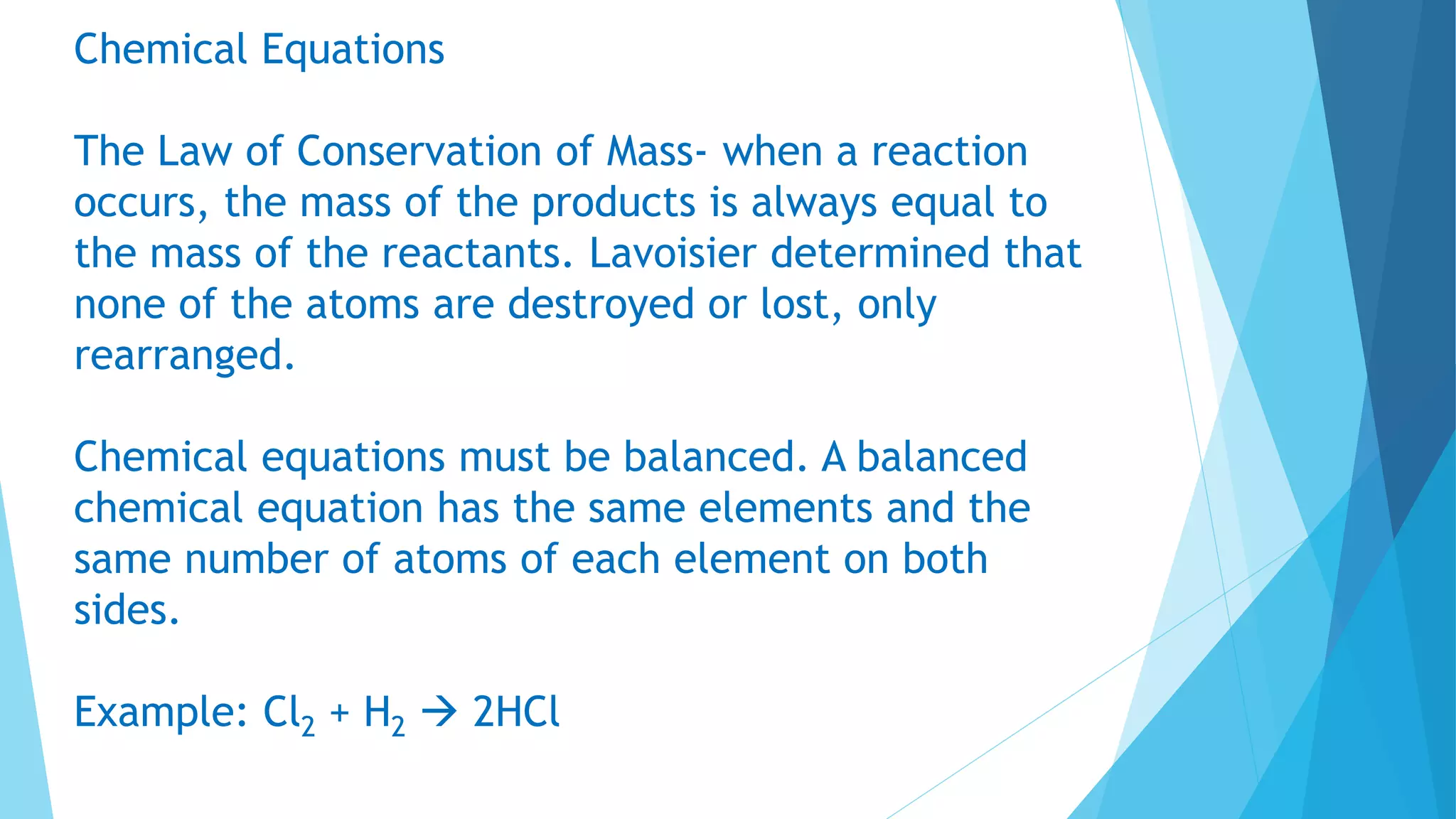
Chemical Equations
The Law of Conservation of Mass- when a reaction
occurs, the mass of the products is always equal to
the mass of the reactants. Lavoisier determined that
none of the atoms are destroyed or lost, only
rearranged.
Chemical equations must be balanced. A balanced
chemical equation has the same elements and the
same number of atoms of each element on both
sides.
Example: Cl2 + H2  2HCl

Science 24 Unit A Review

  • 1.
  • 2.
    Chapter 1- UsefulChemistry Chemistry Then and Now - Farmers used to do their jobs which involved a lot of labour. Thanks to modern chemistry, farmers have a more efficient way to get jobs done. Farmers use synthetic (non-natural) chemicals to control pests. Pesticides come in 2 types: Herbicides kill unwanted plants, like weeds. Insecticides kill bugs like grasshoppers, which can devastate a crop.
  • 3.
    People of thepast also used to make their own soap using ashes from fires and animal fat. Modern chemists substitute plant oils for animal fat. Soaps can either contain perfumes to make you smell better, exfoliants to scrub off dead skin, or other additives. Soaps contain strong bases. The bases produce soap when they react with the fatty acids in grease. One molecule in soap dissolves in grease and another molecule dissolves in water. This reaction enables us to wash away grease.
  • 4.
    Chemistry and Synthetics Fabricfor clothes was often taken from nature. Examples are cotton from the cotton plant, linen from the flax plant, wools from the coats of sheep, and fibres from the cocoons of silk worms were made into silk. Chemists have produced man-made fibres to make clothing. The first was nylon, which is made from coal, water and air. Examples are polyester, Gore-Tex TM and Kevlar.
  • 5.
    Plastics, Polymers, andAlloys Polymers are compounds that occur in nature. A spider web and sap from rubber trees are examples. Synthetic polymers have been created to suit particular needs such as plastics. Alloys are mixtures of metals that have properties of the original metal but also have other properties. For example, gold is a very soft metal that would never keep its shape as jewelry. 14k gold is an alloy made of gold, silver, and copper.
  • 6.
    Chemistry at Home Wehave chemicals in our houses that each has a purpose for. We have cleaners for ovens, floors, and etc. We have chemicals that help clean and protect cuts like hydrogen peroxide. We also have chemicals that, when mixed together, can be a food source. For example, we can add together yeast, flour, and other things to make bread.
  • 7.
    Chemistry at Work Thinkof all the types of jobs out there and the chemicals they use. Some examples are: Automotive repair shops Hair salons Office work Construction sites WHMIS or Workplace Hazardous Material Information System is useful information on the store, handle and dispose of dangerous materials that may be used at work.
  • 8.
    Chapter 2- UsefulReactions In chemical reactions, substances react to produce new substances. The active component in bleach reacts with stains to make the stain colourless. The yeast in bread reacts to create carbon dioxide, a gas that gives the bread its airy texture. The chlorine in swimming pools mixes with water to create an acid to kill micro- organisms in the pool.
  • 9.
    The Changes thatOccur In a chemical reaction, the substances that you start with are not the same as the substances that you end with. This type of change cannot be reversed.
  • 10.
    Combustion is theburning of a substance that occurs in the presence of oxygen. Energy is given off. Neutralization is another chemical reaction where an acid and a base are combined to create a compound and water.
  • 11.
    Evidence that aReaction has Occurred -a different colour is produced -an odour, or smell, can be detected -Bubbles appear as gas forms -a solid, or precipitate, forms -energy is given off in forms of light, heat, or sound--- or absorbed
  • 12.
    Energy and ChemicalReactions Chemical changes always involve energy changes. Some, like fireworks, are obvious Others, like rust forming, are slow. Heat is actually released as rust forms!!! Exothermic- energy is released in the environment. Endothermic- energy is absorbed and can feel cool to the touch.
  • 13.
    Chapter 3- Typesof Chemical Reactions Word equations uses words (no!) to indicate what changed during the reaction and what is produced. Writing word equations has a format that never changes. -The left side lists all the reactants -The right side lists all the products -An arrow is used to show that a reaction takes place
  • 14.
    Types of Reactions 1.Simplecomposition- two or more elements form a compound. 2.Simple decomposition- a compound that breaks into its component elements. 3.Combustion- oxygen, ignition, and a fuel source burns to produce carbon dioxide, water vapour and energy. 4.Neutralization- an acid reacts with a base to produce a form of salt and water.
  • 15.
    Formulas for CommonCompounds Example: sulfur + zinc  zinc sulfide The metal is named first and the non-metal follows with an “ide” attached to the name. Common names of compounds are often used simply because its easier to remember. We use the name of salt instead of sodium chloride. Water instead of dihydrogen oxide.
  • 16.
    Chemical Equations The Lawof Conservation of Mass- when a reaction occurs, the mass of the products is always equal to the mass of the reactants. Lavoisier determined that none of the atoms are destroyed or lost, only rearranged. Chemical equations must be balanced. A balanced chemical equation has the same elements and the same number of atoms of each element on both sides. Example: Cl2 + H2  2HCl