Physical vs. ChemicalChanges
Physical changes occur when substances or
objects undergo a change without changing into
another substance
Chemical changes are changes substances undergo
when they become new or different substances.
3.
Physical vs. ChemicalChanges
Remember that after a:
Physical change – object’s identity remains the same
Usually involves energy (like heat) and states of
matter.
Chemical change – object’s identity changes
Chemical changes happen on a molecular level
http://www.chem4kids.com/files/matter_chemphys.html
4.
Physical Change
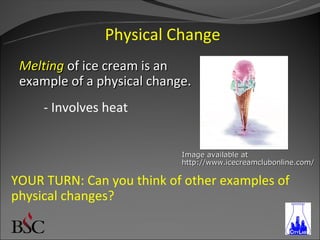
Meltingof ice cream is an
example of a physical change.
- Involves heat
Image available at
http://www.icecreamclubonline.com/
YOUR TURN: Can you think of other examples of
physical changes?
5.
Chemical Change
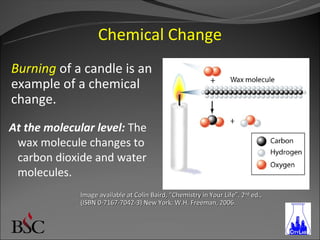
Burning ofa candle is an
example of a chemical
change.
At the molecular level: The
wax molecule changes to
carbon dioxide and water
molecules.
Image available at Colin Baird, “Chemistry in Your Life”. 2nd ed.,
(ISBN 0-7167-7042-3) New York: W.H. Freeman, 2006.
6.
Other examples ofchemical changes
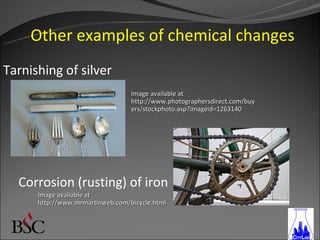
Tarnishing of silver
Image available at
http://www.photographersdirect.com/buy
ers/stockphoto.asp?imageid=1263140
Corrosion (rusting) of iron
Image available at
http://www.mrmartinweb.com/bicycle.html
7.
Other examples ofchemical changes
Can you think of another term for chemical
changes?
Chemical change = chemical reaction
YOUR TURN: Can you think of other examples of
everyday life chemical reactions?
8.
Can you identifythe following changes as
physical or chemical?
Melting of ice
Digestion of food
Formation of frost on your window
Milk turns sour
Crushing a plastic bottle
Fireworks
9.
Collecting and PreservingEvidence
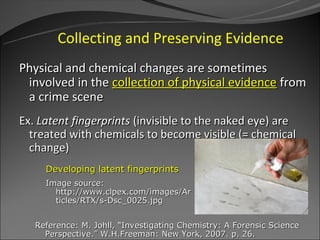
Physical and chemical changes are sometimes
involved in the collection of physical evidence from
a crime scene
Ex. Latent fingerprints (invisible to the naked eye) are
treated with chemicals to become visible (= chemical
change)
Developing latent fingerprints
Image source:
http://www.clpex.com/images/Ar
ticles/RTX/s-Dsc_0025.jpg
Reference: M. Johll, “Investigating Chemistry: A Forensic Science
Perspective.” W.H.Freeman: New York, 2007. p. 26.
10.
Collecting and PreservingEvidence
Ex. Bloody clothes are dried out to prevent the
blood from decomposing.
Identify the underlined words above as either a
physical or chemical change.
Question: Why are evidence collected in separate
containers?
Reference: M. Johll, 2007, p. 25
11.
Identifying chemical changes
Chemicalchanges are more difficult to identify than physical
changes
Can’t see changes in molecules
But we can look for observable signs
color change
bubbling and fizzing
light production
smoke, and
presence of heat
http://www.usoe.k12.ut.us/curr/Science/sciber00/8th/matter/
sciber/chemchng.htm
12.
Everyday life chemicalchanges/reactions
Acid-base reactions
Q. Do you know where in our body do we have acids?
Q. Can you give some examples of acids? Bases?
Q. Can you give an example of acid-base reaction?
13.
Everyday life chemicalchanges/reactions
Oxidation reactions
Q. Can you tell which gas is used or produced during
oxidation?
Q. What could be an observable sign of oxidation
reaction?
Image available atC. Snyder, “The Extraordinary
Chemistry of Ordinary Things,” 4th ed. Wiley, 2003.
16.
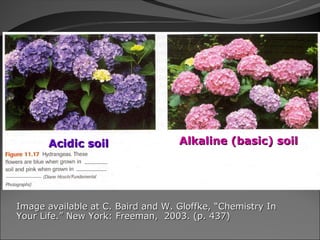
Acidic soil Alkaline (basic) soil
Image available at C. Baird and W. Gloffke, “Chemistry In
Your Life.” New York: Freeman, 2003. (p. 437)
17.
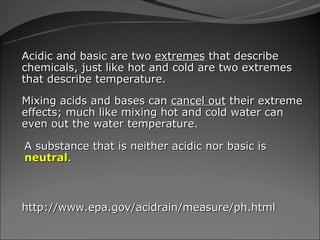
Acidic and basicare two extremes that describe
chemicals, just like hot and cold are two extremes
that describe temperature.
Mixing acids and bases can cancel out their extreme
effects; much like mixing hot and cold water can
even out the water temperature.
A substance that is neither acidic nor basic is
neutral.
http://www.epa.gov/acidrain/measure/ph.html
#12 To identify a chemical change look for observable signs such as …
#15 Many objects and solutions that we use encounter everyday are either acids or bases. Can you tell them apart?
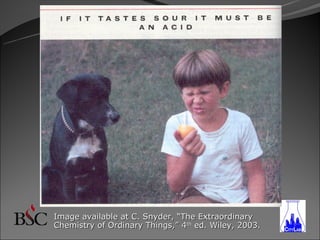
#16 Edible acids taste sour. (Remember, we don’t taste chemicals like cleaners) Edible bases taste bitter. Can you name some bases?
#17 Some uses of acids and bases in your garden. Acidic soil does not always support plant growth. Hence, lime (a base) is added to make the soil less acidic.. Sometimes, the acidity of soil determines the color of flowers.
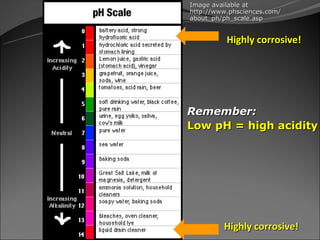
#19 The term pH refers to the degree of acidity of substances. Scientists use the pH scale to compare acidity of objects. The scale ranges from 0-14. A pH of 7 is neutral. A pH less than 7 is acidic, and a pH greater than 7 is basic.