PHYSICAL AND CHEMICAL CHANGES
Presentation By
Nelson.C.S
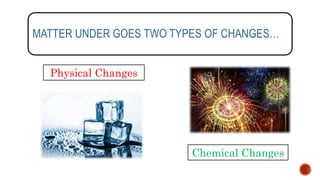
MATTER UNDER GOES TWO TYPES OF CHANGES…
Physical Changes
Chemical Changes
PHYSICAL
CHANGES
WHAT IS PHYSICAL CHANGE?
A Physical Change alters the form of a
substance, but does not change it to another
substance.
It changes shape or size.
It dissolves.
It changes phase (freezes, boils, evaporates,
condenses)
EXAMPLES OF
PHYSICAL CHANGE
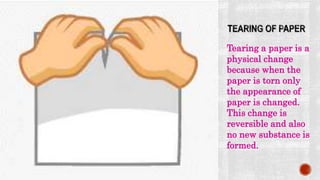
Tearing a paper is a
physical change
because when the
paper is torn only
the appearance of
paper is changed.
This change is
reversible and also
no new substance is
formed.
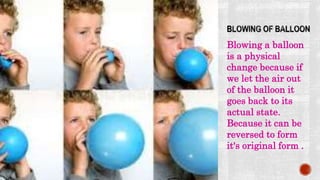
Blowing a balloon
is a physical
change because if
we let the air out
of the balloon it
goes back to its
actual state.
Because it can be
reversed to form
it's original form .
CHEMICAL
CHANGES
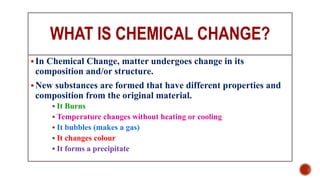
WHAT IS CHEMICAL CHANGE?
In Chemical Change, matter undergoes change in its
composition and/or structure.
New substances are formed that have different properties and
composition from the original material.
 It Burns
 Temperature changes without heating or cooling
 It bubbles (makes a gas)
 It changes colour
 It forms a precipitate
EXAMPLES OF
CHEMICAL CHANGE
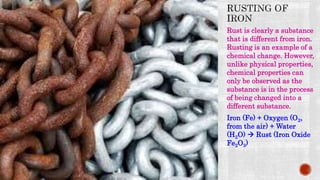
Rust is clearly a substance
that is different from iron.
Rusting is an example of a
chemical change. However,
unlike physical properties,
chemical properties can
only be observed as the
substance is in the process
of being changed into a
different substance.
Iron (Fe) + Oxygen (O2,
from the air) + Water
(H2O)  Rust (Iron Oxide
Fe2O3)
CO2 AND [CA(OH)2]
Carbon dioxide reacts with
limewater to form calcium
carbonate, which
precipitates out of the
solution. The carbon
dioxide and limewater
react to produce calcium
carbonate and water. ...
The white milky
suspension/precipitate is
caused by the formation of
calcium carbonate.
Carbon Dioxide (CO2) + Lime
Water [Ca(OH)2]  Calcium
Carbonate (CaCO3) + Water
(H2O)
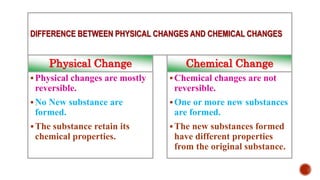
DIFFERENCE BETWEEN PHYSICAL CHANGES AND CHEMICAL CHANGES
Physical Change
Physical changes are mostly
reversible.
No New substance are
formed.
The substance retain its
chemical properties.
Chemical Change
Chemical changes are not
reversible.
One or more new substances
are formed.
The new substances formed
have different properties
from the original substance.
Physical and chemical changes

Physical and chemical changes

  • 1.
    PHYSICAL AND CHEMICALCHANGES Presentation By Nelson.C.S
  • 2.
    MATTER UNDER GOESTWO TYPES OF CHANGES… Physical Changes Chemical Changes
  • 3.
  • 4.
    WHAT IS PHYSICALCHANGE? A Physical Change alters the form of a substance, but does not change it to another substance. It changes shape or size. It dissolves. It changes phase (freezes, boils, evaporates, condenses)
  • 5.
  • 6.
    Tearing a paperis a physical change because when the paper is torn only the appearance of paper is changed. This change is reversible and also no new substance is formed.
  • 7.
    Blowing a balloon isa physical change because if we let the air out of the balloon it goes back to its actual state. Because it can be reversed to form it's original form .
  • 8.
  • 9.
    WHAT IS CHEMICALCHANGE? In Chemical Change, matter undergoes change in its composition and/or structure. New substances are formed that have different properties and composition from the original material.  It Burns  Temperature changes without heating or cooling  It bubbles (makes a gas)  It changes colour  It forms a precipitate
  • 10.
  • 11.
    Rust is clearlya substance that is different from iron. Rusting is an example of a chemical change. However, unlike physical properties, chemical properties can only be observed as the substance is in the process of being changed into a different substance. Iron (Fe) + Oxygen (O2, from the air) + Water (H2O)  Rust (Iron Oxide Fe2O3)
  • 12.
    CO2 AND [CA(OH)2] Carbondioxide reacts with limewater to form calcium carbonate, which precipitates out of the solution. The carbon dioxide and limewater react to produce calcium carbonate and water. ... The white milky suspension/precipitate is caused by the formation of calcium carbonate. Carbon Dioxide (CO2) + Lime Water [Ca(OH)2]  Calcium Carbonate (CaCO3) + Water (H2O)
  • 13.
    DIFFERENCE BETWEEN PHYSICALCHANGES AND CHEMICAL CHANGES Physical Change Physical changes are mostly reversible. No New substance are formed. The substance retain its chemical properties. Chemical Change Chemical changes are not reversible. One or more new substances are formed. The new substances formed have different properties from the original substance.