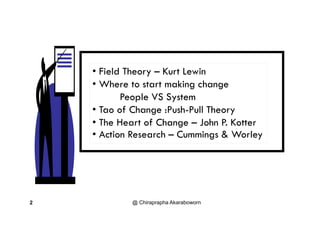
• Field Theory– Kurt Lewin
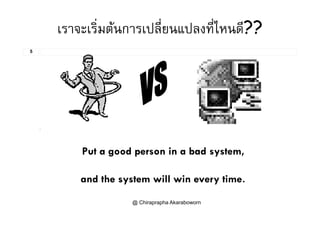
• Where to start making changeWhere to start making change
People VS System
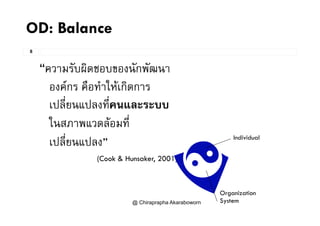
• Tao of Change :Push-Pull Theoryao o C a ge us u eo y
• The Heart of Change – John P. Kotter
• Action Research – Cummings & Worleyg y
@ Chiraprapha Akaraboworn2
3.
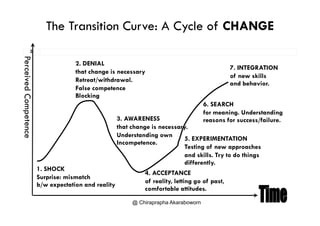
The Transition Curve:A Cycle of CHANGE
3
2 DENIAL
Pe
2. DENIAL
that change is necessary
Retreat/withdrawal.
False competence
7. INTEGRATION
of new skills
and behavior.
erceived
False competence
Blocking
6. SEARCH
for meaning Understanding
dComp
3. AWARENESS
that change is necessary.
Understanding own
5 EXPERIMENTATION
for meaning. Understanding
reasons for success/failure.
petence
Incompetence.
5. EXPERIMENTATION
Testing of new approaches
and skills. Try to do things
differently.
1. SHOCK
Surprise: mismatch
b/w expectation and reality
4. ACCEPTANCE
of reality, letting go of past,
comfortable attitudes.
differently.
@ Chiraprapha Akaraboworn
comfortable attitudes.
4.
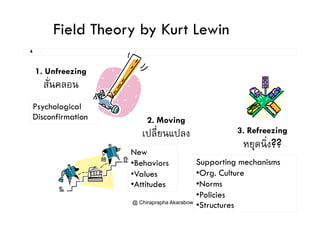
Field Theory byKurt Lewin
4
y y
1. Unfreezing
สั่นคลอนสนคลอน
Psychological
2. Moving
เปลี่ยนแปลง 3. Refreezing
่
Disconfirmation
หยุดนิง??
New
•Behaviors Supporting mechanismsBehaviors
•Values
•Attitudes
Supporting mechanisms
•Org. Culture
•Norms
@ Chiraprapha Akaraboworn
•Policies
•Structures
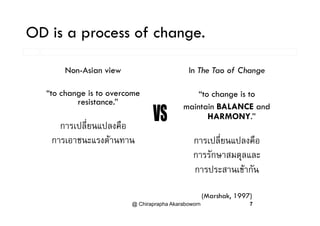
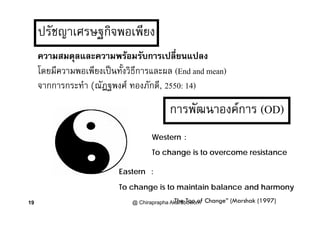
OD is aprocess of change.OD is a process of change.
In The Tao of ChangeNon-Asian view
“to change is to
maintain BALANCE and
“to change is to overcome
resistance.”
HARMONY.”
ป ี่ ป ื
การเปลี่ยนแปลงคือ
การเอาชนะแรงตานทาน การเปลยนแปลงคอ
การรักษาสมดุลและ
การเอาชนะแรงตานทาน
การประสานเขากัน
@ Chiraprapha Akaraboworn 7
(Marshak, 1997)
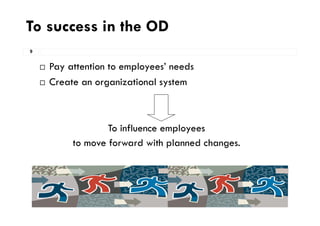
To success inthe OD
9
Pay attention to employees’ needs
Create an organizational system
To influence employees
to move forward with planned changes.
@ Chiraprapha Akaraboworn
10.
Team Up
10
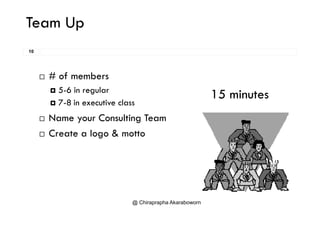
#of members
5 6 l 5-6 in regular
7-8 in executive class
15 minutes
Name your Consulting Team
Create a logo & motto
@ Chiraprapha Akaraboworn
11.
Push-Pull Theory
11
Manufacturers andworkplaces can no longer base production
on desktop planning alone and then distribute, or push, them
t th k t It h b tt f fonto the market. It has become a matter of course for
customers, or users, each with a different value system, to
stand in the frontline of the marketplace and so to speak,stand in the frontline of the marketplace and so to speak,
pull the good they need, in the amount and at the time they
need them.
(Ono & Ohno, 1988, p. xiv)(Ono & Ohno, 1988, p. xiv)
@ Chiraprapha Akaraboworn
12.
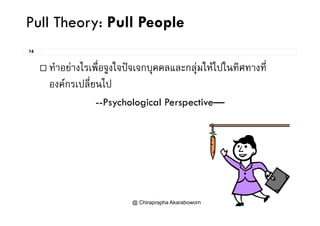
Push System &Pull People
12
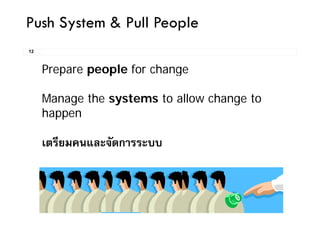
Prepare people for change
Manage the systems to allow change to
happenhappen
ี ัเตรียมคนและจัดการระบบ
@ Chiraprapha Akaraboworn
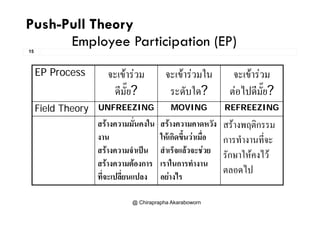
Push-Pull Theory
15
Employee Participation(EP)
EP Process จะเขารวม
ี ั๊ ?
จะเขารวมใน
ั ใ ?
จะเขารวม
ไป ี ั๊ ?ดีมัย? ระดับใด? ตอไปดีมัย?
Field Theory UNFREEZING MOVING REFREEZINGy
สรางความมั่นคงใน
งาน
สรางความคาดหวัง
ใหเกิดขึ้นวาเมื่อ
สรางพฤติกรรม
การทํางานที่จะงาน
สรางความจําเปน
สรางความตองการ
ใหเกดขนวาเมอ
สําเร็จแลวจะชวย
เราในการทํางาน
การทางานทจะ
รักษาใหคงไว
สรางความตองการ
ที่จะเปลี่ยนแปลง
เราในการทางาน
อยางไร
ตลอดไป
@ Chiraprapha Akaraboworn
16.
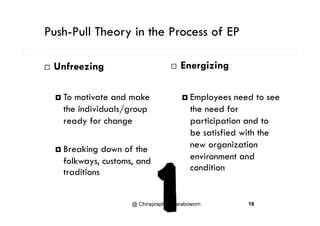
Push-Pull Theory inthe Process of EPy
E i i Unfreezing Energizing
To motivate and make
the individuals/group
Employees need to see
the need for/g p
ready for change participation and to
be satisfied with the
Breaking down of the
folkways, customs, and
new organization
environment and
d
y , ,
traditions condition
@ Chiraprapha Akaraboworn 16
17.
Push-Pull Theory inthe Process of EPy
Ch li Moving Channeling
Identification Why employees
choose the degree to
Internalization
g
which they will be
involved in their job
@ Chiraprapha Akaraboworn 17
18.
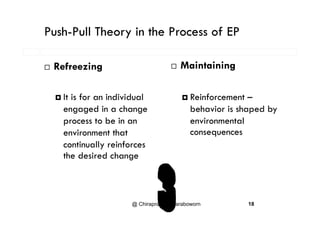
Push-Pull Theory inthe Process of EPy
M i i i Refreezing Maintaining
It is for an individual
engaged in a change
Reinforcement –
behavior is shaped byg g g
process to be in an
environment that
p y
environmental
consequences
continually reinforces
the desired change
@ Chiraprapha Akaraboworn 18
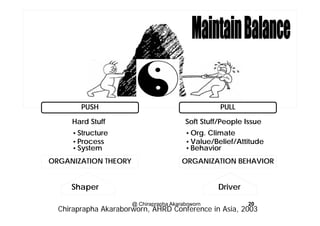
PUSH PULL
Hard Stuff
•Structure
SoftStuff/People Issue
•Org. Climate
/ i f/ i•Process
•System
•Value/Belief/Attitude
•Behavior
ORGANIZATION THEORY ORGANIZATION BEHAVIOR
“Shaper” Driver”
@ Chiraprapha Akaraboworn 20
p
Chiraprapha Akaraborworn, AHRD Conference in Asia, 2003
21.
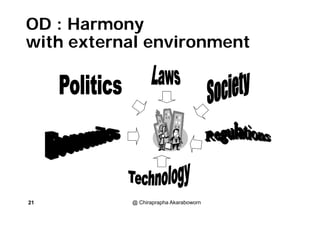
OD : Harmony
itht l i twith external environment
@ Chiraprapha Akaraboworn21
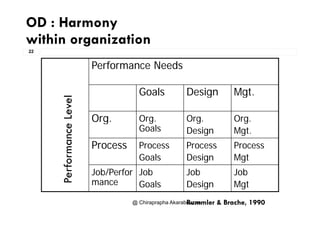
22.
OD : Harmony
ithii ti
22
within organization
P f N dPerformance Needs
Goals Design Mgt.
evel
Org. Org.
Goals
Org.
Design
Org.
Mgt.
nceLe
Process Process
Goals
Process
Design
Process
Mgt
orma
Job/Perfor
mance
Job
Goals
Job
Design
Job
Mgt
Perf
@ Chiraprapha AkarabowornRummler & Brache, 1990
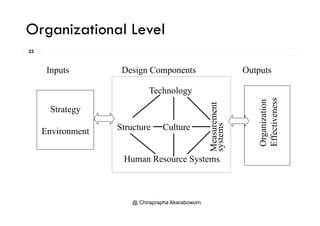
23.
Organizational Level
23
g
Inputs DesignComponents Outputs
h l
Strategy
tion
ness
Technology
ent
gy
Environment
rganizat
ffectiven
Structure Culture
asurem
tems
Or
Ef
Mea
syst
Human Resource Systems
@ Chiraprapha Akaraboworn
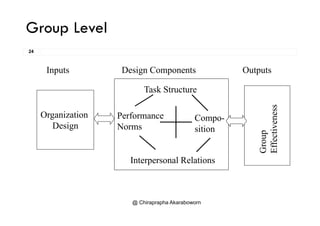
24.
Group Level
24
Inputs DesignComponents Outputs
T k St t
O i ti
Task Structure
P f
ess
Organization
Design
Performance
Norms
Compo-
sition
up
ectivene
Interpersonal Relations
Grou
Effe
p
@ Chiraprapha Akaraboworn
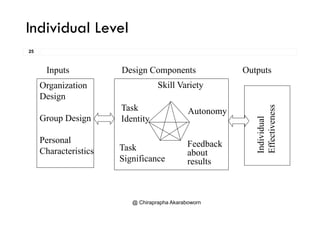
25.
Individual Level
25
Inputs DesignComponents Outputs
Organization Skill VarietyOrganization
Design
Skill Variety
Task Autonomy
ess
Group Design
P l
Identity
Autonomy
vidual
ectivene
Personal
Characteristics Task
Significance
Feedback
about
results
Indiv
Effe
esu ts
@ Chiraprapha Akaraboworn
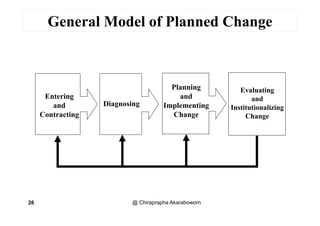
26.
General Model ofPlanned Change
Planning Evaluating
and
Institutionalizing
Planning
and
Implementing
Ch
Diagnosing
Entering
and
C t ti ChangeChangeContracting
@ Chiraprapha Akaraboworn26
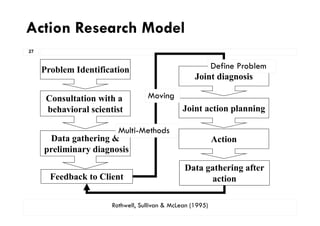
27.
Action Research Model
27
ProblemIdentification
Joint diagnosis
Define Problem
Joint action planning
Consultation with a
behavioral scientist
Moving
p g
Data gathering & Action
Multi-Methods
Data gathering &
preliminary diagnosis
Action
Feedback to Client
Data gathering after
action
@ Chiraprapha Akaraboworn
Rothwell, Sullivan & McLean (1995)
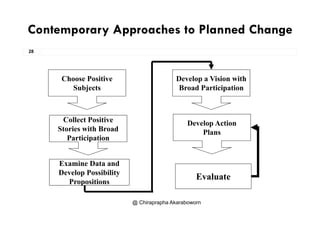
28.
Contemporary Approaches toPlanned Change
28
p y pp
Choose Positive
Subjects
Develop a Vision with
Broad ParticipationSubjects Broad Participation
Collect Positive
Stories with Broad
Participation
Develop Action
Plans
Participation
Examine Data and
Evaluate
Examine Data and
Develop Possibility
Propositions
@ Chiraprapha Akaraboworn
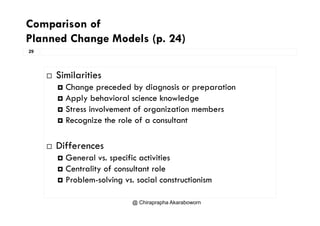
29.
Comparison of
Pl dCh M d l ( 24)
29
Planned Change Models (p. 24)
Similarities
Change preceded by diagnosis or preparation Change preceded by diagnosis or preparation
Apply behavioral science knowledge
Stress involvement of organization membersg
Recognize the role of a consultant
Differences
General vs. specific activities
Centrality of consultant role
Problem-solving vs. social constructionism
@ Chiraprapha Akaraboworn
30.
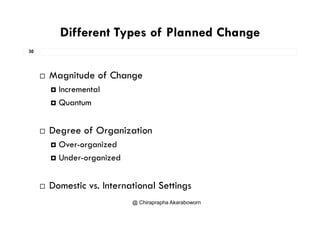
Different Types ofPlanned Change
30
Different Types of Planned Change
Magnitude of Change
I t l Incremental
Quantum
Degree of Organization
Over-organized
Under-organized
Domestic vs. International Settings
@ Chiraprapha Akaraboworn
g
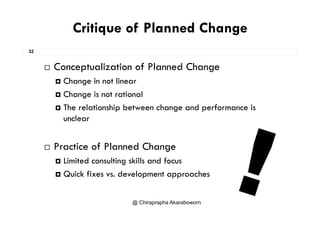
Critique of PlannedChange
32
Conceptualization of Planned Change
Change in not linear
Change is not rational
The relationship between change and performance is
unclear
Practice of Planned Change
Limited consulting skills and focusg
Quick fixes vs. development approaches
@ Chiraprapha Akaraboworn
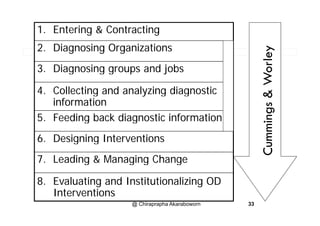
33.
1. Entering &Contracting
2. Diagnosing Organizations
ley
3. Diagnosing groups and jobs
4 C ll ti d l i di ti
Wor
4. Collecting and analyzing diagnostic
information
gs&
5. Feeding back diagnostic information
6 Designing Interventions
mming
6. Designing Interventions
7. Leading & Managing Change
Cum
g g g g
8. Evaluating and Institutionalizing OD
I t ti
@ Chiraprapha Akaraboworn 33
Interventions
34.
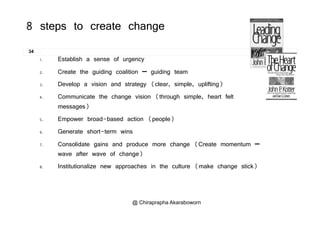
8 steps tocreate change
34
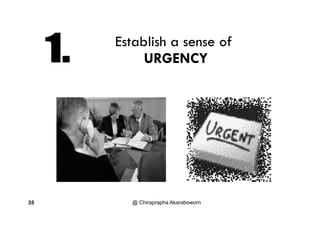
1. Establish a sense of urgencyg y
2. Create the guiding coalition – guiding team
3. Develop a vision and strategy (clear, simple, uplifting)p gy p p g
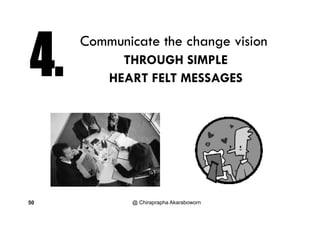
4. Communicate the change vision (through simple, heart felt
messages)
5. Empower broad-based action (people)
6. Generate short-term wins
7. Consolidate gains and produce more change (Create momentum –
wave after wave of change)
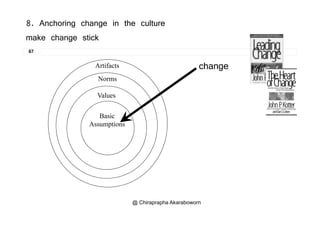
I i i li h i h l ( k h i k)8. Institutionalize new approaches in the culture (make change stick)
@ Chiraprapha Akaraboworn
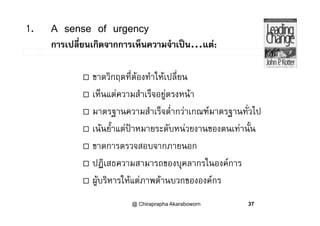
1. A senseof urgency
to motivate action:
ตองแสดงหลักฐานขอมูลที่ทําใหพนักงานเห็นความ
จําเปนจาเปน
see, touch and feel.
แสดงขอมูลที่เปนมูลเหตุจากภายนอกที่ทําใหเกิดการ
เปลี่ยนแปลงภายในเปลยนแปลงภายใน
ลดความภาคภูมิของความสําเร็จในอดีต
@ Chiraprapha Akaraboworn 38
39.
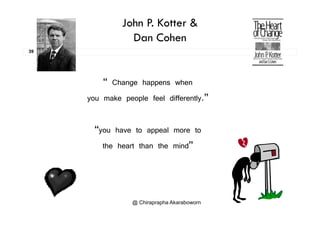
John P. Kotter&
D C h
39
Dan Cohen
“ Change happens when
you make people feel differently.”
“you have to appeal more to
the heart than the mind”
@ Chiraprapha Akaraboworn
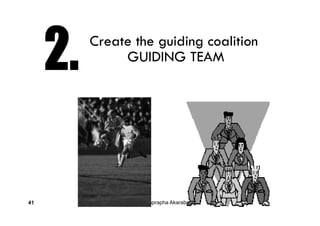
C h dlCreate the guiding coalition
GUIDING TEAMGU NG M
@ Chiraprapha Akaraboworn41
42.
2. The guidingcoalition
42
หาแนวรวม
Find the right people
เปนผูบริหารระดับสูง
เปนที่ยอมรับแกคนในองคกร
เปนผูนําการเปลี่ยนแปลง
Trust and common goals
มีเปาหมายรวมกันและสามารถไววางใจได
@ Chiraprapha Akaraboworn
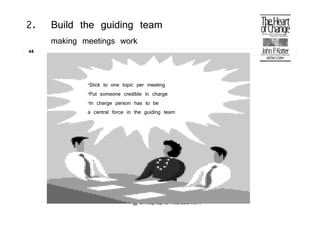
2. Build theguiding team
44
making meetings work
•Stick to one topic per meetingp p g
•Put someone credible in charge
•In charge person has to be
a central force in the guiding teama central force in the guiding team
@ Chiraprapha Akaraboworn
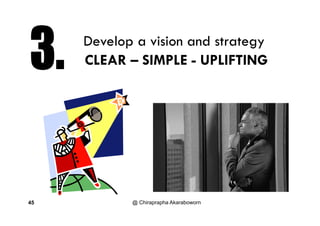
45.
l dDevelop avision and strategy
CLEAR – SIMPLE - UPLIFTINGCLEAR – SIMPLE - UPLIFTING
@ Chiraprapha Akaraboworn45
46.
3. Creating avision
46
develop a vision and strategy
เปาหมายชัด วิสัยทัศนนํา
@ Chiraprapha Akaraboworn
เปาหมายชด วสยทศนนา
3. Get thevision right
4 things help direct action in the right direction
1. Budgets: financial piece of the plan
2. Plans: step by step how to implement a strategy and is a
logical, linear process
3. Strategies: shows how to achieve the vision, and requires
accurate and up to date info about customers andp
competitors
4. Visions: show an end state where all the plans andp
strategies will take you
@ Chiraprapha Akaraboworn 48
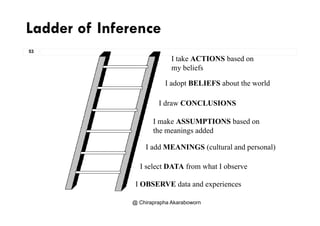
Ladder of Inference
53
Itake ACTIONS based on
my beliefs
I adopt BELIEFS about the world
I draw CONCLUSIONS
I make ASSUMPTIONS based on
the meanings added
I add MEANINGS (cultural and personal)
I l DATA f h I bI select DATA from what I observe
I OBSERVE data and experiences
@ Chiraprapha Akaraboworn
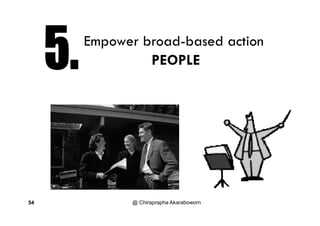
54.
b d bdEmpower broad-based action
PEOPLEPEOPLE
@ Chiraprapha Akaraboworn54
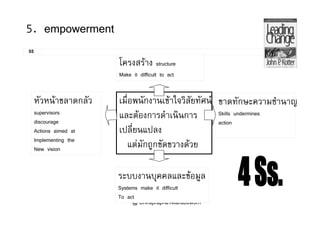
55.
5. empowerment
55
โครงสรางโครงสราง structure
Makeit difficult to act
เมื่อพนักงานเขาใจวิสัยทัศน
ํ ิ
หัวหนาขลาดกลัว
supervisors
ขาดทักษะความชํานาญ
Skills underminesและตองการดาเนนการ
เปลี่ยนแปลง
supervisors
discourage
Actions aimed at
I l ti th
Skills undermines
action
แตมักถูกขัดขวางดวยImplementing the
New vision
ระบบงานบุคคลและขอมูล
Systems make it difficult
@ Chiraprapha Akaraboworn
y
To act
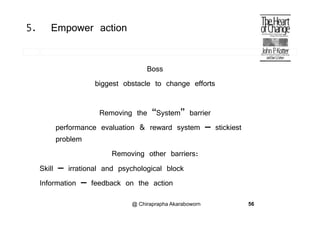
56.
5. Empower action
Boss
biggestobstacle to change effortsgg g
Removing the “System” barrierRemoving the System barrier
performance evaluation & reward system – stickiest
problemproblem
Removing other barriers:
Skill – irrational and psychological block
Information – feedback on the action
@ Chiraprapha Akaraboworn 56
6. short-term wins
58
offer reward for hard-working employees with positive,
l b ildi f db kmorale-building feedback
give change leaders concrete data to test and refine
their visions.
Zealous believers will stay the course no matter how long
the change takesg
@ Chiraprapha Akaraboworn
59.
6. Create ashort-term wins
Provide feedback to change leaders about the validity of
their visions an strategies
Give those working hard to achieve a vision a pat on the
back an emotional liftback, an emotional lift
Build faith in the effort, attracting those who are not yet
actively helping
Take power away from the cynics
@ Chiraprapha Akaraboworn 59
60.
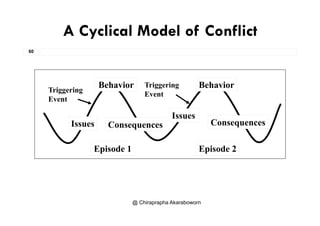
A Cyclical Modelof Conflict
60
y
TriggeringBehavior Behavior
Triggering
Event
Triggering
Event
Behavior Behavior
I
Issues Consequences Consequences
Issues
Episode 1 Episode 2
@ Chiraprapha Akaraboworn
Consolidate gains andConsolidategains and
produce more change
CREATE MOMENTUM
WAVE AFTER WAVE OF CHANGEWAVE AFTER WAVE OF CHANGE
@ Chiraprapha Akaraboworn63
64.
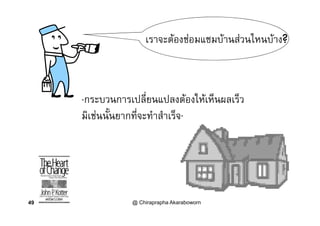
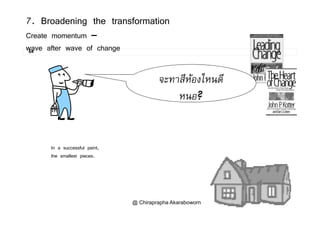
7. Broadening thetransformation
Create momentum –
64
Create momentum
wave after wave of change
จะทาสีหองไหนดี
หนอ?
In a successful paint,
the smallest pieces.
@ Chiraprapha Akaraboworn



![Leadership theories[1]](https://cdn.slidesharecdn.com/ss_thumbnails/leadershiptheories1-121127231002-phpapp01-thumbnail.jpg?width=640&height=640&fit=bounds)


![Book review on [The secret of leadership]](https://cdn.slidesharecdn.com/ss_thumbnails/181143-gopicharanreddy-181005135524-thumbnail.jpg?width=640&height=640&fit=bounds)


![Mss Powerpoint0709[1]](https://cdn.slidesharecdn.com/ss_thumbnails/msspowerpoint07091-124767424796-phpapp02-thumbnail.jpg?width=640&height=640&fit=bounds)


