Organisational Development Interventions
 "Interventions" are principal learning processes in the "action" stage of organization development.
 Structured activities => (mean such diverse procedures as experiential exercises, questionnaires,
attitude surveys, interviews, relevant group discussions, and even lunchtime meetings between the
change agent and a member of the client organization.)
 Used individually or in combination
 To improve their social or task performance.
 Introduced by a change agent
 Part of an improvement program.
 Every action that influences an organization's improvement program in a change agent-client
system relationship can be said to be an intervention.
Organisational Development Interventions
Beckhard lists six such assumptions:
1. The basic building blocks of an organization are groups (teams).Therefore, the basic units of change are
groups, not individuals.
2. An always relevant change goal is the reduction of inappropriate competition between parts of the
organization and the development of a more collaborative condition.
3. Decision making in a healthy organization is located where the information sources are, rather than in a
particular role or level of hierarchy.
4. Organizations, subunits of organizations, and individuals continuously manage their affairs against
goals. Controls are interim measurements, not the basis of managerial strategy.
5. One goal of a healthy organization is to develop generally open communication, mutual trust, and
confidence between and across levels.
6. People support what they help create. People affected by a change must be allowed active participation
and a sense of ownership in the planning and conduct of the change.
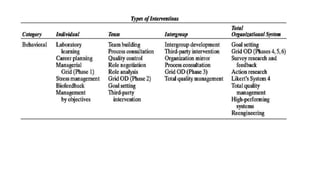
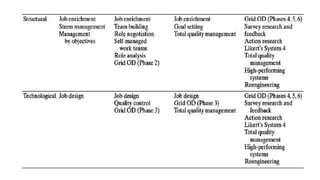
Interventions range from those designed to improve the effectiveness of individuals through those designed to deal with
teams and groups, intergroup relations, and the total organization.
There are interventions that focus on task issues (what people do), and those that focus on process issues (how people
go about doing it).
Finally, interventions may be roughly classified according to which change mechanism they tend to
emphasize: Ex: feedback, awareness of changing cultural norms, interaction and communication,
conflict, and education through either new knowledge or skill practice.
One of the most difficult tasks confronting the change agent is to help create in the client system a safe
climate for learning and change.
In a favourable climate, human learning builds on itself and continues indefinitely during man's lifetime.
Out of new behaviour, new dilemmas and problems emerge as the spiral continues upward to new
levels.
In an unfavourable climate, in contrast, learning is far less certain, and in an atmosphere of Psychological
threat, it often stops altogether.
Unfreezing old ways can be inhibited in organizations because the climate makes employees
feel that it is inappropriate to reveal true feelings, even though such revelations could be constructive. In
an inhibited atmosphere, therefore, necessary feedback is not available. Also, trying out new ways may
be viewed as risky because it violates established norms. Such an organization may also be constrained
because of the law of systems: If one part changes, other parts will become involved. Hence, it is easier
to maintain the status quo. Hierarchical authority, specialization, span of control, and other
characteristics of formal systems also discourage experimentation.
The change agent must address himself to all of these hazards and obstacles. Some of the things which
will help him are:
1. A real need in the client system to change
2. Genuine support from management
3. Setting a personal example: listening, supporting behaviour
4. A sound background in the behavioural sciences
5. A working knowledge of systems theory
6. A belief in man as a rational, self-educating being fully capable of learning better ways to do things.
A few examples of interventions include team building, coaching, Large Group Interventions,
mentoring, performance appraisal, downsizing, TQM, and leadership development.
Major Types of Interventions
The field of Organization Development uses a variety of processes, approaches, methods, techniques,
applications, etc., (these are often termed "interventions") to address organizational issues and goals in
order to increase performance.
The following partial list of interventions is organized generally in the order presented by Cummings
and Worley in their "Organization Development and Change" (West Publishing, 1993).
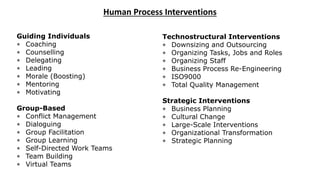
Guiding Individuals
 Coaching
 Counselling
 Delegating
 Leading
 Morale (Boosting)
 Mentoring
 Motivating
Group-Based
 Conflict Management
 Dialoguing
 Group Facilitation
 Group Learning
 Self-Directed Work Teams
 Team Building
 Virtual Teams
Technostructural Interventions
 Downsizing and Outsourcing
 Organizing Tasks, Jobs and Roles
 Organizing Staff
 Business Process Re-Engineering
 ISO9000
 Total Quality Management
Strategic Interventions
 Business Planning
 Cultural Change
 Large-Scale Interventions
 Organizational Transformation
 Strategic Planning
Human Process Interventions
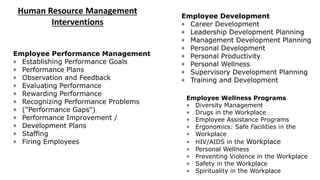
Human Resource Management
Interventions
Employee Performance Management
 Establishing Performance Goals
 Performance Plans
 Observation and Feedback
 Evaluating Performance
 Rewarding Performance
 Recognizing Performance Problems
 ("Performance Gaps")
 Performance Improvement /
 Development Plans
 Staffing
 Firing Employees
Employee Development
 Career Development
 Leadership Development Planning
 Management Development Planning
 Personal Development
 Personal Productivity
 Personal Wellness
 Supervisory Development Planning
 Training and Development
Employee Wellness Programs
 Diversity Management
 Drugs in the Workplace
 Employee Assistance Programs
 Ergonomics: Safe Facilities in the
 Workplace
 HIV/AIDS in the Workplace
 Personal Wellness
 Preventing Violence in the Workplace
 Safety in the Workplace
 Spirituality in the Workplace
Most Common OD Interventions That Companies Practice
1. Applying criteria to goals
Here the leadership establishes objective criteria for the outputs of the
organization's goal-setting processes. Then they hold people accountable not only
for stating goals against those criteria but also for producing the desired results.
Example: Organizations are implementing the concept of Balanced Scorecard,
X-Matrix etc., to capture the goals of the employees, which in turn is helpful in
their assessment and mid-term correction of their performance.
2. Establishing inter-unit task forces
These groups can cross both functional parts of the organization (the
"silos") as well as employee levels. They are ideally accountable to one person
and are appropriately rewarded for completing their assigned task effectively.
Then they disband.
Example: Organizations have introduced various schemes for rewarding their
employees for their performance, like:
 Introducing the concept of Variable pay in as a part of CTC
 Spot Recognition Award
 Project bonus, performance bonus etc.,
Most Common OD Interventions That Companies Practice
3. Experimentation with alternative arrangements
Today organizations are subject to "management by best-seller."
The goal in these interventions is to create what is being called a "learning
organization," one that performs experiments on organizational structure and
processes, analyses the results, and builds on them.
Example:
Organizations today are targeting at streamlining the process of Learning and
Development and encouraging the culture of Learning in the organizations.
- Targeting achieving mandatory man-days of training for their employees
- Introducing the Competency based practices
Most Common OD Interventions That Companies Practice
4. Identifying "key communicators“
This is to carefully determine who seems to be "in the know" within the
organization. These people often do not know that they are, in fact, key
communicators. This collection of individuals is then fed honest information
during critical times, one-on-one and confidentially.
Example:
 Defining the process of Organizational Communication policy
 Introducing Top – down and Bottom – up Communication approach
 Introducing Employee Forums and Suggestion Box options for employee
interaction
 Identifying Critical employees in the organization and making them the Brand
Ambassadors of their company
Most Common OD Interventions That Companies Practice
5. Identifying "Fireable Offenses"
This intervention deepens the understanding of and commitment to the stated
values of the organization.
This facilitates the work of the Top Management to answer the critical question,
"If we're serious about these values, then what might an employee do that would
be so affrontive to them that he/she would be fired?"
Example:
 Publishing and Instilling Values and Beliefs among all employees
 Introducing Policies like Whistle Blowing, Sexual Harassment etc.,
Most Common OD Interventions That Companies Practice
6. In-visioning
This is actually a set of interventions that help to "acculturate" everyone in the
organization into an agreed-upon vision, mission, purpose, and values. The
interventions might include training, goal setting, organizational survey feedback,
Communications planning, etc.
7. Team Building
This intervention can take many forms.
Example: The most common is interviews and other pre-work, followed by a one-
to three-day offsite session. During the meeting the group diagnoses its function
as a unit and plans improvements in its operating procedures.
Most Common OD Interventions That Companies Practice
8. Inter-group Problem Solving
This intervention usually involves working with the two groups separately before
bringing them together. They establish common goals and negotiate changes in how
the groups interface.
Example:
 This is practiced in Product Development
 Companies and most of the IT and ITES Companies.
 Focused group discussion are encouraged by the management, for generating
better ideas and concepts
Most Common OD Interventions That Companies Practice
9. Management/ Leadership training
 Many OD professionals come from a training background.
 They understand that organizations cannot succeed long term without well-trained
leaders.
 The OD contribution there can be to ensure that the development curriculum emphasizes
practical, current situations that need attention within the organization and to monitor the
degree to which training delivery is sufficiently participative as to promise adequate
transfer of learnings to the job.
Example:
 Most of the organizations today are focusing at Leadership
 Management for their employees.
 Earlier, this was targeted to the Top Management alone, but now, organizations are seeing
its relevance to inculcate the leadership skills in their middle management and junior
management as well.
 Business Organization Retreat (BOD) is being the most common practice, is a part of
this initiative.
Most Common OD Interventions That Companies Practice
10. Setting up measurement systems
The total-quality movement emphasizes that all work is a part of a process and that
measurement is essential for process improvement.
The OD professional is equipped with tools and techniques to assist leaders and
others to create measurement methods and systems to monitor key success indicators.
Example: The concepts like Six Sigma, TQM etc. act as Measurements tools for the
process followed in the organization.
There are 3 types of interventions that an organization should be able to identify and plan to
implement.
1. Individual : Interventions pertaining to an individual.
2. Group : Interventions pertaining to a group.
3. Organization : Interventions related to the organization’s strategy and policy.
Below mentioned are the OD intervention process that an organization should have to address
any intervention.
1. Entering and Contracting: Here we establish the fact that yes we do require OD
intervention to address an issue.
2. Diagnosis: In this process we identify the intervention and establish the root cause of the
issue.
3. Designing Intervention: In this process we design the approach to address the issue or
intervene to sort the issue out and bring value to business.
4. Leading and Managing Change: Here we establish a focus group with management buy in
and implement the designed intervention. OD intervention is a structured programme driven
from top to bottom.
5. Evaluating and Institutionalizing Interventions: Here we evaluate the course of actions
implemented and see if we are on track or if we need to re-design the approach so that the
objective if met.
There are 4 buckets in which the OD intervention process can be bundled
together:
1. Human Process:
Human process related activities are tagged under this group viz.
a. Job Analysis.
b. Team Building Activities.
2. Strategic:
Activities related to organizational strategies and policies are grouped under
this bucket.
3. Human Resource Management: Human resource related activities are
grouped under this bucket viz.
a. Reward and Recognition.
b. Appraisal.
c. Career Development.
4. Technostructural: Activities related to technology or where technology is
related are tagged under this bucket.
Note: These interventions are unavoidable in totality, however a vigilant and matured
organization should be able to apprehend the issue much before it erupts off on bigger
scale and should be able to address at the very initial stage when it can be done with
minimum efforts. The cost of negligence can have adverse impact in terms of cost, wide
spread agitation resulting in to image, reputation, and delivery and branding loss.

Organisational Development Interventions

  • 1.
    Organisational Development Interventions "Interventions" are principal learning processes in the "action" stage of organization development.  Structured activities => (mean such diverse procedures as experiential exercises, questionnaires, attitude surveys, interviews, relevant group discussions, and even lunchtime meetings between the change agent and a member of the client organization.)  Used individually or in combination  To improve their social or task performance.  Introduced by a change agent  Part of an improvement program.  Every action that influences an organization's improvement program in a change agent-client system relationship can be said to be an intervention.
  • 2.
    Organisational Development Interventions Beckhardlists six such assumptions: 1. The basic building blocks of an organization are groups (teams).Therefore, the basic units of change are groups, not individuals. 2. An always relevant change goal is the reduction of inappropriate competition between parts of the organization and the development of a more collaborative condition. 3. Decision making in a healthy organization is located where the information sources are, rather than in a particular role or level of hierarchy. 4. Organizations, subunits of organizations, and individuals continuously manage their affairs against goals. Controls are interim measurements, not the basis of managerial strategy. 5. One goal of a healthy organization is to develop generally open communication, mutual trust, and confidence between and across levels. 6. People support what they help create. People affected by a change must be allowed active participation and a sense of ownership in the planning and conduct of the change. Interventions range from those designed to improve the effectiveness of individuals through those designed to deal with teams and groups, intergroup relations, and the total organization. There are interventions that focus on task issues (what people do), and those that focus on process issues (how people go about doing it).
  • 3.
    Finally, interventions maybe roughly classified according to which change mechanism they tend to emphasize: Ex: feedback, awareness of changing cultural norms, interaction and communication, conflict, and education through either new knowledge or skill practice. One of the most difficult tasks confronting the change agent is to help create in the client system a safe climate for learning and change. In a favourable climate, human learning builds on itself and continues indefinitely during man's lifetime. Out of new behaviour, new dilemmas and problems emerge as the spiral continues upward to new levels. In an unfavourable climate, in contrast, learning is far less certain, and in an atmosphere of Psychological threat, it often stops altogether. Unfreezing old ways can be inhibited in organizations because the climate makes employees feel that it is inappropriate to reveal true feelings, even though such revelations could be constructive. In an inhibited atmosphere, therefore, necessary feedback is not available. Also, trying out new ways may be viewed as risky because it violates established norms. Such an organization may also be constrained because of the law of systems: If one part changes, other parts will become involved. Hence, it is easier to maintain the status quo. Hierarchical authority, specialization, span of control, and other characteristics of formal systems also discourage experimentation.
  • 4.
    The change agentmust address himself to all of these hazards and obstacles. Some of the things which will help him are: 1. A real need in the client system to change 2. Genuine support from management 3. Setting a personal example: listening, supporting behaviour 4. A sound background in the behavioural sciences 5. A working knowledge of systems theory 6. A belief in man as a rational, self-educating being fully capable of learning better ways to do things. A few examples of interventions include team building, coaching, Large Group Interventions, mentoring, performance appraisal, downsizing, TQM, and leadership development. Major Types of Interventions The field of Organization Development uses a variety of processes, approaches, methods, techniques, applications, etc., (these are often termed "interventions") to address organizational issues and goals in order to increase performance. The following partial list of interventions is organized generally in the order presented by Cummings and Worley in their "Organization Development and Change" (West Publishing, 1993).
  • 5.
    Guiding Individuals  Coaching Counselling  Delegating  Leading  Morale (Boosting)  Mentoring  Motivating Group-Based  Conflict Management  Dialoguing  Group Facilitation  Group Learning  Self-Directed Work Teams  Team Building  Virtual Teams Technostructural Interventions  Downsizing and Outsourcing  Organizing Tasks, Jobs and Roles  Organizing Staff  Business Process Re-Engineering  ISO9000  Total Quality Management Strategic Interventions  Business Planning  Cultural Change  Large-Scale Interventions  Organizational Transformation  Strategic Planning Human Process Interventions
  • 6.
    Human Resource Management Interventions EmployeePerformance Management  Establishing Performance Goals  Performance Plans  Observation and Feedback  Evaluating Performance  Rewarding Performance  Recognizing Performance Problems  ("Performance Gaps")  Performance Improvement /  Development Plans  Staffing  Firing Employees Employee Development  Career Development  Leadership Development Planning  Management Development Planning  Personal Development  Personal Productivity  Personal Wellness  Supervisory Development Planning  Training and Development Employee Wellness Programs  Diversity Management  Drugs in the Workplace  Employee Assistance Programs  Ergonomics: Safe Facilities in the  Workplace  HIV/AIDS in the Workplace  Personal Wellness  Preventing Violence in the Workplace  Safety in the Workplace  Spirituality in the Workplace
  • 7.
    Most Common ODInterventions That Companies Practice 1. Applying criteria to goals Here the leadership establishes objective criteria for the outputs of the organization's goal-setting processes. Then they hold people accountable not only for stating goals against those criteria but also for producing the desired results. Example: Organizations are implementing the concept of Balanced Scorecard, X-Matrix etc., to capture the goals of the employees, which in turn is helpful in their assessment and mid-term correction of their performance.
  • 8.
    2. Establishing inter-unittask forces These groups can cross both functional parts of the organization (the "silos") as well as employee levels. They are ideally accountable to one person and are appropriately rewarded for completing their assigned task effectively. Then they disband. Example: Organizations have introduced various schemes for rewarding their employees for their performance, like:  Introducing the concept of Variable pay in as a part of CTC  Spot Recognition Award  Project bonus, performance bonus etc., Most Common OD Interventions That Companies Practice
  • 9.
    Most Common ODInterventions That Companies Practice 3. Experimentation with alternative arrangements Today organizations are subject to "management by best-seller." The goal in these interventions is to create what is being called a "learning organization," one that performs experiments on organizational structure and processes, analyses the results, and builds on them. Example: Organizations today are targeting at streamlining the process of Learning and Development and encouraging the culture of Learning in the organizations. - Targeting achieving mandatory man-days of training for their employees - Introducing the Competency based practices
  • 10.
    Most Common ODInterventions That Companies Practice 4. Identifying "key communicators“ This is to carefully determine who seems to be "in the know" within the organization. These people often do not know that they are, in fact, key communicators. This collection of individuals is then fed honest information during critical times, one-on-one and confidentially. Example:  Defining the process of Organizational Communication policy  Introducing Top – down and Bottom – up Communication approach  Introducing Employee Forums and Suggestion Box options for employee interaction  Identifying Critical employees in the organization and making them the Brand Ambassadors of their company
  • 11.
    Most Common ODInterventions That Companies Practice 5. Identifying "Fireable Offenses" This intervention deepens the understanding of and commitment to the stated values of the organization. This facilitates the work of the Top Management to answer the critical question, "If we're serious about these values, then what might an employee do that would be so affrontive to them that he/she would be fired?" Example:  Publishing and Instilling Values and Beliefs among all employees  Introducing Policies like Whistle Blowing, Sexual Harassment etc.,
  • 12.
    Most Common ODInterventions That Companies Practice 6. In-visioning This is actually a set of interventions that help to "acculturate" everyone in the organization into an agreed-upon vision, mission, purpose, and values. The interventions might include training, goal setting, organizational survey feedback, Communications planning, etc. 7. Team Building This intervention can take many forms. Example: The most common is interviews and other pre-work, followed by a one- to three-day offsite session. During the meeting the group diagnoses its function as a unit and plans improvements in its operating procedures.
  • 13.
    Most Common ODInterventions That Companies Practice 8. Inter-group Problem Solving This intervention usually involves working with the two groups separately before bringing them together. They establish common goals and negotiate changes in how the groups interface. Example:  This is practiced in Product Development  Companies and most of the IT and ITES Companies.  Focused group discussion are encouraged by the management, for generating better ideas and concepts
  • 14.
    Most Common ODInterventions That Companies Practice 9. Management/ Leadership training  Many OD professionals come from a training background.  They understand that organizations cannot succeed long term without well-trained leaders.  The OD contribution there can be to ensure that the development curriculum emphasizes practical, current situations that need attention within the organization and to monitor the degree to which training delivery is sufficiently participative as to promise adequate transfer of learnings to the job. Example:  Most of the organizations today are focusing at Leadership  Management for their employees.  Earlier, this was targeted to the Top Management alone, but now, organizations are seeing its relevance to inculcate the leadership skills in their middle management and junior management as well.  Business Organization Retreat (BOD) is being the most common practice, is a part of this initiative.
  • 15.
    Most Common ODInterventions That Companies Practice 10. Setting up measurement systems The total-quality movement emphasizes that all work is a part of a process and that measurement is essential for process improvement. The OD professional is equipped with tools and techniques to assist leaders and others to create measurement methods and systems to monitor key success indicators. Example: The concepts like Six Sigma, TQM etc. act as Measurements tools for the process followed in the organization.
  • 18.
    There are 3types of interventions that an organization should be able to identify and plan to implement. 1. Individual : Interventions pertaining to an individual. 2. Group : Interventions pertaining to a group. 3. Organization : Interventions related to the organization’s strategy and policy. Below mentioned are the OD intervention process that an organization should have to address any intervention. 1. Entering and Contracting: Here we establish the fact that yes we do require OD intervention to address an issue. 2. Diagnosis: In this process we identify the intervention and establish the root cause of the issue. 3. Designing Intervention: In this process we design the approach to address the issue or intervene to sort the issue out and bring value to business. 4. Leading and Managing Change: Here we establish a focus group with management buy in and implement the designed intervention. OD intervention is a structured programme driven from top to bottom. 5. Evaluating and Institutionalizing Interventions: Here we evaluate the course of actions implemented and see if we are on track or if we need to re-design the approach so that the objective if met.
  • 19.
    There are 4buckets in which the OD intervention process can be bundled together: 1. Human Process: Human process related activities are tagged under this group viz. a. Job Analysis. b. Team Building Activities. 2. Strategic: Activities related to organizational strategies and policies are grouped under this bucket. 3. Human Resource Management: Human resource related activities are grouped under this bucket viz. a. Reward and Recognition. b. Appraisal. c. Career Development. 4. Technostructural: Activities related to technology or where technology is related are tagged under this bucket.
  • 20.
    Note: These interventionsare unavoidable in totality, however a vigilant and matured organization should be able to apprehend the issue much before it erupts off on bigger scale and should be able to address at the very initial stage when it can be done with minimum efforts. The cost of negligence can have adverse impact in terms of cost, wide spread agitation resulting in to image, reputation, and delivery and branding loss.