ORGANIZATIONAL CHANGE (4TH ED.)
Barbara Senior & Stephen Swailes
Chapter 8: Soft systems models for change
LEARNING OBJECTIVES
By the end of this chapter, you will be able to:
 recognize that some change situations
(problems/opportunities), by nature of their complexity
and particular characteristics, require soft rather than
hard systems approaches to change;
 consider the philosophy, value orientation and
theoretical underpinnings of organization development
as a generalized example of soft systems models for
change;
 outline and describe the processes and practices that
comprise most OD approaches to designing and
implementing organizational change;
 critically review the limitations of OD approaches to
managing change.
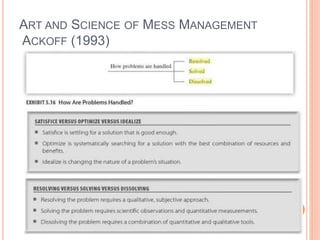
ART AND SCIENCE OF MESS MANAGEMENT
ACKOFF (1993)
ORGANIZATION DEVELOPMENT, 5TH ED.
FRENCH & BELL, 1995
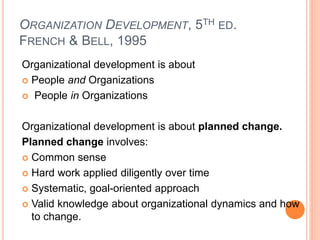
Organizational development is about
 People and Organizations
 People in Organizations
Organizational development is about planned change.
Planned change involves:
 Common sense
 Hard work applied diligently over time
 Systematic, goal-oriented approach
 Valid knowledge about organizational dynamics and how
to change.
ORGANIZATION DEVELOPMENT, 5TH ED.
FRENCH & BELL, 1995
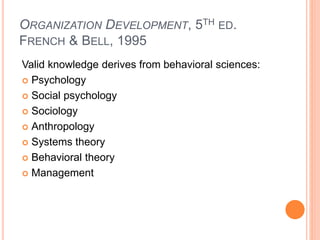
Valid knowledge derives from behavioral sciences:
 Psychology
 Social psychology
 Sociology
 Anthropology
 Systems theory
 Behavioral theory
 Management
ORGANIZATION DEVELOPMENT, 5TH ED.
FRENCH & BELL, 1995
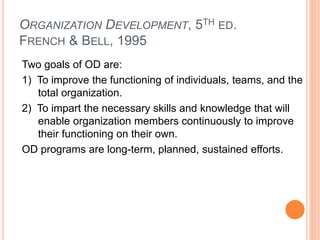
Two goals of OD are:
1) To improve the functioning of individuals, teams, and the
total organization.
2) To impart the necessary skills and knowledge that will
enable organization members continuously to improve
their functioning on their own.
OD programs are long-term, planned, sustained efforts.
ORGANIZATION DEVELOPMENT, 5TH ED.
FRENCH & BELL, 1995
A central feature of OD is widespread participation:
1) Get as many people as possible into the act.
2) An overall game plan or strategy is then developed
that includes a series activities, each intended to
achieve an outcome that moves the organization
toward the desired goals.
However, OD programs are not so linear and
straightforward.
In organizations where individuals, teams, and
organizations are not realizing their full potential, OD can
improve the situation.
ORGANIZATION DEVELOPMENT, 5TH ED.
FRENCH & BELL, 1995
Change – “the new state of things is different from the old
state of things.”
Explore the implications of the following quotes:
 Change is omnipresent.
 Change is an opportunity, not a threat.
 Most demands for change come from outside the
organization.
ORGANIZATION DEVELOPMENT, 5TH ED.
FRENCH & BELL, 1995
Change has different facts to it:
 Change can be deliberate (planned), or accidental
(unplanned)
 Magnitude of change can be large or small.
 The scope can affect many elements of the
organization or only a few.
 Change can happen fast (abrupt, revolutionary) or slow
(evolutionary).
 The change can bring about an entirely new state of
things, or it can have the same nature with new
features.
ORGANIZATION DEVELOPMENT, 5TH ED.
FRENCH & BELL, 1995
Organizational development is all about “change.”
 First-order change – making moderate adjustments to
the organization, its people, and its processes.
 Second-order change – organizations are reinvented;
work tasks are being reengineered; the rules of the
marketplace are being rewritten; the fundamental
nature of organizations is changing.
Today the demands on organizations are so great that
second-order change is required in many instances.
ORGANIZATION DEVELOPMENT, 5TH ED.
FRENCH & BELL, 1995
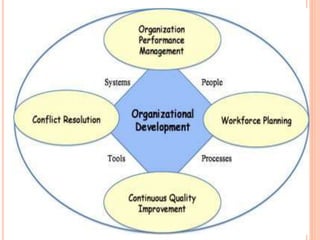
Organizational development is a process that
focuses on organizational culture, processes,
and structure utilizing a total system perspective.
(French & Bell, 1995, p. 4)
ORGANIZATION DEVELOPMENT, 5TH ED.
FRENCH & BELL, 1995
Major events in the process of OD and change:
 Sensing something is wrong that should be
corrected.
 Diagnosing the situation to determine what is
happening
 Planning and taking actions to change the
problematic conditions
 Evaluating the effects of the actions
 Making adjustments as needed
 Repeat the sequence
ORGANIZATION DEVELOPMENT, 5TH ED.
FRENCH & BELL, 1995
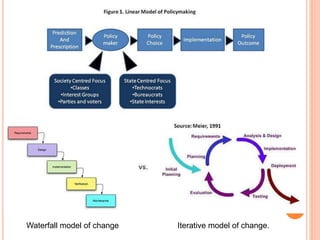
Organizational development is an iterative
process of diagnosing, taking action, diagnosing,
and taking action.
All organizational improvement programs are
really complex processes of goals => actions =>
redefined goals => new actions.
Waterfall model of change Iterative model of change.
ORGANIZATION DEVELOPMENT, 5TH ED.
FRENCH & BELL, 1995
 Organizational culture must be altered if
permanent change is to occur.
 Organizational processes are also key leverage
points for achieving organizational
improvement.
 Processes are how things get done in
organizations, the methods for arriving at
results.
ORGANIZATION DEVELOPMENT, 5TH ED.
FRENCH & BELL, 1995
Important organizational processes are
 communication,
 problem solving and decision making,
 resource allocation,
 conflict resolution,
 allocation of rewards,
 human resource practices,
 strategic management,
 how authority is exercised, and
 self-renewal or continuous learning.
ORGANIZATION DEVELOPMENT, 5TH ED.
FRENCH & BELL, 1995
How things are done in organizations
(organizational processes) is as important as
what is done.
Often the best way to improve a group’s
effectiveness is to pay attention to and improve
its processes. OD practitioners found that
processes were just as critical for organizational
effectiveness as they were for group
effectiveness.
ORGANIZATION DEVELOPMENT, 5TH ED.
FRENCH & BELL, 1995
 Organizations are complex social systems
interacting with the environment.
 A superordinate goal of OD programs is to
optimize the system by ensuring that system
components are harmonious and congruent.
 A systems perspective suggests that changing
one element of the system, say, strategy, will
require changes in other elements such as
structure, processes, and culture.
ORGANIZATION DEVELOPMENT, 5TH ED.
FRENCH & BELL, 1995
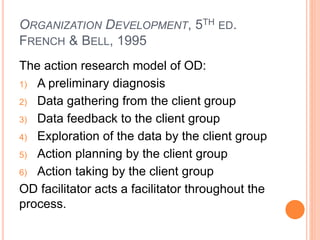
The action research model of OD:
1) A preliminary diagnosis
2) Data gathering from the client group
3) Data feedback to the client group
4) Exploration of the data by the client group
5) Action planning by the client group
6) Action taking by the client group
OD facilitator acts a facilitator throughout the
process.
3 FUNDAMENTAL CONCEPTS OF PEOPLE IN
ORGANIZATIONS (PATON AND MCCALMAN, 2008)
1. Organizations are about people
2. Management assumptions about people
often lead to ineffective design of
organizations and this hinders
performance.
3. People are the most important asset and
their commitment goes a long way in
determining effective organization design
and development.
SIGNIFICANCE OF ORGANIZATIONS AS SYSTEMS
 Organizations as a whole and parts
 There are interconnections of causes and
consequences of complex and messy situations.
 OD challenges the assumption that a single
important cause of change with clear effects can
be found, as well as the assumption that any
cause and its effects are necessarily closely
related in space and time.
 Organizations are a balance of forces built up
and refined over a period of time.
 OD approaches to change are essentially
processes of facilitating planned change.
SIGNIFICANCE OF ORGANIZATIONS AS SYSTEMS
Consequently, an effective manager of change:
anticipates the need for change as opposed to
reacting after the event to the emergency;
diagnoses the nature of the change that is
required and carefully considers a number of
alternatives that might improve organizational
functioning, as opposed to taking the fastest
way to escape the problem; and manages the
change process over a period of time so that it
is effective and accepted as opposed to lurching
from crisis to crisis. (Pugh, 1993, p. 109)
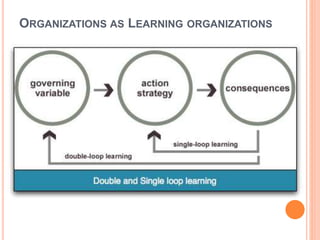
ORGANIZATIONS AS LEARNING ORGANIZATIONS
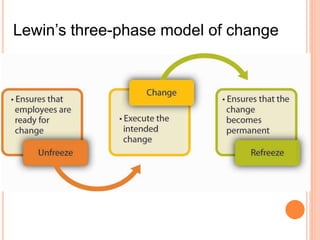
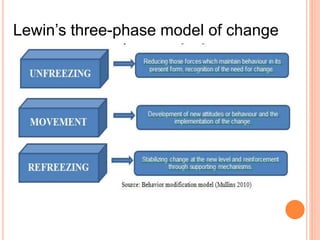
Lewin’s three-phase model of change
OD-AN ACTION RESEARCH BASED MODEL OF CHANGE
A collaborative effort between leaders and
facilitators involves the following steps
1. Management and staff perception of problem(s)
2. Data gathering and preliminary diagnosis by those
concerned with leading the change (who can be
internal and/or external to the organization)
3. Feedback to key client, management and those
involved in the change
4. Joint agreement of the problem(s)
5. Implementation
6. Reinforcement and assessment of the change.
OD MODEL FOR CHANGE
1a. Diagnose current situation
i. look at purposes and goals
ii. structure and culture
iii. leadership approaches and styles
iv. recruitment practices, career paths
and opportunities
v. individuals’ motivation and
commitment to their work and org.
vi. employee training and development
vii. intra- and inter-group relationships
OD MODEL FOR CHANGE
1a. Diagnose current situation
Methods of data collection:
 Questionnaires
 Interviews
 Observations
 Unobtrusive measures
OD MODEL FOR CHANGE
1b. Develop a vision for change
Vision: describes core values and purposes,
as well as an envisioned future. Provides
direction that can energize commitment as
people work toward a common goal.
2. Gain commitment to the vision and the
need for change
OD MODEL FOR CHANGE
3. Develop an action plan
a. The role of change agent
 Help the organization define the problem by
asking for a definition of what it is
 Help the organization examine what causes
the problem and diagnose how this can be
overcome.
 Assist in getting the organization to offer
alternative solutions.
 Provide direction to the implementation of
alternative solutions.
 Transmit the learning process that allows the
client to deal with change on an ongoing
basis by itself in the future.
OD MODEL FOR CHANGE
3. Develop an action plan
b. Responsibility charting
The “actors” involved in each action or
decision:
R = People with responsibility (not
necessarily authority)
A = People with approval (right to veto)
S = People who support (put resources
towards)
I = People who inform (to be consulted
before action but with no right of veto)
OD MODEL FOR CHANGE
3. Develop an action plan
c. The what and where of change
Beckhard and Harris say an effective action plan
should have the following characteristics (1987,
p. 72):
 Relevance: activities are clearly linked to the
change goals and priorities.
 Specificity: activities are clearly identified
rather than broadly generalized
 Integration: the parts are closely connected
 Chronology: there is a logical sequence of
events
 Adaptability: there are contingency plans for
adjusting to unexpected foces.
OD MODEL FOR CHANGE
4. Implement the change
Survey feedback
Organizational mirroring
Inter-group confrontation (with 3rd party
assistance)
Role negotiation
Process consultation
Team building
Life and career planning
Role of short-term wins
OD MODEL FOR CHANGE
5. Assess and reinforce the change
Assessing change
 Survey or audit
 Interviews with individuals or focus groups
 An examination of turnover and
absenteeism rates
 An analysis (observation or questionnaire)
of group performance
 Re-picturing the organization (new
metaphors or pictures)
Reinforcing and consolidating change
ASSESSMENT OF OD MODEL FOR CHANGE
 OD does not always face up to harsh realities of
change
 OD is limited when change situation are
“constrained”
 OD requires “out of the ordinary” leadership
 OD fits uneasily with the structures and culture in
the pubic sector
 OD does not “work” in all cultures

Ogc chap 8

  • 1.
    ORGANIZATIONAL CHANGE (4THED.) Barbara Senior & Stephen Swailes Chapter 8: Soft systems models for change
  • 2.
    LEARNING OBJECTIVES By theend of this chapter, you will be able to:  recognize that some change situations (problems/opportunities), by nature of their complexity and particular characteristics, require soft rather than hard systems approaches to change;  consider the philosophy, value orientation and theoretical underpinnings of organization development as a generalized example of soft systems models for change;  outline and describe the processes and practices that comprise most OD approaches to designing and implementing organizational change;  critically review the limitations of OD approaches to managing change.
  • 3.
    ART AND SCIENCEOF MESS MANAGEMENT ACKOFF (1993)
  • 5.
    ORGANIZATION DEVELOPMENT, 5THED. FRENCH & BELL, 1995 Organizational development is about  People and Organizations  People in Organizations Organizational development is about planned change. Planned change involves:  Common sense  Hard work applied diligently over time  Systematic, goal-oriented approach  Valid knowledge about organizational dynamics and how to change.
  • 6.
    ORGANIZATION DEVELOPMENT, 5THED. FRENCH & BELL, 1995 Valid knowledge derives from behavioral sciences:  Psychology  Social psychology  Sociology  Anthropology  Systems theory  Behavioral theory  Management
  • 7.
    ORGANIZATION DEVELOPMENT, 5THED. FRENCH & BELL, 1995 Two goals of OD are: 1) To improve the functioning of individuals, teams, and the total organization. 2) To impart the necessary skills and knowledge that will enable organization members continuously to improve their functioning on their own. OD programs are long-term, planned, sustained efforts.
  • 8.
    ORGANIZATION DEVELOPMENT, 5THED. FRENCH & BELL, 1995 A central feature of OD is widespread participation: 1) Get as many people as possible into the act. 2) An overall game plan or strategy is then developed that includes a series activities, each intended to achieve an outcome that moves the organization toward the desired goals. However, OD programs are not so linear and straightforward. In organizations where individuals, teams, and organizations are not realizing their full potential, OD can improve the situation.
  • 9.
    ORGANIZATION DEVELOPMENT, 5THED. FRENCH & BELL, 1995 Change – “the new state of things is different from the old state of things.” Explore the implications of the following quotes:  Change is omnipresent.  Change is an opportunity, not a threat.  Most demands for change come from outside the organization.
  • 10.
    ORGANIZATION DEVELOPMENT, 5THED. FRENCH & BELL, 1995 Change has different facts to it:  Change can be deliberate (planned), or accidental (unplanned)  Magnitude of change can be large or small.  The scope can affect many elements of the organization or only a few.  Change can happen fast (abrupt, revolutionary) or slow (evolutionary).  The change can bring about an entirely new state of things, or it can have the same nature with new features.
  • 11.
    ORGANIZATION DEVELOPMENT, 5THED. FRENCH & BELL, 1995 Organizational development is all about “change.”  First-order change – making moderate adjustments to the organization, its people, and its processes.  Second-order change – organizations are reinvented; work tasks are being reengineered; the rules of the marketplace are being rewritten; the fundamental nature of organizations is changing. Today the demands on organizations are so great that second-order change is required in many instances.
  • 12.
    ORGANIZATION DEVELOPMENT, 5THED. FRENCH & BELL, 1995 Organizational development is a process that focuses on organizational culture, processes, and structure utilizing a total system perspective. (French & Bell, 1995, p. 4)
  • 13.
    ORGANIZATION DEVELOPMENT, 5THED. FRENCH & BELL, 1995 Major events in the process of OD and change:  Sensing something is wrong that should be corrected.  Diagnosing the situation to determine what is happening  Planning and taking actions to change the problematic conditions  Evaluating the effects of the actions  Making adjustments as needed  Repeat the sequence
  • 14.
    ORGANIZATION DEVELOPMENT, 5THED. FRENCH & BELL, 1995 Organizational development is an iterative process of diagnosing, taking action, diagnosing, and taking action. All organizational improvement programs are really complex processes of goals => actions => redefined goals => new actions.
  • 15.
    Waterfall model ofchange Iterative model of change.
  • 16.
    ORGANIZATION DEVELOPMENT, 5THED. FRENCH & BELL, 1995  Organizational culture must be altered if permanent change is to occur.  Organizational processes are also key leverage points for achieving organizational improvement.  Processes are how things get done in organizations, the methods for arriving at results.
  • 17.
    ORGANIZATION DEVELOPMENT, 5THED. FRENCH & BELL, 1995 Important organizational processes are  communication,  problem solving and decision making,  resource allocation,  conflict resolution,  allocation of rewards,  human resource practices,  strategic management,  how authority is exercised, and  self-renewal or continuous learning.
  • 18.
    ORGANIZATION DEVELOPMENT, 5THED. FRENCH & BELL, 1995 How things are done in organizations (organizational processes) is as important as what is done. Often the best way to improve a group’s effectiveness is to pay attention to and improve its processes. OD practitioners found that processes were just as critical for organizational effectiveness as they were for group effectiveness.
  • 19.
    ORGANIZATION DEVELOPMENT, 5THED. FRENCH & BELL, 1995  Organizations are complex social systems interacting with the environment.  A superordinate goal of OD programs is to optimize the system by ensuring that system components are harmonious and congruent.  A systems perspective suggests that changing one element of the system, say, strategy, will require changes in other elements such as structure, processes, and culture.
  • 20.
    ORGANIZATION DEVELOPMENT, 5THED. FRENCH & BELL, 1995 The action research model of OD: 1) A preliminary diagnosis 2) Data gathering from the client group 3) Data feedback to the client group 4) Exploration of the data by the client group 5) Action planning by the client group 6) Action taking by the client group OD facilitator acts a facilitator throughout the process.
  • 22.
    3 FUNDAMENTAL CONCEPTSOF PEOPLE IN ORGANIZATIONS (PATON AND MCCALMAN, 2008) 1. Organizations are about people 2. Management assumptions about people often lead to ineffective design of organizations and this hinders performance. 3. People are the most important asset and their commitment goes a long way in determining effective organization design and development.
  • 23.
    SIGNIFICANCE OF ORGANIZATIONSAS SYSTEMS  Organizations as a whole and parts  There are interconnections of causes and consequences of complex and messy situations.  OD challenges the assumption that a single important cause of change with clear effects can be found, as well as the assumption that any cause and its effects are necessarily closely related in space and time.  Organizations are a balance of forces built up and refined over a period of time.  OD approaches to change are essentially processes of facilitating planned change.
  • 24.
    SIGNIFICANCE OF ORGANIZATIONSAS SYSTEMS Consequently, an effective manager of change: anticipates the need for change as opposed to reacting after the event to the emergency; diagnoses the nature of the change that is required and carefully considers a number of alternatives that might improve organizational functioning, as opposed to taking the fastest way to escape the problem; and manages the change process over a period of time so that it is effective and accepted as opposed to lurching from crisis to crisis. (Pugh, 1993, p. 109)
  • 25.
  • 26.
  • 27.
  • 28.
    OD-AN ACTION RESEARCHBASED MODEL OF CHANGE A collaborative effort between leaders and facilitators involves the following steps 1. Management and staff perception of problem(s) 2. Data gathering and preliminary diagnosis by those concerned with leading the change (who can be internal and/or external to the organization) 3. Feedback to key client, management and those involved in the change 4. Joint agreement of the problem(s) 5. Implementation 6. Reinforcement and assessment of the change.
  • 29.
    OD MODEL FORCHANGE 1a. Diagnose current situation i. look at purposes and goals ii. structure and culture iii. leadership approaches and styles iv. recruitment practices, career paths and opportunities v. individuals’ motivation and commitment to their work and org. vi. employee training and development vii. intra- and inter-group relationships
  • 30.
    OD MODEL FORCHANGE 1a. Diagnose current situation Methods of data collection:  Questionnaires  Interviews  Observations  Unobtrusive measures
  • 31.
    OD MODEL FORCHANGE 1b. Develop a vision for change Vision: describes core values and purposes, as well as an envisioned future. Provides direction that can energize commitment as people work toward a common goal. 2. Gain commitment to the vision and the need for change
  • 32.
    OD MODEL FORCHANGE 3. Develop an action plan a. The role of change agent  Help the organization define the problem by asking for a definition of what it is  Help the organization examine what causes the problem and diagnose how this can be overcome.  Assist in getting the organization to offer alternative solutions.  Provide direction to the implementation of alternative solutions.  Transmit the learning process that allows the client to deal with change on an ongoing basis by itself in the future.
  • 33.
    OD MODEL FORCHANGE 3. Develop an action plan b. Responsibility charting The “actors” involved in each action or decision: R = People with responsibility (not necessarily authority) A = People with approval (right to veto) S = People who support (put resources towards) I = People who inform (to be consulted before action but with no right of veto)
  • 34.
    OD MODEL FORCHANGE 3. Develop an action plan c. The what and where of change Beckhard and Harris say an effective action plan should have the following characteristics (1987, p. 72):  Relevance: activities are clearly linked to the change goals and priorities.  Specificity: activities are clearly identified rather than broadly generalized  Integration: the parts are closely connected  Chronology: there is a logical sequence of events  Adaptability: there are contingency plans for adjusting to unexpected foces.
  • 35.
    OD MODEL FORCHANGE 4. Implement the change Survey feedback Organizational mirroring Inter-group confrontation (with 3rd party assistance) Role negotiation Process consultation Team building Life and career planning Role of short-term wins
  • 36.
    OD MODEL FORCHANGE 5. Assess and reinforce the change Assessing change  Survey or audit  Interviews with individuals or focus groups  An examination of turnover and absenteeism rates  An analysis (observation or questionnaire) of group performance  Re-picturing the organization (new metaphors or pictures) Reinforcing and consolidating change
  • 37.
    ASSESSMENT OF ODMODEL FOR CHANGE  OD does not always face up to harsh realities of change  OD is limited when change situation are “constrained”  OD requires “out of the ordinary” leadership  OD fits uneasily with the structures and culture in the pubic sector  OD does not “work” in all cultures