

ORGANIZATIONAL
DEVELOPMENT

THE NEW BUZZ WORD
INTRODUCTION
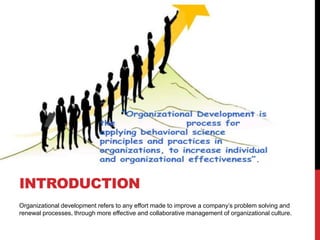
Organizational development refers to any effort made to improve a company’s problem solving and
renewal processes, through more effective and collaborative management of organizational culture.
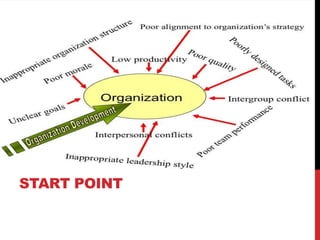
START POINT
OD?
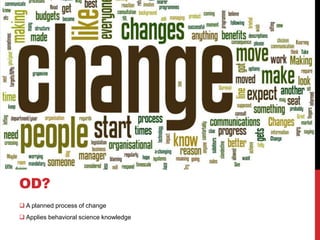
 A planned process of change
 Applies behavioral science knowledge
OD?
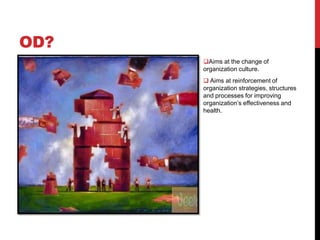
      Aims at the change of
      organization culture.
       Aims at reinforcement of
      organization strategies, structures
      and processes for improving
      organization’s effectiveness and
      health.
OD?
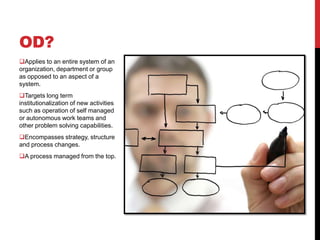
Applies to an entire system of an
organization, department or group
as opposed to an aspect of a
system.
Targets long term
institutionalization of new activities
such as operation of self managed
or autonomous work teams and
other problem solving capabilities.
Encompasses strategy, structure
and process changes.
A process managed from the top.
EVOLUTION OF OD IN INDIA
In India, OD and planned change
started in the early 1960s
Indian professionals trained at the
National Training Laboratories
(NTL) at Bethel, Maine, USA,
Grid programmes were initiated
and widely used-
EVOLUTION OF OD IN INDIA
In the mid-1970s, OD was first
introduced in India in Larsen and
Toubro as a formal and structured
part of the HRD department.
EVOLUTION OF OD IN INDIA
Even after 25 years of existence
the Indian Society for Applied
Behavioral Science (ISABS), an
associate of NTL, produced less
than100 process specialists in the
vast country.
EVOLUTION OF OD IN INDIA
Scenario has changed-
   T-group trainers
   HRD movement
   Contributions of multinationals
   Influence of Western education
   Post liberalization period, every one has been forced to seek change
   Contribution of ISTD, ISISD,IIM.
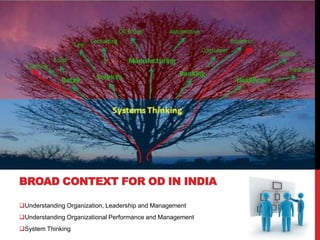
BROAD CONTEXT FOR OD IN INDIA

Understanding Organization, Leadership and Management
Understanding Organizational Performance and Management
System Thinking
ARTICLE
CEO Paul Polman on Unliver’s Bold Gamble
THANK YOU

Organisational Development

  • 1.
  • 2.
    INTRODUCTION Organizational development refersto any effort made to improve a company’s problem solving and renewal processes, through more effective and collaborative management of organizational culture.
  • 3.
  • 4.
    OD?  A plannedprocess of change  Applies behavioral science knowledge
  • 5.
    OD? Aims at the change of organization culture.  Aims at reinforcement of organization strategies, structures and processes for improving organization’s effectiveness and health.
  • 6.
    OD? Applies to anentire system of an organization, department or group as opposed to an aspect of a system. Targets long term institutionalization of new activities such as operation of self managed or autonomous work teams and other problem solving capabilities. Encompasses strategy, structure and process changes. A process managed from the top.
  • 7.
    EVOLUTION OF ODIN INDIA In India, OD and planned change started in the early 1960s Indian professionals trained at the National Training Laboratories (NTL) at Bethel, Maine, USA, Grid programmes were initiated and widely used-
  • 8.
    EVOLUTION OF ODIN INDIA In the mid-1970s, OD was first introduced in India in Larsen and Toubro as a formal and structured part of the HRD department.
  • 9.
    EVOLUTION OF ODIN INDIA Even after 25 years of existence the Indian Society for Applied Behavioral Science (ISABS), an associate of NTL, produced less than100 process specialists in the vast country.
  • 10.
    EVOLUTION OF ODIN INDIA Scenario has changed-  T-group trainers  HRD movement  Contributions of multinationals  Influence of Western education  Post liberalization period, every one has been forced to seek change  Contribution of ISTD, ISISD,IIM.
  • 11.
    BROAD CONTEXT FOROD IN INDIA Understanding Organization, Leadership and Management Understanding Organizational Performance and Management System Thinking
  • 12.
    ARTICLE CEO Paul Polmanon Unliver’s Bold Gamble
  • 13.