Water And Waste Water Engineering
Hydraulic Jump
•Flow in super critical state is an unstable type of flow.
It has a tendency to transfer n to sub critical flow. Flow
depth is small in super critical state.which increase
suddenly while changing sub critical state. This
phenomenon sudden increase in depth of flow is
called as HYDRAULIC JUMP.
•Hydraulic jump occurs when a steam moving with
super critical velocity meets a steam having large
depth with sub critical velocity.
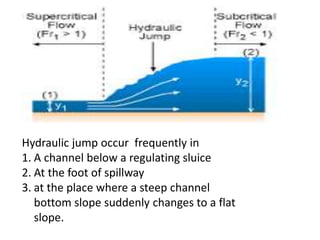
Hydraulic jump occur frequently in
1. A channel below a regulating sluice
2. At the foot of spillway
3. at the place where a steep channel
bottom slope suddenly changes to a flat
slope.
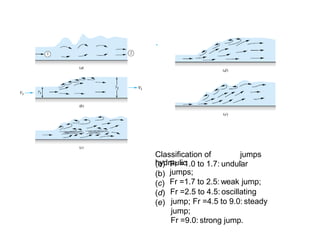
Classification of jumpJump are classified in to five categories
1. Under jump: The water surface shows undulation
with small ripple on the surface.
2. Weak jump: in this case series of small rollers form on
jump surface. only a small amount of energy is
dissipated.
3. Oscillating jump: In this jump, flow oscillates in a
random manner between the bed of channel to water
surface.
4. Steady jump: It is well stabilized jump. Roller are fully
developed to cause sufficient energy loss.
5. Strong jump: Water surface is rough. It dissipates
max. energy.
Classification of
hydraulic
jumps
:(a)
(b)
(c)
(d)
(e)
Fr =1.0 to 1.7: undular
jumps;
Fr =1.7 to 2.5: weak jump;
Fr =2.5 to 4.5: oscillating
jump; Fr =4.5 to 9.0: steady
jump;
Fr =9.0: strong jump.
Use of hydraulic jump• Hydraulic jump is used to dissipate or destroy the energy of water where it is not
needed otherwise it may cause damage to hydraulic structures.
• It may be used for mixing of certain chemicals like in case of water treatment plants.
• It may also be used as a discharge measuring device.
Energy dissipation
•Hydraulic jumps are one of the most effective options
in dissipating energy over water structure
•Turbulent flow and secondary waves cause most of the
energy dissipation
•Applying the conservation of momentum equation, the
energy loss can be calculated
ΔE = (y₂ - y₁)³ / (4y₁y₂)
y₁ = Flow depth at supercritical flow
y₂ = Flow depth at subcritical flow
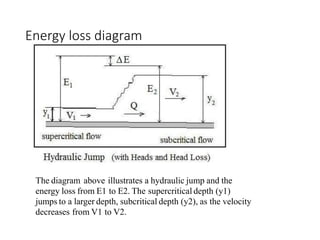
Energy loss diagram
The diagram above illustrates a hydraulic jump and the
energy loss from E1 to E2. The supercritical depth (y1)
jumps to a larger depth, subcritical depth (y2), as the velocity
decreases from V1 to V2.
Hydraulic Jump

Hydraulic Jump

  • 1.
    Water And WasteWater Engineering
  • 2.
    Hydraulic Jump •Flow insuper critical state is an unstable type of flow. It has a tendency to transfer n to sub critical flow. Flow depth is small in super critical state.which increase suddenly while changing sub critical state. This phenomenon sudden increase in depth of flow is called as HYDRAULIC JUMP. •Hydraulic jump occurs when a steam moving with super critical velocity meets a steam having large depth with sub critical velocity.
  • 3.
    Hydraulic jump occurfrequently in 1. A channel below a regulating sluice 2. At the foot of spillway 3. at the place where a steep channel bottom slope suddenly changes to a flat slope.
  • 4.
    Classification of jumpJumpare classified in to five categories 1. Under jump: The water surface shows undulation with small ripple on the surface. 2. Weak jump: in this case series of small rollers form on jump surface. only a small amount of energy is dissipated. 3. Oscillating jump: In this jump, flow oscillates in a random manner between the bed of channel to water surface. 4. Steady jump: It is well stabilized jump. Roller are fully developed to cause sufficient energy loss. 5. Strong jump: Water surface is rough. It dissipates max. energy.
  • 5.
    Classification of hydraulic jumps :(a) (b) (c) (d) (e) Fr =1.0to 1.7: undular jumps; Fr =1.7 to 2.5: weak jump; Fr =2.5 to 4.5: oscillating jump; Fr =4.5 to 9.0: steady jump; Fr =9.0: strong jump.
  • 6.
    Use of hydraulicjump• Hydraulic jump is used to dissipate or destroy the energy of water where it is not needed otherwise it may cause damage to hydraulic structures. • It may be used for mixing of certain chemicals like in case of water treatment plants. • It may also be used as a discharge measuring device.
  • 7.
    Energy dissipation •Hydraulic jumpsare one of the most effective options in dissipating energy over water structure •Turbulent flow and secondary waves cause most of the energy dissipation •Applying the conservation of momentum equation, the energy loss can be calculated ΔE = (y₂ - y₁)³ / (4y₁y₂) y₁ = Flow depth at supercritical flow y₂ = Flow depth at subcritical flow
  • 8.
    Energy loss diagram Thediagram above illustrates a hydraulic jump and the energy loss from E1 to E2. The supercritical depth (y1) jumps to a larger depth, subcritical depth (y2), as the velocity decreases from V1 to V2.