
VALVES IN PIPE
LINES
Valve is a device that regulates, direct controls the
flow of a fluid (gases, liquids, fluidized solids, or
slurries) by opening, closing, or partially
Obstructing various passageways. Valves are
technically fittings, but are usually discussed as a
separate category.
2
VALVE
1. Gate Valve
2. Plug Valve
3. Globe valve
4. Butterfly Valve
5. Diaphragm Valve
6. Check Valve
7. Ball Valve
8. Pressure reducing valve
3
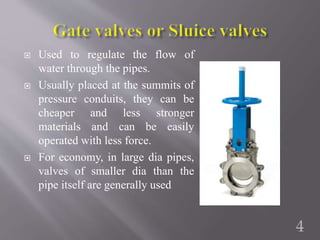
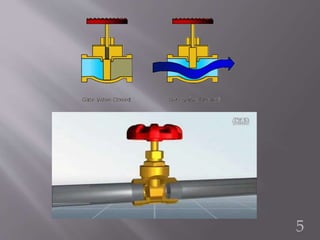
 Used to regulate the flow of
water through the pipes.
 Usually placed at the summits of
pressure conduits, they can be
cheaper and less stronger
materials and can be easily
operated with less force.
 For economy, in large dia pipes,
valves of smaller dia than the
pipe itself are generally used
4
5
6
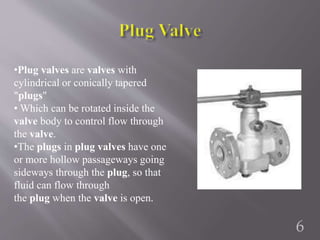
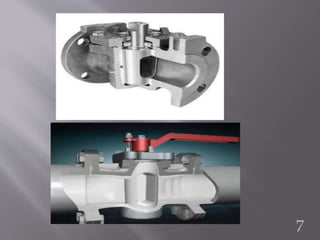
•Plug valves are valves with
cylindrical or conically tapered
"plugs"
• Which can be rotated inside the
valve body to control flow through
the valve.
•The plugs in plug valves have one
or more hollow passageways going
sideways through the plug, so that
fluid can flow through
the plug when the valve is open.
7
 Used in small bore
pipe work and as
taps and although a
variation is used as
a control valve.
 Have a circular seal
connected axially to
a vertical spindle
and hand wheel.
8
9
 Used to regulate and stop the
flow especially in large size
conduits.
 Butterfly valves with sliding
parts have the advantages of
ease of operations, compact
size, reduced chamber or valve
house and improved closing
and retarding characteristics.
 Involve slightly higher head
loss than sluice valves
 Not suitable for continuous
throttling.
 Sealing is not as effective as
sluice valves at high pressures.
10
11
12
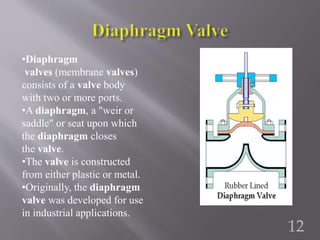
•Diaphragm
valves (membrane valves)
consists of a valve body
with two or more ports.
•A diaphragm, a "weir or
saddle" or seat upon which
the diaphragm closes
the valve.
•The valve is constructed
from either plastic or metal.
•Originally, the diaphragm
valve was developed for use
in industrial applications.
13
 Also known as ‘Non-Return Valves’
 It prevents the water to flow back in the opposite
direction.
 It may be installed on the delivery side of the pumping
set.
 Check valves are also required at inter-connections
between a polluted water system, so as to prevent the
entry of pollution into the pure water.
 Foot valve – check valve installed at the end of suction
line
 Foot valve prevents draining of the suction when the
pump stops.
14
15
 Used to maintain a constant level in a service reservoir or
elevated tank or stand pipe
 Equilibrium type of valve – most effective.
 In most severe operating conditions, needle type of valve
will give better service – more expensive.
 The disadvantage – Valve may operate for long periods in a
throttled condition. This can be avoided by arranging for the
float to function in a small auxiliary cylinder or a tank.
 When water reaches the top of the auxiliary tank, the ball
will rise quickly from the fully open position to the closed
position without shock.
 The valve will not open again until the water level in the
reservoir reaches the base of the auxiliary tank.
16
17
 Used to reduce water hammer pressures in pressure
pipes.
 This valve is adjusted to open out automatically as
soon as pressure in the pipe exceeds a certain fixed
predetermined value.
 Due to the opening of this valve, certain water will get
out of the pipe, and thus, reducing the water pressure.
 As soon as the pressure reduces, the valve will close
automatically.
18
19
THANK YOU
20

Valves in pipe lines

  • 1.
  • 2.
    Valve is adevice that regulates, direct controls the flow of a fluid (gases, liquids, fluidized solids, or slurries) by opening, closing, or partially Obstructing various passageways. Valves are technically fittings, but are usually discussed as a separate category. 2 VALVE
  • 3.
    1. Gate Valve 2.Plug Valve 3. Globe valve 4. Butterfly Valve 5. Diaphragm Valve 6. Check Valve 7. Ball Valve 8. Pressure reducing valve 3
  • 4.
     Used toregulate the flow of water through the pipes.  Usually placed at the summits of pressure conduits, they can be cheaper and less stronger materials and can be easily operated with less force.  For economy, in large dia pipes, valves of smaller dia than the pipe itself are generally used 4
  • 5.
  • 6.
    6 •Plug valves arevalves with cylindrical or conically tapered "plugs" • Which can be rotated inside the valve body to control flow through the valve. •The plugs in plug valves have one or more hollow passageways going sideways through the plug, so that fluid can flow through the plug when the valve is open.
  • 7.
  • 8.
     Used insmall bore pipe work and as taps and although a variation is used as a control valve.  Have a circular seal connected axially to a vertical spindle and hand wheel. 8
  • 9.
  • 10.
     Used toregulate and stop the flow especially in large size conduits.  Butterfly valves with sliding parts have the advantages of ease of operations, compact size, reduced chamber or valve house and improved closing and retarding characteristics.  Involve slightly higher head loss than sluice valves  Not suitable for continuous throttling.  Sealing is not as effective as sluice valves at high pressures. 10
  • 11.
  • 12.
    12 •Diaphragm valves (membrane valves) consistsof a valve body with two or more ports. •A diaphragm, a "weir or saddle" or seat upon which the diaphragm closes the valve. •The valve is constructed from either plastic or metal. •Originally, the diaphragm valve was developed for use in industrial applications.
  • 13.
  • 14.
     Also knownas ‘Non-Return Valves’  It prevents the water to flow back in the opposite direction.  It may be installed on the delivery side of the pumping set.  Check valves are also required at inter-connections between a polluted water system, so as to prevent the entry of pollution into the pure water.  Foot valve – check valve installed at the end of suction line  Foot valve prevents draining of the suction when the pump stops. 14
  • 15.
  • 16.
     Used tomaintain a constant level in a service reservoir or elevated tank or stand pipe  Equilibrium type of valve – most effective.  In most severe operating conditions, needle type of valve will give better service – more expensive.  The disadvantage – Valve may operate for long periods in a throttled condition. This can be avoided by arranging for the float to function in a small auxiliary cylinder or a tank.  When water reaches the top of the auxiliary tank, the ball will rise quickly from the fully open position to the closed position without shock.  The valve will not open again until the water level in the reservoir reaches the base of the auxiliary tank. 16
  • 17.
  • 18.
     Used toreduce water hammer pressures in pressure pipes.  This valve is adjusted to open out automatically as soon as pressure in the pipe exceeds a certain fixed predetermined value.  Due to the opening of this valve, certain water will get out of the pipe, and thus, reducing the water pressure.  As soon as the pressure reduces, the valve will close automatically. 18
  • 19.
  • 20.