Production optimization
using gas lift technique
Jarjis Mohammed
Shwan Rajab
Sana Abdul Wahab
Supervised by: Mr. Pshtiwan Jaf 1
Outlines
 Introduction
 Project Objective
 Project Theoretical Background
 Project Methodology
 Modelling and Simulation
 Gas Lift Sensitives
 Recommendation
 References
2
Introduction
 After completed the drilling, set the tubing and completed the
well successfully, Petroleum engineers realize that the
hydrocarbon fluid won't lift up from bottom hole to the
surface by its reservoir drives which are mainly gas cap or
water drive. Simply the gas lift technique is to reduce the
density of hydrocarbon fluid inside the well to lift it to the
surface by injecting compressed gas.
3
Introduction Cont.
 The gas lift technique is one of the methods of artificial lift that
use for the same reason. Each of the methods has their advantages
and disadvantages, some of them are suitable for the shallow
depth, in contrast, some of them are suitable for the deep wells.
 The selecting process of the artificial lift methods is based on
some criteria that we have covered in our project.
4
Introduction Cont.
Figure (1): Simple gas lift operation (Croft Production Systems, 2015)
 This figure shows the simple gas
lift technique by injecting gas in
the annuals pathway to the tubing
through a special gas lift valve
called (Mandrel valve).
5
The Project Objective
 The main objective of this project is to find out the parameters
that select the design of the gas lift system, such as determine the
optimum depth to injection and the optimum injection rate.
 By using PROSPER software program, we model the data and
find out the best design of gas lift that is suitable for the available
data.
6
Advantages of Gas lift
 Handle abrasive fluid and sand.
 Compatible with wells producing with high GOR.
 Minimal surface wellhead requirements.
 Less maintenance required compared with other artificial methods.
 Surface control of production rate.
 Gas lift is flexible. A wide vary of volumes and lift depths are often
achieved with primarily a similar well equipment 7
Limitations of gas lift
 Gas availability
 Gas freezing and hydrate problems.
 Casing must withstand lift pressure.
 Safety problem with high pressure gas.
8
Types of Gas Lift
In gas lift technique, there are two types which are:
 Continuous Gas Lift: A continuous gas lift operation is a steady-state
flow of the aerated fluid from the bottom of the well to the surface.
 Intermittent Gas Lift: Intermittent gas lift operation is characterized
by a start-and-stop flow from the bottom (or near the bottom) of the
well to the surface. This is unsteady state flow.
9
Types of Gas Lift Cont.
Figure (2): Types of gas lift (Hernandez 2016) 10
The Gas lift System
The basic gas lift system includes:
 Gas storages
 Gas compressors
 Injection gas lines
 Injection gas manifold
 Gas lift special tubing equipment (Mandrels)
 Gas-liquid separator
11
The Gas lift System…
Figure (3): Gas lift system (Schlumberger, 1999)
12
Gas lift installation
 The first step of implementing any gas lift system is a carefully
engineered design using specific well data and equipment
specifications.
 After the design is completed, the valves are then set to prescribed
design pressure settings, which determine the pressures that the valves
will open and close at.
 The valves are then placed in the gas lift mandrels and are ready to be
installed in the production string at the well location.
13
Gas lift installation cont..
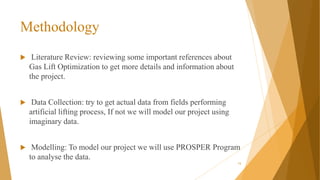
 Tubing flow installation: Lift gas is injected through the
annulus and the well is produced from the tubing.
 Casing flow installation: Lift gas is injected through the
tubing string and the well is produced from the tubing-casing
annulus.
Figure (4): installation Types (Schlumberger, 1999)
14
Methodology
 Literature Review: reviewing some important references about
Gas Lift Optimization to get more details and information about
the project.
 Data Collection: try to get actual data from fields performing
artificial lifting process, If not we will model our project using
imaginary data.
 Modelling: To model our project we will use PROSPER Program
to analyse the data.
15
Modelling and Simulation
 PROSPER is a software package used in the oil industry for
production and well performance analysis purposes by the
petroleum production engineers. This software provides a good
prediction on the production aspects of a specific well after being
utilized to enhance its production.
16
Gas Lift Sensitives
 the following parameters determine the outflow of any reservoir.
For example, in the gas lift application; where the node is
indicated at the bottom of the well, any changes or modifications
in the below parameters can be considered while carrying out
sensitivities.
 Gas injection rate sensitivity
 Injection depth Sensitivity
 Gas lift Gas Injection GLR Sensitivity
17
Gas Lift Sensitives Contd.
 Gas injection rate sensitivity
Through using PROSPER simulator different injection rate of the
lifting gas can be analysed. For example, on well Koya 1 different
injection rates are tried from 0 to 2.25 MMscf/day, consequently, the
below graph is plotted.
18
Gas Lift Sensitives Contd.
19
 Gas injection rate sensitivity
Gas Lift Sensitives Contd.
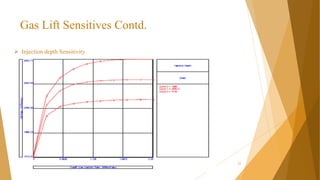
 Injection depth Sensitivity
The deeper injection of Gas lift gas rate leads to an increase in the
oil rate/or liquid rate. This happens because, when gas injected at a
deeper point, this will result in a further reduction in oil column
density inside the vertical tubing.
20
Gas Lift Sensitives Contd.
21
 Injection depth Sensitivity
Gas Lift Sensitives Contd.
22
 Gas lift Gas Injection GLR Sensitivities
In PROSPER simulator different injected GLR can be analysed. For
example, on well Koya-1 different GORs are tried from 237
SCF/STB to 1200 SCF/STB, consequently, the below graph appears.
Gas Lift Sensitives Contd.
23
 Gas lift Gas Injection GLR Sensitivities
Recommendation
24
 For proper selection, installation, and operations of gas lift
system, the operator must know the equipment and the
fundamental of gas lift technology.
 Inject optimum amount of gas to getting maximum oil
production. But economically, less amount of gas could inject
for get oil production less than a maximum oil production
with a little decreased.
Conclusion
 There are two types of gas lift.
1- Intermittent 2- Continuous
 Most important variables of design:
1- Casing pressure (Operating pressure)
2- Setting depth for each mandrel
3- Gas Injection rate
 There are two types of installation.
1- Tubing flow installation
2- Casing Flow Installation
25
References
 Brown, K. (1973). Gas lift theory and practice, including a review
of petroleum engineering fundamentals. Tulsa, Okla.: Petroleum
Pub. Co.
 Hernandez, A. (2016). Fundamentals of gas lift engineering.
Cambridge, MA: Gulf Professional Publishing.
 Pittman, R. (1982). Gas Lift Design and Performance.
International Petroleum Exhibition and Technical Symposium.
26
27

Production optimization using gas lift technique

  • 1.
    Production optimization using gaslift technique Jarjis Mohammed Shwan Rajab Sana Abdul Wahab Supervised by: Mr. Pshtiwan Jaf 1
  • 2.
    Outlines  Introduction  ProjectObjective  Project Theoretical Background  Project Methodology  Modelling and Simulation  Gas Lift Sensitives  Recommendation  References 2
  • 3.
    Introduction  After completedthe drilling, set the tubing and completed the well successfully, Petroleum engineers realize that the hydrocarbon fluid won't lift up from bottom hole to the surface by its reservoir drives which are mainly gas cap or water drive. Simply the gas lift technique is to reduce the density of hydrocarbon fluid inside the well to lift it to the surface by injecting compressed gas. 3
  • 4.
    Introduction Cont.  Thegas lift technique is one of the methods of artificial lift that use for the same reason. Each of the methods has their advantages and disadvantages, some of them are suitable for the shallow depth, in contrast, some of them are suitable for the deep wells.  The selecting process of the artificial lift methods is based on some criteria that we have covered in our project. 4
  • 5.
    Introduction Cont. Figure (1):Simple gas lift operation (Croft Production Systems, 2015)  This figure shows the simple gas lift technique by injecting gas in the annuals pathway to the tubing through a special gas lift valve called (Mandrel valve). 5
  • 6.
    The Project Objective The main objective of this project is to find out the parameters that select the design of the gas lift system, such as determine the optimum depth to injection and the optimum injection rate.  By using PROSPER software program, we model the data and find out the best design of gas lift that is suitable for the available data. 6
  • 7.
    Advantages of Gaslift  Handle abrasive fluid and sand.  Compatible with wells producing with high GOR.  Minimal surface wellhead requirements.  Less maintenance required compared with other artificial methods.  Surface control of production rate.  Gas lift is flexible. A wide vary of volumes and lift depths are often achieved with primarily a similar well equipment 7
  • 8.
    Limitations of gaslift  Gas availability  Gas freezing and hydrate problems.  Casing must withstand lift pressure.  Safety problem with high pressure gas. 8
  • 9.
    Types of GasLift In gas lift technique, there are two types which are:  Continuous Gas Lift: A continuous gas lift operation is a steady-state flow of the aerated fluid from the bottom of the well to the surface.  Intermittent Gas Lift: Intermittent gas lift operation is characterized by a start-and-stop flow from the bottom (or near the bottom) of the well to the surface. This is unsteady state flow. 9
  • 10.
    Types of GasLift Cont. Figure (2): Types of gas lift (Hernandez 2016) 10
  • 11.
    The Gas liftSystem The basic gas lift system includes:  Gas storages  Gas compressors  Injection gas lines  Injection gas manifold  Gas lift special tubing equipment (Mandrels)  Gas-liquid separator 11
  • 12.
    The Gas liftSystem… Figure (3): Gas lift system (Schlumberger, 1999) 12
  • 13.
    Gas lift installation The first step of implementing any gas lift system is a carefully engineered design using specific well data and equipment specifications.  After the design is completed, the valves are then set to prescribed design pressure settings, which determine the pressures that the valves will open and close at.  The valves are then placed in the gas lift mandrels and are ready to be installed in the production string at the well location. 13
  • 14.
    Gas lift installationcont..  Tubing flow installation: Lift gas is injected through the annulus and the well is produced from the tubing.  Casing flow installation: Lift gas is injected through the tubing string and the well is produced from the tubing-casing annulus. Figure (4): installation Types (Schlumberger, 1999) 14
  • 15.
    Methodology  Literature Review:reviewing some important references about Gas Lift Optimization to get more details and information about the project.  Data Collection: try to get actual data from fields performing artificial lifting process, If not we will model our project using imaginary data.  Modelling: To model our project we will use PROSPER Program to analyse the data. 15
  • 16.
    Modelling and Simulation PROSPER is a software package used in the oil industry for production and well performance analysis purposes by the petroleum production engineers. This software provides a good prediction on the production aspects of a specific well after being utilized to enhance its production. 16
  • 17.
    Gas Lift Sensitives the following parameters determine the outflow of any reservoir. For example, in the gas lift application; where the node is indicated at the bottom of the well, any changes or modifications in the below parameters can be considered while carrying out sensitivities.  Gas injection rate sensitivity  Injection depth Sensitivity  Gas lift Gas Injection GLR Sensitivity 17
  • 18.
    Gas Lift SensitivesContd.  Gas injection rate sensitivity Through using PROSPER simulator different injection rate of the lifting gas can be analysed. For example, on well Koya 1 different injection rates are tried from 0 to 2.25 MMscf/day, consequently, the below graph is plotted. 18
  • 19.
    Gas Lift SensitivesContd. 19  Gas injection rate sensitivity
  • 20.
    Gas Lift SensitivesContd.  Injection depth Sensitivity The deeper injection of Gas lift gas rate leads to an increase in the oil rate/or liquid rate. This happens because, when gas injected at a deeper point, this will result in a further reduction in oil column density inside the vertical tubing. 20
  • 21.
    Gas Lift SensitivesContd. 21  Injection depth Sensitivity
  • 22.
    Gas Lift SensitivesContd. 22  Gas lift Gas Injection GLR Sensitivities In PROSPER simulator different injected GLR can be analysed. For example, on well Koya-1 different GORs are tried from 237 SCF/STB to 1200 SCF/STB, consequently, the below graph appears.
  • 23.
    Gas Lift SensitivesContd. 23  Gas lift Gas Injection GLR Sensitivities
  • 24.
    Recommendation 24  For properselection, installation, and operations of gas lift system, the operator must know the equipment and the fundamental of gas lift technology.  Inject optimum amount of gas to getting maximum oil production. But economically, less amount of gas could inject for get oil production less than a maximum oil production with a little decreased.
  • 25.
    Conclusion  There aretwo types of gas lift. 1- Intermittent 2- Continuous  Most important variables of design: 1- Casing pressure (Operating pressure) 2- Setting depth for each mandrel 3- Gas Injection rate  There are two types of installation. 1- Tubing flow installation 2- Casing Flow Installation 25
  • 26.
    References  Brown, K.(1973). Gas lift theory and practice, including a review of petroleum engineering fundamentals. Tulsa, Okla.: Petroleum Pub. Co.  Hernandez, A. (2016). Fundamentals of gas lift engineering. Cambridge, MA: Gulf Professional Publishing.  Pittman, R. (1982). Gas Lift Design and Performance. International Petroleum Exhibition and Technical Symposium. 26
  • 27.