Vitamins

Benefits and essentials
What are Vitamins?
• It is an organic compound, required in small
  amounts by an organism to obtain cellular
  functions.
• It is called vitamin, when it can not be
  synthesized in sufficient quantities by the
  organism, and must therefore be supplied by
  the diet.
History of Vitamins
• In ancient Egypt: Feeding of patients with liver
  to prevent night blindness (now known as
  vitamin A deficiency)
• In 1749, the prevention of scurvy by citrus
  foods, was first discovered by the Scottish
  surgeon James Lind.
• In the Orient: Beriberi was common (a disease
  caused by the deficiency of Vitamin B1),
  because of polished white rice.
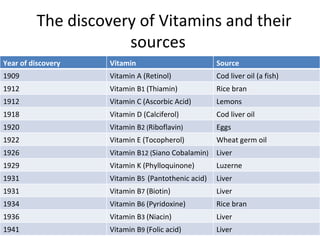
The discovery of Vitamins and their
                     sources
Year of discovery   Vitamin                         Source
1909                Vitamin A (Retinol)             Cod liver oil (a fish)
1912                Vitamin B1 (Thiamin)            Rice bran
1912                Vitamin C (Ascorbic Acid)       Lemons
1918                Vitamin D (Calciferol)          Cod liver oil
1920                Vitamin B2 (Riboflavin)         Eggs
1922                Vitamin E (Tocopherol)          Wheat germ oil
1926                Vitamin B12 (Siano Cobalamin) Liver
1929                Vitamin K (Phylloquinone)       Luzerne
1931                Vitamin B5 (Pantothenic acid)   Liver
1931                Vitamin B7 (Biotin)             Liver
1934                Vitamin B6 (Pyridoxine)         Rice bran
1936                Vitamin B3 (Niacin)             Liver
1941                Vitamin B9 (Folic acid)         Liver
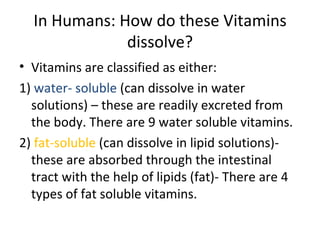
In Humans: How do these Vitamins
              dissolve?
• Vitamins are classified as either:
1) water- soluble (can dissolve in water
  solutions) – these are readily excreted from
  the body. There are 9 water soluble vitamins.
2) fat-soluble (can dissolve in lipid solutions)-
  these are absorbed through the intestinal
  tract with the help of lipids (fat)- There are 4
  types of fat soluble vitamins.
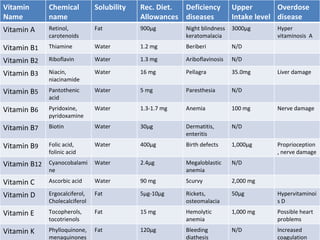
Vitamin       Chemical          Solubility   Rec. Diet. Deficiency          Upper        Overdose
Name          name                           Allowances diseases            Intake level disease
Vitamin A     Retinol,          Fat          900µg        Night blindness   3000µg      Hyper
              carotenoids                                 keratomalacia                 vitaminosis A

Vitamin B1    Thiamine          Water        1.2 mg       Beriberi          N/D

Vitamin B2    Riboflavin        Water        1.3 mg       Ariboflavinosis   N/D

Vitamin B3    Niacin,           Water        16 mg        Pellagra          35.0mg      Liver damage
              niacinamide

Vitamin B5    Pantothenic       Water        5 mg         Paresthesia       N/D
              acid

Vitamin B6    Pyridoxine,       Water        1.3-1.7 mg   Anemia            100 mg      Nerve damage
              pyridoxamine

Vitamin B7    Biotin            Water        30µg         Dermatitis,       N/D
                                                          enteritis

Vitamin B9    Folic acid,       Water        400µg        Birth defects     1,000µg     Proprioception
              folinic acid                                                              , nerve damage
Vitamin B12   Cyanocobalami     Water        2.4µg        Megaloblastic     N/D
              ne                                          anemia

Vitamin C     Ascorbic acid     Water        90 mg        Scurvy            2,000 mg

Vitamin D     Ergocalciferol,   Fat          5µg-10µg     Rickets,          50µg        Hypervitaminoi
              Cholecalciferol                             osteomalacia                  sD

Vitamin E     Tocopherols,      Fat          15 mg        Hemolytic         1,000 mg    Possible heart
              tocotrienols                                anemia                        problems

Vitamin K     Phylloquinone,    Fat          120µg        Bleeding          N/D         Increased
              menaquinones                                diathesis                     coagulation
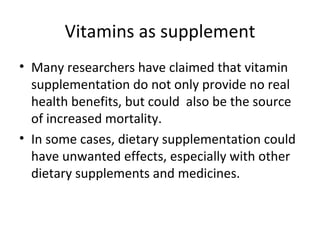
Vitamins as supplement
• Many researchers have claimed that vitamin
  supplementation do not only provide no real
  health benefits, but could also be the source
  of increased mortality.
• In some cases, dietary supplementation could
  have unwanted effects, especially with other
  dietary supplements and medicines.
No wonder that an apple a day
   keeps the doctor away!

         Thank you!

Vitamins

  • 1.
  • 3.
    What are Vitamins? •It is an organic compound, required in small amounts by an organism to obtain cellular functions. • It is called vitamin, when it can not be synthesized in sufficient quantities by the organism, and must therefore be supplied by the diet.
  • 4.
    History of Vitamins •In ancient Egypt: Feeding of patients with liver to prevent night blindness (now known as vitamin A deficiency) • In 1749, the prevention of scurvy by citrus foods, was first discovered by the Scottish surgeon James Lind. • In the Orient: Beriberi was common (a disease caused by the deficiency of Vitamin B1), because of polished white rice.
  • 5.
    The discovery ofVitamins and their sources Year of discovery Vitamin Source 1909 Vitamin A (Retinol) Cod liver oil (a fish) 1912 Vitamin B1 (Thiamin) Rice bran 1912 Vitamin C (Ascorbic Acid) Lemons 1918 Vitamin D (Calciferol) Cod liver oil 1920 Vitamin B2 (Riboflavin) Eggs 1922 Vitamin E (Tocopherol) Wheat germ oil 1926 Vitamin B12 (Siano Cobalamin) Liver 1929 Vitamin K (Phylloquinone) Luzerne 1931 Vitamin B5 (Pantothenic acid) Liver 1931 Vitamin B7 (Biotin) Liver 1934 Vitamin B6 (Pyridoxine) Rice bran 1936 Vitamin B3 (Niacin) Liver 1941 Vitamin B9 (Folic acid) Liver
  • 6.
    In Humans: Howdo these Vitamins dissolve? • Vitamins are classified as either: 1) water- soluble (can dissolve in water solutions) – these are readily excreted from the body. There are 9 water soluble vitamins. 2) fat-soluble (can dissolve in lipid solutions)- these are absorbed through the intestinal tract with the help of lipids (fat)- There are 4 types of fat soluble vitamins.
  • 7.
    Vitamin Chemical Solubility Rec. Diet. Deficiency Upper Overdose Name name Allowances diseases Intake level disease Vitamin A Retinol, Fat 900µg Night blindness 3000µg Hyper carotenoids keratomalacia vitaminosis A Vitamin B1 Thiamine Water 1.2 mg Beriberi N/D Vitamin B2 Riboflavin Water 1.3 mg Ariboflavinosis N/D Vitamin B3 Niacin, Water 16 mg Pellagra 35.0mg Liver damage niacinamide Vitamin B5 Pantothenic Water 5 mg Paresthesia N/D acid Vitamin B6 Pyridoxine, Water 1.3-1.7 mg Anemia 100 mg Nerve damage pyridoxamine Vitamin B7 Biotin Water 30µg Dermatitis, N/D enteritis Vitamin B9 Folic acid, Water 400µg Birth defects 1,000µg Proprioception folinic acid , nerve damage Vitamin B12 Cyanocobalami Water 2.4µg Megaloblastic N/D ne anemia Vitamin C Ascorbic acid Water 90 mg Scurvy 2,000 mg Vitamin D Ergocalciferol, Fat 5µg-10µg Rickets, 50µg Hypervitaminoi Cholecalciferol osteomalacia sD Vitamin E Tocopherols, Fat 15 mg Hemolytic 1,000 mg Possible heart tocotrienols anemia problems Vitamin K Phylloquinone, Fat 120µg Bleeding N/D Increased menaquinones diathesis coagulation
  • 8.
    Vitamins as supplement •Many researchers have claimed that vitamin supplementation do not only provide no real health benefits, but could also be the source of increased mortality. • In some cases, dietary supplementation could have unwanted effects, especially with other dietary supplements and medicines.
  • 9.
    No wonder thatan apple a day keeps the doctor away! Thank you!