© E.V. Blackburn, 2005
Stereochemistry
Stereoisomerism
© E.V. Blackburn, 2005
Isomerism
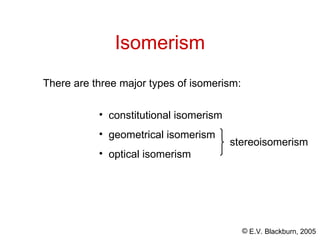
There are three major types of isomerism:
• constitutional isomerism
• geometrical isomerism
• optical isomerism
stereoisomerism
© E.V. Blackburn, 2005
Constitutional isomers
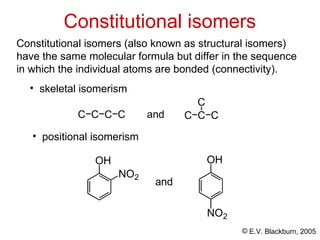
Constitutional isomers (also known as structural isomers)
have the same molecular formula but differ in the sequence
in which the individual atoms are bonded (connectivity).
• skeletal isomerism
• positional isomerism
C C C C and C C C
C
OH OH
NO2
NO2
and
© E.V. Blackburn, 2005
Constitutional isomers
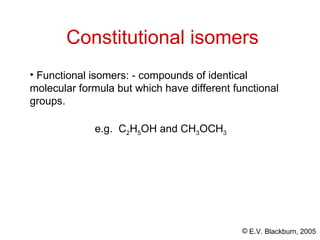
• Functional isomers: - compounds of identical
molecular formula but which have different functional
groups.
e.g. C2H5OH and CH3OCH3
© E.V. Blackburn, 2005
Stereoisomerism
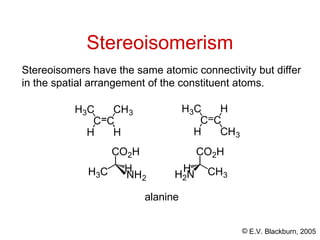
Stereoisomers have the same atomic connectivity but differ
in the spatial arrangement of the constituent atoms.
C C
H
CH3
H
H3C
C C
CH3
H
H
H3C
CO2H
H3C H
CO2H
CH3
H2N
H
NH2
alanine
© E.V. Blackburn, 2005
Enantiomers
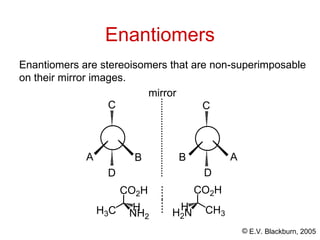
Enantiomers are stereoisomers that are non-superimposable
on their mirror images.
A A
B B
C C
D D
mirror
CO2H
H3C NH2
H CH3
CO2H
H2N
H
© E.V. Blackburn, 2005
Diastereomers
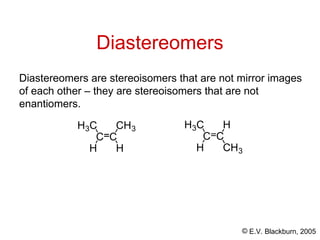
Diastereomers are stereoisomers that are not mirror images
of each other – they are stereoisomers that are not
enantiomers.
C C
H
CH3
H
H3C
C C
CH3
H
H
H3C
© E.V. Blackburn, 2005
Chirality
Chirality is a necessary and sufficient condition for the
existence of enantiomers.
“cheir” - Greek meaning “hand”
Molecules that are superimposable on their mirror
images are said to be achiral.
Try problem 5.1 on page 197 of Solomons and Fryhle.
Molecules that can exist as enantiomers are said to be
chiral; they are non-superimposable on their mirror
images.
© E.V. Blackburn, 2005
Tetrahedral stereogenic
centres
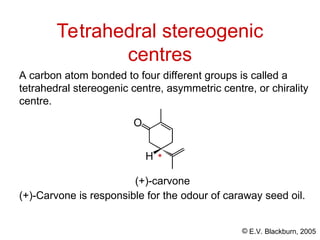
A carbon atom bonded to four different groups is called a
tetrahedral stereogenic centre, asymmetric centre, or chirality
centre.
O
H
(+)-carvone
(+)-Carvone is responsible for the odour of caraway seed oil.
*
© E.V. Blackburn, 2005
Stereogenic centres
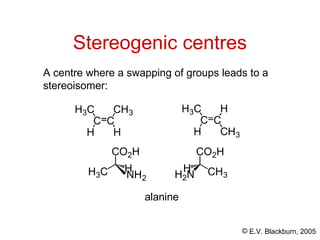
A centre where a swapping of groups leads to a
stereoisomer:
C C
H
CH3
H
H3C
C C
CH3
H
H
H3C
CO2H
H3C H
CO2H
CH3
H2N
H
NH2
alanine
© E.V. Blackburn, 2005
Historical origin of stereochemistry
• Only one compound with the formula CH3X is ever found.
• Only one compound with the formula CH2XY is ever
found.
• Two compounds with the formula CHXYZ are found – a
pair of enantiomers.
© E.V. Blackburn, 2005
van’t Hoff and Le Bel
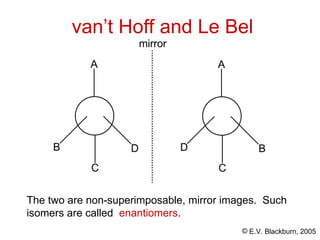
The two are non-superimposable, mirror images. Such
isomers are called enantiomers.
D
B
A
C
B
D
A
C
mirror
© E.V. Blackburn, 2005
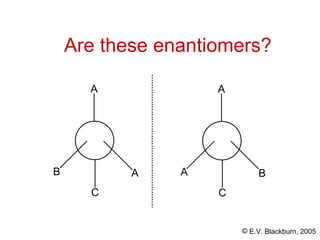
Are these enantiomers?
A
B
A
C
B
A
A
C
© E.V. Blackburn, 2005
Configurations
Configurations are not the same as conformations.
Conformations are interconvertible by rotation about
single bond(s) whereas bonds must be broken to
change one configuration into another.
The particular arrangement of atoms in space that is
characteristic of a given molecule is called its
configuration.
© E.V. Blackburn, 2005
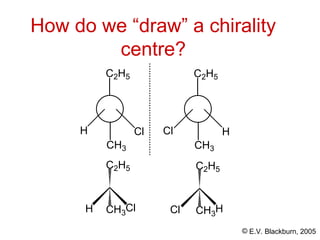
How do we “draw” a chirality
centre?
Cl
H
C2H5
CH3
H
Cl
C2H5
CH3
H
Cl
C2H5
CH3
Cl
H
C2H5
CH3
© E.V. Blackburn, 2005
H Cl
CH3
C2H5
Cl H
CH3
C2H5
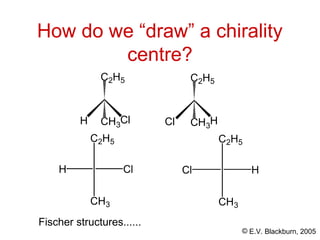
Fischer structures......
How do we “draw” a chirality
centre?
H
Cl
C2H5
CH3
Cl
H
C2H5
CH3
© E.V. Blackburn, 2005
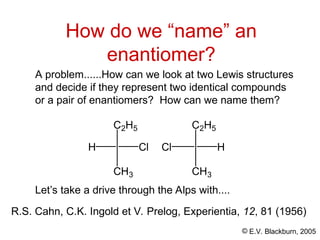
A problem......How can we look at two Lewis structures
and decide if they represent two identical compounds
or a pair of enantiomers? How can we name them?
How do we “name” an
enantiomer?
H Cl
C2H5
CH3
Cl H
C2H5
CH3
Let’s take a drive through the Alps with....
R.S. Cahn, C.K. Ingold et V. Prelog, Experientia, 12, 81 (1956)
© E.V. Blackburn, 2005
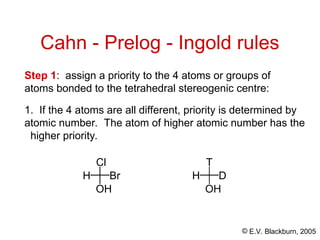
Cahn - Prelog - Ingold rules
1. If the 4 atoms are all different, priority is determined by
atomic number. The atom of higher atomic number has the
higher priority.
Step 1: assign a priority to the 4 atoms or groups of
atoms bonded to the tetrahedral stereogenic centre:
Cl
H Br
OH
T
H D
OH
© E.V. Blackburn, 2005
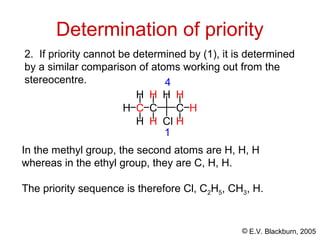
Determination of priority
2. If priority cannot be determined by (1), it is determined
by a similar comparison of atoms working out from the
stereocentre.
In the methyl group, the second atoms are H, H, H
whereas in the ethyl group, they are C, H, H.
The priority sequence is therefore Cl, C2H5, CH3, H.
H
C
C
H
C
H
Cl
H
H
H
H
H
H
4
1
© E.V. Blackburn, 2005
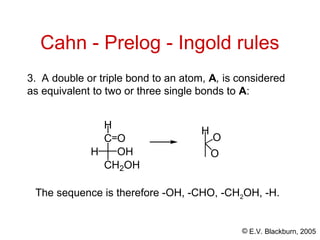
The sequence is therefore -OH, -CHO, -CH2OH, -H.
Cahn - Prelog - Ingold rules
3. A double or triple bond to an atom, A, is considered
as equivalent to two or three single bonds to A:
H
O
O
H
C
CH2OH
H OH
O
© E.V. Blackburn, 2005
Step 2
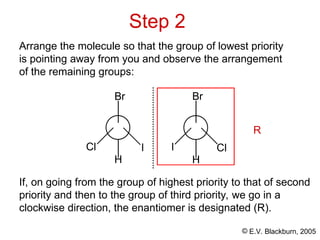
Arrange the molecule so that the group of lowest priority
is pointing away from you and observe the arrangement
of the remaining groups:
I
Cl
H
Cl
I
H
Br Br
If, on going from the group of highest priority to that of second
priority and then to the group of third priority, we go in a
clockwise direction, the enantiomer is designated (R).
R
© E.V. Blackburn, 2005
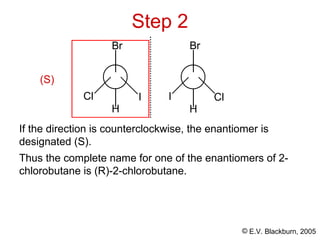
Thus the complete name for one of the enantiomers of 2-
chlorobutane is (R)-2-chlorobutane.
Step 2
I
Cl
H
Cl
I
H
Br Br
If the direction is counterclockwise, the enantiomer is
designated (S).
(S)
© E.V. Blackburn, 2005
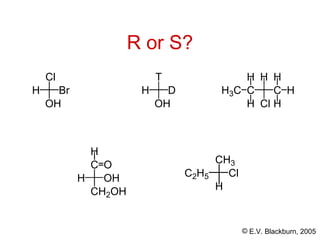
R or S?
Cl
H Br
OH
T
H D
OH
H
C
H3C
H
C
H
Cl
H
H
H
H
C
CH2OH
H OH
O CH3
H
C2H5 Cl
© E.V. Blackburn, 2005
Problems
Try problems 5.11 and 5.12, page 206, and 5.13 on page
208 of Solomons and Fryhle.
© E.V. Blackburn, 2005
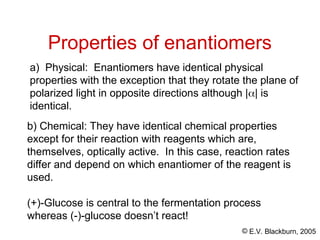
Properties of enantiomers
b) Chemical: They have identical chemical properties
except for their reaction with reagents which are,
themselves, optically active. In this case, reaction rates
differ and depend on which enantiomer of the reagent is
used.
(+)-Glucose is central to the fermentation process
whereas (-)-glucose doesn’t react!
a) Physical: Enantiomers have identical physical
properties with the exception that they rotate the plane of
polarized light in opposite directions although || is
identical.
© E.V. Blackburn, 2005
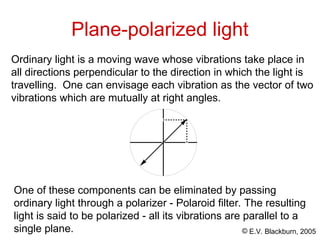
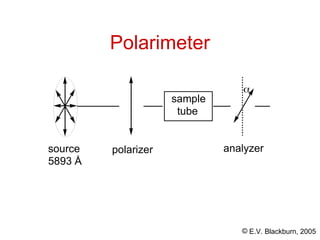
Plane-polarized light
Ordinary light is a moving wave whose vibrations take place in
all directions perpendicular to the direction in which the light is
travelling. One can envisage each vibration as the vector of two
vibrations which are mutually at right angles.
One of these components can be eliminated by passing
ordinary light through a polarizer - Polaroid filter. The resulting
light is said to be polarized - all its vibrations are parallel to a
single plane.
© E.V. Blackburn, 2005
Polarimeter
source
5893 Å
polarizer
sample
tube
analyzer

© E.V. Blackburn, 2005
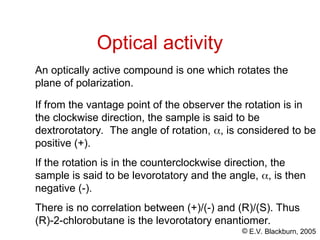
If from the vantage point of the observer the rotation is in
the clockwise direction, the sample is said to be
dextrorotatory. The angle of rotation, , is considered to be
positive (+).
If the rotation is in the counterclockwise direction, the
sample is said to be levorotatory and the angle, , is then
negative (-).
There is no correlation between (+)/(-) and (R)/(S). Thus
(R)-2-chlorobutane is the levorotatory enantiomer.
Optical activity
An optically active compound is one which rotates the
plane of polarization.
© E.V. Blackburn, 2005
Specific rotation
 is proportional to the concentration of the sample
and the length of the sample tube:
[]
t
= 
l x c
 - angle of rotation measured in degrees
t - temperature
 - wavelength of light
l - length of sample cell
c - concentration in grams of substance contained
in 1 mL of solution
© E.V. Blackburn, 2005
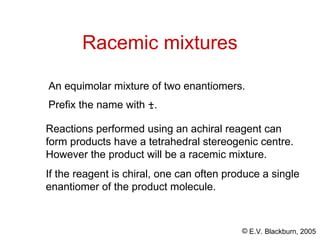
Racemic mixtures
An equimolar mixture of two enantiomers.
Prefix the name with +.
-
Reactions performed using an achiral reagent can
form products have a tetrahedral stereogenic centre.
However the product will be a racemic mixture.
If the reagent is chiral, one can often produce a single
enantiomer of the product molecule.
© E.V. Blackburn, 2005
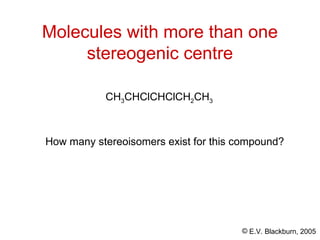
Molecules with more than one
stereogenic centre
How many stereoisomers exist for this compound?
CH3CHClCHClCH2CH3
© E.V. Blackburn, 2005
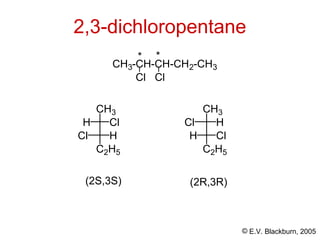
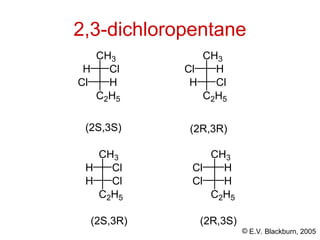
2,3-dichloropentane
(2S,3S) (2R,3R)
CH3-CH-CH-CH2-CH3
Cl
Cl
* *
H Cl
CH3
Cl H
C2H5
Cl H
CH3
H Cl
C2H5
© E.V. Blackburn, 2005
2,3-dichloropentane
(2S,3R) (2R,3S)
(2S,3S) (2R,3R)
H Cl
CH3
Cl H
C2H5
Cl H
CH3
H Cl
C2H5
H Cl
CH3
H Cl
C2H5
Cl H
CH3
Cl H
C2H5
© E.V. Blackburn, 2005
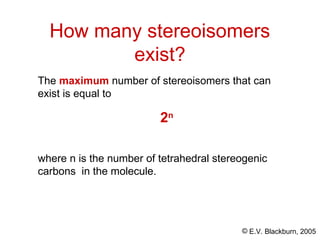
The maximum number of stereoisomers that can
exist is equal to
2n
where n is the number of tetrahedral stereogenic
carbons in the molecule.
How many stereoisomers
exist?
© E.V. Blackburn, 2005
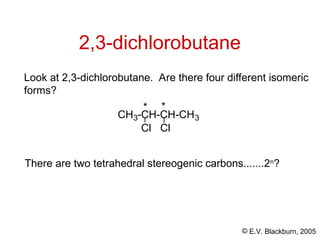
2,3-dichlorobutane
Look at 2,3-dichlorobutane. Are there four different isomeric
forms?
There are two tetrahedral stereogenic carbons.......2n
?
CH3-CH-CH-CH3
Cl
Cl
* *
© E.V. Blackburn, 2005
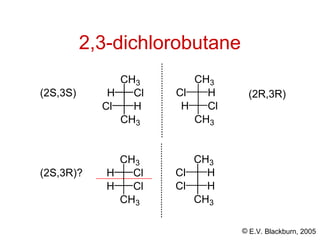
2,3-dichlorobutane
(2S,3S) (2R,3R)
(2S,3R)?
Cl H
CH3
H Cl
CH3
H Cl
CH3
Cl H
CH3
Cl H
CH3
Cl H
CH3
H Cl
CH3
H Cl
CH3
© E.V. Blackburn, 2005
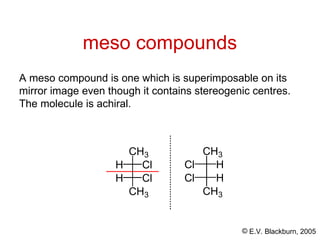
meso compounds
A meso compound is one which is superimposable on its
mirror image even though it contains stereogenic centres.
The molecule is achiral.
Cl H
CH3
Cl H
CH3
H Cl
CH3
H Cl
CH3
© E.V. Blackburn, 2005
Problems
Try problems 5.18 – 5.23 on pages 221 - 223 of Solomons
and Fryhle.
© E.V. Blackburn, 2005
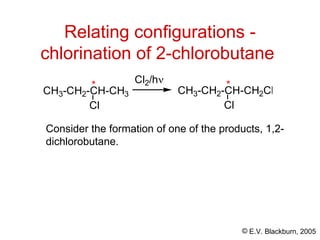
Relating configurations -
chlorination of 2-chlorobutane
Consider the formation of one of the products, 1,2-
dichlorobutane.
CH3-CH2-CH-CH3
Cl
* Cl2/h
CH3-CH2-CH-CH2Cl
Cl
*
© E.V. Blackburn, 2005
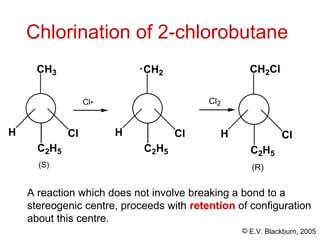
A reaction which does not involve breaking a bond to a
stereogenic centre, proceeds with retention of configuration
about this centre.
Cl
H
CH3
C2H5
(S)
Cl
Chlorination of 2-chlorobutane
Cl
H
CH2
C2H5
Cl
H
CH2Cl
C2H5
Cl2
(R)
© E.V. Blackburn, 2005
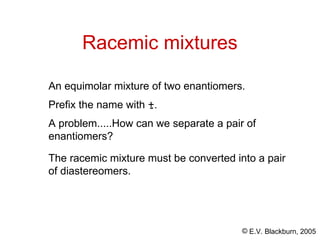
Racemic mixtures
An equimolar mixture of two enantiomers.
Prefix the name with +.
-
A problem.....How can we separate a pair of
enantiomers?
The racemic mixture must be converted into a pair
of diastereomers.
© E.V. Blackburn, 2005
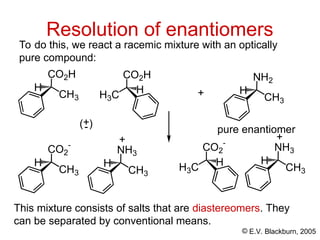
Resolution of enantiomers
This mixture consists of salts that are diastereomers. They
can be separated by conventional means.
To do this, we react a racemic mixture with an optically
pure compound:
CO2H
H3C
CH3
CO2H
H
H
( )
+
-
+ CH3
NH2
H
pure enantiomer
CH3
CO2
-
H
CH3
NH3
H
+
CO2
-
H3C H CH3
NH3
H
+
© E.V. Blackburn, 2005
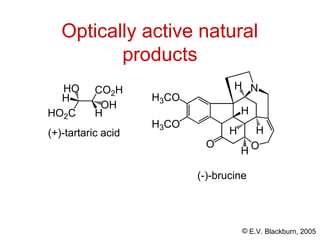
Optically active natural
products
CO2H
HO2C H
H
OH
HO
(+)-tartaric acid
H3CO
H3CO
O
O
H
H H
H
N
H
(-)-brucine

STEREOCHEMISTRY for basic learning by students

  • 1.
    © E.V. Blackburn,2005 Stereochemistry Stereoisomerism
  • 2.
    © E.V. Blackburn,2005 Isomerism There are three major types of isomerism: • constitutional isomerism • geometrical isomerism • optical isomerism stereoisomerism
  • 3.
    © E.V. Blackburn,2005 Constitutional isomers Constitutional isomers (also known as structural isomers) have the same molecular formula but differ in the sequence in which the individual atoms are bonded (connectivity). • skeletal isomerism • positional isomerism C C C C and C C C C OH OH NO2 NO2 and
  • 4.
    © E.V. Blackburn,2005 Constitutional isomers • Functional isomers: - compounds of identical molecular formula but which have different functional groups. e.g. C2H5OH and CH3OCH3
  • 5.
    © E.V. Blackburn,2005 Stereoisomerism Stereoisomers have the same atomic connectivity but differ in the spatial arrangement of the constituent atoms. C C H CH3 H H3C C C CH3 H H H3C CO2H H3C H CO2H CH3 H2N H NH2 alanine
  • 6.
    © E.V. Blackburn,2005 Enantiomers Enantiomers are stereoisomers that are non-superimposable on their mirror images. A A B B C C D D mirror CO2H H3C NH2 H CH3 CO2H H2N H
  • 7.
    © E.V. Blackburn,2005 Diastereomers Diastereomers are stereoisomers that are not mirror images of each other – they are stereoisomers that are not enantiomers. C C H CH3 H H3C C C CH3 H H H3C
  • 8.
    © E.V. Blackburn,2005 Chirality Chirality is a necessary and sufficient condition for the existence of enantiomers. “cheir” - Greek meaning “hand” Molecules that are superimposable on their mirror images are said to be achiral. Try problem 5.1 on page 197 of Solomons and Fryhle. Molecules that can exist as enantiomers are said to be chiral; they are non-superimposable on their mirror images.
  • 9.
    © E.V. Blackburn,2005 Tetrahedral stereogenic centres A carbon atom bonded to four different groups is called a tetrahedral stereogenic centre, asymmetric centre, or chirality centre. O H (+)-carvone (+)-Carvone is responsible for the odour of caraway seed oil. *
  • 10.
    © E.V. Blackburn,2005 Stereogenic centres A centre where a swapping of groups leads to a stereoisomer: C C H CH3 H H3C C C CH3 H H H3C CO2H H3C H CO2H CH3 H2N H NH2 alanine
  • 11.
    © E.V. Blackburn,2005 Historical origin of stereochemistry • Only one compound with the formula CH3X is ever found. • Only one compound with the formula CH2XY is ever found. • Two compounds with the formula CHXYZ are found – a pair of enantiomers.
  • 12.
    © E.V. Blackburn,2005 van’t Hoff and Le Bel The two are non-superimposable, mirror images. Such isomers are called enantiomers. D B A C B D A C mirror
  • 13.
    © E.V. Blackburn,2005 Are these enantiomers? A B A C B A A C
  • 14.
    © E.V. Blackburn,2005 Configurations Configurations are not the same as conformations. Conformations are interconvertible by rotation about single bond(s) whereas bonds must be broken to change one configuration into another. The particular arrangement of atoms in space that is characteristic of a given molecule is called its configuration.
  • 15.
    © E.V. Blackburn,2005 How do we “draw” a chirality centre? Cl H C2H5 CH3 H Cl C2H5 CH3 H Cl C2H5 CH3 Cl H C2H5 CH3
  • 16.
    © E.V. Blackburn,2005 H Cl CH3 C2H5 Cl H CH3 C2H5 Fischer structures...... How do we “draw” a chirality centre? H Cl C2H5 CH3 Cl H C2H5 CH3
  • 17.
    © E.V. Blackburn,2005 A problem......How can we look at two Lewis structures and decide if they represent two identical compounds or a pair of enantiomers? How can we name them? How do we “name” an enantiomer? H Cl C2H5 CH3 Cl H C2H5 CH3 Let’s take a drive through the Alps with.... R.S. Cahn, C.K. Ingold et V. Prelog, Experientia, 12, 81 (1956)
  • 18.
    © E.V. Blackburn,2005 Cahn - Prelog - Ingold rules 1. If the 4 atoms are all different, priority is determined by atomic number. The atom of higher atomic number has the higher priority. Step 1: assign a priority to the 4 atoms or groups of atoms bonded to the tetrahedral stereogenic centre: Cl H Br OH T H D OH
  • 19.
    © E.V. Blackburn,2005 Determination of priority 2. If priority cannot be determined by (1), it is determined by a similar comparison of atoms working out from the stereocentre. In the methyl group, the second atoms are H, H, H whereas in the ethyl group, they are C, H, H. The priority sequence is therefore Cl, C2H5, CH3, H. H C C H C H Cl H H H H H H 4 1
  • 20.
    © E.V. Blackburn,2005 The sequence is therefore -OH, -CHO, -CH2OH, -H. Cahn - Prelog - Ingold rules 3. A double or triple bond to an atom, A, is considered as equivalent to two or three single bonds to A: H O O H C CH2OH H OH O
  • 21.
    © E.V. Blackburn,2005 Step 2 Arrange the molecule so that the group of lowest priority is pointing away from you and observe the arrangement of the remaining groups: I Cl H Cl I H Br Br If, on going from the group of highest priority to that of second priority and then to the group of third priority, we go in a clockwise direction, the enantiomer is designated (R). R
  • 22.
    © E.V. Blackburn,2005 Thus the complete name for one of the enantiomers of 2- chlorobutane is (R)-2-chlorobutane. Step 2 I Cl H Cl I H Br Br If the direction is counterclockwise, the enantiomer is designated (S). (S)
  • 23.
    © E.V. Blackburn,2005 R or S? Cl H Br OH T H D OH H C H3C H C H Cl H H H H C CH2OH H OH O CH3 H C2H5 Cl
  • 24.
    © E.V. Blackburn,2005 Problems Try problems 5.11 and 5.12, page 206, and 5.13 on page 208 of Solomons and Fryhle.
  • 25.
    © E.V. Blackburn,2005 Properties of enantiomers b) Chemical: They have identical chemical properties except for their reaction with reagents which are, themselves, optically active. In this case, reaction rates differ and depend on which enantiomer of the reagent is used. (+)-Glucose is central to the fermentation process whereas (-)-glucose doesn’t react! a) Physical: Enantiomers have identical physical properties with the exception that they rotate the plane of polarized light in opposite directions although || is identical.
  • 26.
    © E.V. Blackburn,2005 Plane-polarized light Ordinary light is a moving wave whose vibrations take place in all directions perpendicular to the direction in which the light is travelling. One can envisage each vibration as the vector of two vibrations which are mutually at right angles. One of these components can be eliminated by passing ordinary light through a polarizer - Polaroid filter. The resulting light is said to be polarized - all its vibrations are parallel to a single plane.
  • 27.
    © E.V. Blackburn,2005 Polarimeter source 5893 Å polarizer sample tube analyzer 
  • 28.
    © E.V. Blackburn,2005 If from the vantage point of the observer the rotation is in the clockwise direction, the sample is said to be dextrorotatory. The angle of rotation, , is considered to be positive (+). If the rotation is in the counterclockwise direction, the sample is said to be levorotatory and the angle, , is then negative (-). There is no correlation between (+)/(-) and (R)/(S). Thus (R)-2-chlorobutane is the levorotatory enantiomer. Optical activity An optically active compound is one which rotates the plane of polarization.
  • 29.
    © E.V. Blackburn,2005 Specific rotation  is proportional to the concentration of the sample and the length of the sample tube: [] t =  l x c  - angle of rotation measured in degrees t - temperature  - wavelength of light l - length of sample cell c - concentration in grams of substance contained in 1 mL of solution
  • 30.
    © E.V. Blackburn,2005 Racemic mixtures An equimolar mixture of two enantiomers. Prefix the name with +. - Reactions performed using an achiral reagent can form products have a tetrahedral stereogenic centre. However the product will be a racemic mixture. If the reagent is chiral, one can often produce a single enantiomer of the product molecule.
  • 31.
    © E.V. Blackburn,2005 Molecules with more than one stereogenic centre How many stereoisomers exist for this compound? CH3CHClCHClCH2CH3
  • 32.
    © E.V. Blackburn,2005 2,3-dichloropentane (2S,3S) (2R,3R) CH3-CH-CH-CH2-CH3 Cl Cl * * H Cl CH3 Cl H C2H5 Cl H CH3 H Cl C2H5
  • 33.
    © E.V. Blackburn,2005 2,3-dichloropentane (2S,3R) (2R,3S) (2S,3S) (2R,3R) H Cl CH3 Cl H C2H5 Cl H CH3 H Cl C2H5 H Cl CH3 H Cl C2H5 Cl H CH3 Cl H C2H5
  • 34.
    © E.V. Blackburn,2005 The maximum number of stereoisomers that can exist is equal to 2n where n is the number of tetrahedral stereogenic carbons in the molecule. How many stereoisomers exist?
  • 35.
    © E.V. Blackburn,2005 2,3-dichlorobutane Look at 2,3-dichlorobutane. Are there four different isomeric forms? There are two tetrahedral stereogenic carbons.......2n ? CH3-CH-CH-CH3 Cl Cl * *
  • 36.
    © E.V. Blackburn,2005 2,3-dichlorobutane (2S,3S) (2R,3R) (2S,3R)? Cl H CH3 H Cl CH3 H Cl CH3 Cl H CH3 Cl H CH3 Cl H CH3 H Cl CH3 H Cl CH3
  • 37.
    © E.V. Blackburn,2005 meso compounds A meso compound is one which is superimposable on its mirror image even though it contains stereogenic centres. The molecule is achiral. Cl H CH3 Cl H CH3 H Cl CH3 H Cl CH3
  • 38.
    © E.V. Blackburn,2005 Problems Try problems 5.18 – 5.23 on pages 221 - 223 of Solomons and Fryhle.
  • 39.
    © E.V. Blackburn,2005 Relating configurations - chlorination of 2-chlorobutane Consider the formation of one of the products, 1,2- dichlorobutane. CH3-CH2-CH-CH3 Cl * Cl2/h CH3-CH2-CH-CH2Cl Cl *
  • 40.
    © E.V. Blackburn,2005 A reaction which does not involve breaking a bond to a stereogenic centre, proceeds with retention of configuration about this centre. Cl H CH3 C2H5 (S) Cl Chlorination of 2-chlorobutane Cl H CH2 C2H5 Cl H CH2Cl C2H5 Cl2 (R)
  • 41.
    © E.V. Blackburn,2005 Racemic mixtures An equimolar mixture of two enantiomers. Prefix the name with +. - A problem.....How can we separate a pair of enantiomers? The racemic mixture must be converted into a pair of diastereomers.
  • 42.
    © E.V. Blackburn,2005 Resolution of enantiomers This mixture consists of salts that are diastereomers. They can be separated by conventional means. To do this, we react a racemic mixture with an optically pure compound: CO2H H3C CH3 CO2H H H ( ) + - + CH3 NH2 H pure enantiomer CH3 CO2 - H CH3 NH3 H + CO2 - H3C H CH3 NH3 H +
  • 43.
    © E.V. Blackburn,2005 Optically active natural products CO2H HO2C H H OH HO (+)-tartaric acid H3CO H3CO O O H H H H N H (-)-brucine