5.1
Chapter 5
Analog Transmission
Copyright © The McGraw-Hill Companies, Inc. Permission required for reproduction or display.
5.2
5-2 ANALOG AND DIGITAL5-2 ANALOG AND DIGITAL
Analog-to-analog conversion is the representation ofAnalog-to-analog conversion is the representation of
analog information by an analog signal. One may askanalog information by an analog signal. One may ask
why we need to modulate an analog signal; it iswhy we need to modulate an analog signal; it is
already analog. Modulation is needed if the medium isalready analog. Modulation is needed if the medium is
bandpass in nature or if only a bandpass channel isbandpass in nature or if only a bandpass channel is
available to us.available to us.
 Amplitude Modulation
 Frequency Modulation
 Phase Modulation
Topics discussed in this section:Topics discussed in this section:
5.3
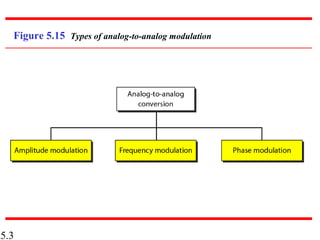
Figure 5.15 Types of analog-to-analog modulation
5.4
Amplitude Modulation
 A carrier signal is modulated only in
amplitude value
 The modulating signal is the envelope of the
carrier
 The required bandwidth is 2B, where B is the
bandwidth of the modulating signal
 Since on both sides of the carrier freq. fc, the
spectrum is identical, we can discard one
half, thus requiring a smaller bandwidth for
transmission.
5.5
Figure 5.16 Amplitude modulation
5.6
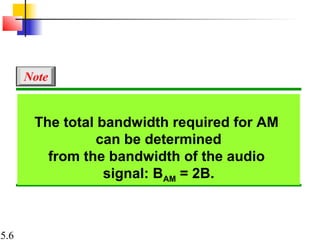
The total bandwidth required for AM
can be determined
from the bandwidth of the audio
signal: BAM = 2B.
Note
5.7
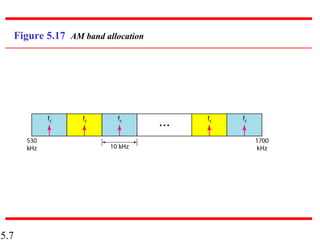
Figure 5.17 AM band allocation
5.8
Frequency Modulation
 The modulating signal changes the
freq. fc of the carrier signal
 The bandwidth for FM is high
 It is approx. 10x the signal frequency
5.9
The total bandwidth required for FM can
be determined from the bandwidth
of the audio signal: BFM = 2(1 + β)B.
Where β is usually 4.
Note
5.10
Figure 5.18 Frequency modulation
5.11
Figure 5.19 FM band allocation
5.12
Phase Modulation (PM)
 The modulating signal only changes the
phase of the carrier signal.
 The phase change manifests itself as a
frequency change but the
instantaneous frequency change is
proportional to the derivative of the
amplitude.
 The bandwidth is higher than for AM.
5.13
Figure 5.20 Phase modulation
5.14
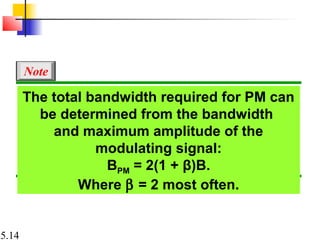
The total bandwidth required for PM can
be determined from the bandwidth
and maximum amplitude of the
modulating signal:
BPM = 2(1 + β)B.
Where β = 2 most often.
Note

Ch5 2 v1

  • 1.
    5.1 Chapter 5 Analog Transmission Copyright© The McGraw-Hill Companies, Inc. Permission required for reproduction or display.
  • 2.
    5.2 5-2 ANALOG ANDDIGITAL5-2 ANALOG AND DIGITAL Analog-to-analog conversion is the representation ofAnalog-to-analog conversion is the representation of analog information by an analog signal. One may askanalog information by an analog signal. One may ask why we need to modulate an analog signal; it iswhy we need to modulate an analog signal; it is already analog. Modulation is needed if the medium isalready analog. Modulation is needed if the medium is bandpass in nature or if only a bandpass channel isbandpass in nature or if only a bandpass channel is available to us.available to us.  Amplitude Modulation  Frequency Modulation  Phase Modulation Topics discussed in this section:Topics discussed in this section:
  • 3.
    5.3 Figure 5.15 Typesof analog-to-analog modulation
  • 4.
    5.4 Amplitude Modulation  Acarrier signal is modulated only in amplitude value  The modulating signal is the envelope of the carrier  The required bandwidth is 2B, where B is the bandwidth of the modulating signal  Since on both sides of the carrier freq. fc, the spectrum is identical, we can discard one half, thus requiring a smaller bandwidth for transmission.
  • 5.
  • 6.
    5.6 The total bandwidthrequired for AM can be determined from the bandwidth of the audio signal: BAM = 2B. Note
  • 7.
    5.7 Figure 5.17 AMband allocation
  • 8.
    5.8 Frequency Modulation  Themodulating signal changes the freq. fc of the carrier signal  The bandwidth for FM is high  It is approx. 10x the signal frequency
  • 9.
    5.9 The total bandwidthrequired for FM can be determined from the bandwidth of the audio signal: BFM = 2(1 + β)B. Where β is usually 4. Note
  • 10.
  • 11.
    5.11 Figure 5.19 FMband allocation
  • 12.
    5.12 Phase Modulation (PM) The modulating signal only changes the phase of the carrier signal.  The phase change manifests itself as a frequency change but the instantaneous frequency change is proportional to the derivative of the amplitude.  The bandwidth is higher than for AM.
  • 13.
  • 14.
    5.14 The total bandwidthrequired for PM can be determined from the bandwidth and maximum amplitude of the modulating signal: BPM = 2(1 + β)B. Where β = 2 most often. Note