A N A L O G T O A N A L O G
C O N V E R S I O N
NETWWORING
MODULATION
The process of changing the
digital signals into Analog Signals
is called Modulation.
Change Analog information by
analog signals is also known as
Modulation.
WHY TO MODULATE ANALOG
SIGNAL?
Modulation is needed . . .
• If the medium is Bandpass in nature.
• BANDPASS - the range of frequencies
which are transmitted through
bandpass filter.
BANDPASS FILTER
An electronic device or circuit.
• Allows signals between two specific
frequencies to pass.
• Prevents signals at unwanted
frequencies.
• Example – Radio
ANALOG To ANALOG
CONVERSION
Analog signals are modified to
represent analog data.
• Also known as Analog Modulation.
• Required when BANDPASS is used.
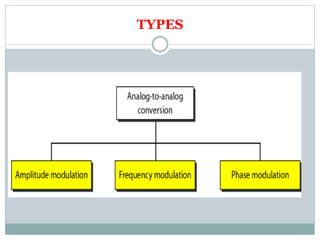
TYPES
AMPLITUDE MODULATION
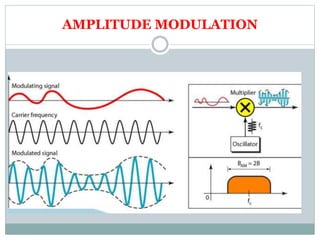
Process of changing the amplitude of
high frequency carrier wave in
accordance with intensity of signal is
called AM.
• Amplitude of the carrier wave :
amplitude of the signal being
modulated.
AMPLITUDE MODULATION
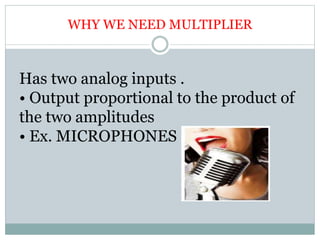
WHY WE NEED MULTIPLIER
Has two analog inputs .
• Output proportional to the product of
the two amplitudes
• Ex. MICROPHONES
AMPLITUDE MODULATION
If the modulation signal frequency
increases, the amplitude of the carrier
changes at a greater rate.
• B
AM =2 B
• BAND WIDTH of AM Signal = TWICE
the BANDWIDTH of MODULATING
Signal
ADVANTAGES
• It is simple to implement.
• It can be demodulated using a
circuit consisting of very few
components
Frequency Modulation
5.12
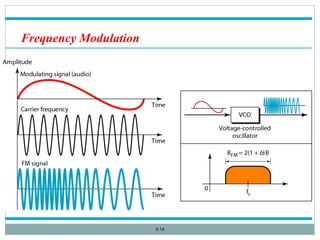
 The modulating signal changes the freq. fc of
the carrier signal
 The bandwidth for FM is high
 It is approx. 10x the signal frequency
5.13
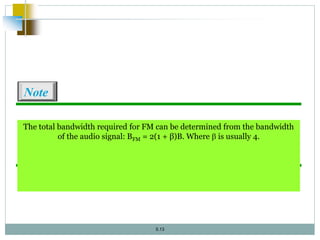
The total bandwidth required for FM can be determined from the bandwidth
of the audio signal: BFM = 2(1 + β)B. Where  is usually 4.
Note
5.14
Frequency Modulation
5.15
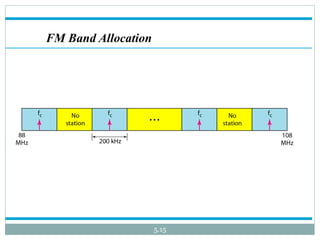
FM Band Allocation
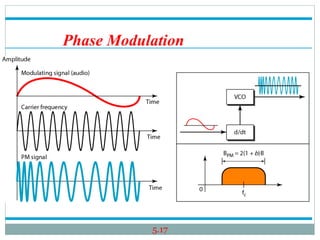
Phase Modulation (PM)
5.16
 The modulating signal only changes the phase
of the carrier signal.
 The phase change manifests itself as a
frequency change but the instantaneous
frequency change is proportional to the
derivative of the amplitude.
 The bandwidth is higher than for AM.
5.17
Phase Modulation

ANALOG TO ANALOG Conversion - Networking.pptx

  • 1.
    A N AL O G T O A N A L O G C O N V E R S I O N NETWWORING
  • 2.
    MODULATION The process ofchanging the digital signals into Analog Signals is called Modulation. Change Analog information by analog signals is also known as Modulation.
  • 3.
    WHY TO MODULATEANALOG SIGNAL? Modulation is needed . . . • If the medium is Bandpass in nature. • BANDPASS - the range of frequencies which are transmitted through bandpass filter.
  • 4.
    BANDPASS FILTER An electronicdevice or circuit. • Allows signals between two specific frequencies to pass. • Prevents signals at unwanted frequencies. • Example – Radio
  • 5.
    ANALOG To ANALOG CONVERSION Analogsignals are modified to represent analog data. • Also known as Analog Modulation. • Required when BANDPASS is used.
  • 6.
  • 7.
    AMPLITUDE MODULATION Process ofchanging the amplitude of high frequency carrier wave in accordance with intensity of signal is called AM. • Amplitude of the carrier wave : amplitude of the signal being modulated.
  • 8.
  • 9.
    WHY WE NEEDMULTIPLIER Has two analog inputs . • Output proportional to the product of the two amplitudes • Ex. MICROPHONES
  • 10.
    AMPLITUDE MODULATION If themodulation signal frequency increases, the amplitude of the carrier changes at a greater rate. • B AM =2 B • BAND WIDTH of AM Signal = TWICE the BANDWIDTH of MODULATING Signal
  • 11.
    ADVANTAGES • It issimple to implement. • It can be demodulated using a circuit consisting of very few components
  • 12.
    Frequency Modulation 5.12  Themodulating signal changes the freq. fc of the carrier signal  The bandwidth for FM is high  It is approx. 10x the signal frequency
  • 13.
    5.13 The total bandwidthrequired for FM can be determined from the bandwidth of the audio signal: BFM = 2(1 + β)B. Where  is usually 4. Note
  • 14.
  • 15.
  • 16.
    Phase Modulation (PM) 5.16 The modulating signal only changes the phase of the carrier signal.  The phase change manifests itself as a frequency change but the instantaneous frequency change is proportional to the derivative of the amplitude.  The bandwidth is higher than for AM.
  • 17.